
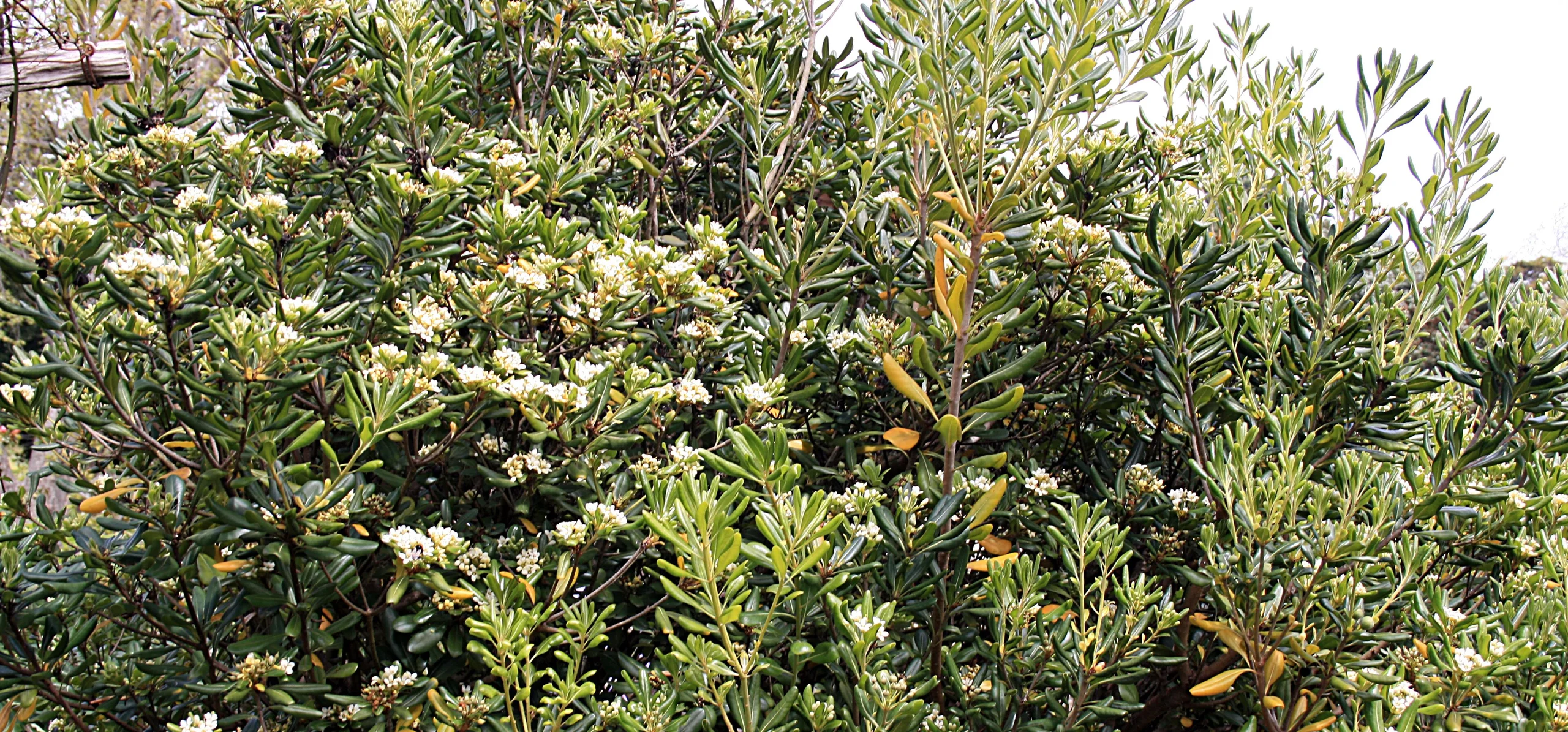
Japanese Pittosporum
Pittosporum tobira
Family · Pittosporaceae
Pittosporum tobira forms a dense, salt-tolerant hedge with orange-blossom-scented spring flowers: hardiness limits, pruning times and the 'Nanum' cultivar.
Pittosporum tobira
Plant profile
- WateringLittleWater every 10 days
- Light exposurePartial sun
- Hardiness zoneUSDA 8–10
Growth
- Family
- Pittosporaceae
- Life cycle
- Perennial
- Growth speed
- 3/10
- Mature size
- 250–400 cm
- Spread
- 150–250 cm
- Propagation
- Seed
- Cutting
- Layering
FloweringCreamy white, orange-blossom-scented flowers turning yellow, late spring to early summer
Dormancyevergreen; growth slows in winter
Time to maturity10-20 years to reach full size (RHS)
Soil & climate
- Soil pH
- pH 5.5–8
- Soil types
- chalk, loam, sand
- Saline soil
- Tolerated
- Drought tolerance
- Yes
Light & Placement
- Origin
- S. Korea, S. Central and S. Japan to the Nansei-shoto islands
- Where to place it
- bright room with some direct sun, cool in winter
- sheltered south- or west-facing wall
- coastal or seafront hedge
- sunny border away from frost pockets
- large container on a sheltered, sunny patio
- 'Nanum' in a decorative pot by a doorway
Safety
- Toxicity
- CatsSafe
- DogsSafe
- HorsesSafe
Data fromGBIF Backbone Taxonomy: Pittosporum tobiPlants of the World Online (Kew): PittosRHS: How to Grow PittosporumNorth Carolina State Extension Gardener ASPCA: Japanese Pittosporum toxicity to
Where it grows
World distribution
Japanese Pittosporum is native to 3 countries: Japan, South Korea, and Taiwan.GBIF records 118,348 documented identifications across 75 countries, with the largest concentrations in France, Italy, and Spain.
- Japan
- South Korea
- Taiwan
Yellow to orange dots: concentration of documented identifications per country. Green countries: sourced native range. Source: GBIFNative range from POWO (Kew).
Pittosporum tobira announces itself with scent before shape. In late spring the small, five-petaled flowers open creamy white and fade to dull yellow, carrying a strong orange-blossom fragrance long before the shrub itself catches the eye. Left to its own devices it forms a dense, rounded evergreen mound of leathery, glossy, obovate leaves, eventually reaching 2.5 to 4 m tall and 1.5 to 2.5 m wide, according to the RHS, which is why it gets planted as often for hedging and coastal screening as for the flowers. It shrugs off salt spray, wind and drought once established, but is only reliably hardy outdoors in mild, coastal or inner-city gardens, so climate decides whether it lives in open ground, against a sheltered wall, or in a pot that comes indoors for winter.
Origin and Habitat
The species is native to S. Korea and S. Central and S. Japan, extending to the Nansei-shoto islands, according to Plants of the World Online (Kew). It has since been introduced widely outside that range, including the Azores, the Balearic Islands, California, Florida and much of Mediterranean Europe, per POWO's distribution data, wherever winters stay mild enough for it to establish. That coastal East Asian origin explains its two defining traits in cultivation: genuine tolerance for salty, windy sites, and a preference for mild winters over hard, prolonged frost.
Choosing a Variety: 'Nanum' and the Variegated Forms
The straight species makes a substantial shrub, so gardeners with less room usually turn to 'Nanum', a genuine dwarf that stays around 0.5 to 1 m tall and wide at full size, per the RHS, forming a dense mound of the same glossy leaves and scented flowers on a fraction of the footprint; it shares the species' H3 hardiness rating and drought resistance, and suits Mediterranean-style or urban gardens. For foliage color rather than a smaller footprint, 'Variegatum' keeps the species' full size but edges each dark green, obovate leaf in creamy white; the RHS rates it H2, a touch more tender than the plain species or 'Nanum', so it wants the same sheltered, south- or west-facing wall recommended for borderline-hardy plants. All three carry the RHS Award of Garden Merit and flower at the same time, late spring into early summer.
Light and Placement
Give Pittosporum tobira full sun or light shade; the RHS notes that variegated forms in particular need a sunny spot to keep their cream markings, since shade encourages plain green regrowth. Outdoors it wants shelter from prevailing cold winds and frost pockets rather than an exposed, open site, even though it tolerates coastal wind once rooted in. As a container or conservatory plant it does well in a bright spot that gets some direct sun, moved outside for the warmer months and given full light through winter indoors so it does not stretch and lose its dense habit.


Soil, Coastal Exposure and Drought Tolerance
Most well-drained soil suits it, per the RHS, and it tolerates chalk, loam and sand across acid, neutral and alkaline pH; the one thing it will not forgive is waterlogging, which is why hedges on heavy clay do better planted on a raised ridge, 15 to 20 cm high, to keep roots out of standing water. Once established it tolerates real drought, heat and salt spray, according to North Carolina State Extension, which is exactly why it turns up so often as a hedge or screen in seafront gardens where salty air and sandy soil would punish less tolerant shrubs.
Watering and Feeding
Water new plants regularly through their first one or two growing seasons to build a deep root system; after that, established Pittosporum tobira needs supplemental water only in extended dry spells, since drought tolerance is one of its strongest traits. Container specimens are the exception: pots dry out faster than open ground, so check the compost through summer rather than relying on the plant's reputation for toughness. A light feed in spring, as new growth starts, is enough; heavy feeding pushes soft growth that is more vulnerable to frost damage over winter.
Pruning and Hedging
As a free-standing shrub, prune in mid-spring: shorten shoots that spoil the outline and trim off any tips damaged by winter cold, following the RHS growing guide. For hedges and topiary, trim two to three times through the growing season, mid-spring to late summer, with the final cut in August so new growth has time to harden before the first frosts. The plant takes hard renovation pruning if it gets leggy, but regrowth can be patchy, so the RHS recommends spreading a hard cutback over two to three seasons, removing at most a third of the plant each year rather than cutting the whole shrub back at once.
Hardiness and Winter Care
The RHS rates the species H3, hardy in coastal and relatively mild UK areas but not reliably surviving elsewhere, corresponding to minimum winter temperatures of about -5 to 1°C; North Carolina State Extension places its outdoor range at USDA zones 8a to 10b. In borderline climates, wrap outdoor plants in biodegradable fleece whenever a hard frost is forecast, and site containers against a south-facing wall for extra warmth. Where winters run colder than that, grow it as a container or conservatory plant instead, moving it into an unheated greenhouse or cool conservatory before the first hard frost rather than risking the crown outdoors.
Propagation
Layering young, ground-level shoots in spring is the easiest method, since the stem stays attached to the parent plant while it roots. Semi-ripe cuttings, 6 to 8 cm long, taken from current-season growth between July and September, are the more common route for raising several plants at once. Seed is the slowest option: collect it once the capsules split open, clean off the sticky coating, then sow at 12 to 15°C and expect two months or more before germination.
Pests, Diseases and Common Mistakes
Watch for red spider mite, aphids and scale insects, particularly under glass, and for occasional powdery mildew, none of which the RHS considers usually serious enough to need treatment. Leaf drop is more often a growing-condition problem than a pest: frost damage, waterlogged roots or drought stress are the usual causes. The most common mistake is planting it in a sheltered inland garden and expecting the same toughness it shows on the coast; without the wind and salt spray it tolerates so well, and without full sun, especially for variegated forms, it grows leggier and loses the dense, rounded habit that makes it worth growing. The second is skipping winter protection in a borderline zone on the assumption that evergreen means hardy everywhere, which is exactly the mismatch that kills otherwise healthy plants in a hard winter.
Test your plant knowledge
Tap a card to flip it and reveal the answer.
Pittosporum tobira tolerates salt spray and coastal wind once established. Tap to reveal ✓ True
Pittosporum tobira is reliably hardy through USDA zone 5 winters. Tap to reveal ✕ False
The species' spring flowers have no scent. Tap to reveal ✕ False
'Nanum' is a dwarf cultivar that stays around 0.5 to 1 m tall and wide. Tap to reveal ✓ True
The ASPCA lists Japanese Pittosporum as non-toxic to cats, dogs and horses. Tap to reveal ✓ True
Sources
References consulted for this guide
- GBIF Backbone Taxonomy: Pittosporum tobira (Murray) Aiton fil.gbif.org
- Plants of the World Online (Kew): Pittosporum tobira (Thunb.) W.T.Aitonpowo.science.kew.org
- RHS: How to Grow Pittosporumrhs.org.uk
- North Carolina State Extension Gardener Plant Toolbox: Pittosporum tobiraplants.ces.ncsu.edu
- ASPCA: Japanese Pittosporum toxicity to petsaspca.org
- Reference entity : Wikipédiaen.wikipedia.org