Japanese Barberry
Berberis thunbergii
Family · Berberidaceae
Purple and gold barberry cultivars, hedge pruning with thick gloves, drought tolerance, and why Berberis thunbergii is banned in some US states but not Europe.
Berberis thunbergii
Plant profile
- WateringLittleWater every 12 days
- Light exposurePartial sun
- Hardiness zoneUSDA 4–8
Growth
- Family
- Berberidaceae
- Life cycle
- Perennial
- Growth speed
- 5/10
- Mature size
- 60–180 cm
- Spread
- 60–180 cm
- Propagation
- Seed
- Cutting
FloweringSmall pale yellow flowers in mid-spring, followed by red berries that often persist into winter
Dormancydeciduous, bare in winter
Time to maturityreaches full size in three to five growing seasons
Soil & climate
- Soil types
- loam, clay, sand, average well-drained garden soil
- Drought tolerance
- Yes
Light & Placement
- Origin
- Central and southern Japan
- Where to place it
- sunny border
- low hedge or edging
- foundation planting
Safety
- Pet safe
- No
ToxicityNot listed by the ASPCA for cats, dogs, or horses; berries are not intended for human or pet consumption
Invasive speciesbanned or restricted for sale in a number of US states, including New York and Pennsylvania, due to its link to tick habitat and bird-spread berries; several states exempt sterile triploid cultivars
Data fromGBIF Backbone Taxonomy: Berberis thunberPlants of the World Online (Kew): BerberMissouri Botanical Garden Plant Finder: Penn State Extension: Japanese BarberryUConn IPM Invasive Plant Fact Sheet: Jap
Where it grows
World distribution
Japanese Barberry is native to a single country: Japan.GBIF records 80,576 documented identifications across 61 countries, with the largest concentrations in United States, Germany, and Sweden.
- Japan
Yellow to orange dots: concentration of documented identifications per country. Green countries: sourced native range. Source: GBIFNative range from POWO (Kew).
Japanese barberry usually arrives in a garden already colored: deep purple 'Atropurpurea', pink-splashed 'Rose Glow', or chartreuse 'Aurea'. It asks for almost nothing once it settles in, full sun, ordinary soil, no feeding schedule to track, and it holds its shape without much intervention. The stems carry slim, sharp spines at nearly every leaf node, which is exactly what makes this shrub useful as a low, deer-proof hedge and what makes pruning it a two-handed, thick-gloves job. In much of Europe it remains an old, reliable border plant. In a growing list of US states it is banned or restricted outright, not for how it grows in a border but for what grows underneath it in the wild.
Identifying the Species: Spines, Leaf Shape, and Fall Color
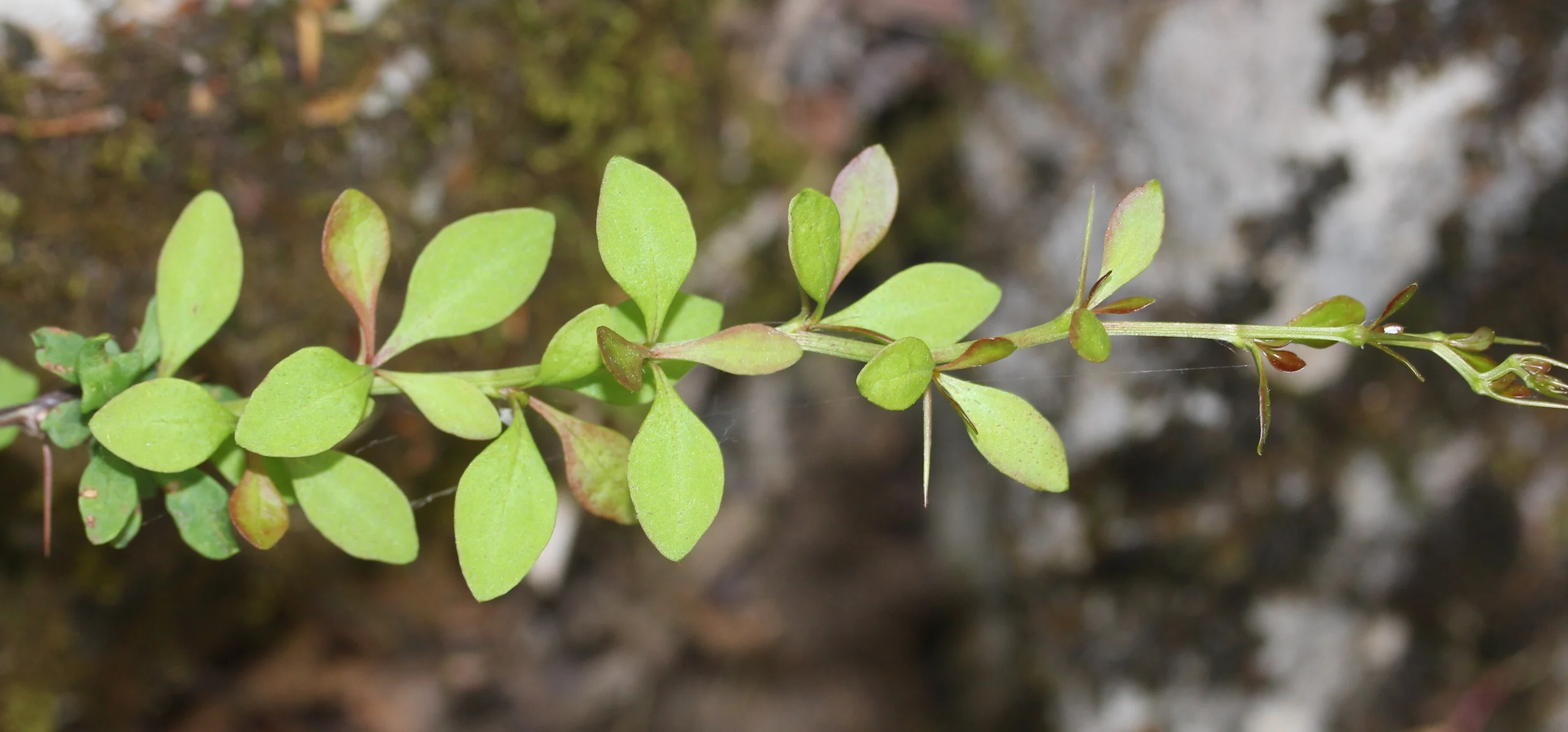
Japanese barberry is a small, dense, broad-rounded deciduous shrub. The species and most straight cultivars settle between 2 and 6 feet tall and about as wide, reaching that size within three to five growing seasons. Leaves are small, spoon-shaped (obovate), untoothed, and clustered in tight rosettes along arching, ridged brown stems. A single sharp spine sits at nearly every node, occasionally three together, a detail worth checking with a bare hand before deciding this is a plant for a path edge. Small pale yellow flowers hang in drooping clusters in mid-spring, and by autumn they have become bright red, oblong berries that often stay on the bare stems well into winter. Fall color on the green-leaved species form is a clean orange-red; the purple and gold cultivars color differently again, see below.
Choosing a Cultivar: Purple, Gold, and Variegated Forms
'Atropurpurea' is the classic purple-leaved form, reddish-purple all season and reliably 4 to 6 feet, the parent of most named purple cultivars sold today. 'Rose Glow' is a sport of it: new growth opens mottled pink, white, and purple before settling into the same deep purple as the older leaves, so a single well-grown plant carries two colors at once through spring. 'Aurea' runs the other direction, bright chartreuse-yellow foliage that ages toward gold, but it is slower and more compact than the purple forms, usually staying under 3 feet, and its leaves scorch pale and papery if the plant sits in full afternoon sun in a hot climate. As a rule across all three: the deepest color needs the most direct sun, and a plant pushed into shade for the sake of a spot in a border will fade back toward plain green within a season or two.
Site, Soil, and Drought Tolerance
This is a shrub for a spot nothing else wants. It grows in average, dry to medium soil with reasonable drainage and shrugs off summer drought once its roots are established, usually by the end of the first full season. What it will not tolerate is standing water: a low, poorly drained corner that stays wet through winter is the one site condition that reliably kills it. Full sun gives the best foliage color and the densest habit; part shade is tolerated but the plant opens up and loses some of its compact form. It is not fussy about soil pH within the normal garden range, which is part of why it naturalizes so easily on roadsides and disturbed ground once a berry lands there.


Planting a Low, Deer-Resistant Hedge
Barberry's main landscape job is the low hedge or foundation edge that needs to survive deer and rabbits without a spray program. Space plants at roughly half their expected mature spread for a hedge that knits together within two or three years rather than staying gappy; a dwarf form like 'Crimson Pygmy' suits an 18 to 24 inch spacing, while full-size 'Atropurpurea' wants closer to 3 feet. The thorns that make pruning unpleasant are the same thorns that keep browsing animals out, so this is one of the few reliably deer-resistant options for a low, colorful hedge in a garden where deer pressure rules out most flowering shrubs.
Pruning: Why Thick Gloves Are Not Optional
Prune right after flowering in late spring, or during dormancy in late winter if shape matters more than that season's bloom. Thick leather gloves and long sleeves are not a suggestion here: the spines are stiff enough to go through a light cotton glove, and reaching blind into the center of an overgrown plant to clear old wood is the single most common way gardeners get scratched up by this shrub. For hedges, shear lightly to hold a shape but avoid cutting hard into bare interior wood, which barberry is slow to reclothe with new growth. An old, leggy specimen tolerates a hard rejuvenation cut back to 6 inches in late winter and resprouts densely from the base within one season.
The Tick Connection: Why It Is Banned in Many US States
Japanese barberry has escaped cultivation across much of the northeastern and midwestern United States, spread by birds eating the winter berries, and it is now banned or restricted for sale in a number of states, including New York and Pennsylvania. The regulation is not about the plant choking out other vegetation on its own; dense, spiny barberry thickets create a shaded, humid microclimate at ground level that suits blacklegged (deer) ticks and the white-footed mice that carry Lyme disease particularly well. Research from the Connecticut Agricultural Experiment Station found far higher densities of infected ticks in barberry stands than in adjacent woodland without barberry, and clearing established stands has been shown to reduce tick numbers on a site for several years afterward. None of this is a claim about the plant itself being toxic or dangerous to touch; it is a habitat effect, tied specifically to how thickly the shrub grows and how long it holds its berries.
Sterile Cultivars: Breeding Out the Seed
Because the regulatory problem is seed spread rather than the plant's ornamental value, breeders have worked to keep the foliage and drop the fertility. Thomas Ranney's program at North Carolina State University produced triploid barberry lines, plants with an extra set of chromosomes that makes seed set and viability drastically reduced, sold under trade names including the Sunjoy and WorryFree series. Several states that restrict the wild-type species specifically exempt these sterile cultivars from the ban, so a gardener in a regulated state can usually still plant a purple or gold barberry, just not an unnamed seedling or an older fertile cultivar. Checking the plant tag for one of these named sterile lines is the practical way to stay compliant without giving up the look.
A Different Story in Europe
None of the above changes how the plant behaves in a European border, where Berberis thunbergii is simply a familiar, undemanding hedging and edging shrub with no equivalent tick research behind it and no sale restriction. It is worth remembering that the two situations are not really a contradiction: the same fast growth, tolerance of poor soil, and prolific berry set that make it a low-maintenance garden plant in one region are what let it spread once birds carry the seed into a climate and landscape with fewer natural checks on it. Where it does grow wild nearby, cutting back and removing berries before they ripen in autumn keeps a garden specimen from adding to that spread.
Test your plant knowledge
Tap a card to flip it and reveal the answer.
Japanese barberry stems carry a sharp spine at nearly every leaf node. Tap to reveal ✓ True
Purple-leaved cultivars like 'Atropurpurea' keep their deepest color in full shade. Tap to reveal ✕ False
Berberis thunbergii is native to Japan, not North America. Tap to reveal ✓ True
Dense stands of Japanese barberry have been linked to lower tick populations than surrounding woodland. Tap to reveal ✕ False
Sterile triploid cultivars such as the Sunjoy and WorryFree series were bred to stop the plant from spreading by seed. Tap to reveal ✓ True
Sources
References consulted for this guide
- GBIF Backbone Taxonomy: Berberis thunbergii DC.gbif.org
- Plants of the World Online (Kew): Berberis thunbergii DC.powo.science.kew.org
- Missouri Botanical Garden Plant Finder: Berberis thunbergiimissouribotanicalgarden.org
- Penn State Extension: Japanese Barberryextension.psu.edu
- UConn IPM Invasive Plant Fact Sheet: Japanese Barberryipm.cahnr.uconn.edu
- Reference entity : Wikipédiaen.wikipedia.org