
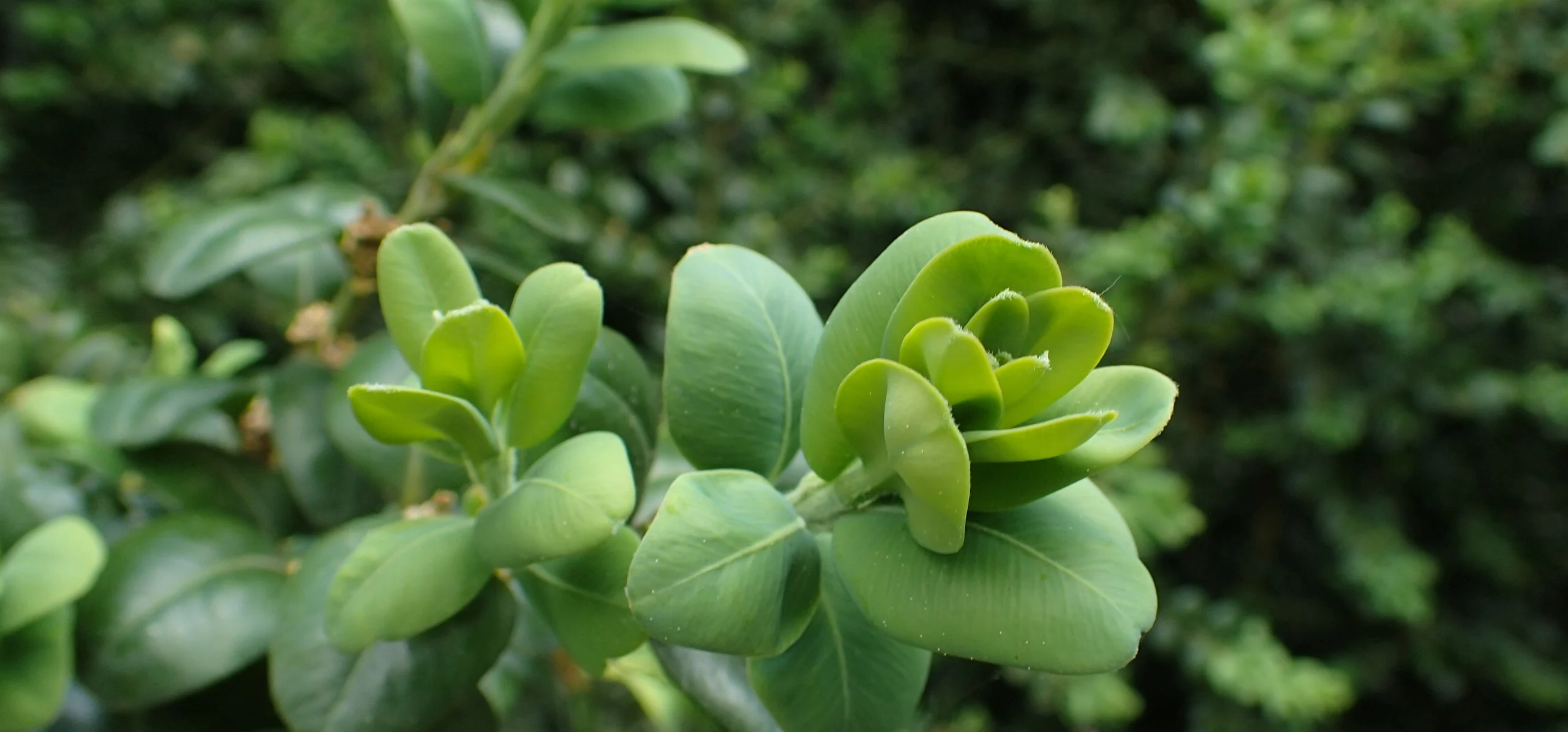
Common Boxwood
Buxus sempervirens
Family · Buxaceae
Common boxwood clips into dense hedges and topiary, but two threats now define its care: box blight and box tree moth, plus when to switch to yew instead.
Buxus sempervirens
Plant profile
- WateringLittleWater every 10 days
- Light exposureIndirect light
- Hardiness zoneUSDA 5–8
Growth
- Family
- Buxaceae
- Life cycle
- Perennial
- Growth speed
- 2/10
- Mature size
- 400–800 cm
- Spread
- 400–800 cm
- Flowering
- Small, inconspicuous greenish flowers in spring; grown for foliage, not bloom
- Propagation
- Cutting
Dormancyevergreen, growth slows in winter
Time to maturityreaches full unclipped size in 10-20 years
Soil & climate
- Soil pH
- pH 6–8
- Soil types
- clay, loam, sand
- Drought tolerance
- Yes
Light & Placement
- Origin
- Europe to N. Iran and North Africa (Plants of the World Online)
- Where to place it
- hedge
- topiary
- border edging
- parterre
- large terracotta pot
- wooden planter
Safety
- Toxicity
- CatsToxic
- DogsToxic
- HorsesToxic
Data fromGBIF Backbone Taxonomy: Buxus sempervirePlants of the World Online (Kew): Buxus RHS: Box blight, causes, symptoms and coRHS: Box tree caterpillarRHS: Box alternatives, how to chooseASPCA: Toxic and non-toxic plants, Boxwo
Where it grows
World distribution
Common Boxwood is native to 19 countries: Albania, Algeria, Austria, Belgium, Croatia, France, Georgia, and Germany….GBIF records 176,870 documented identifications across 80 countries, with the largest concentrations in France, United Kingdom, and Spain.
- Albania
- Algeria
- Austria
- Belgium
- Croatia
- France
- Georgia
- Germany
- Greece
- Iran
- Italy
- Libya
Show 7 more countriesShow fewer countries
- Morocco
- Portugal
- Russia
- Spain
- Switzerland
- Türkiye
- United Kingdom
Yellow to orange dots: concentration of documented identifications per country. Green countries: sourced native range. Source: GBIFNative range from POWO (Kew).
A boxwood hedge or topiary ball that still looks tight and glossy today can be defoliated within a season by either of two problems that barely troubled most gardens twenty years ago: box blight and box tree moth. So anything written about Buxus sempervirens now has to lead with them rather than treat them as an afterthought. The species itself is undemanding, an evergreen shrub native to Europe, the Caucasus and North Africa, slow enough to hold a crisp clipped shape for decades and tolerant of poor soil, shade and hard pruning. What has changed is the risk, not the plant's basic needs, so growing box well today means siting and clipping it correctly and knowing how to spot both threats early, not just watering and trimming the way gardeners did a generation ago.
Siting, Soil and Planting
Box grows in almost any soil that is not waterlogged. North Carolina State Extension lists it as adaptable to clay, loam, sand or soils rich in organic matter, with a neutral pH range of roughly 6.0 to 8.0, and the RHS confirms it tolerates acid, neutral or alkaline ground equally well. Light needs are more nuanced than the plant's reputation for shade tolerance suggests: the RHS notes it copes with full shade to partial shade, and takes full sun in cooler, damper climates, but in hot, dry conditions strong sun combined with wind scorches the foliage bronze, especially on a newly planted hedge whose roots have not yet spread. Space small pot-grown plants 30 to 40 cm apart for a hedge line, and work organic matter into the top 20 cm rather than digging deep, since box is shallow-rooted. Mulch after planting to keep roots cool and even out soil moisture, which also reduces the splash of soil onto lower leaves that helps spread box blight spores.
Watering and Establishment
Newly planted box needs consistent watering through its first two summers while the shallow root system spreads, especially where a hedge is planted from small liners rather than larger pot-grown stock. Once established it is genuinely drought-tolerant, per NC State Extension, and copes with dry spells better than with soil that stays wet, which stresses roots and creates the humid, still air at ground level that favors blight. Water at the base rather than overhead: wet foliage left standing is one of the conditions the RHS names as encouraging box blight to spread.
Clipping Hedges and Topiary
Box takes RHS pruning group 8, meaning it responds to being clipped into shape repeatedly through the growing season rather than cut back to an open framework once. The main clipping window is summer, with renovation cuts into old wood possible in late spring if a hedge needs hard reduction. Two details matter more for box than for most hedging shrubs. First, always clip in dry weather: cutting wet foliage is one of the clearest ways to carry box blight spores from an infected plant to a healthy one on the same shears, and RHS guidance is explicit about disinfecting tools between different parts of a garden, not only between different gardens. Second, avoid a hot, sunny afternoon for the cut itself, since freshly exposed inner growth scorches fast; an overcast morning or evening is safer. A topiary shape that has gone shaggy is better brought back over two seasons than scalped in one go, which exposes bare wood that is slow to reclothe on a naturally slow grower.


Box Blight: The Disease That Changed How Box Is Grown
Box blight is caused by two related fungi, Calonectria pseudonaviculata and Calonectria henricotiae, the RHS's current names for what many gardeners still call by the older name Cylindrocladium buxicola. The tell is brown, papery patches of dead leaf that drop fast and leave bare gaps, black streaking on young green stems, and, in humid weather, a fine white spore bloom on the underside of dying leaves. It spreads by rain splash and on tools, and its resting structures can survive in fallen leaf litter for years, which is why raking up and removing, not composting, all fallen box debris matters as much as anything sprayed on the plant. RHS guidance treats fungicide as a supporting measure at best, not a cure on its own: the priority is better air movement through lighter, more frequent clipping instead of one dense annual shear, watering at the base, disinfecting shears between plants, and quarantining any new box for around four weeks before it goes near an existing hedge. A badly infected hedge with dieback down to the base rarely recovers cleanly and is usually better replaced.
Box Tree Moth: A Faster-Moving Threat
Cydalima perspectalis, the box tree moth, is native to East Asia and reached Britain around 2007, spreading into private gardens from about 2011 onward, and it can do more visible damage in a single bad season than box blight often manages in several. The caterpillar is the destructive stage: pale green with black and white stripes, feeding inside webbing spun across the foliage and capable of stripping a shrub to bare stems, including the bark on young growth. There are several overlapping generations from spring through autumn, and it overwinters as a partly grown caterpillar tucked in webbing between leaves, ready to resume feeding as soon as it warms up. Check box plants for webbing and skeletonized leaves from early spring and again through summer. Hand-picking caterpillars works while a population is still small, pheromone traps help track when adult moths are active locally, and nematode-based biological sprays give some control if applied while caterpillars are young. A hedge stripped bare but still alive usually regrows from the wood the following year, which is one advantage box has over losing a hedge outright to blight.
Alternatives Where the Pressure Is Too High
On a site with a documented history of either problem, or in a region where box tree moth is already established, replanting straight back into box is asking for a repeat. The RHS names yew, Taxus, as the closest all-round substitute for formal hedging and topiary: pest- and disease-resistant, tolerant of sun or shade and anything short of waterlogged ground, and it takes hard renovation cuts the way box does. Osmanthus and Sarcococca are also RHS-listed options that clip well and add scented flowers box never offers, and Podocarpus gives a similarly fine texture once established, though it starts slower. One widely planted substitute is worth naming as a caution rather than a recommendation: Ilex crenata, Japanese holly, looks almost identical to box when clipped, but the RHS reports it struggles with winter wet and hot, dry summers, and has turned out to be, in the RHS's own words, the most widely planted alternative and also the least successful. Match any replacement to the site's actual soil and exposure rather than to leaf size alone.
Toxicity and Common Mistakes
The ASPCA lists boxwood as toxic to dogs, cats and horses. The steroidal alkaloids in the leaves, buxine chief among them, cause vomiting and diarrhea in dogs and cats, while in horses the reaction is markedly worse, with colic, seizures and respiratory distress reported after eating clippings left within reach. Keep prunings out of paddocks and away from stabled horses rather than assuming a nibble is harmless. The most common mistake on an established hedge is a single hard, dense shear once a year on a still, humid afternoon, which packs the foliage tight with no airflow between cuts; lighter, more frequent trims through the season keep the canopy open. The second is treating box tree moth as a one-off scare after the first bad year: because it overwinters on the plant itself, a hedge that was hit once needs checking again the following spring before a new generation of caterpillars has the chance to do real damage.
Test your plant knowledge
Tap a card to flip it and reveal the answer.
Box blight spreads faster when hedges are clipped in wet weather. Tap to reveal ✓ True
The box tree moth, Cydalima perspectalis, is native to Europe. Tap to reveal ✕ False
The ASPCA lists boxwood as non-toxic to horses. Tap to reveal ✕ False
Left unclipped, Buxus sempervirens can eventually grow into a small tree several metres tall. Tap to reveal ✓ True
Ilex crenata (Japanese holly) has proven to be the most reliably successful substitute for box in UK gardens. Tap to reveal ✕ False
Sources
References consulted for this guide
- GBIF Backbone Taxonomy: Buxus sempervirens L.gbif.org
- Plants of the World Online (Kew): Buxus sempervirens L.powo.science.kew.org
- RHS: Box blight, causes, symptoms and controlrhs.org.uk
- RHS: Box tree caterpillarrhs.org.uk
- RHS: Box alternatives, how to chooserhs.org.uk
- ASPCA: Toxic and non-toxic plants, Boxwoodaspca.org
- NC State Extension Gardener Plant Toolbox: Buxus sempervirensplants.ces.ncsu.edu
- Reference entity : Wikipédiaen.wikipedia.org