Crimson Bottlebrush
Callistemon citrinus
Family · Myrtaceae
Callistemon citrinus wants full sun, acid to neutral soil, and shelter below -5°C. Here is how to plant, prune, and overwinter crimson bottlebrush.
Callistemon citrinus
Plant profile
- WateringModerateWater every 10 days
- Light exposureFull sun
- Hardiness zoneUSDA 8–11
Growth
- Family
- Myrtaceae
- Life cycle
- Perennial
- Growth speed
- 5/10
- Mature size
- 400–800 cm
- Spread
- 250–400 cm
- Flowering
- Bristly crimson flower spikes in summer on the previous season's wood
- Propagation
- Seed
- Cutting
DormancyEvergreen, no true winter dormancy
Time to maturity10 to 20 years to reach full size outdoors (RHS); flowers within its first few years
Soil & climate
- Soil pH
- pH 5–6
- Soil types
- clay, loam, sand
- Saline soil
- Tolerated
- Drought tolerance
- Yes
Light & Placement
- Origin
- Eastern and south-eastern Australia; naturalized in California and other warm regions
- Where to place it
- Unheated greenhouse, conservatory, or bright porch with good ventilation over winter in cold climates
- South- or west-facing bed in full sun, sheltered from cold wind
- Coastal gardens; tolerates salt spray
- Large container with peat-free, loam-based potting compost and good drainage
- Move potted plants under cover for winter outside USDA zones 9-11
Safety
- Toxicity
- CatsSafe
- DogsSafe
- HorsesSafe
Invasive speciesNaturalized outside cultivation in California and other warm regions after garden escape (POWO).
Data fromGBIF Backbone Taxonomy: Callistemon citrPlants of the World Online (Kew): MelaleRHS: Callistemon citrinus (crimson bottlASPCA: Toxic and Non-Toxic Plants, CalliNC State Extension Gardener Plant Toolbo
Where it grows
World distribution
Crimson Bottlebrush is native to a single country: Australia.GBIF records 4,682 documented identifications across 74 countries, with the largest concentrations in Australia, United States, and New Zealand.
- Australia
Yellow to orange dots: concentration of documented identifications per country. Green countries: sourced native range. Source: GBIFNative range from POWO (Kew).
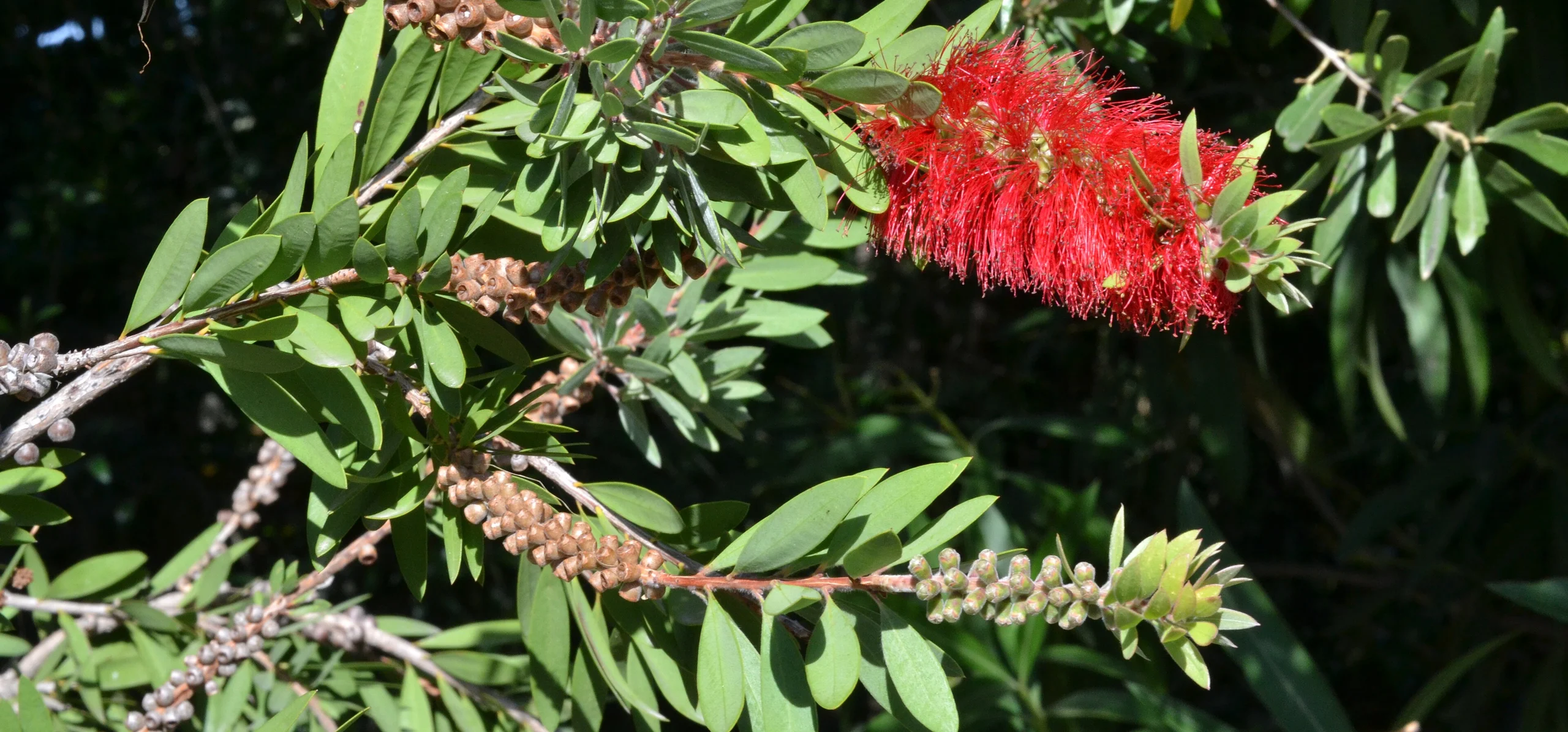
A crimson bottlebrush bought in flower from a garden centre is already telling you what it wants: full, unfiltered sun and a spot where cold wind cannot reach it. Callistemon citrinus is an evergreen shrub from the east coast of Australia, and outside its native range it behaves almost like a Mediterranean plant, drought tolerant once its roots are established but intolerant of hard freezes much below about -5°C. Left where it is happy, a single plant carries cylindrical, bristly red flower spikes along last year's wood through summer, then quietly sets small woody seed capsules that stay fused to the stem for years afterward. The two things that stall a new plant are shade, which produces sparse foliage and few flowers, and heavy, waterlogged soil, which the roots do not tolerate for long.
Origin and the Callistemon/Melaleuca Name Change
GBIF's backbone taxonomy records the accepted name as Callistemon citrinus (Curtis) Skeels, in the myrtle family Myrtaceae, order Myrtales. Plants of the World Online at Kew currently files the same plant as a synonym under Melaleuca citrina (Curtis) Dum.Cours.: later molecular studies folded the whole genus Callistemon into the older, larger genus Melaleuca, so a tag reading either name in a nursery refers to the identical shrub. This guide keeps the widely used name Callistemon citrinus, since that is still how most growers, tags, and catalogues refer to it. POWO lists the native range as eastern and south-eastern Australia, and records the species as naturalized outside cultivation in California and a handful of other warm regions after escaping garden plantings, so a wild-looking bottlebrush growing unplanted in a mild climate is not necessarily native there.
Light and Position
Full sun is not negotiable: the RHS recommends a south- or west-facing position in full sun, and NC State Extension specifies at least six hours of direct light a day. In dappled or half shade the plant survives but grows leggy, with foliage bunched toward the light and noticeably fewer of the bristly red flower spikes. Choose a spot sheltered from cold wind as well as open to sun, since an exposed site combines with winter cold to damage the evergreen foliage; a wall or hedge on the windward side, or a bed against a south-facing wall, adds a useful few degrees of protection. Where winters are too cold for it to stay outdoors year round, the RHS grows it under glass in an unheated or frost-free structure with full light and good ventilation, moving pots back outside once the weather has settled.
Soil, Planting and pH
The RHS lists clay, loam, and sand as workable soil types, provided the pH stays acid to neutral; NC State Extension is more specific, putting the target below pH 6.0 in a loam rich in organic matter. Drainage matters more than texture: both sources call for moist but free-draining conditions, and a bottlebrush left standing in wet, compacted soil over winter is far more likely to die from root problems than from cold. Work compost or well-rotted organic matter into the planting hole on heavier ground, and in naturally alkaline gardens, grow it in a large container of ericaceous or acid-leaning potting mix rather than fighting the native soil chemistry bed by bed. NC State also rates the species salt tolerant, which makes it a workable choice for a coastal garden exposed to sea spray, a setting where many other flowering shrubs struggle.


Watering and Feeding
Water regularly through the first one to two growing seasons while roots are establishing, then taper off: both the RHS and NC State Extension describe established plants as drought tolerant, needing supplemental water mainly during extended dry spells rather than on a fixed schedule. Overwatering a settled plant, particularly one in a container that does not drain freely, is a more common problem than underwatering it. A light feed in spring, as new growth starts, supports the flush of flower spikes that follows; skip feeding in the depths of winter, when the plant is not actively growing and unused nitrogen just sits in the soil.
Pruning: Shrub or Small Tree
Left unpruned in a mild climate, Callistemon citrinus can grow from a multi-stemmed shrub into a small tree 4 to 8 metres tall over 10 to 20 years, according to the RHS; most gardens keep it far smaller with routine pruning. The plant flowers on the previous season's wood, so the standard advice from university extension services is to prune right after flowering finishes, shortening the flowering shoots rather than shearing the whole plant, which would remove next year's buds along with this year's growth. It is unusually tolerant of hard pruning and regenerates readily even when cut back into old wood, which makes it forgiving for a gardener reshaping a neglected or overgrown specimen. Removing lower branches and thinning to two or three main stems is the standard route to training it as a small specimen tree instead of a dense shrub.
Winter Protection and Hardiness
The RHS rates Callistemon citrinus H3, tolerating brief dips to around -5°C, and notes it will only survive outdoors year round in the mildest, most sheltered parts of the British Isles; everywhere else, it needs moving under cover for winter. NC State Extension places it in USDA zones 8b to 11b, hardy down to roughly 20 to 25°F outdoors, with protection needed in zone 8. In practice that means a garden in zone 8, or a UK garden exposed to frost pockets, is better off growing it in a large container that can be wheeled into an unheated greenhouse, porch, or frost-free shed once temperatures start dropping in autumn, then brought back outside once the risk of hard frost has passed in spring.
Pests, Diseases and Toxicity to Pets
The RHS lists scale insects, mealybug, and glasshouse red spider mite as the pests most likely to show up, usually on a plant grown under glass or kept too dry and too warm; honey fungus is the disease risk to watch for in the ground. Check the undersides of leaves and along stems for small brown scale bumps or cottony mealybug clusters, and treat early with insecticidal soap or horticultural oil before a light infestation turns into sticky honeydew and sooty mould. On the safety side, the ASPCA lists Callistemon citrinus as non-toxic to cats, dogs, and horses, and NC State Extension notes that birds feed on its seed and nectar while bees work the open flowers heavily, so it is a reasonable, pet-safe choice near a patio where wildlife activity is part of the appeal.
Test your plant knowledge
Tap a card to flip it and reveal the answer.
Established crimson bottlebrush plants tolerate short dips to about -5°C, but need a sheltered spot or winter protection in colder climates. Tap to reveal ✓ True
Callistemon citrinus flowers best in full shade. Tap to reveal ✕ False
The plant tolerates being cut back hard into old wood and will regrow. Tap to reveal ✓ True
The ASPCA lists Callistemon citrinus as toxic to dogs and cats. Tap to reveal ✕ False
Callistemon citrinus prefers acidic to neutral soil rather than alkaline soil. Tap to reveal ✓ True
Sources
References consulted for this guide
- GBIF Backbone Taxonomy: Callistemon citrinus (Curtis) Skeelsgbif.org
- Plants of the World Online (Kew): Melaleuca citrina (Curtis) Dum.Cours., current name for Callistemon citrinuspowo.science.kew.org
- RHS: Callistemon citrinus (crimson bottlebrush)rhs.org.uk
- ASPCA: Toxic and Non-Toxic Plants, Callistemon citrinusaspca.org
- NC State Extension Gardener Plant Toolbox: Callistemon citrinus (Melaleuca citrina)plants.ces.ncsu.edu
- Reference entity : Wikipédiaen.wikipedia.org