Autograph Tree
Clusia rosea
Family · Clusiaceae
Clusia rosea, the autograph tree: thick leaves that hold a scratched signature, tolerant of neglect, salt spray and wind, but toxic to cats and dogs.
Clusia rosea
Plant profile
- WateringLittleWater every 14 days
- Light exposurePartial sun
- Hardiness zoneUSDA 10–11
Growth
- Family
- Clusiaceae
- Life cycle
- Perennial
- Growth speed
- 4/10
- Mature size
- 762–914 cm
- Spread
- 457–762 cm
- Flowering
- Night-opening pink and white flowers on mature plants; separate male and female trees
- Propagation
- Seed
- Cutting
DormancyNone; evergreen year-round
Time to maturityReaches full tree size over decades
Soil & climate
- Soil types
- Clay, sand or loam, Well-draining, tolerates poor sandy soil
- Saline soil
- Tolerated
- Drought tolerance
- Yes
Light & Placement
- Origin
- Florida, the Caribbean and northern South America
- Where to place it
- Bright spot near an unobstructed east or west window
- A few steps back from a south-facing window
- Full sun to partial shade in frost-free zone 10b-11 climates
- Coastal planting exposed to salt spray and wind
- Container with a drainage hole
- Heavy pot to balance top growth on mature plants
Safety
- Toxicity
- CatsToxic
- DogsToxic
- HorsesToxic
Invasive speciesNaturalized and invasive outside its native range in Hawaii and Sri Lanka
Data fromClusia rosea Jacq., GBIF Backbone TaxonoClusia rosea Jacq., Plants of the World Clusia Rosea toxicity, ASPCA Animal PoisClusia rosea: Pitch Apple, UF/IFAS ExtenClusia rosea, CABI Compendium
Where it grows
World distribution
Autograph Tree is native to 28 countries: Antigua & Barbuda, Aruba, Bahamas, Belize, Cayman Islands, Colombia, Costa Rica, and Cuba….GBIF records 4,242 documented identifications across 58 countries, with the largest concentrations in United States, Colombia, and Puerto Rico.
- Antigua & Barbuda
- Aruba
- Bahamas
- Belize
- Cayman Islands
- Colombia
- Costa Rica
- Cuba
- Curaçao
- Dominican Republic
- Ecuador
- El Salvador
Show 16 more countriesShow fewer countries
- French Guiana
- Guatemala
- Guyana
- Haiti
- Honduras
- Jamaica
- Mexico
- Nicaragua
- Panama
- Puerto Rico
- St. Lucia
- Suriname
- Trinidad & Tobago
- Turks & Caicos Islands
- United States
- Venezuela
Yellow to orange dots: concentration of documented identifications per country. Green countries: sourced native range. Source: GBIFNative range from POWO (Kew).
Clusia rosea earns its common name from a trick anyone can try on the first day they bring one home: drag a fingernail or the tip of a key across the thick, waxy leaf, and the mark stays there, darkening over the following day into a stable brown scar exactly where you drew it. That durability runs through the whole plant. In the wild this is a hemiepiphyte that starts high in the canopy of another tree and can end up strangling its host; in a living room it is one of the toughest foliage plants sold, shrugging off missed waterings, low light and the kind of neglect that kills a fern in a week. What it will not forgive is a pot that never drains or years of deep shade, and knowing where the line sits between tough and indestructible is most of what growing one well comes down to.
A strangler that starts high in the canopy
Plants of the World Online lists its native range as Florida to Venezuela and Ecuador, and across that range Clusia rosea rarely begins life rooted in soil. Separate male and female trees carry pink and white, six-petaled flowers that open at night; pollinated female flowers set a fleshy, poisonous fruit that splits open when ripe to reveal bright red seeds in a black, resinous pulp once used to caulk boat seams, the origin of the older name pitch apple. Birds eat that fruit and drop undigested seeds in the crotch of a host tree, where they germinate as epiphytes with no contact with the ground. As the seedling grows it sends down aerial roots that reach the soil, thicken and fuse around the host trunk, the same strangler habit known from Ficus species. A large, free-standing Clusia rosea seen growing in the open has usually killed and replaced the tree it started on decades earlier; the buttressed base and tangle of fused roots at ground level are what remains of that first host.
The leaf that holds a signature
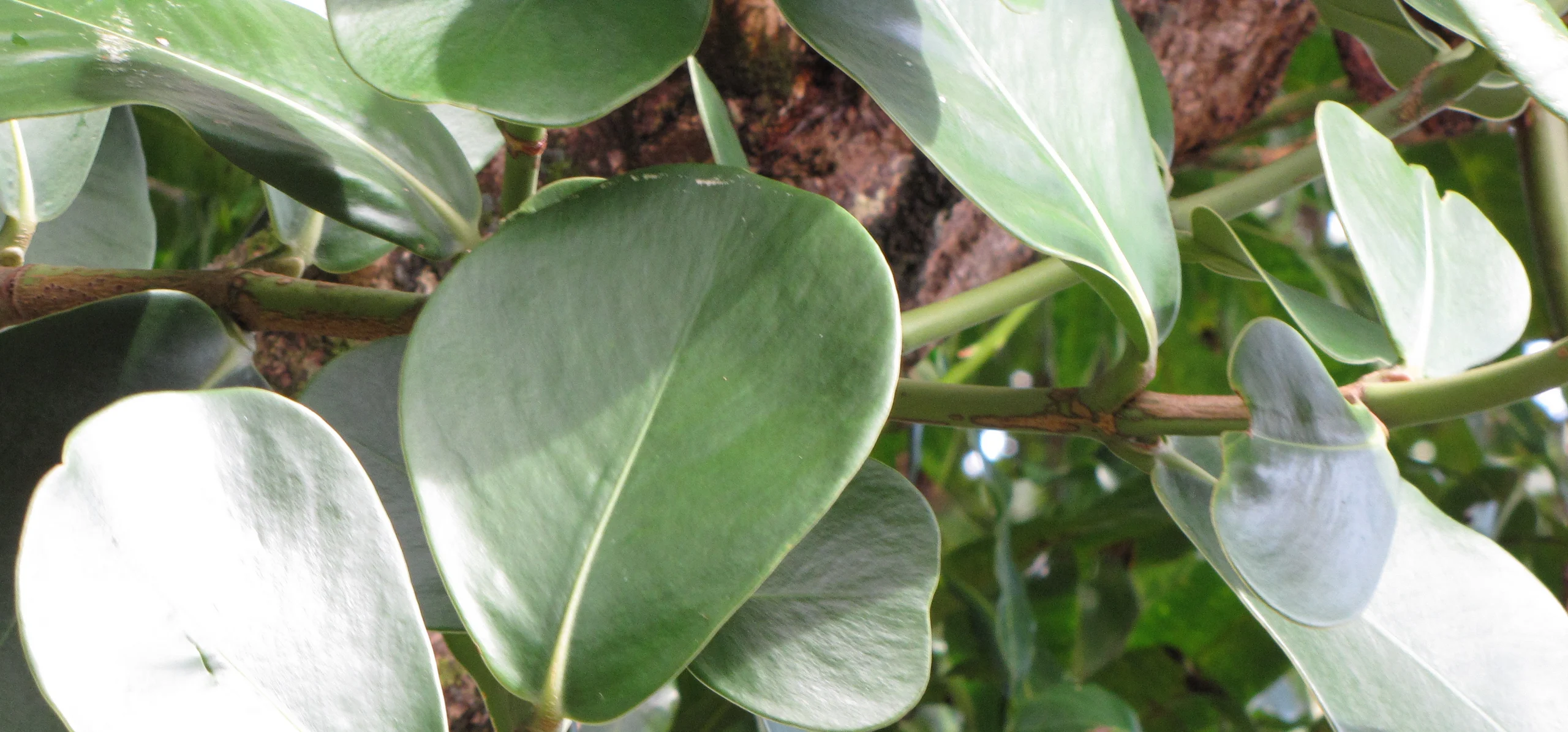
The trait behind the common name comes from leaves built almost like tough leather: thick, obovate to paddle-shaped, glossy dark green above and paler below, growing in opposite pairs along stiff branches. Scratching the surface ruptures cells just under the cuticle, and the wound oxidizes and darkens over a day or two into a legible mark that stays as long as the leaf does, often over a year. Older leaves are large enough, sometimes the size of a hand, that a full signature fits on one; the habit long predates houseplant fame and gave rise to the older common names Scotch attorney and pitch apple, both used across the Caribbean and Florida for generations.
'Princess' and other compact forms
The straight species is a forest tree that reaches many meters given the room, which is not what most growers are buying. The cultivar sold as 'Princess' was selected for dense, upright, slow branching that stays compact in a pot for years instead of the leggy stem the species produces indoors, and it is now the form most often sold as a houseplant. A variegated form, sold as 'Variegata', carries irregular cream or yellow margins on the same thick leaves and wants brighter light to keep the pattern from fading back to green. All share the same care; the difference is in habit and how much light keeps the leaf pattern crisp, not in what the plant needs to survive.


Light and placement, indoors and out
Outdoors, UF/IFAS extension rates Clusia rosea for full sun to partial shade, and it is planted as often in an open, sun-baked parking lot island as under the light shade of taller trees. Indoors, that same range shows up as tolerance rather than preference: bright, indirect light from an unobstructed east or west window keeps growth steady and leaf color deep, while a dimmer interior spot still keeps the plant alive, just slower. Direct, hot afternoon sun through glass concentrates enough heat to scorch unhardened leaves, so a plant moved from a shaded nursery bench straight into a south-facing window needs a week or two of filtered exposure first.
Watering: what tolerating neglect actually means
The thick leaves are a water reserve, the same adaptation that lets the plant start life as an epiphyte living on rainfall and humidity alone with no soil contact. That reserve is why Clusia rosea forgives a missed week between waterings better than almost anything else sold as a houseplant, with drought tolerance rated high by University of Florida extension trials. It does not forgive the opposite: a pot without a drainage hole, or one left standing in a saucer of water, rots roots within weeks because the plant is built to shed water fast, not sit in it. Water thoroughly once the top half of the mix has dried, then let it drain completely; in winter, when growth all but stops, stretching that interval further does less harm than watering on a fixed schedule regardless of how dry the pot actually is.
Salt, wind and hedges in Florida and the Caribbean
Where hardiness allows it outdoors, USDA zones 10b through 11 per UF/IFAS, Clusia rosea is planted less as a specimen tree than as a hedge, and salt and wind tolerance are the reason why. It takes direct salt spray and sandy, salt-laden soil without the leaf burn that damages less tolerant hedges, which is why it lines beachfront property lines across Miami-Dade, the Keys and much of the wider Caribbean, and why it survives a storm's wind load better than most broadleaf shrubs its size. Dense, opposite branching takes hard shearing well, so a Clusia hedge can stay a tight formal wall or grow into a loose screen, the same plant serving either role depending only on how often it is cut.
Pruning, cuttings and the pests worth watching
Because it tolerates hard cuts, Clusia rosea is forgiving to prune when it outgrows a pot or a hedge line: cut back to just above a leaf node at any time of year in frost-free conditions, and new growth breaks below the cut within weeks. UF/IFAS lists both seed and cuttings as standard propagation for the species; a stem cutting a few inches long, with the lower leaves stripped, roots in a well-draining mix or in water kept warm, though it is slower to establish than softer-stemmed houseplants. Aerial roots on older indoor specimens can simply be trimmed off or tucked back into the pot; UF/IFAS notes that trimming prop and aerial roots is essentially the only routine maintenance this plant asks for. Pest pressure is just as light: UF/IFAS lists it as largely free of serious pests and diseases, with scale the one insect flagged as an occasional concern. Indoor growers most often find scale as small, immobile brown or tan bumps along stems and leaf undersides, and mealybugs as white, cottony clusters wedged into leaf joints; both pierce the thick leaves to feed and can leave a sticky residue behind. A cotton swab dipped in rubbing alcohol removes light infestations of either insect, and insecticidal soap or neem oil applied to the whole plant catches nymphs already spread; the thick, glossy leaves tolerate this direct treatment better than thin-leaved houseplants do.
Toxicity, and where the same toughness becomes a problem
The ASPCA lists this plant, under the older name Clusia major, as toxic to cats, dogs and horses, naming terpenes as the toxic principle and vomiting with digestive upset as the clinical signs; the fruit is the most hazardous part, the leaves carrying lower amounts of the same compounds. That same resilience, tolerance of poor soil, salt, drought and low light, has let Clusia rosea escape cultivation well outside its native range. In Hawaii it has naturalized across low-elevation forest and disturbed ground on several islands after birds spread its seeds, and it is treated as one of the state's invasive woody plants. In Sri Lanka it has spread through the central hill country's remaining submontane forest, climbing and strangling native trees the same way it does at home, with no natural check on its spread. Neither Hawaii nor Sri Lanka is part of its native range, so gardeners in similar tropical climates outside the Americas should check local invasive plant lists before planting it outdoors.
Test your plant knowledge
Tap a card to flip it and reveal the answer.
Scratching a mark into a Clusia rosea leaf leaves a lasting scar, which is why it is called the autograph tree. Tap to reveal ✓ True
In the wild, Clusia rosea seeds always germinate directly in soil and never as epiphytes on other trees. Tap to reveal ✕ False
Clusia rosea is tolerant enough of salt spray and wind to be planted as a coastal hedge in Florida. Tap to reveal ✓ True
The ASPCA lists Clusia rosea as non-toxic to cats and dogs. Tap to reveal ✕ False
Clusia rosea has become invasive outside its native range, including in Hawaii and Sri Lanka. Tap to reveal ✓ True
Sources
References consulted for this guide
- Clusia rosea Jacq., GBIF Backbone Taxonomygbif.org
- Clusia rosea Jacq., Plants of the World Online (Kew)powo.science.kew.org
- Clusia Rosea toxicity, ASPCA Animal Poison Controlaspca.org
- Clusia rosea: Pitch Apple, UF/IFAS Extension (Ask IFAS ST172)ask.ifas.ufl.edu
- Clusia rosea, CABI Compendiumcabi.org
- Reference entity : Wikipédiaen.wikipedia.org