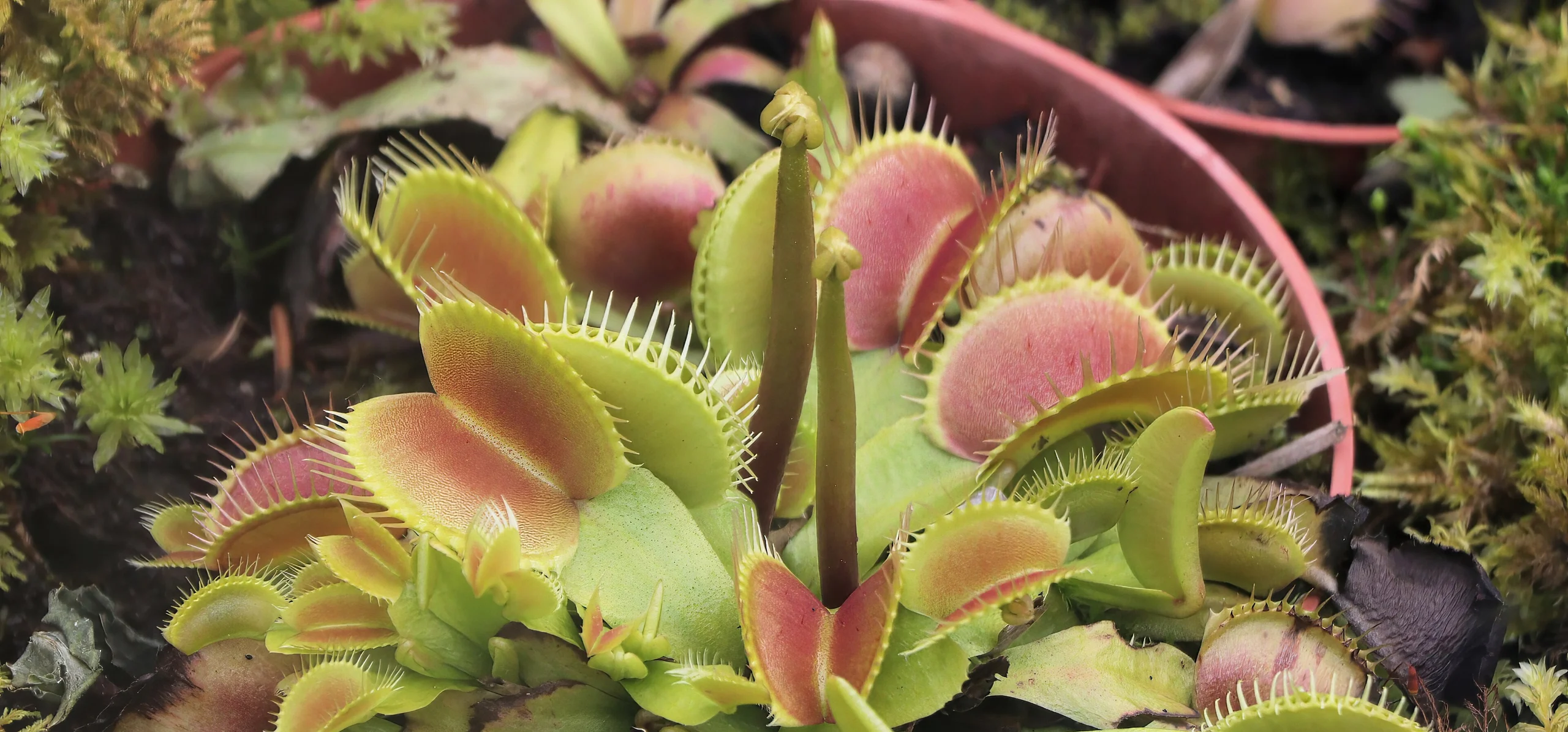
Venus Flytrap
Dionaea muscipula
Family · Droseraceae
Dionaea muscipula fails fast on tap water in a warm room. Use rainwater only, full sun, and a 2 to 10°C winter rest of about three months to keep it for years.
Dionaea muscipula
Plant profile
- WateringVery highWater every 3 days
- Light exposureFull sun
- Hardiness zoneUSDA 5–10
Growth
- Family
- Droseraceae
- Life cycle
- Perennial
- Growth speed
- 3/10
- Mature size
- 5–13 cm
- Spread
- 10–20 cm
- Flowering
- White flowers in umbels held well above the traps on a leafless stalk, spring
- Propagation
- Seed
- Division
DormancyCold winter dormancy of about three months near 2 to 10°C is required for long-term health; without it the plant weakens over successive growing seasons
Soil & climate
- Soil types
- Live sphagnum moss, Equal parts peat moss and coarse sand or perlite/vermiculite
- Drought tolerance
- No
Light & Placement
- Origin
- Coastal North Carolina and north-eastern South Carolina, USA (POWO)
- Where to place it
- Sunniest available windowsill, south-facing
- Under a strong grow light if no bright window is available
- Full sun position outdoors in summer, pot standing in a tray of rainwater
- Shallow pot with drainage holes, small enough that the rhizome fills it within a year or two
Safety
- Toxicity
- CatsSafe
- DogsSafe
- HorsesSafe
Data fromDionaea muscipula Ellis, GBIF Backbone TDionaea muscipula J.Ellis | Plants of thDionaea muscipula (Venus Flytrap), NC StDionaea muscipula, Plant Finder, MissourVenus Fly Trap, Toxic and Non-Toxic Plan
Where it grows
World distribution
Venus Flytrap is native to a single country: United States.GBIF records 3,779 documented identifications across 22 countries, with the largest concentrations in United States, Belgium, and Germany.
- United States
Yellow to orange dots: concentration of documented identifications per country. Green countries: sourced native range. Source: GBIFNative range from POWO (Kew).
A Venus flytrap bought from a garden centre or supermarket rarely survives its first year, and the reason is almost always the same three mistakes stacked on top of each other: watered from the tap, kept on a shaded kitchen windowsill, and never given the cold winter rest its biology expects every year. Dionaea muscipula is not a tropical houseplant that tolerates neglect, it is a temperate bog plant from a strip of the Carolina coast that needs mineral-free water, direct sun, and an annual cold season to keep producing traps rather than slowly starving. None of this is difficult once it is understood, but skipping any one of the three turns what should be a decades-long perennial into a plant that blackens and dies within a few months.
Only rainwater or distilled water, never tap
North Carolina State University's extension service is blunt about this one: irrigate with rainwater or distilled water, since treated, chlorinated water or hard water can kill the plant. The peat and sphagnum this species grows in hold almost no dissolved minerals in the wild, and a root system adapted to that starts absorbing calcium, chlorine and fluoride from ordinary tap water as if they were nutrients, a slow poisoning that shows up as blackened root tips and stunted new traps weeks or months later rather than an obvious overnight collapse. Rainwater, dehumidifier water, or plain distilled water from the supermarket all work; softened water does not, since a softener replaces calcium with sodium, which is just as damaging. Keep the compost constantly damp, standing the pot in a shallow tray of that water through summer so it never dries out, and let the tray run dry for a day or two in cooler months rather than year round.
Full sun, not a shaded windowsill
NC State Extension lists the species as needing full sun to partial shade, which in practice means as many hours of direct sun as a window or a patio can give it, not the bright but indirect light that suits most houseplants. Grown too dark, a flytrap survives a while on stored energy, then produces thinner, floppier traps that stay green and close slowly, and eventually stops trapping insects because the trigger hairs need active photosynthesis to reset. Traps grown in strong light usually flush a deeper red or purple across the inner lobes, while shaded traps tend to stay plain green, a difference in pigment rather than health but a useful visual check on whether the plant gets enough light. A south-facing windowsill that bakes in summer, or a spot outdoors in full sun once nights stay above about 10°C, both work better than the dim corner most houseplants tolerate.

Peat and perlite, or pure sphagnum, and no fertiliser
The same NC State guide recommends a planting mix of whole-fibre sphagnum moss, or a mix of equal parts peat moss and coarse vermiculite or sharp sand, and is equally direct that growers should not fertilise the plant. Ordinary potting compost, with its added nutrients and neutral pH, damages a flytrap's roots within weeks, and so does any liquid feed poured into the pot: this is a plant that gets its nitrogen from digested insects, not the soil, and roots that have never needed to process fertiliser salts have no way to cope with them. Repot every year or two once the old sphagnum breaks down and holds less air, using a pot with drainage rather than a sealed terrarium bowl, since standing water with no airflow through the mix encourages rot at the base of the rhizome.
Leave the traps closed
Each trap opens, closes and reopens a limited number of times before it stops resetting and blackens on its own, so triggering one with a pencil or a finger just to watch it snap shut spends part of that budget for nothing in return. A trap that has actually caught something is worth watching, since the sealed lobes secrete digestive enzymes and slowly reopen over a week or two once the insect is absorbed, but an empty trap closed for fun gets nothing back for the energy it just spent. This is also worth explaining around pets: the ASPCA lists Venus flytrap as non-toxic to dogs, cats and horses, so a curious cat mouthing a trap is a plant problem rather than a poisoning risk, but a plant missing several traps to idle hands or paws still has less capacity to feed itself.
The cold dormancy that keeps it alive past year two
Dionaea muscipula is a temperate plant that experiences a real winter in its native range, and it needs the same cold season in cultivation to keep growing normally afterwards. NC State Extension notes it is winter hardy in USDA zones 7 to 10, and can be kept even in zones 5 and 6 with winter protection, meaning the plant is built to sit through weeks of near-freezing weather rather than a mild, unbroken indoor climate. In practice this means an unheated garage, a cold porch, a cold frame outdoors, or the fridge's vegetable drawer for potted specimens, kept at roughly 2 to 10°C for about three months over winter, watered just enough to stop the sphagnum drying out completely. Most leaves blacken and die back during this rest, which looks alarming the first time but is entirely normal: new, paler traps unfurl from the rhizome within weeks of bringing the plant back into warmth and light in spring. A flytrap kept warm and lit year round, with no rest at all, tends to weaken over successive seasons rather than dying outright the first winter it is denied one.
Dividing the rhizome
A flytrap that has been growing well for two or three years usually stops being a single rosette and produces several crowns from the same underground rhizome, each capable of becoming an independent plant. NC State Extension lists division alongside seed as the species' propagation methods, and division is by far the faster: at repotting time, lift the whole clump out of its mix, rinse the loose sphagnum away so the separate crowns are visible, and cut or gently pull them apart with a clean blade, keeping a section of root and rhizome attached to each piece. Pot each division into fresh, damp sphagnum immediately, since an exposed rhizome dries out and dies within hours rather than days. Growth from seed is far slower and starts flowering only after several years, which is why nearly all traps sold commercially began life as a division rather than a seedling.
Native to a sliver of the Carolinas, and protected there
Every wild Venus flytrap grows within roughly a hundred miles of Wilmington, North Carolina, in the boggy, sandy savannas of coastal North Carolina and adjoining north-eastern South Carolina, according to both Plants of the World Online and the Missouri Botanical Garden; POWO also records a handful of introduced populations outside that range, in New Jersey and Florida, which are naturalised escapes rather than part of the species' native distribution. NC State Extension and the Missouri Botanical Garden both describe it as an endangered species that cannot be legally collected from the wild, and it is also listed on Appendix II of CITES, the treaty restricting trade in threatened species, largely because decades of poaching for the houseplant trade emptied bog after bog faster than the slow-growing rhizomes could recover. Every flytrap sold today should be nursery-propagated stock, grown from seed or division rather than dug out of a Carolina bog, and a supplier that states this openly is the safest way to be sure a purchase is not funding the wild population's decline.
Test your plant knowledge
Tap a card to flip it and reveal the answer.
Venus flytraps should be watered with ordinary tap water. Tap to reveal ✕ False
A trap that turns black after closing several times is normal, not a sign of a dying plant. Tap to reveal ✓ True
Venus flytraps should be fertilised regularly like most houseplants. Tap to reveal ✕ False
Venus flytraps need a cold winter dormancy to keep growing well in later years. Tap to reveal ✓ True
The Venus flytrap is native to a small area of coastal North and South Carolina. Tap to reveal ✓ True
Sources
References consulted for this guide
- Dionaea muscipula Ellis, GBIF Backbone Taxonomygbif.org
- Dionaea muscipula J.Ellis | Plants of the World Online, Kew Sciencepowo.science.kew.org
- Dionaea muscipula (Venus Flytrap), NC State Extension Gardener Plant Toolboxplants.ces.ncsu.edu
- Dionaea muscipula, Plant Finder, Missouri Botanical Gardenmissouribotanicalgarden.org
- Venus Fly Trap, Toxic and Non-Toxic Plants, ASPCA Animal Poison Controlaspca.org
- Reference entity : Wikipédiaen.wikipedia.org