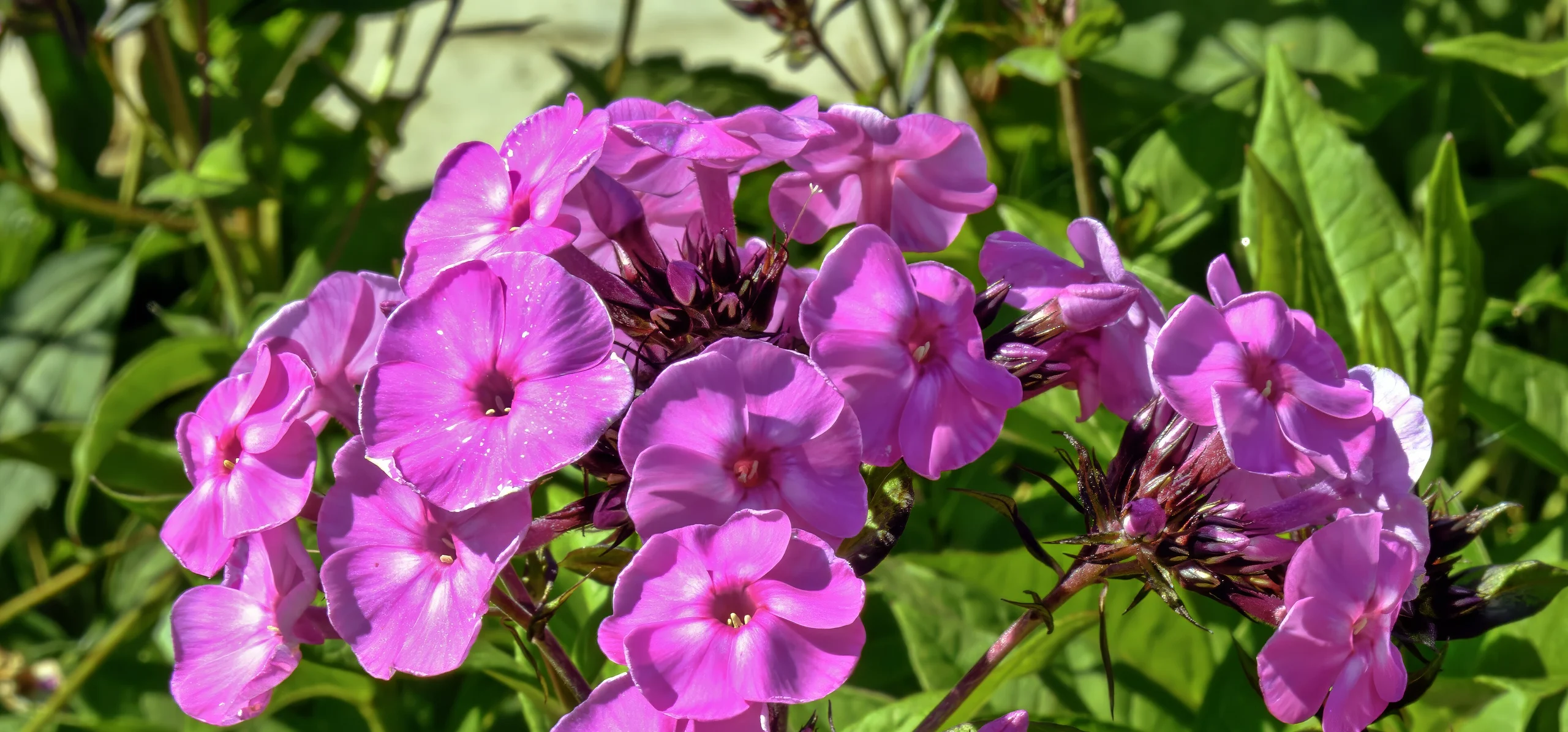
Garden Phlox
Phlox paniculata
Family · Polemoniaceae
Grow garden phlox (Phlox paniculata) with the spacing, soil moisture, and mildew-resistant cultivars it needs for full, healthy blooms from July to September.
Phlox paniculata
Plant profile
- WateringModerateWater every 7 days
- Light exposurePartial sun
- Hardiness zoneUSDA 4–8
Growth
- Family
- Polemoniaceae
- Life cycle
- Perennial
- Growth speed
- 6/10
- Mature size
- 60–120 cm
- Spread
- 60–90 cm
- Flowering
- Mid-July to September
- Propagation
- Division
- Cutting
- Seed
DormancyDies back to the ground in autumn; resprouts from the crown in spring
Time to maturity2 to 3 years to a full-size flowering clump
Soil & climate
- Soil pH
- pH 6–8
- Soil types
- loam, clay, fertile humus-rich soil
- Drought tolerance
- No
Light & Placement
- Origin
- N. Central & E. U.S.A. (New York to Iowa, south to Georgia, Mississippi and Arkansas)
- Where to place it
- Sunny perennial border
- Cottage garden bed
- Pollinator or cutting garden
- Woodland edge with morning sun
Safety
- Toxicity
- Not listed by the ASPCA for cats, dogs or horses
- Pet safe
- Yes
Invasive speciesSelf-seeded volunteers can spread and gradually crowd out named cultivars if spent flowers are left to set seed; not regulated as invasive in the US
Data fromGBIF: Phlox paniculata L.POWO (Kew): Phlox paniculata L.RHS: How to grow border phloxNC State Extension Gardener Plant ToolboMissouri Botanical Garden: Phlox panicul
Where it grows
World distribution
Garden Phlox is native to a single country: United States.GBIF records 19,187 documented identifications across 51 countries, with the largest concentrations in United States, Canada, and Sweden.
- United States
Yellow to orange dots: concentration of documented identifications per country. Green countries: sourced native range. Source: GBIFNative range from POWO (Kew).
A garden phlox bought in bloom from a nursery grows on its own roots, so the clump in that pot is exactly what returns each summer once it settles into the bed. Phlox paniculata, garden or fall phlox, is a herbaceous perennial in the Polemoniaceae family, native to the north central and eastern United States, from New York and Iowa south to Georgia, Mississippi and Arkansas, where it grows along streambanks and woodland edges rather than in the tightly packed, still-air borders most gardeners plant it in. That mismatch between wild habitat and garden life is exactly why powdery mildew, not cold or drought, is the plant's defining problem. Get spacing and moisture right from the first week and a single clump planted this year will still be blooming from July into September a decade from now, dividing every few seasons into far more plants than the bed started with.
Choosing a Mildew-Resistant Variety
Hundreds of named cultivars exist in white, lavender, magenta, salmon, red and bicolor forms, all selected from a wild species whose natural flower color is a washed-out magenta-pink. That matters at purchase time because seedlings from any named cultivar tend to revert toward that wild color, so the showy cultivar you buy will only stay true if you stop it from self-seeding. Two cultivars stand out specifically for disease resistance rather than flower size alone: 'David', a white-flowered selection developed at Mt. Cuba Center for its consistent resistance to powdery mildew, and 'Jeana', a magenta seedling found growing wild along the Harpeth River in Tennessee and named the Perennial Plant Association's 2024 Plant of the Year for combining mildew resistance with unusually heavy pollinator traffic. If mildew has disfigured phlox in your garden before, start with one of these two rather than an older cultivar bred purely for bloom size.
Planting and Spacing for Airflow
Plant container-grown phlox in spring or autumn, or bare-root divisions in late winter while dormant. Space plants at least 45 to 60 cm apart, more than feels necessary at planting time, because the goal is not fullness this year but open air movement between stems for years to come. Once an established clump thickens, thin it each spring to five or six of the strongest stems, cutting the rest out at ground level while they are still short. That single habit, thinning for airflow, does more to prevent powdery mildew than any fungicide applied afterward.
Light, Soil and Watering
Full sun produces the strongest bloom and the least mildew pressure; light afternoon shade is tolerated, especially in hot climates, but stems stretch and flowering thins. Soil should be fertile, humus-rich and evenly moist. Garden phlox tolerates soil pH from acid to alkaline but performs best in neutral to slightly alkaline conditions, roughly pH 6.0 to 8.0, so on acidic ground a handful of garden lime worked in every two to three years helps. Because the species comes from streamside habitat, drought stress is the other major trigger for mildew alongside crowding: water deeply during dry summer spells rather than relying on rainfall, and keep a mulch layer over the root zone to hold moisture and keep roots cool.
How often to water your Garden Phlox
Feeding and Staking
Feed lightly in spring with a balanced fertilizer or an inch of compost worked into the soil surface; heavy nitrogen produces soft, floppy growth that falls over and mildews faster. Taller cultivars, some reaching 1.2 m, can topple in wind and heavy rain, particularly in rich soil, so stake with brushwood or a peony ring early in the season rather than after stems have already leaned. An alternative to staking is the Chelsea chop: cutting stems back by half in late May delays flowering by roughly three to four weeks and produces shorter, bushier growth that stands up on its own. Chopping only part of a clump this way also stretches the bloom season across a bed planted with a single cultivar.
Powdery Mildew and Other Problems
Mildew shows up as a grey-white, dusty coating on leaves from midsummer on, worst in years with drought stress or still, humid air. Beyond the spacing and watering habits already covered, strip and discard, never compost, the first mildewed leaves you find, and if a cultivar has repeatedly looked bad by August in past seasons, one or two fungicide sprays from mid-July into August usually carry it through to frost looking presentable. Watch too for phlox plant bugs and four-lined plant bugs, which leave small, round, translucent spots across the leaves, spider mites in hot dry weather, visible as fine stippling and webbing, and oriental beetles chewing at flowers and foliage in summer. In waterlogged soil, phytophthora root and crown rot and black root rot can kill a clump outright, so however much this species wants consistent moisture, it needs ground that drains; standing water is the one condition it will not forgive.
Deadheading, Division and Propagation
Deadhead spent flower panicles through the summer. This extends bloom toward September and, on a named cultivar, stops the self-seeding that leads to the color reversion mentioned earlier, since volunteer seedlings almost always bloom the plain magenta-pink of the wild species and, left unchecked, will eventually crowd out the parent plant. Lift and divide congested clumps every two to four years in early spring, before new shoots are more than a few centimeters tall, replanting sections of three to five vigorous shoots with roots attached; divisions typically flower again the same season. To keep a cultivar true without disturbing the clump, take root cuttings in winter, which flower in about two seasons, or softwood stem cuttings in late spring. Growing from seed is worth doing only if you are happy to let flower color vary, since seedlings rarely come true to the parent.
Overwintering and Garden Role
Garden phlox dies back to ground level in autumn. Cut the old stems down to a few centimeters in late winter or early spring, before new growth emerges, rather than in autumn, since hollow standing stems left over winter give overwintering mildew spores and insect eggs somewhere to sit until the next growing season. The species is hardy through USDA zones 4 to 8 without protection once established, needing no extra winter mulch beyond normal garden cover. In the border it earns its space for more than color: the fragrant, flat-topped flower clusters draw hummingbirds, bees and butterflies through the height of summer, when many other perennials have already finished, and while deer and rabbits will browse it in a pinch, it is not a preferred food source and tends to be left alone where more palatable plants are nearby.


Test your plant knowledge
Tap a card to flip it and reveal the answer.
Powdery mildew is more likely on garden phlox planted too closely together. Tap to reveal ✓ True
Seed collected from a named phlox cultivar will grow into plants with the same flower color as the parent. Tap to reveal ✕ False
Garden phlox tolerates being planted in soggy, poorly drained soil. Tap to reveal ✕ False
'David' and 'Jeana' are garden phlox cultivars specifically valued for resistance to powdery mildew. Tap to reveal ✓ True
Once planted, an established garden phlox clump never needs to be divided again. Tap to reveal ✕ False
Sources
References consulted for this guide
- GBIF: Phlox paniculata L.gbif.org
- POWO (Kew): Phlox paniculata L.powo.science.kew.org
- RHS: How to grow border phloxrhs.org.uk
- NC State Extension Gardener Plant Toolbox: Phlox paniculataplants.ces.ncsu.edu
- Missouri Botanical Garden: Phlox paniculata Plant Findermissouribotanicalgarden.org
- Reference entity : Wikipédiaen.wikipedia.org