American Pokeweed
Phytolacca americana
Family · Phytolaccaceae
American pokeweed grows fast from a taproot and feeds birds with toxic berries. How to identify it, handle it safely and decide whether to keep or remove it.
Phytolacca americana
Plant profile
- WateringModerateWater every 7 days
- Light exposurePartial sun
- Hardiness zoneUSDA 4–8
Growth
- Family
- Phytolaccaceae
- Life cycle
- Perennial
- Growth speed
- 9/10
- Mature size
- 120–300 cm
- Spread
- 90–150 cm
- Flowering
- White to greenish-white flowers July-September; berries ripen June-November
- Propagation
- Seed
- Division
- Cutting
Dormancydies back to the taproot each winter, resprouts in spring
Soil & climate
- Soil pH
- pH 5–8.5
- Soil types
- clay, loam, sand
- Drought tolerance
- Yes
Light & Placement
- Origin
- Eastern North America, from eastern Canada to Mexico
- Where to place it
- woodland edge
- fence line
- hedgerow
- naturalized border
- pollinator or bird garden
Safety
- Toxicity
- HumansToxic
Invasive speciesself-seeds aggressively via birds; listed as an invasive species in parts of its introduced range, including China
Data fromPhytolacca americana, GBIF Backbone TaxoPOWO: Phytolacca americana L.NC State Extension Gardener Plant ToolboMissouri Botanical Garden: Phytolacca am
Where it grows
World distribution
American Pokeweed is native to 3 countries: Canada, Mexico, and United States.GBIF records 209,233 documented identifications across 100 countries, with the largest concentrations in United States, France, and Portugal.
- Canada
- Mexico
- United States
Yellow to orange dots: concentration of documented identifications per country. Green countries: sourced native range. Source: GBIFNative range from POWO (Kew).
What You're Looking At: Identifying American Pokeweed
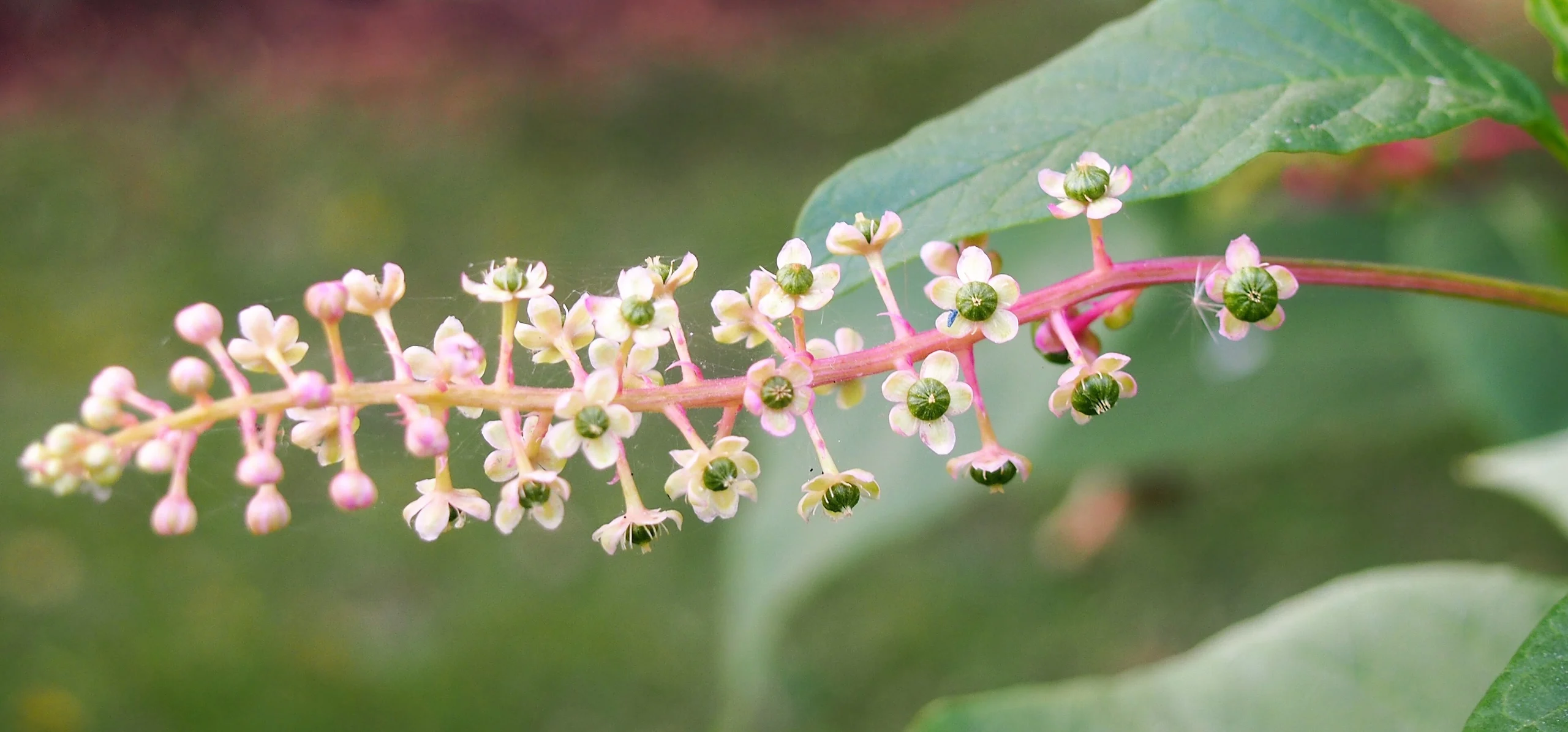
If a plant has shot up waist-high or taller in a single season, with smooth stems that turn magenta-red as summer wears on and dangling clusters of berries ripening from green to deep purple-black, you are almost certainly looking at American pokeweed, Phytolacca americana. It is an herbaceous perennial that dies back to a thick, fleshy taproot each winter and resprouts from that root every spring, reaching 1.2 to 3 m (4 to 10 ft) tall with a spread of 0.9 to 1.5 m (3 to 5 ft) within a single growing season. Small white to greenish-white flowers open in upright then drooping racemes from July into September, followed by berries that ripen from June through November, green at first and glossy purple-black when ripe. The whole plant, roots included, is poisonous, so identification matters before you decide whether to leave it, contain it or dig it out.
Native Range and Where It Naturalizes
Phytolacca americana is native to eastern North America, from eastern Canada south to Mexico according to Kew's Plants of the World Online, with the Missouri Botanical Garden placing its heartland in the southeastern United States and noting a distribution across northern and central North America. It thrives on the disturbed, sun-baked edges that define so much of that range: forest margins, fence lines, riverbanks, vacant lots. Birds carrying the seed in their gut have also given it a second life well outside its native range, and it now turns up as a naturalized, sometimes weedy plant in parts of Europe and Asia, having spread there first through gardens and, in China, through cultivation for traditional medicine.
Toxicity: Why Every Part Is Dangerous
Every part of this plant is toxic, but not equally: horticulturists at NC State Extension note the toxins concentrate most heavily in the rootstock, less in the mature leaves and stems, and least in the ripe fruit. Ingestion causes severe stomach cramping, nausea, vomiting and persistent diarrhea, with weakness, breathing difficulty and, in serious cases, seizures reported in more severe poisonings. Handling the plant carries its own risk, sap on bare skin can trigger dermatitis, so wear gloves when you cut, pull or weed around it. The young spring shoots have a long folk history as poke sallet after repeated boiling and draining, but the margin for error is thin: mature leaves, stems and any hint of red in the shoot are far more toxic, and cases of poisoning from home-prepared pokeweed are still documented every year. Treat it as inedible and keep children and pets away from the berries.
Light and Site
Pokeweed is not fussy about light: NC State Extension lists it as growing equally well in full sun, six or more hours of direct light, or partial shade of two to six hours. In practice that means it colonizes almost anywhere the ground has been disturbed, from a sunny fence line to the dappled edge of a woodland planting. If you are choosing a spot on purpose rather than tolerating a volunteer, give it a back corner or a naturalized border rather than the front of a bed, both for its eventual size and for the toxicity of the berries.
Soil and Watering
Few native plants ask so little of the soil. It grows in clay, loam or sand and tolerates acidic, neutral or alkaline pH alike, taking hold in good garden loam as readily as in poor, compacted ground. The Missouri Botanical Garden describes it as tolerant of consistently moist soil and drought once established: the deep taproot that lets it regrow every spring is the same taproot that carries it through a dry summer with little help. Water a new plant while it settles in over its first few weeks; after that, rainfall alone is usually enough outside of a severe drought.
How often to water your American Pokeweed
Should You Keep It, Contain It or Pull It?
Pokeweed earns its keep in a wild corner or hedgerow but turns into a nuisance fast in a tended bed. Missouri Botanical Garden flags its aggressive self-seeding and susceptibility to mosaic virus among its main garden problems, and a single plant left to fruit can seed a wide area within a year or two, since birds carry the seed well beyond the parent plant. If you want to keep it, deadhead the racemes before the berries ripen to stop it self-sowing, and let just one or two plants stand rather than a whole colony. If you would rather be rid of it, cutting the top growth back does not kill it: the root resprouts within weeks, so dig out the taproot while the plant is young and the ground is soft, ideally before it flowers, and wear gloves throughout. Established plants have a surprisingly deep, brittle taproot that often snaps and regrows from any piece left behind, so persistence over a season or two is normal.
Wildlife Value: Birds and Pollinators
What makes pokeweed hard to eradicate is exactly what makes it valuable if you have room for it. The ripe berries are a significant late-summer and autumn food source for songbirds such as mockingbirds, catbirds and thrushes, which pass the seeds through unharmed and are the main reason the plant turns up in new spots each year. The small flowers, though unshowy, are visited through summer by bees and other pollinating insects drawn to the open racemes. A single uncontained plant in a back corner can feed a surprising amount of local wildlife across a season, provided it is kept well away from vegetable beds, play areas and anywhere pets or children forage.


Test your plant knowledge
Tap a card to flip it and reveal the answer.
American pokeweed is toxic in every part of the plant, including the ripe berries. Tap to reveal ✓ True
Cutting the top growth back is usually enough to kill an unwanted pokeweed plant. Tap to reveal ✕ False
Pokeweed tolerates clay, loam and sandy soil, and a wide range of pH. Tap to reveal ✓ True
Pokeweed only grows well in full sun and struggles in any shade. Tap to reveal ✕ False
Birds that eat pokeweed berries help spread the plant to new locations. Tap to reveal ✓ True
Sources
References consulted for this guide
- Phytolacca americana, GBIF Backbone Taxonomygbif.org
- POWO: Phytolacca americana L.powo.science.kew.org
- NC State Extension Gardener Plant Toolbox: American Pokeweedplants.ces.ncsu.edu
- Missouri Botanical Garden: Phytolacca americana Plant Findermissouribotanicalgarden.org
- Reference entity : Wikipédiaen.wikipedia.org