African Violet
Streptocarpus ionanthus ionanthus
Family · Gesneriaceae
African violet (Streptocarpus ionanthus) care: bright indirect light, room-temperature bottom watering, and a shallow pot that keeps roots from rotting.
Streptocarpus ionanthus ionanthus
Plant profile
- WateringModerateWater every 7 days
- Light exposureIndirect light
- Ideal temperature16–24 °C
- Humidity40–50 %
Growth
- Family
- Gesneriaceae
- Life cycle
- Perennial
- Growth speed
- 4/10
- Mature size
- 5–10 cm
- Spread
- 10–50 cm
- Flowering
- Continuous with enough light
- Propagation
- Cutting
- Division
- Seed
DormancySlows in low-light winter
Time to maturity2 to 5 years to reach full size (RHS)
Soil & climate
- Soil pH
- pH 6–6.5
- Saline soil
- Not tolerated
- Drought tolerance
- No
Soil typesEqual parts potting soil, peat moss, and perlite, Light, free-draining compost, roughly 2:1 compost to perlite
Light & Placement
- Origin
- East and southwest Tanzania
- Where to place it
- North- or east-facing windowsill in spring and summer
- South- or west-facing windowsill in winter
- Under fluorescent tubes, 30-38 cm above the leaves, 12-16 hours a day
- Sheltered, shaded spot outdoors only in frost-free, tropical climates
- Shallow pot, about 10 cm across, only slightly larger than the rootball
Safety
- Toxicity
- CatsSafe
- DogsSafe
- HorsesSafe
Data fromStreptocarpus ionanthus subsp. ionanthusAfrican Violet toxicity, ASPCA Animal PoAfrican violets, RHS Growing GuideStreptocarpus ionanthus (AV), RHS PlantsAfrican Violets, Virginia Cooperative Ex
Where it grows
World distribution
GBIF records 318 documented identifications across 26 countries, with the largest concentrations in Tanzania, United States, and Brazil.
Yellow to orange dots: concentration of documented identifications per country. Green countries: sourced native range. Source: GBIF.
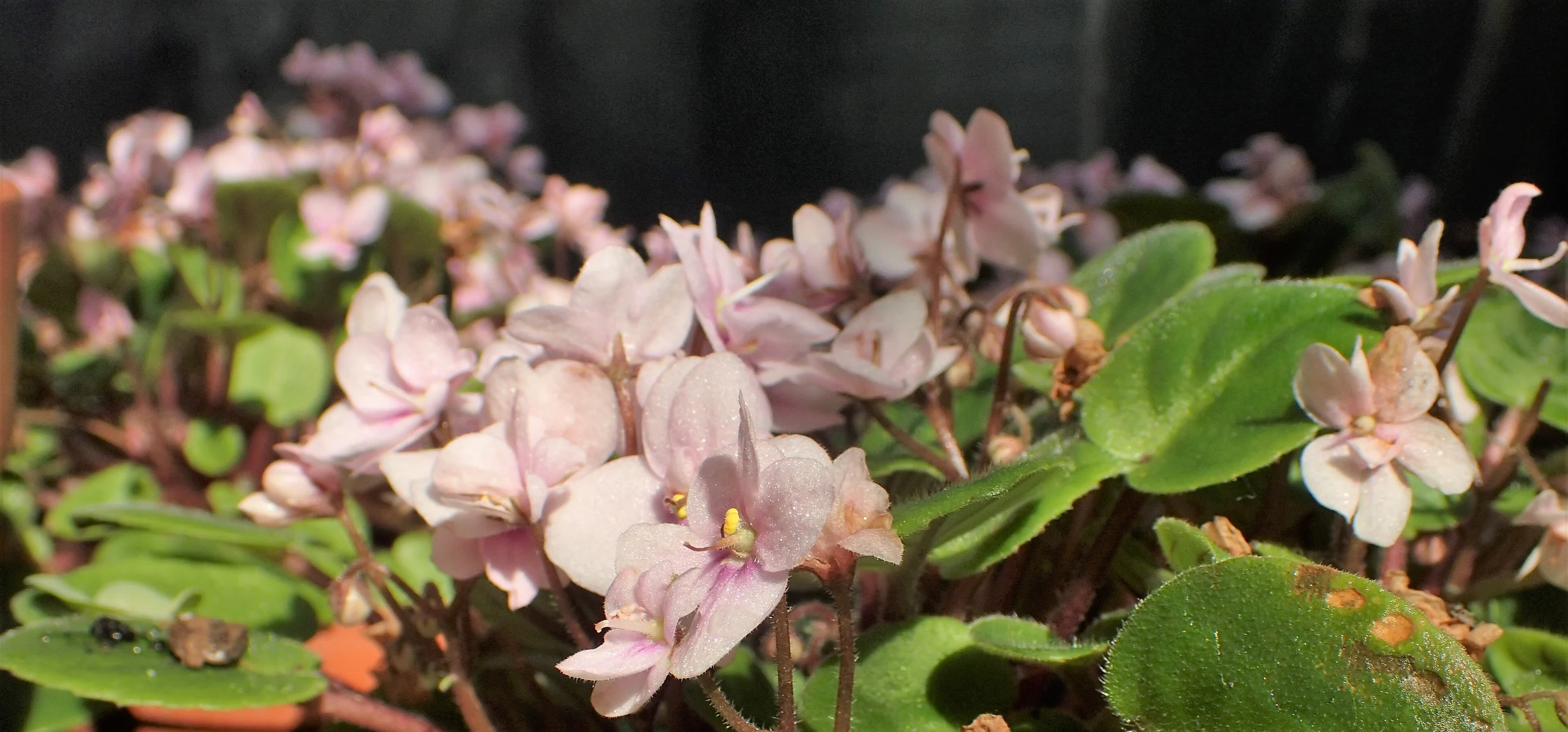
A newly bought African violet usually arrives in full bloom, sitting in a small plastic pot with fuzzy, dark green leaves fanned out in a flat rosette. Each five-petaled flower lasts three to six weeks, and a well-kept plant keeps sending up new flower stalks almost continuously rather than flowering once and stopping. The two habits that kill more of these plants than anything else are splashing cold water on the leaves and repotting into a container that is too roomy for the roots, both easy to avoid once you know why they matter.
From Saintpaulia to Streptocarpus: What the Name Change Means
Nurseries, seed packets, and most gardening books still sell this plant as Saintpaulia ionantha, but that name is a taxonomic synonym. Genetic studies moved the whole genus Saintpaulia into Streptocarpus, and the currently accepted name in the GBIF backbone taxonomy is Streptocarpus ionanthus subsp. ionanthus, in the family Gesneriaceae. The common name African violet has not changed and this guide keeps using it, since that is what growers search for and what is printed on plant tags. In the wild, Plants of the World Online (Kew) records the species as native to east and southwest Tanzania, where it grows as a lithophyte, rooted directly on shaded, humid rock outcrops in mountain forest, which explains why the plant wants filtered light and steady moisture rather than sun and drought.
Choosing a Variety
Modern African violet cultivars go well beyond the plain blue-violet species. Breeders offer single, semi-double, and fully double flowers, bicolored blooms with a contrasting picotee edge, trailing forms that spill over the pot rim instead of forming a tight rosette, and miniatures bred to stay under 15 cm across. For a first plant, a standard single-flowered rosette cultivar is the easiest to read: yellowing or dulling leaf color, elongated leaf stalks, and stalled flowering all show up faster and more clearly on a simple form than on a ruffled double.


Light Without Direct Sun
African violets flower on a light schedule as much as a light intensity: they need roughly ten hours of bright light and at least eight hours of uninterrupted darkness a day to keep budding. A north- or east-facing windowsill works well in spring and summer; in winter, when the sun sits lower, move plants to a south- or west-facing sill instead. Direct midday sun through glass scorches the hairy leaves into brown, papery blotches within a day, so filter strong sun with a sheer curtain or pull the plant back from the glass. Growers without a good window commonly use two 40-watt fluorescent tubes set 30 to 38 cm above the leaves for 12 to 16 hours a day, which gives more consistent flowering than a windowsill through the darker months.
Watering the Right Way
Cold tap water striking a warm leaf causes permanent pale ring-shaped blotches, so always use water at room temperature or slightly warmer. Let the surface of the potting mix dry to the touch between waterings, then either water from below by standing the pot in a saucer of water for about 30 minutes and discarding the runoff, or water from above at the soil line while keeping the crown and leaves dry. Overwatering, not underwatering, is the single biggest killer of African violets: standing water around the crown or roots leads to crown rot and root rot, both of which are usually fatal by the time the leaves show it.
Soil, Pot Size, and Repotting
A light, fast-draining mix suits the shallow root system best: equal parts potting soil, peat moss, and perlite is a reliable starting recipe, and the medium should sit slightly acidic, around pH 6.0 to 6.5. Pot size matters more for this plant than for most houseplants: use a container only slightly larger than the rootball, no more than about 10 cm across and 10 cm deep for a mature plant, since a pot that is too roomy holds excess moisture and pushes the plant into leaf growth instead of flowers. Repot only when necessary, moving up a single pot size at a time, roughly every two to three years; a slightly underpotted, crowded plant blooms more reliably than an overpotted one.
Feeding for Continuous Bloom
Because African violets can flower year-round rather than storing energy for one seasonal bloom, they benefit from regular light feeding through spring and summer: a dilute, balanced liquid houseplant fertilizer or a fertilizer formulated specifically for African violets, applied roughly every three to four weeks and watered in immediately after a normal watering. Skipping feed for a season shows up as pale, faded leaf color and slower flowering; overdoing it shows up as a crust of white mineral salts on the soil surface and pot rim, which can burn stems and petioles that touch it.
Propagating From a Single Leaf
A healthy, medium-sized leaf from the middle ring of the rosette, not the oldest outer leaves or the newest center ones, roots reliably on its own. Trim the leaf stalk to about 2.5 to 4 cm and insert it at an angle into a moist, free-draining mix such as equal parts vermiculite and sand, then cover loosely to hold humidity while roots form. Expect roots in three to four weeks and tiny plantlets at the base of the original leaf three to four weeks after that; from cutting to a plant large enough to flower typically takes six to nine months. Large, multi-crowned plants can also be divided at repotting time, as long as each division keeps its own share of roots.
Pests, Diseases, and Common Mistakes
Mealybugs are the most common visible pest, showing up as small cottony tufts in leaf axils; dab them off with a cotton swab dipped in a 1:1 alcohol and water mix. Cyclamen mites are harder to see and cause new growth to twist and stay stunted at the crown; because they are difficult to eradicate, badly infested plants are usually best discarded rather than treated. Grey mold (botrytis) and powdery mildew both take hold where air circulation is poor and leaves stay wet, so space plants apart and keep water off the foliage. Beyond pests, the recurring mistakes are the same three: cold water on the leaves, a pot too large for the roots, and letting the plant sit in standing water, all of which are far easier to prevent than to reverse. On the safety side, the ASPCA lists African violet as non-toxic to dogs, cats, and horses, one of the few reliably flowering houseplants that does not need to be kept out of reach, though a curious cat pawing through the shallow, loose potting mix can still scatter soil or snap the brittle leaf stalks.
Test your plant knowledge
Tap a card to flip it and reveal the answer.
African violet leaves can be watered with cold tap water straight from the faucet. Tap to reveal ✕ False
African violets need several hours of uninterrupted darkness each day to keep flowering. Tap to reveal ✓ True
A pot only slightly larger than the rootball helps an African violet flower more reliably. Tap to reveal ✓ True
African violets are listed as toxic to cats and dogs if chewed. Tap to reveal ✕ False
A new African violet plant can be grown from a single healthy leaf. Tap to reveal ✓ True
Sources
References consulted for this guide
- Streptocarpus ionanthus subsp. ionanthus, GBIF Backbone Taxonomygbif.org
- African Violet toxicity, ASPCA Animal Poison Controlaspca.org
- African violets, RHS Growing Guiderhs.org.uk
- Streptocarpus ionanthus (AV), RHS Plantsrhs.org.uk
- African Violets, Virginia Cooperative Extension (Virginia Tech)pubs.ext.vt.edu