Rex Begonia
Begonia rex
Family · Begoniaceae
Rex begonia leaves brown at the edges without steady humidity and rot at the rhizome if overwatered. The light, water and leaf-cutting routine that avoids both.
Begonia rex
Plant profile
- WateringHighWater every 7 days
- Light exposurePartial shade
- Ideal temperature15–24 °C
- Humidity50–70 %
Growth
- Family
- Begoniaceae
- Life cycle
- Perennial
- Growth speed
- 4/10
- Mature size
- 10–50 cm
- Spread
- 10–50 cm
- Flowering
- Small pink or white flowers in winter, grown mainly for foliage
- Propagation
- Cutting
- Division
DormancySemi-dormant in winter, older leaves yellow and drop
Time to maturityReaches full size in 2 to 5 years
Soil & climate
- Soil pH
- pH 6.5–7.5
- Drought tolerance
- No
Soil typesPorous, well-drained houseplant compost, Loosened with perlite or orchid bark, Chalk, loam or sand based, neutral to alkaline
Light & Placement
- Origin
- S. Bhutan to N. Myanmar
- Where to place it
- East-facing window
- A metre or two back from a south or west window
- Frost-free greenhouse or conservatory in partial shade
- Shallow, wide pot to match the surface-creeping rhizome
Safety
- Toxicity
- CatsToxic
- DogsToxic
- HorsesToxic
Data fromBegonia rex Putz., GBIF Backbone TaxonomBegonia rex Putz. ex K.Koch, Plants of tBegonia rex (R), king begonia, RHS PlantRex Begonia, Toxic and Non-Toxic Plants,Begonia rex-cultorum, Missouri Botanical
Where it grows
World distribution
Rex Begonia is native to 3 countries: Bhutan, India, and Myanmar (Burma).GBIF records 290 documented identifications across 30 countries, with the largest concentrations in Brazil, China, and India.
- Bhutan
- India
- Myanmar (Burma)
Yellow to orange dots: concentration of documented identifications per country. Green countries: sourced native range. Source: GBIFNative range from POWO (Kew).
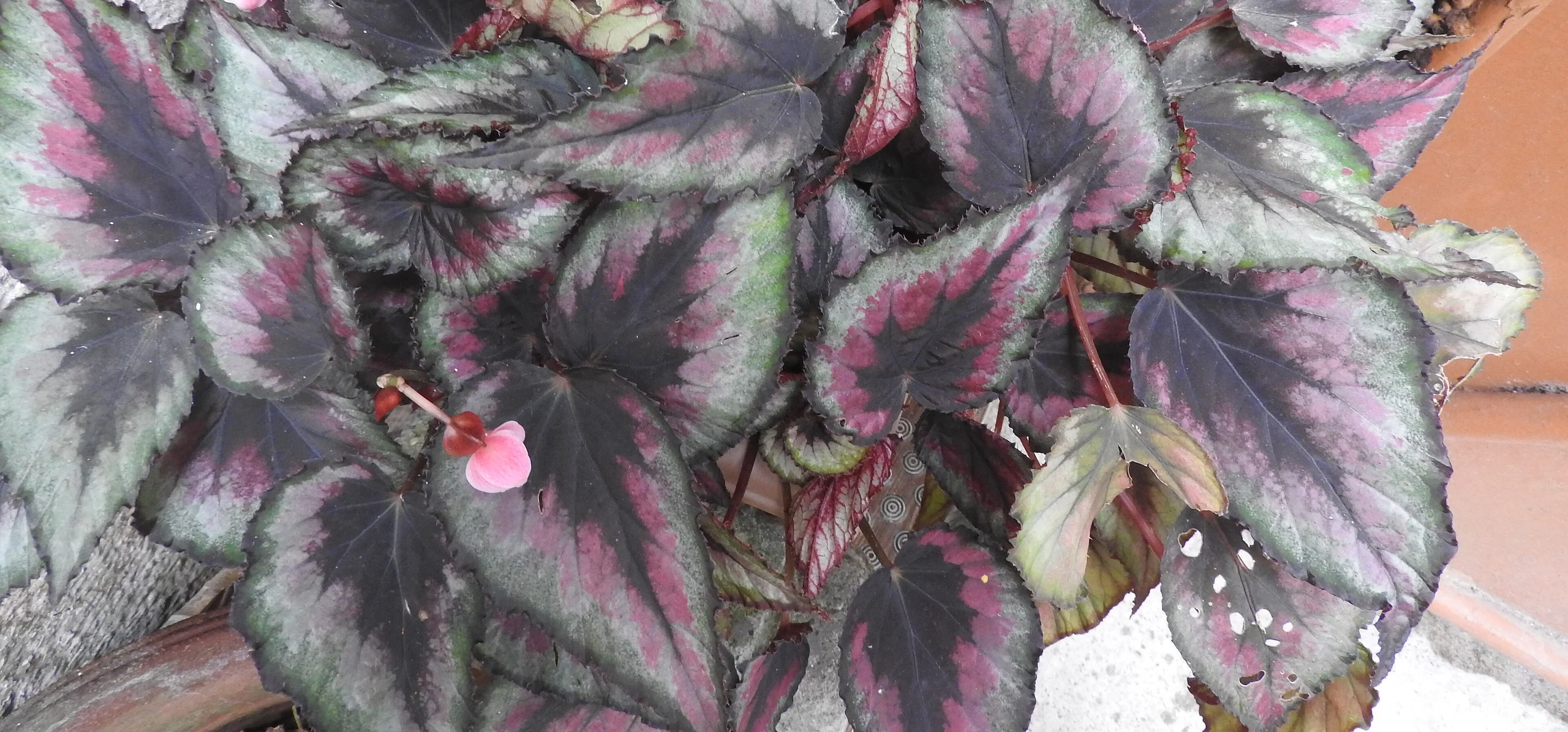
A rex begonia earns its shelf space for the leaves, not the flowers: each one grows from a spiralling rhizome that creeps along the surface of the pot rather than pushing up a trunk, and unfurls asymmetric, almost metallic foliage zoned in silver, plum and bottle green that darkens and sharpens over about ten days as it hardens off. The wild species, Begonia rex, comes from cool, humid forest valleys and rocky slopes spanning southern Bhutan to northern Myanmar, and nearly every cultivar sold today traces back to that plant and a handful of related Himalayan and Southeast Asian species crossed together since the 1850s. Two things kill more rex begonias than anything else: dry indoor air that browns the leaf margins, and a pot kept wet enough to rot the rhizome. Get the humidity and the watering rhythm right and the plant keeps producing new leaves for years, even through a dormant-looking lull in winter.
From a Himalayan hillside to hundreds of cultivars
In the wild, Begonia rex grows low to the ground on shaded, damp slopes, spreading by its creeping rhizome rather than climbing or forming a woody stem. Breeders have since crossed it with related species to produce cultivars in almost every leaf pattern going, spiralled centres, silver spots, ruffled edges, near-black backgrounds, but the underlying plant stays the same: a rhizomatous, evergreen perennial that reaches roughly 10 to 50 cm tall and wide at maturity, usually within two to five years. The small pink or occasionally white flowers appear in winter but are easy to miss next to the foliage, and most growers pinch them off so the plant puts its energy into leaves instead.
Light without direct sun
This is a partial-shade plant by nature, so indoors it wants bright, indirect light rather than a sunny sill. An east-facing window suits it well, and a south- or west-facing one works only a metre or two back from the glass or behind a sheer curtain. Direct sun scorches the thin, slightly fuzzy leaf surface within a day, leaving pale, papery patches that never recolour. Too little light shows up more slowly: new leaves come in smaller and duller, with the silver zoning barely visible, and it is worth moving the plant a little closer to the window before assuming something else is wrong.


Watering the rhizome without rotting it
Because the rhizome sits on or just under the soil surface rather than deep in the pot, it is far more exposed to rot than a plant with an ordinary root system. Water when the top two to three centimetres of mix have dried out, soaking thoroughly and then letting the excess drain away completely, never leaving the pot sitting in a saucer of water. A shallow, wide pot suits the plant better than a tall one, since it matches how the rhizome actually spreads and keeps the mix from staying wet at depth long after the surface looks dry. Water the soil directly rather than the crown of the plant; splashing the rhizome itself is one of the more common ways growers trigger rot.
Humidity and the leaf-edge browning problem
Most of the crisping, browning leaf edges reported on this species trace back to humidity below roughly 50%, which is lower than most homes provide by default. A pebble tray topped up with water, grouping it with other humidity-loving plants, or running a small humidifier nearby all help; misting the leaves does very little and dries too fast to matter, and wetting the foliage repeatedly also raises the risk of powdery mildew. Above 60% humidity the leaves stay glossy and fully sized at the edges rather than curling inward. Cold draughts from a window or air-conditioning vent cause similar edge damage and are easy to mistake for a humidity problem, so rule out draughts before adjusting the humidity setup.
Soil, pots and feeding
A porous, well-drained mix keeps the rhizome from sitting in damp conditions: a standard houseplant compost loosened generously with perlite or orchid bark works well, and the plant tolerates soil ranging from neutral to slightly alkaline rather than needing acidic conditions. Feed with a balanced liquid fertiliser diluted to half strength every two to three weeks during active growth in spring and summer, since rex begonias are relatively heavy feeders for a houseplant of this size, and stop feeding entirely once growth slows in autumn. Repot only when the rhizome has filled the width of its shallow pot, moving up one size rather than into something deep.
Winter dormancy and leaf drop
As light and temperature drop in autumn, many rex begonias slow down noticeably: older leaves yellow and drop, growth pauses, and the plant can look sparse or half-dead for a few months. This is normal dormancy rather than a sign of failure. Cut watering back to whenever the mix has dried well through, stop fertilising, and keep the plant somewhere it will not drop below about 15°C, since it needs frost-free, greenhouse-like conditions through winter. New leaves resume unfurling as the days lengthen in spring, usually starting from the tips of the rhizome that stayed dormant over winter.
Propagating from a single leaf
A healthy, mature leaf is enough to start a new plant. Cut it from the stem, then either slice it into wedges that each include a section of main vein, or lay the whole leaf flat and score through the main veins on the underside with a blade. Press the cut edges or the scored underside into moist, well-draining mix, or pin the leaf flat with the veins in light contact with the surface. Plantlets emerge from the cut veins over several weeks in warm, humid conditions, most reliably under a clear cover or propagator lid. Rhizome sections with at least one growth point, cut and laid on the surface of moist mix, root just as easily and grow on faster than leaf cuttings.
Powdery mildew, pests and pet safety
Poor air circulation combined with wet foliage is the main trigger for powdery mildew on this species, a grey-white dusting across the leaf surface; increasing airflow and watering the soil rather than the leaves prevents most cases. Mealybugs, thrips, vine weevils and aphids are the pests to check for, usually clustering in the crevices where new leaves unfurl from the rhizome. On the safety side, the ASPCA lists rex begonia as toxic to cats, dogs and horses, with soluble calcium oxalates as the toxic principle and the underground rhizome carrying the highest concentration; ingestion typically causes vomiting and salivation in dogs and cats, so keep the pot out of reach of pets that chew houseplants.
Test your plant knowledge
Tap a card to flip it and reveal the answer.
Rex begonias tolerate several hours of direct sun on a windowsill. Tap to reveal ✕ False
New plants can be started from a single leaf cut into wedges. Tap to reveal ✓ True
It is normal for a rex begonia to drop older leaves and slow down in winter. Tap to reveal ✓ True
Rex begonia is listed as non-toxic to cats and dogs by the ASPCA. Tap to reveal ✕ False
A shallow, wide pot suits this plant better than a tall, deep one. Tap to reveal ✓ True
Sources
References consulted for this guide
- Begonia rex Putz., GBIF Backbone Taxonomygbif.org
- Begonia rex Putz. ex K.Koch, Plants of the World Online (Kew)powo.science.kew.org
- Begonia rex (R), king begonia, RHS Plantsrhs.org.uk
- Rex Begonia, Toxic and Non-Toxic Plants, ASPCA Animal Poison Controlaspca.org
- Begonia rex-cultorum, Missouri Botanical Garden Plant Findermissouribotanicalgarden.org
- Reference entity : Wikipédiaen.wikipedia.org