Polka Dot Begonia
Begonia maculata
Family · Begoniaceae
Begonia maculata, the polka dot begonia, needs bright filtered light, humidity without misting, and regular pruning to stop its cane stems turning leggy.
Begonia maculata
Plant profile
- WateringModerateWater every 7 days
- Light exposureIndirect light
- Ideal temperature15–24 °C
- Humidity50–70 %
Growth
- Family
- Begoniaceae
- Life cycle
- Perennial
- Growth speed
- 6/10
- Mature size
- 50–100 cm
- Spread
- 10–50 cm
- Flowering
- Pale pink or white clusters in summer
- Propagation
- Cutting
DormancySlows down in winter, no true dormancy
Time to maturityReaches full size in 2 to 5 years
Soil & climate
- Soil pH
- pH 5.5–7
- Saline soil
- Not tolerated
- Drought tolerance
- No
Soil typesLight, peat-free potting compost, Loam or clay-loam loosened with perlite or coarse sand
Light & Placement
- Origin
- Brazil (Rio de Janeiro), rainforest understory
- Where to place it
- East-facing window with filtered light
- A few steps back from a bright south window
- Shaded, frost-free conservatory or greenhouse in summer
- Terracotta pot to wick away excess moisture
- Plastic nursery pot with good drainage holes
Safety
- Toxicity
- CatsToxic
- DogsToxic
Data fromBegonia maculata Raddi, GBIF Backbone TaBegonia maculata Raddi, Plants of the WoBegonia maculata (spotted begonia), RHS Begonia, Toxic and Non-Toxic Plants, ASP
Where it grows
World distribution
Polka Dot Begonia is native to a single country: Brazil.GBIF records 806 documented identifications across 33 countries, with the largest concentrations in Brazil, Mexico, and United States.
- Brazil
Yellow to orange dots: concentration of documented identifications per country. Green countries: sourced native range. Source: GBIFNative range from POWO (Kew).
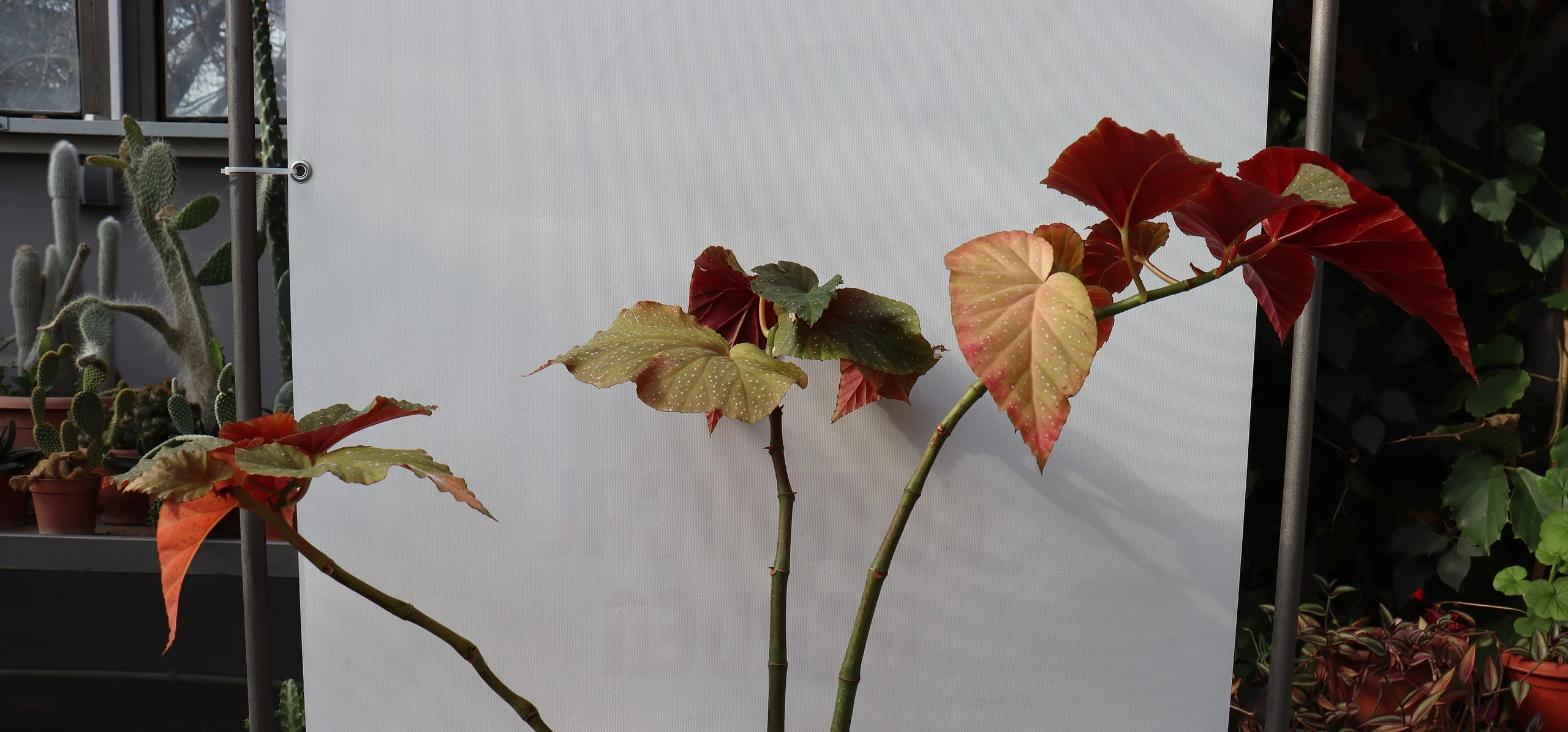
Begonia maculata, sold as the polka dot begonia or cane begonia, is an upright, cane-stemmed species from the Brazilian rainforest, one of the more forgiving spotted-leaf plants once its light and humidity settle into a routine. The wing-shaped leaves are olive green on top with rows of silver-white spots and a deep burgundy-red underside, carried along jointed, bamboo-like stems that reach half a metre to a metre indoors. A new leaf unfurls small and pale at the growing tip, then darkens and expands over one to two weeks as the cane keeps climbing toward the light. Give it bright, filtered light, humidity above 50%, and water only once the topsoil has dried, and it settles in fast; skip any of those three and the lowest leaves start dropping first.
A cane begonia from the Brazilian understory
Begonia maculata was first described by the Italian botanist Giuseppe Raddi from plants collected in Rio de Janeiro state, and Plants of the World Online still records Brazil as its native range. In the wild it grows as an understory shrub on the floor of wet tropical forest, in the dappled, humid light that filters through a closed canopy rather than in open sun. Botanically it belongs to the cane-stemmed group of begonias, distinguished from the rhizomatous types (like Begonia masoniana) and the tuberous, dormant types by its fibrous roots and erect, jointed stems that keep extending season after season rather than resting underground. Older nursery names such as Begonia argentea and Begonia argyrostigma, both referring to the silvery spotting, are now folded into maculata, Latin for spotted.
Light: why the spots need brightness
Indoors this species wants bright, indirect or filtered light, the kind a sheer curtain gives a few steps back from an east-facing window; an hour of gentle morning sun is tolerated, but hours of hot midday or west sun bleach the leaf color and can scorch the thin tissue between the spots. Too little light shows up before too much: canes stretch with long, bare gaps between leaves as they reach for a brighter source, and the spots lose contrast against a duller green background. A plant getting the light it needs holds leaves close together along the cane and pushes out new growth every few weeks through spring and summer.
Watering the canes
Water moderately while the plant is actively growing, letting the top two to three centimetres of the peat-free, well-drained mix dry out before the next watering, then cut back further once growth slows in autumn and winter. The canes are more forgiving of a missed watering than of sitting in wet, waterlogged compost, which rots the base of the stem and is the single most common way this species is lost. Water at the soil line rather than over the crown of the plant, since pooled water where the canes meet the roots encourages the same rot.


Humidity without misting
Coming from a forest floor with consistently humid air, Begonia maculata wants humidity above 50%, ideally 60% or higher, but the usual fix of misting the foliage works against it here: water left sitting on the spotted leaves is exactly what triggers the powdery mildew this species is prone to, a dusty white coating that spreads fastest in still, damp air. A pebble tray topped up with water beneath the pot, a room humidifier, or simply grouping it with other plants raises the ambient humidity without wetting the leaves, and it is worth running a small fan nearby to keep the air moving. Keep the plant away from cold draughts and heating vents, both of which dry the air around it and cause the same leaf curling that low humidity does.
Soil, potting and feeding
A light, peat-free potting compost that drains freely, loosened with perlite or coarse sand, suits it best; the Royal Horticultural Society lists clay, loam and sand as workable bases, kept moist but never waterlogged, at an acid to neutral pH. A terracotta pot helps wick away excess moisture from a mix that is watered generously in summer, while a snug pot, only slightly larger than the root ball, keeps the plant from sitting in more damp soil than its roots can use. Feed with a balanced liquid fertiliser diluted to about half strength at alternate waterings through spring and summer, and stop once growth slows for the winter.
When the canes get leggy
Left alone, a cane begonia grows tall before it grows bushy: the lowest leaves yellow and drop after a season or two, leaving a bare stem topped with foliage, and a plant grown in slightly low light does this faster. Pinching or cutting a cane back by about a third in spring pushes new growth from the dormant nodes lower down, and an overly leggy, mostly bare cane can be cut back hard, to within a few centimetres of the soil, to force it to rebuild from the base. Always cut just above a node, the slightly swollen joint where a leaf or leaf scar sits, since that is where the new shoot will emerge.
Propagating from stem cuttings in water
The prunings do not need to go to waste: a ten to fifteen centimetre section of cane with at least two nodes, its lower leaves removed, roots readily in a jar of water kept on a bright windowsill out of direct sun. Roots typically appear from the submerged nodes within two to four weeks, and once they reach a couple of centimetres the cutting can be potted into the same moist, peat-free mix as the parent plant. This is the standard way to multiply the species, and pairing it with the pruning above turns a leggy, top-heavy plant into several fuller ones.
Pests, common problems and toxicity to pets
Powdery mildew, a fine white dust on the leaf surface, is the problem most specific to this species and follows wet foliage and still air rather than a single cause; better airflow and dry leaves usually stop it without a fungicide. Spider mites turn up in dry indoor air and show as fine webbing and dull, stippled patches on the leaf underside, and respond to raised humidity and a wipe-down of the foliage. Cold draughts and waterlogged soil both cause sudden leaf drop and are easy to mistake for disease. On the safety side, the ASPCA lists begonia as toxic to both cats and dogs, with soluble calcium oxalates as the toxic principle and the highest concentration in the underground parts of the plant; a pet that chews the foliage typically shows drooling, oral irritation or vomiting, so it is worth keeping the pot out of reach of a curious cat or dog.
Test your plant knowledge
Tap a card to flip it and reveal the answer.
Begonia maculata's stems are jointed like bamboo canes, which is why it is nicknamed cane begonia. Tap to reveal ✓ True
Misting the leaves is the best way to raise humidity for this plant. Tap to reveal ✕ False
Stem cuttings with a couple of nodes will root in a jar of water. Tap to reveal ✓ True
The ASPCA lists begonia as non-toxic to cats and dogs. Tap to reveal ✕ False
Pruning a leggy cane back to a node encourages fuller, bushier growth. Tap to reveal ✓ True
Sources
References consulted for this guide
- Begonia maculata Raddi, GBIF Backbone Taxonomygbif.org
- Begonia maculata Raddi, Plants of the World Online (Kew)powo.science.kew.org
- Begonia maculata (spotted begonia), RHS Plantsrhs.org.uk
- Begonia, Toxic and Non-Toxic Plants, ASPCA Animal Poison Controlaspca.org
- Reference entity : Wikipédiaen.wikipedia.org