Nerve Plant
Fittonia albivenis
Family · Acanthaceae
Fittonia albivenis wilts flat within an hour of drying out, then stands back up after watering. Even moisture, low light and high humidity keep it upright.
Fittonia albivenis
Plant profile
- WateringHighWater every 4 days
- Light exposurePartial shade
- Humidity60–90 %
- Hardiness zoneUSDA 11
Growth
- Family
- Acanthaceae
- Life cycle
- Perennial
- Growth speed
- 6/10
- Mature size
- 10–20 cm
- Spread
- 30–46 cm
- Flowering
- Small, inconspicuous bracted spikes possible, rarely significant indoors
- Propagation
- Cutting
- Layering
DormancyNo true dormancy indoors; growth slows and watering eases back in winter
Time to maturityReaches mature size within 1 to 2 years
Soil & climate
- Soil types
- Moist, well-drained potting mix, Peat-free, humus-rich compost
- Saline soil
- Not tolerated
- Drought tolerance
- No
Light & Placement
- Origin
- South Tropical America
- Where to place it
- North or east window, a meter or two back, out of direct sun
- Closed terrarium or glass cloche
- Bright bathroom or kitchen shelf
- Frost-free, shaded greenhouse or conservatory
- Small plastic pot to hold moisture
- Open terrarium or glass container for extra humidity
Safety
- Toxicity
- CatsSafe
- DogsSafe
- HorsesSafe
Data fromFittonia albivenis (Lindl. ex Veitch) BrFittonia albivenis Verschaffeltii Group,Nerve Plant, Toxic and Non-Toxic Plants,Fittonia albivenis (Argyroneura Group),
Where it grows
World distribution
Nerve Plant is native to 6 countries: Bolivia, Brazil, Colombia, Ecuador, Peru, and Venezuela.GBIF records 862 documented identifications across 41 countries, with the largest concentrations in Ecuador, Peru, and Brazil.
- Bolivia
- Brazil
- Colombia
- Ecuador
- Peru
- Venezuela
Yellow to orange dots: concentration of documented identifications per country. Green countries: sourced native range. Source: GBIFNative range from POWO (Kew).
Fittonia albivenis earns its reputation the first time it goes thirsty: the small, quilted leaves go limp and drape over the pot rim within an hour, looking essentially dead, then stand back up almost as fast once the soil is watered again. That drama is normal for this species, not a sign of disease, but it also means the plant punishes a missed watering faster than almost anything else kept indoors. Native to the wet tropical forest floor of South Tropical America according to Kew's Plants of the World Online, it wants low to medium indirect light, soil that never fully dries, and humidity well above what a heated living room usually offers. Get those three things right and it fills a small pot with a dense carpet of veined leaves within a season; get them wrong and it faints on a loop until the roots finally give out.
The fainting reflex, and why it happens
The leaves of this species are thin, soft and held on shallow, fibrous roots that draw water quickly but store almost none of it. As soon as the potting mix dries even slightly, the cells inside the leaf lose turgor pressure and the whole leaf collapses flat, a wilt that looks far more severe than the same drop in soil moisture would cause in a thicker leaved plant such as a pothos or a snake plant. Watering restores turgor within an hour or two in most cases, which is why growers describe the plant as fainting rather than dying. The reflex is not free, though: a leaf that faints and recovers repeatedly in the same week is under real stress, and a pot left dry for a full day rather than a few hours often loses leaves permanently even after watering.
Light: low to medium, never direct sun
In its native understory this plant grows under a forest canopy, and it keeps that preference indoors. It does best in partial shade with bright, indirect light and does not tolerate direct sunlight well, a limit worth respecting since the thin leaf tissue that faints so easily also scorches easily, turning papery and bleached within a day of full midday sun on a south facing sill. A spot a meter or so back from an east or north window, or a shelf lit only by a nearby lamp, suits it far better than the brightest window in the room. Low light will not kill it outright, only slow the spread and mute the vein pattern, so when choosing between a dim corner and a sunny sill, the dim corner is the safer bet for this particular species.
Watering: even moisture, never bone dry
Water moderately through the growing season, keeping the mix just moist, and ease back to barely moist in winter when growth slows. What matters most is consistency rather than volume: because the fainting reflex triggers on the first sign of drought, the goal is to water before the surface fully dries rather than on a fixed weekly schedule. Room temperature water is worth the extra few minutes it takes to sit out; cold water straight from the tap shocks roots that are already working at the edge of their capacity in a small pot. A saucer that stays permanently full causes the opposite problem, waterlogged roots that rot quietly under a plant that still looks fine above the soil, so drainage still matters even for a species this thirsty.


Humidity, and why it thrives in terrariums
High humidity is non negotiable for this species, and both the RHS and the Missouri Botanical Garden point to the same range, roughly 60 to 90 percent, well above what most homes hold in winter with the heating on. That single requirement explains why nerve plant turns up in closed terrariums, glass cloches and bottle gardens more often than almost any other houseplant: a sealed or mostly sealed container traps the moisture the leaves need and removes the daily swing between damp morning and bone dry afternoon that causes so much of the fainting. Outside a terrarium, a bathroom, a kitchen windowsill, or a pebble tray topped up with water all help; misting alone dries too fast to make a lasting difference.
Pinching to keep it bushy, not leggy
Left alone, the stems creep and stretch toward whatever light is available, and a pot that started dense often ends up sparse and trailing after a year with no pruning. Occasionally pinching off the growing tips of the longer stems, done any time the plant is actively growing, forces the plant to branch from the nodes just below the cut instead of continuing to stretch in a single direction. A few minutes of pinching every month or so keeps the mounded, carpet like shape the species is grown for, and the pinched tips themselves are exactly the cuttings used to start new plants.
Pink, red and white veined forms
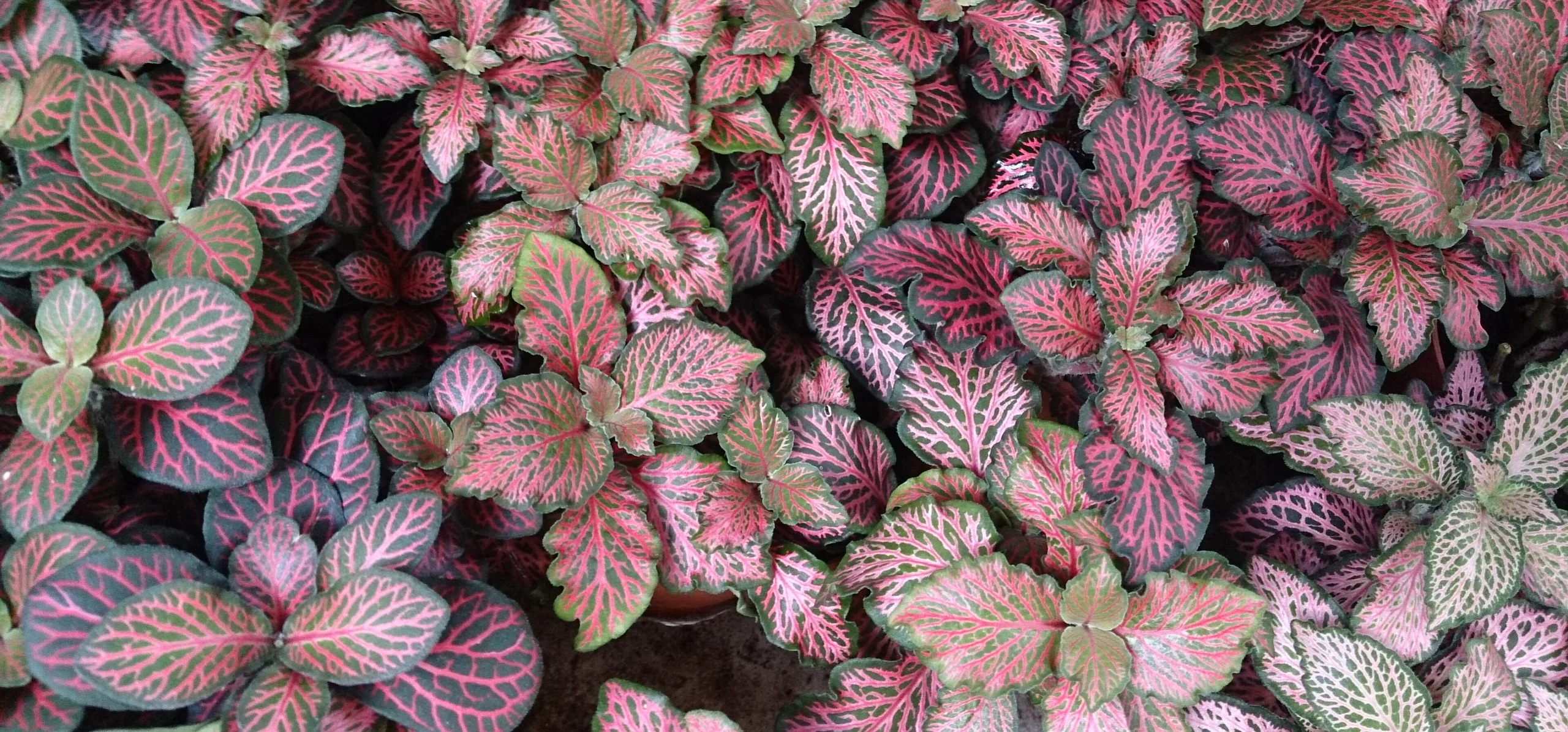
Nearly every fittonia sold today, whatever the pot label says, belongs to the same species, Fittonia albivenis, split into two horticultural groups by vein color rather than by botany. The Verschaffeltii Group carries pink to red veins branching across deep olive green leaves, while the Argyroneura Group carries white veins on the same dark green background; smaller, more compact selections of the white veined form are sometimes sold as the Nana or Mini Group. Older names still printed on plant tags, Fittonia verschaffeltii and Fittonia argyroneura among them, are now treated as synonyms of Fittonia albivenis rather than separate species, along with several nineteenth century names such as Eranthemum rubronervium once used for the red veined form.
Propagation: stem cuttings root in water
This species roots easily from tip cuttings taken with three or four leaf pairs, one of the most forgiving propagation methods among common houseplants. Cut just below a node, strip the lowest leaf pair so no foliage sits in the water, and stand the cutting in a small glass on a bright windowsill out of direct sun; new white roots usually appear from the submerged node within one to two weeks. Pot the rooted cutting into a barely damp mix once the roots reach a centimeter or two, and keep humidity high while it settles in, since a fresh cutting faints just as readily as a mature plant if the new mix is allowed to dry out.
Cold sensitivity, pests and pet safety
The RHS rates this species H1A, meaning it needs to stay indoors or under glass year round and never drop below about 15 degrees Celsius; a cold draft from an opened window in winter causes the same collapse as a dry pot, so ruling out a chilly spot is worth doing before assuming pests. Spider mites, favored by the same dry, heated air that stresses the leaves, and mealybugs are the pests most likely to appear, while a cold, damp pot can develop grey mold on the lower leaves. On the safety side, the ASPCA lists the nerve plant as non-toxic to cats, dogs and horses, so a curious pet that chews a leaf risks nothing worse than mild, short lived stomach upset.
Test your plant knowledge
Tap a card to flip it and reveal the answer.
Fittonia albivenis leaves wilt flat when the soil dries out, then usually stand back up within an hour or two of watering. Tap to reveal ✓ True
This plant does best on a south facing windowsill in full, direct sun. Tap to reveal ✕ False
Fittonia albivenis is a popular choice for closed terrariums because it needs very high humidity. Tap to reveal ✓ True
The nerve plant is considered toxic to cats and dogs if chewed. Tap to reveal ✕ False
Pinching out the growing tips helps the plant branch and stay compact instead of growing leggy. Tap to reveal ✓ True
Sources
References consulted for this guide
- Fittonia albivenis (Lindl. ex Veitch) Brummitt, GBIF Backbone Taxonomygbif.org
- Fittonia albivenis (Lindl. ex Veitch) Brummitt, Plants of the World Online (Kew)powo.science.kew.org
- Fittonia albivenis Verschaffeltii Group, mosaic plant, RHS Plantsrhs.org.uk
- Nerve Plant, Toxic and Non-Toxic Plants, ASPCA Animal Poison Controlaspca.org
- Fittonia albivenis (Argyroneura Group), Missouri Botanical Garden Plant Findermissouribotanicalgarden.org
- Reference entity : Wikipédiaen.wikipedia.org