Mexican Petunia
Ruellia simplex
Family · Acanthaceae
Mexican petunia grows fast, self-seeds freely, and is invasive in parts of the southern US. Here is how to enjoy its purple blooms while keeping it contained.
Ruellia simplex
Plant profile
- WateringModerateWater every 7 days
- Light exposurePartial sun
- Hardiness zoneUSDA 8–10
Growth
- Family
- Acanthaceae
- Life cycle
- Perennial
- Growth speed
- 8/10
- Mature size
- 90–120 cm
- Spread
- 60–90 cm
- Flowering
- Late spring through fall, one-day blooms
- Propagation
- Seed
- Cutting
- Division
DormancyFoliage dies back at first hard frost; roots regrow from the base in spring within its hardiness range
Time to maturityFlowers within the first growing season
Soil & climate
- Soil pH
- pH 5.5–8
- Soil types
- Clay, Loam, Sand, Organically rich
- Drought tolerance
- Yes
Light & Placement
- Origin
- Mexico to Tropical America
- Where to place it
- Sunny mixed border
- Poolside bed
- Contained bed away from ponds or canals
- Large container, 14 to 16 inches across, to confine spreading roots
Safety
- Toxicity
- Not evaluated by the ASPCA (not-listed)
Invasive speciesListed as a Category I invasive species by the Florida Exotic Pest Plant Council; spreads by rhizome and prolific self-seeding
Data fromRuellia simplex C.Wright, GBIF Backbone Ruellia simplex C.Wright, Plants of the Ruellia simplex, NC State Extension GardRuellia simplex, UF/IFAS Center for AquaMexican Petunia, University of Arkansas
Where it grows
World distribution
Mexican Petunia is native to 21 countries: Antigua & Barbuda, Argentina, Bolivia, Brazil, Cayman Islands, Costa Rica, Cuba, and Dominican Republic….GBIF records 20,021 documented identifications across 140 countries, with the largest concentrations in United States, Mexico, and Brazil.
- Antigua & Barbuda
- Argentina
- Bolivia
- Brazil
- Cayman Islands
- Costa Rica
- Cuba
- Dominican Republic
- Ecuador
- Guatemala
- Haiti
- Honduras
Show 9 more countriesShow fewer countries
- Jamaica
- Mexico
- Panama
- Paraguay
- Peru
- Puerto Rico
- St. Lucia
- Trinidad & Tobago
- Uruguay
Yellow to orange dots: concentration of documented identifications per country. Green countries: sourced native range. Source: GBIFNative range from POWO (Kew).
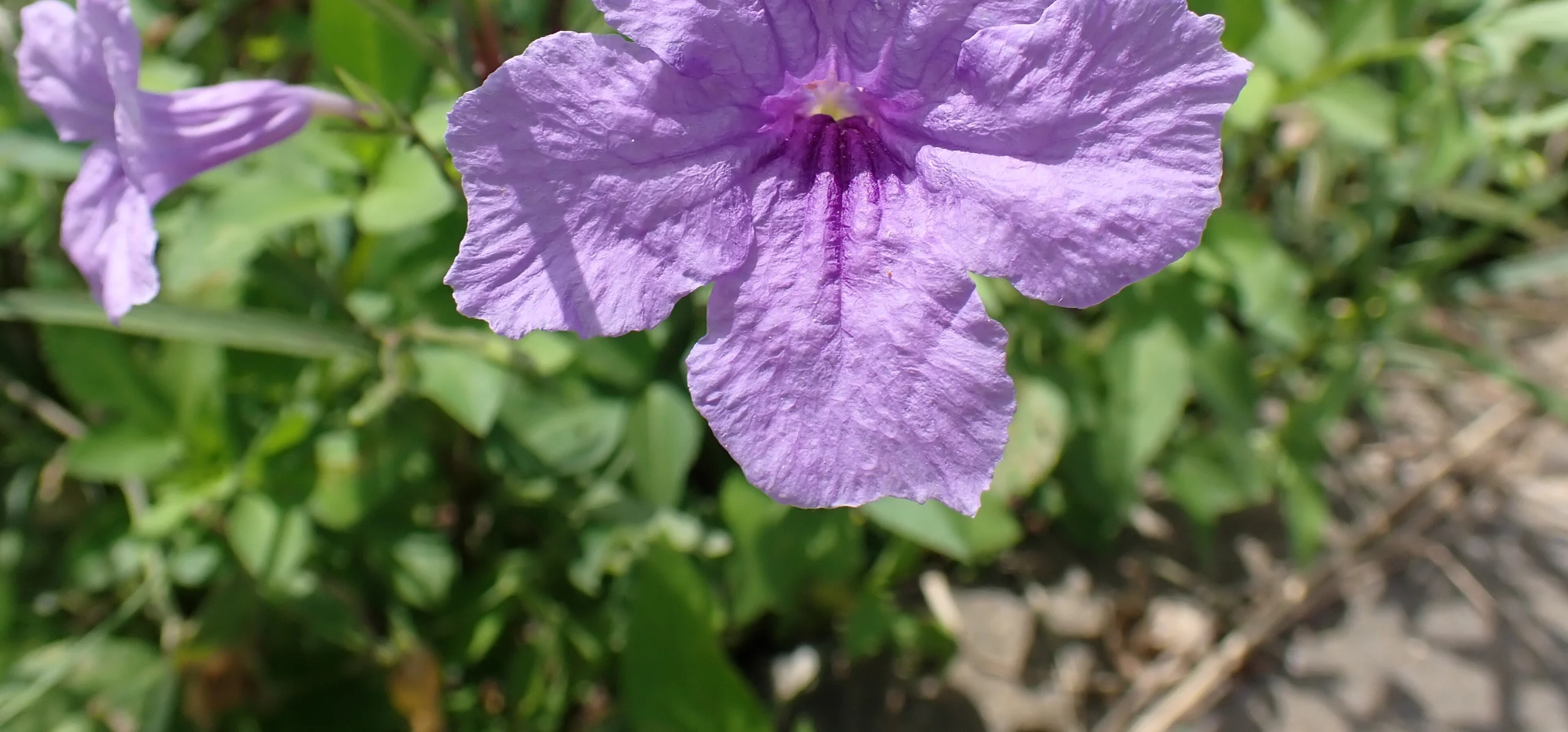
Ruellia simplex earns its keep with funnel-shaped purple flowers that open fresh every morning and close by mid-afternoon, repeating the show daily from late spring into fall. It tolerates heat, drought, and poor soil better than almost anything else in a border, which is exactly why it has become a problem plant in parts of the Gulf South: the straight species self-seeds and spreads by rhizome so readily that the Florida Exotic Pest Plant Council lists it as a Category I invasive. Before you plant it, decide whether you want the aggressive standard form or one of the slower, sterile cultivars, and plan from day one to keep it out of natural areas.
Choosing a Variety That Won't Escape the Garden
The straight species, sold as Ruellia simplex or under its old name Ruellia brittoniana, is the tall, three to four foot form responsible for most of the wild colonies reported along ditches and wetland edges in Florida, Texas, and Hawaii. Nurseries also carry the dwarf cultivar 'Katie', which tops out around 6 inches and spreads far more slowly, and the sterile Mayan series ('Mayan Purple', 'Mayan Pink', 'Mayan White') bred at the University of Florida specifically to stop seed production. If your property borders a canal, pond, or wooded lot, a sterile cultivar or the dwarf form is the responsible choice; the tall standard form is best reserved for contained beds well away from waterways.
Light and Site Selection
Full sun produces the densest flowering and the most compact habit. Mexican petunia also grows in partial shade, roughly two to six hours of direct light, but stems stretch and flower count drops noticeably the further it sits from full sun. It handles reflected heat from pavement and south-facing walls without scorching, which makes it a common choice for poolside beds and parking-lot islands in warm climates, another reason it escapes cultivation so easily near infrastructure that connects to open land.


Watering and Drought Tolerance
Once established, Ruellia simplex is extremely heat and drought tolerant and will flower through dry spells that wilt less resilient perennials. It also accepts consistently moist to occasionally wet soil, which is why it naturalizes so readily along pond margins and drainage ditches. In a typical border, water new plantings two to three times a week for the first month, then taper to once a week or less; established clumps in average garden soil rarely need supplemental water except during extended drought.
Soil and Planting
This species is unfussy about soil chemistry, growing acceptably in acid, neutral, and alkaline conditions, and it adapts to clay, loam, or sandy ground as long as there is at least some organic matter. Amend heavy clay with compost at planting time to improve early root establishment, but do not expect soil pH to limit growth the way it does for more particular perennials. Space plants 18 to 24 inches apart; given the rapid growth rate, tighter spacing fills in within a single season.
Keeping It in Bounds
Because the standard form spreads by both rhizome and explosive seed dispersal, the single most effective control measure is deadheading spent flower spikes before seed pods form, which in practice means checking plants every few days during peak bloom. Confining roots in a large container, at least 14 to 16 inches across, stops rhizome spread entirely and is a good compromise if you love the flower but garden near a waterway. Where clumps have already spread beyond the bed, dig out the fleshy rhizomes rather than mowing or cutting, since fragments left in the soil resprout readily.
Winter Care and Frost Dieback
Mexican petunia is winter hardy in USDA zones 8a through 10b. Foliage blackens and collapses at the first hard frost, but the root system survives underground within that range and sends up fresh growth once soil warms in spring. Cut the frozen top growth back to a few inches after the last hard freeze rather than mid-winter, since the dead stems offer the crown some insulation. Gardeners in zone 7 sometimes overwinter it with a heavy mulch layer, though survival is not guaranteed outside the mapped range.
Propagation
Stem cuttings root within one to two weeks in water or moist potting mix and are the fastest way to bulk up a planting or share a favorite color form without relying on seed. Division of established clumps works equally well in early spring, just before new growth starts. Seed germinates readily without any cold stratification, which is convenient for propagation but is also the mechanism behind its spread into wild areas, so dispose of seed heads in household trash rather than a compost pile or green-waste bin.
Pests and Problems
Ruellia simplex has no serious, recurring insect pests and few disease issues under normal garden conditions; occasional reports of southern blight (Sclerotium rolfsii) appear in warm, humid, poorly drained sites. The bigger practical problem gardeners run into is not a pest but the plant's own vigor: clumps that seemed well behaved for a year or two can suddenly colonize an entire bed once conditions turn favorable, so an annual check for seedlings well beyond the original planting is worth the five minutes it takes.
Test your plant knowledge
Tap a card to flip it and reveal the answer.
Mexican petunia flowers open in the morning and close by mid-afternoon. Tap to reveal ✓ True
Ruellia simplex needs consistently soggy soil to survive. Tap to reveal ✕ False
The standard form of Ruellia simplex is listed as a Category I invasive species by the Florida Exotic Pest Plant Council. Tap to reveal ✓ True
Ruellia simplex is only winter hardy in tropical zones 11 and above. Tap to reveal ✕ False
Growing Mexican petunia in a large container helps stop it from spreading by rhizome. Tap to reveal ✓ True
Sources
References consulted for this guide
- Ruellia simplex C.Wright, GBIF Backbone Taxonomygbif.org
- Ruellia simplex C.Wright, Plants of the World Online (Kew)powo.science.kew.org
- Ruellia simplex, NC State Extension Gardener Plant Toolboxplants.ces.ncsu.edu
- Ruellia simplex, UF/IFAS Center for Aquatic and Invasive Plants Archiveplants-archive.ifas.ufl.edu
- Mexican Petunia, University of Arkansas Cooperative Extensionuaex.uada.edu
- Reference entity : Wikipédiaen.wikipedia.org