Tulip Tree
Liriodendron tulipifera
Family · Magnoliaceae
Liriodendron tulipifera grows 24 to 37 m tall in USDA zones 4 to 9; site it well clear of structures for its weak wood, in full sun on moist, acidic soil.
Liriodendron tulipifera
Plant profile
- WateringModerateWater every 7 days
- Light exposurePartial sun
- Hardiness zoneUSDA 4–9
Growth
- Family
- Magnoliaceae
- Life cycle
- Perennial
- Growth speed
- 8/10
- Mature size
- 2438–3658 cm
- Spread
- 914–1829 cm
- Flowering
- Cup-shaped yellow-green flowers with an orange band, May into early June
- Propagation
- Seed
- Grafting
Dormancydeciduous, bare in winter
Time to maturityreaches full landscape size in roughly 20 to 50 years
Soil & climate
- Soil types
- loam, silt
- Drought tolerance
- No
Light & Placement
- Origin
- S. Ontario to N. Central & E. U.S.A.
- Where to place it
- Large open lawn or parkland with room for a 24 to 37 m crown
- Well clear of the house, driveway, patio, and power lines
Safety
- Toxicity
- CatsSafe
- DogsSafe
- HorsesSafe
Data fromGBIF Backbone Taxonomy: Liriodendron tulPlants of the World Online (Kew): LiriodRHS: Liriodendron tulipifera (tulip treeNorth Carolina Extension Gardener Plant ASPCA: Toxic and Non-Toxic Plants, Tulip
Where it grows
World distribution
Tulip Tree is native to 2 countries: Canada and United States.GBIF records 84,287 documented identifications across 57 countries, with the largest concentrations in United States, Canada, and United Kingdom.
- Canada
- United States
Yellow to orange dots: concentration of documented identifications per country. Green countries: sourced native range. Source: GBIFNative range from POWO (Kew).
A young Liriodendron tulipifera bought as a bare root whip or a container grown sapling needs a permanent site chosen for the tree it becomes, not the tree it is now: on decent ground it reaches roughly 24 to 37 m (80 to 120 ft) tall with a 9 to 18 m (30 to 60 ft) spread, and it grows fast enough to outgrow a first impression within a decade. The wood is notably weak for a tree this size, so siting it well clear of the house, power lines, and anywhere a falling limb would matter is the single decision that saves the most trouble later. It tolerates USDA zones 4 through 9 and asks for full sun and moist, acidic, well drained soil; get those two things right at planting and the tree does most of the rest of the work itself. What it will not forgive is a low, compacted, or permanently soggy spot, or a summer of drought once it is established.
Choosing a Site for a Fast-Growing Giant
Liriodendron tulipifera is not a tree for a small city plot or a border close to the house. NC State Extension lists it as reaching 80 to 120 ft (24 to 37 m) in height with a 30 to 60 ft (9 to 18 m) spread at maturity, typically on a single straight trunk with little branching low down. The wood is comparatively weak and brittle for a tree of this size, and NC State Extension flags it as prone to limb breakage in wind and ice; plant it well away from the house, garage, driveway, and power lines, and leave enough open ground that a large falling limb decades from now is a landscaping inconvenience rather than a hazard. Its shallow root system also limits what will grow well in the deep shade beneath a mature crown, so plan the space underneath as lawn or open ground rather than a flower bed.
Origin, Growth Habit, and Mature Size
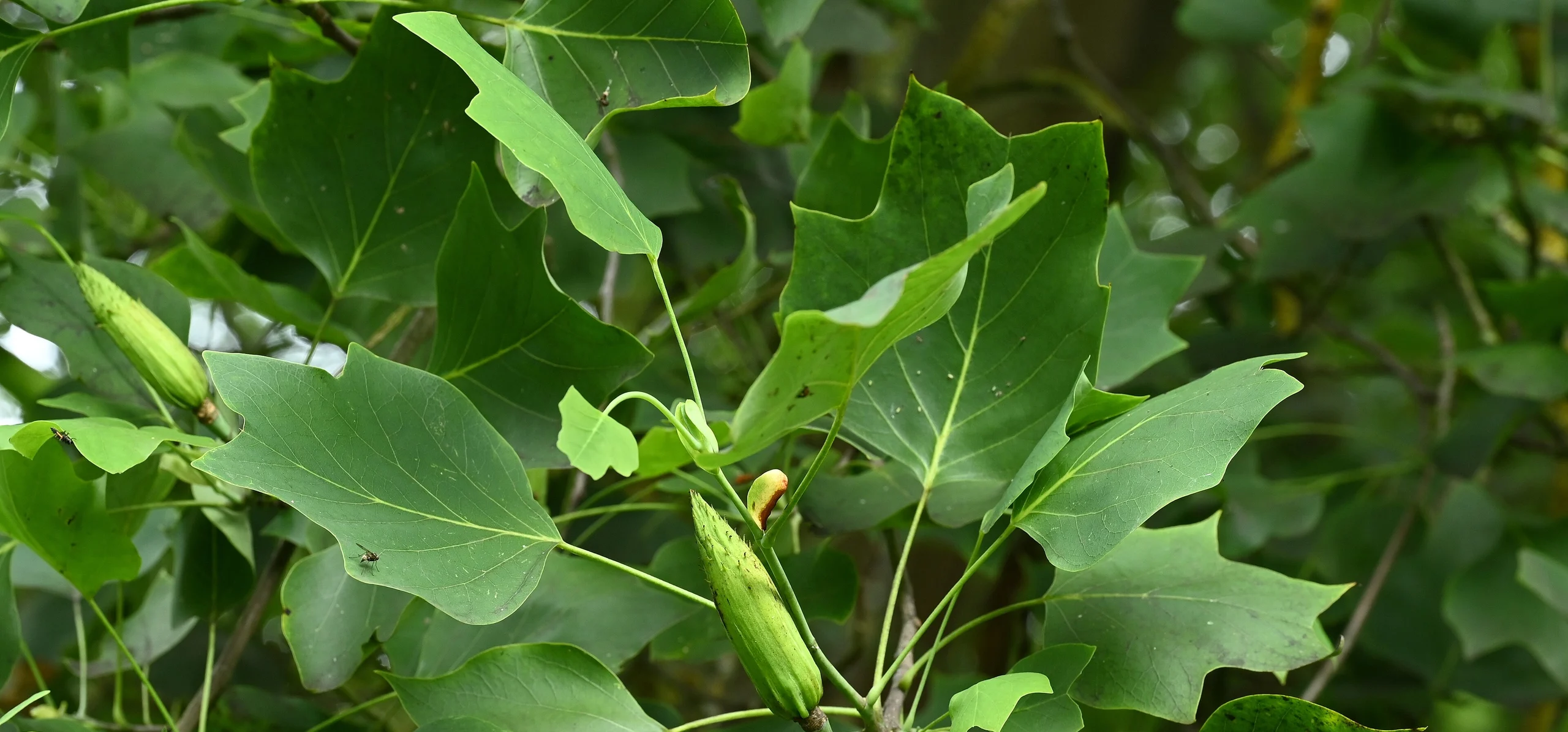
The species is native from southern Ontario south through the north-central and eastern United States, from New England down to Florida and Louisiana, according to Plants of the World Online (Kew). In the wild it grows as a canopy tree in mixed deciduous forest, rising as a straight, largely branch-free column before opening into a narrow, pyramidal crown; open-grown trees branch lower and develop a broader, more rounded shape. NC State Extension rates its growth rate as rapid, and RHS lists a time to ultimate height of roughly 20 to 50 years, faster than an oak but not as quick as a poplar planted purely for shade. The distinctive four-lobed leaves, about 5 to 6 in (13 to 15 cm) across, are glossy bright green through summer and turn a clear golden yellow in autumn, one of the more reliable fall colour displays among large shade trees.
Soil, Planting, and pH
NC State Extension lists loam or silt as the preferred soil texture, with good drainage and an acidic pH under 6.0; RHS adds that clay and sandy soils are tolerated too, provided the ground stays moist without waterlogging. Dig the planting hole at least twice the width of the root ball, loosen compacted sides so roots are not forced to circle, and set the trunk flare level with the surrounding grade. Avoid low spots that collect runoff: standing water around the roots is one of the more common ways a newly planted tulip tree fails in its first year or two. Full sun for six or more hours a day gives the straightest trunk and the densest crown; RHS notes it will also tolerate partial shade, though growth is slower and the habit looser.


Watering Through Establishment and Drought Stress
For the first one to two growing seasons, water deeply and regularly so the root ball and surrounding soil stay moist but not saturated; a young tulip tree that dries out in its first summer rarely recovers well. Once established it copes with normal seasonal rainfall in most temperate climates, but NC State Extension notes it is sensitive to heat and drought, and a stressed tree will yellow and drop leaves early, sometimes by midsummer, as a way of cutting its own water loss. During any extended dry spell in the first three to five years, give the root zone a slow, deep soak rather than a quick surface sprinkle, and mulch out to the drip line to hold soil moisture and keep the shallow roots cooler.
Flowers, Pollinators, and Wildlife Value
The flowers that give the tree its name open from May into early June: cup-shaped, roughly 1.5 to 2 in (4 to 5 cm) across, with six greenish-yellow petals marked by a reddish-orange band near the base. NC State Extension notes they often go unnoticed on a large tree because they open after the leaves are fully out and sit high in the canopy, more visible from an upstairs window than from the ground. Hummingbirds, bees, and butterflies feed on the nectar, and the species serves as a larval host plant for the Eastern Tiger Swallowtail, Spicebush Swallowtail, and Viceroy. Flowers are followed by brown, cone-like clusters of samaras, 2 to 3 in (5 to 7.5 cm) long, that mature in autumn and separate individually through winter, spinning away on the wind well beyond the parent tree's canopy.
Pests, Diseases, and Storm Damage
Aphids and scale insects are the most common pests, feeding on leaves and stems, and in the case of aphids, dropping sticky honeydew onto whatever sits beneath the canopy; this is reason enough on its own to avoid siting the tree directly over a patio or parked car. NC State Extension lists verticillium wilt, powdery mildew, leaf spot, and canker among the diseases to watch for; verticillium wilt in particular causes sudden wilting and dieback of individual branches and has no cure once established, so prune out and destroy affected limbs promptly. The bigger long-term risk is structural: the weak, brittle wood means storm damage and occasional limb loss are a normal part of owning a mature specimen, not a sign that something has gone wrong, which is exactly why siting it well clear of structures matters more than it would for a tougher-wooded tree.
Propagation
Seed is the species' natural method, though NC State Extension notes germination is slow, and like many temperate tree seeds it needs a period of cold, moist stratification over winter before it will sprout; results from one seed lot to the next can still be uneven. Named forms selected for leaf variegation, a narrower fastigiate habit, or rounded leaf lobes are propagated by grafting onto seedling rootstock rather than grown from seed, since seedlings do not come true to the parent tree. For a home gardener planting a single specimen tree, buying a container grown or balled and burlapped sapling from a nursery remains far more practical than starting from seed, which suits the species' natural role as a fast, early colonising pioneer tree rather than one bred for easy home propagation.
Test your plant knowledge
Tap a card to flip it and reveal the answer.
Liriodendron tulipifera has notably weak, brittle wood and should be planted well clear of the house and power lines. Tap to reveal ✓ True
The tulip tree's flowers usually go unnoticed because they open before the leaves emerge in early spring. Tap to reveal ✕ False
Liriodendron tulipifera is toxic to cats, dogs, and horses if chewed or eaten. Tap to reveal ✕ False
This tree tolerates full sun as well as partial shade, though growth is slower and the habit looser in shade. Tap to reveal ✓ True
Tulip tree seed germinates quickly and reliably without any cold treatment. Tap to reveal ✕ False
Sources
References consulted for this guide
- GBIF Backbone Taxonomy: Liriodendron tulipifera L.gbif.org
- Plants of the World Online (Kew): Liriodendron tulipifera L.powo.science.kew.org
- RHS: Liriodendron tulipifera (tulip tree)rhs.org.uk
- North Carolina Extension Gardener Plant Toolbox: Liriodendron tulipiferaplants.ces.ncsu.edu
- ASPCA: Toxic and Non-Toxic Plants, Tulip Poplaraspca.org
- Reference entity : Wikipédiaen.wikipedia.org