Southern Magnolia
Magnolia grandiflora
Family · Magnoliaceae
Southern magnolia needs acid to neutral soil, a sheltered site away from cold wind, and only light pruning right after its lemon-scented summer flowers fade.
Magnolia grandiflora
Plant profile
- WateringModerateWater every 10 days
- Light exposurePartial sun
- Ideal temperature-23–38 °C
- Hardiness zoneUSDA 6–10
Growth
- Family
- Magnoliaceae
- Life cycle
- Perennial
- Growth speed
- 5/10
- Mature size
- 1800–2400 cm
- Spread
- 900–1500 cm
- Propagation
- Seed
- Cutting
- Grafting
FloweringCup-shaped, lemon-scented white flowers 20 to 30 cm across, late spring through summer
Dormancyevergreen, minimal winter dormancy
Time to maturityreaches full size in 20 to 50 years
Soil & climate
- Soil pH
- pH 5.5–6.5
- Soil types
- clay, loam, sand
- Saline soil
- Tolerated
- Drought tolerance
- Yes
Light & Placement
- Origin
- Southeastern United States, from North Carolina to Florida and west into Texas
- Where to place it
- specimen tree
- trained against a sheltered wall
- screening in mild climates
- large tub for compact cultivars such as 'Kay Parris' or 'Little Gem'
Safety
- Toxicity
- Not listed by the ASPCA; status undocumented rather than confirmed safe
- Pet safe
- No
Invasive speciescan self-seed and naturalize outside its native range in warm, humid climates
Data fromGBIF Backbone Taxonomy: Magnolia grandifPlants of the World Online (Kew): MagnolRHS: Magnolia grandiflora (evergreen magNC State Extension Gardener Plant ToolboClemson Cooperative Extension HGIC: Magn
Where it grows
World distribution
Southern Magnolia is native to a single country: United States.GBIF records 22,795 documented identifications across 76 countries, with the largest concentrations in United States, France, and Colombia.
- United States
Yellow to orange dots: concentration of documented identifications per country. Green countries: sourced native range. Source: GBIFNative range from POWO (Kew).
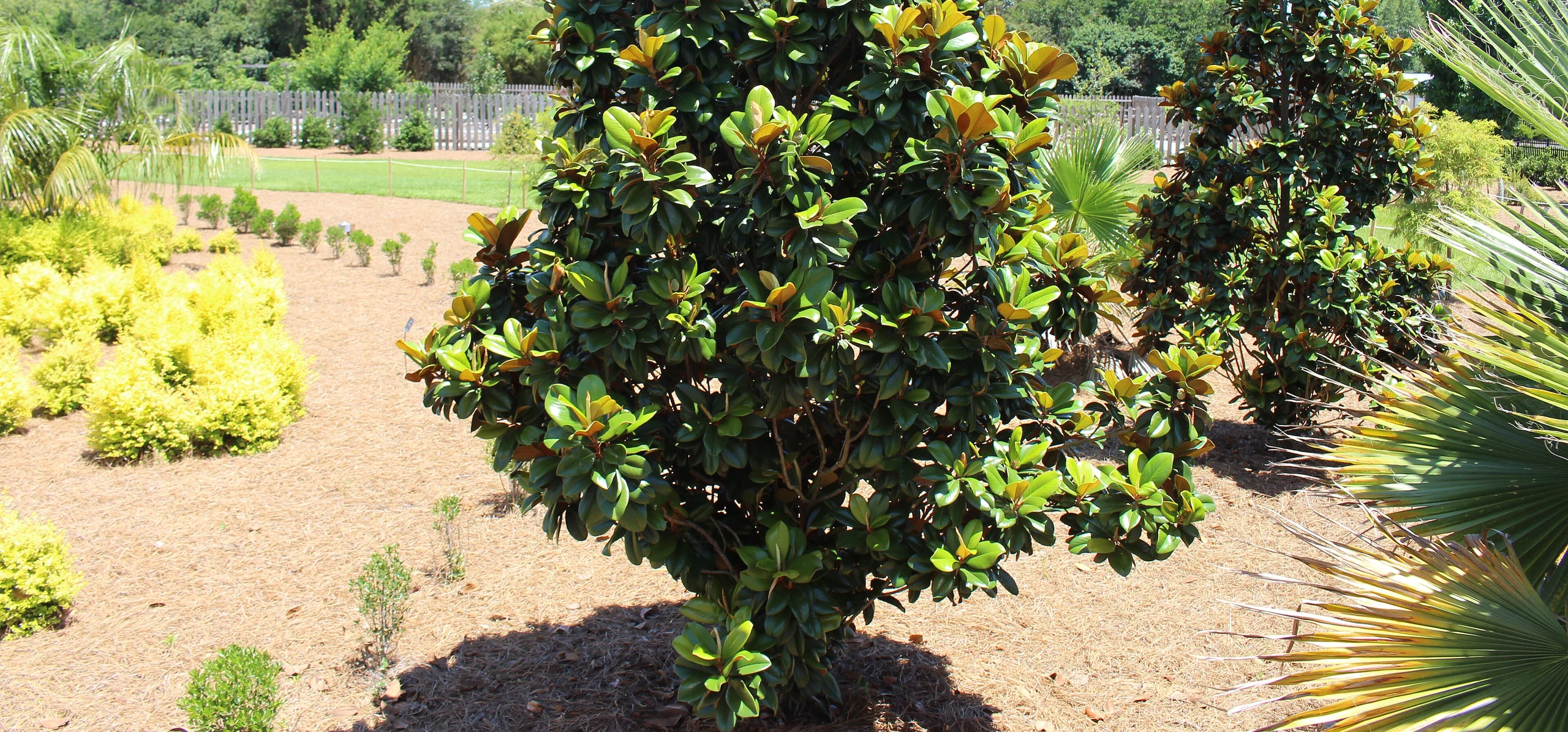
A young Southern Magnolia with a single leader, glossy dark leaves and a rust-brown felted underside already shows the two features that identify Magnolia grandiflora at any age: no other broadleaf evergreen pairs that texture with cup-shaped, lemon-scented white flowers up to 30 cm across. Left alone in its native southeastern United States it becomes a dense pyramidal tree 18 to 24 metres tall; trained against a sheltered wall in a cooler European garden, or grown as a compact cultivar such as 'Little Gem', the same species stays a manageable large shrub. The trade-offs that come with the size are a shallow, wide-spreading root system that rules out underplanting, a steady year-round drop of tough leathery leaves, and real sensitivity to cold, drying wind on an exposed site. Get the site, the soil pH and the pruning timing right and Magnolia grandiflora asks for very little else.
Origin, Family and the Rusty-Felted Leaf
The GBIF Backbone Taxonomy accepts the name Magnolia grandiflora L., in the family Magnoliaceae, order Magnoliales, class Magnoliopsida. Plants of the World Online (Kew) gives its native range as SE. U.S.A. to Texas, and North Carolina State Extension narrows that further: the wild population runs through the warm, humid coastal plain from North Carolina south to Florida and west into Texas. The surest identification point is the underside of the leaf, described by NC State Extension as leathery, persistent and carrying a rusty-brown, felted (tomentose) coating, a texture no other commonly planted evergreen magnolia shares to the same degree. Two of its older synonyms, Magnolia ferruginea and Magnolia foetida, both point at that same rust colour and at the heavy scent released when a leaf is crushed.
Size: An 18-Metre Tree Down South, a Wall Shrub Further North
NC State Extension lists a mature height of 60 to 80 feet (about 18 to 24 m) with a 30 to 50 foot spread, reached at a medium growth rate; form varies a great deal between seedlings, from narrowly pyramidal to broad and low-branched. Grown in the UK, the RHS records a slower pace: over 20 to 50 years a free-standing plant typically reaches just over 12 m tall with a spread over 8 m, still a substantial tree but well short of the Gulf Coast maximum. That gap between native-range size and cooler-climate size is exactly why the species is planted two ways: as a specimen tree where summers are long and hot, and as a wall-trained shrub or compact cultivar everywhere the growing season runs shorter.
Choosing a Compact Cultivar
| Cultivar | Approx. size | Why grow it |
|---|---|---|
| 'Little Gem' | 20 to 35 ft tall, about 10 ft wide | Narrow habit, smaller leaves, flowers young |
| 'Kay Parris' | About 20 ft tall, 10 to 15 ft wide | RHS-listed for a sunny wall, tolerates some shade |
| 'Teddy Bear' | About 20 ft tall, 12 ft wide | Dense, rounded habit for a foundation planting |
| 'Bracken's Brown Beauty' | Compact, smaller leaves than the species | Winter hardy to USDA zone 6, more reliable in cold gardens |
Clemson Cooperative Extension and NC State Extension both single out 'Little Gem', 'Kay Parris' and 'Teddy Bear' as genuinely smaller plants rather than a young seedling of the species that will eventually reach full size; 'Bracken's Brown Beauty' is grown less for its footprint than for reliably surviving winters that would damage a straight seedling.


Planting: Spring, Full Sun and a Sheltered Site
University of Florida IFAS Extension recommends transplanting in winter or spring and warns that recovery is slow because the wide-spreading root system does not take well to disturbance; loosening or removing circling roots at planting time is worth the extra minutes. The RHS grows Magnolia grandiflora in full sun to part shade, favouring a sheltered south-, west- or east-facing aspect over an open, wind-exposed one. Leave real room around the trunk: UF IFAS describes the root system as spreading from the trunk a distance equal to about four times the width of the canopy, well beyond the branch tips, which is reason enough to keep new plantings clear of paths, drains and foundations rather than judging clearance by the size of the young tree in front of you.
Soil, Mulching and Why Nothing Grows Underneath
Clemson Cooperative Extension calls for rich, porous, well-drained soil with a pH of 5.5 to 6.5, though the species tolerates a slightly more alkaline, wet or clay soil without real difficulty; UF IFAS separately rates its tolerance of aerosol salt as high, which is part of why it is planted so widely near the US coast. NC State Extension is blunt about what happens underneath a mature specimen: nothing will grow there. Dense year-round shade, the wide mat of surface roots and a steady carpet of tough, slow-to-rot leaves between them make a flower bed or lawn under the canopy a losing battle; a mulch ring that simply covers the bare soil, rather than an underplanting scheme, is the practical answer.
Pruning and Training Against a Warm Wall
Both RHS and Clemson Cooperative Extension recommend pruning right after flowering rather than in winter, removing only badly placed or damaged shoots; the RHS files a free-standing plant under pruning group 9 and a wall-trained one under group 13, since large cuts on this species heal poorly and are best avoided altogether by shaping the plant while it is young. The RHS rates Magnolia grandiflora H5, hardy through most of the UK, but that rating assumes a reasonably sheltered spot: a broad-leaved evergreen loses water through its foliage all winter, and on an open site, cold, drying wind can pull moisture out of the leaves faster than frozen roots can replace it, scorching the leaf margins brown by spring. Training the plant flat against a warm wall, the classic UK treatment, both adds a few degrees of shelter and turns that same wind sensitivity into a non-issue.
Flowers, Fragrance and the Cone-Like Fruit
NC State Extension records cup-shaped, creamy white flowers 8 to 12 inches (about 20 to 30 cm) across, opening mainly from late spring through summer with occasional flowers into autumn; the scent is famously heavy and citrus-toned, carrying a long way on a still, warm evening. Pollinated flowers develop into fuzzy, cone-like fruiting structures 3 to 8 inches long, ripening from around September into November, when the segments split to expose bright red to red-orange seeds that hang briefly on slender threads before birds take them. Those threads are worth pointing out to anyone who has never seen a magnolia fruit up close: the seed does not simply fall, it dangles in the open air for a day or two first.
Pests, Sooty Mould and Everyday Leaf Litter
Clemson Cooperative Extension lists several armoured and soft scale insects, among them false oleander scale, tea scale and scurfy scale, as the main pest problem, causing yellowing and leaf drop where populations build up and often leaving a sticky honeydew that sooty mould then grows on; horticultural oil applied in late winter or early summer is the extension's standard control. Algal leaf spot shows up in humid climates, and UF IFAS adds twig girdler and black twig borer as occasional wood-boring problems, though none of these typically call for routine chemical treatment. The day-to-day nuisance is simpler than any pest: this is an evergreen that still drops leaves in both fall and spring, and the fallen leaves are thick, leathery and slow to break down, so raking or mulching them is a recurring task rather than a one-off autumn clean-up. On pet safety, Magnolia grandiflora itself is not listed by the ASPCA's toxic or non-toxic plant database; only a different species, Magnolia stellata (sold as Magnolia Bush), appears there, rated non-toxic to cats, dogs and horses, so treat the Southern Magnolia's status as undocumented rather than confirmed safe.
Test your plant knowledge
Tap a card to flip it and reveal the answer.
Magnolia grandiflora's cone-like fruit splits open to reveal bright red to red-orange seeds hanging on slender threads. Tap to reveal ✓ True
The RHS recommends hard, structural pruning of Southern Magnolia every winter to keep it compact. Tap to reveal ✕ False
A mature Southern Magnolia's dense shade and shallow roots make underplanting with a flower bed or lawn impractical. Tap to reveal ✓ True
'Little Gem' and 'Kay Parris' are compact cultivars bred to stay smaller than the straight species. Tap to reveal ✓ True
The ASPCA lists Magnolia grandiflora specifically as non-toxic to cats and dogs. Tap to reveal ✕ False
Sources
References consulted for this guide
- GBIF Backbone Taxonomy: Magnolia grandiflora L.gbif.org
- Plants of the World Online (Kew): Magnolia grandiflora L.powo.science.kew.org
- RHS: Magnolia grandiflora (evergreen magnolia)rhs.org.uk
- NC State Extension Gardener Plant Toolbox: Magnolia grandifloraplants.ces.ncsu.edu
- Clemson Cooperative Extension HGIC: Magnoliahgic.clemson.edu
- Reference entity : Wikipédiaen.wikipedia.org