Pomegranate
Punica granatum
Family · Lythraceae
Punica granatum fruits only where summers run long and hot; elsewhere it still flowers freely. Covers splitting, suckers, wall training and 'Nana' in pots.
Punica granatum
Plant profile
- WateringModerateWater every 6 days
- Light exposureFull sun
- Ideal temperature-12–-5 °C
- Hardiness zoneUSDA 6–10
Growth
- Family
- Lythraceae
- Life cycle
- Perennial
- Growth speed
- 5/10
- Mature size
- 150–600 cm
- Spread
- 150–600 cm
- Propagation
- Cutting
FloweringFunnel shaped, bright scarlet flowers 3-4cm across in summer; fruit needs a long hot summer and warm autumn to ripen
Dormancydeciduous, leafless through winter dormancy
Time to maturityMay flower and set one or two fruits the first year after planting; bears well after about three years in the ground
Soil & climate
- Soil pH
- pH 5.5–7
- Soil types
- loam, sand, chalk
- Saline soil
- Partially tolerated
- Drought tolerance
- Yes
Light & Placement
- Origin
- NE. Turkiye to W. and N. Pakistan
- Where to place it
- Bright, cool room or unheated greenhouse for overwintering a potted dwarf 'Nana' outside its hardy zone
- Full sun against a south or west facing wall for the most reliable fruit ripening
- Open, hot, sheltered spot in mild or coastal gardens
- Free draining, loam based potting compost
Safety
- Toxicity
- No dedicated ASPCA listing for Punica granatum
- Pet safe
- No
Data fromPunica granatum, GBIF Backbone TaxonomyPunica granatum L., Plants of the World RHS: Punica granatumClemson HGIC: Pomegranate (Punica granatUC IPM: Pomegranate, Home and Landscape
Where it grows
World distribution
Pomegranate is native to 9 countries: Afghanistan, Georgia, Iran, Iraq, Pakistan, Russia, Tajikistan, and Türkiye….GBIF records 52,294 documented identifications across 189 countries, with the largest concentrations in France, Spain, and Italy.
- Afghanistan
- Georgia
- Iran
- Iraq
- Pakistan
- Russia
- Tajikistan
- Türkiye
- Turkmenistan
Yellow to orange dots: concentration of documented identifications per country. Green countries: sourced native range. Source: GBIFNative range from POWO (Kew).
A pomegranate arriving as a small potted shrub, sometimes still carrying a shrivelled fruit from the nursery tag, raises one immediate question: will it actually fruit here, or is this strictly an ornamental in this climate. GBIF's accepted name for the species is Punica granatum L., recorded under the English vernacular names Pomegranate and Pomegranate Tree; the genus holds only one other species, Punica protopunica, endemic to the island of Socotra. Ripening a full crop needs a long, hot summer and a warm autumn. Short of that, the same shrub still earns its place for scarlet summer flowers and bronze tinted new growth, so deciding which outcome to expect changes where you plant it and how much you worry when fruit is thin.
Fruit Needs a Long, Hot Summer
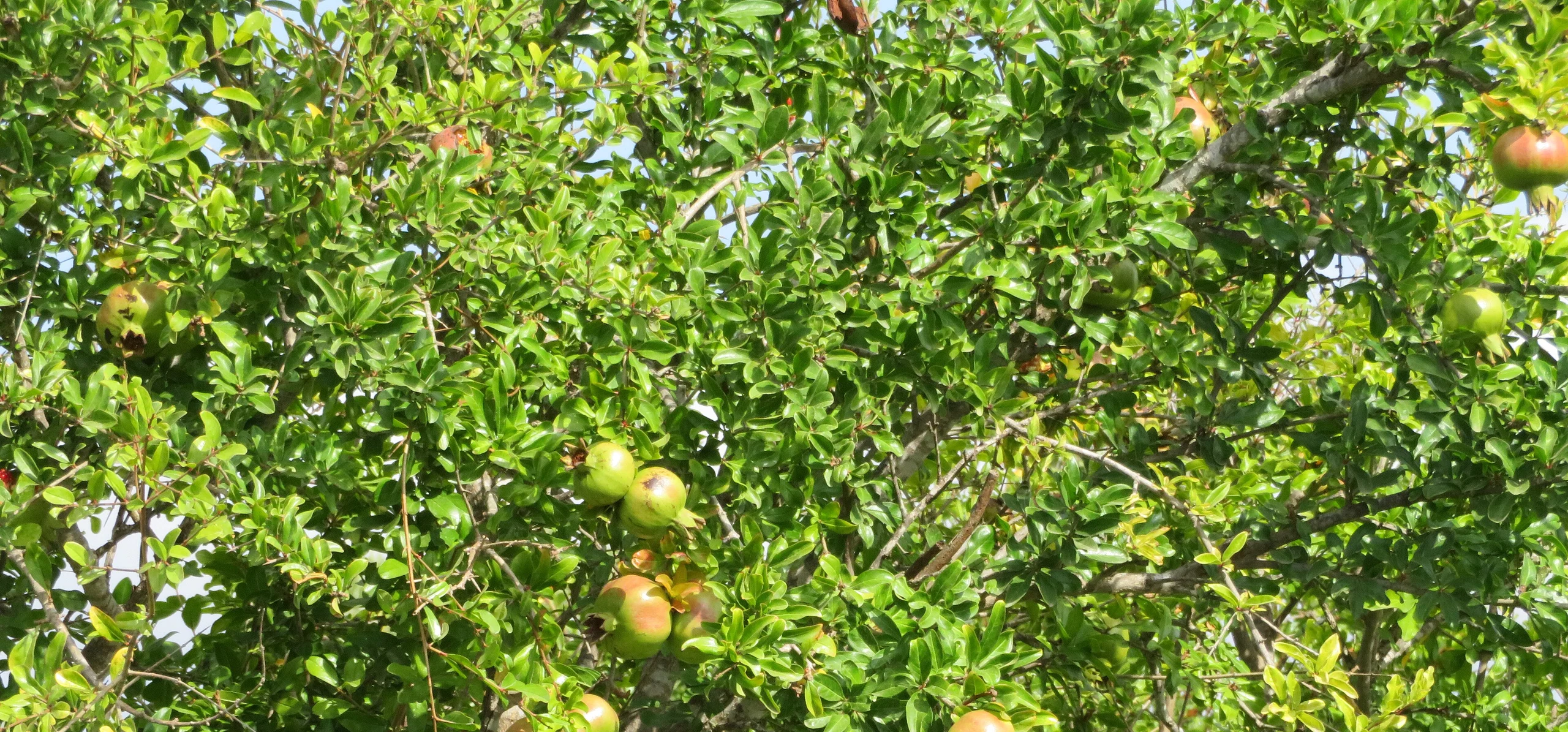
The RHS is specific about the threshold: fruit needs high autumn temperatures, roughly 13 to 16C, to finish ripening, and across most of Britain the crop rarely completes outdoors for exactly that reason. In a climate with a genuinely long, hot growing season, a pomegranate against a sunny wall sets and ripens fruit reliably most years. In a cooler or shorter summer climate, plant it for the flowers and glossy foliage instead, and treat any fruit that swells and colours as a bonus rather than the goal. Trying to force a crop with extra feeding or water will not substitute for the heat the fruit itself needs to finish.
Choosing a Variety: 'Wonderful' and Dwarf 'Nana'
'Wonderful' is the cultivar behind most fresh pomegranates sold in shops, prized for large, deep red fruit with juicy arils, and it is the standard choice where summers are hot enough to ripen it fully. Where cold is the limiting factor rather than heat, extension sources point to the Russian series, cultivars such as 'Salavatski' bred for cold hardiness up to zone 6, at some cost to fruit size and flavour compared with 'Wonderful'. Dwarf 'Nana' is a different proposition altogether: a genuinely miniature form, its whole plant, leaves, flowers and fruit all scaled down, that stays compact enough for a windowsill pot or a bonsai training pot rather than a garden bed, flowering and setting small, mostly ornamental fruit even indoors. It will not replace 'Wonderful' at the table, but it is the pomegranate to choose when the space on offer is a container, not a border.


Full Sun Against a Wall
Outside its hot native range, a pomegranate wants the warmest, sunniest spot the garden has: full sun all day, and ideally a south or west facing wall that stores daytime heat and releases it overnight, extending the effective growing season by several crucial degrees. The RHS rates the species H3, meaning it survives outdoors reliably only in mild, coastal or sheltered gardens, or against exactly this kind of warm wall elsewhere; open ground in a colder, exposed spot pushes it toward the ornamental only outcome described above. Soil matters less than aspect: Punica granatum tolerates chalk, loam and sand equally well as long as drainage is good, and it is not fussy about pH within a fairly wide acid to alkaline range.
Watering and Why Fruit Splits
Established plants are genuinely drought tolerant, a trait several extension sources single out, and a mature pomegranate in the ground can go through a dry spell with little more than reduced growth. The problem comes from swinging between extremes while fruit is on the plant: a dry stretch followed by heavy rain or a deep watering pushes water into the fruit faster than the rind can expand, and the fruit splits open along its side, wasting the crop and inviting rot. Even, moderate watering through flowering and fruit swell, backed by a layer of mulch to buffer the soil against rapid drying, keeps that supply steady. In containers the margin for error is smaller: compost dries faster than open ground, so check a potted plant more often through hot weather rather than relying on a fixed schedule.
Pruning: Suckers and Thinning
Left alone, pomegranate suckers profusely from the base, and an unpruned plant turns into a dense thicket of thin stems within a few seasons. Extension guidance is to remove these basal suckers routinely, as soon as they appear, rather than let them multiply and crowd the framework you actually want to keep. Beyond suckering, prune before spring growth resumes: light, annual thinning that opens up the centre of the shrub improves air movement and lets more of the interior wood catch the sun that ripens fruit, since flowers and fruit form mainly on two and three year old wood rather than on the current season's whips. Cutting a plant back hard rather than thinning it removes exactly the wood most likely to fruit next.
Cold Hardiness Once Established
A young or newly planted pomegranate is more tender than its reputation suggests, but a well rooted specimen is hardier than most gardeners expect. Clemson Cooperative Extension places pomegranate in USDA zones 8 to 10, extending to zone 7b with winter protection, a threshold that works out to roughly -12C: below that, the top growth is commonly killed back to the ground, but an established root system usually survives and resprouts the following spring. That resilience is specific to plants that have had at least a full season to root in; a pomegranate still in its first winter in the ground, or one left in a pot outdoors, does not have the same buffer and should be given a sheltered spot or moved under cover when hard frost threatens.
Fruit Drop in Young Trees, Pests and Diseases
A newly planted pomegranate flowering in its first year is not unusual, but Clemson notes it typically sets only one or two fruits at that stage, with reliable, heavier bearing arriving after about three years in the ground; much of what a young plant sets in between drops before it matures, simply because the plant is not yet large enough to carry a full crop to ripeness. On the pest side, UC IPM lists leaffooted bugs, mealybugs, scale insects and whiteflies as the invertebrates most likely to turn up, alongside two diseases, Armillaria root rot and botrytis blight, both linked more to poor drainage and overly damp conditions than to the plant itself. None of this is usually severe: Clemson describes pomegranate as relatively trouble free overall, with occasional leaf and fruit spotting in humid weather that rarely needs treatment.
Deciduous Habit and Autumn Colour
Punica granatum is deciduous, dropping its narrow, glossy leaves for a leafless winter dormancy in any climate with a real cold season, and it is not a plant to expect year round foliage from outside the mildest gardens. Before they fall, the leaves typically turn a clear yellow, a display extension sources note as a genuine autumn feature in its own right rather than an afterthought to the fruit or flowers. New leaves reappear bronze tinted in spring before greening up and hardening off, echoing the same bronze new growth that makes even a non fruiting plant worth a spot in full sun.
Test your plant knowledge
Tap a card to flip it and reveal the answer.
A well rooted pomegranate can shrug off a brief drop to about -12C (10F), even though the branches above ground are killed back to the base. Tap to reveal ✓ True
The RHS rates Punica granatum H3, meaning it survives UK winters outdoors reliably only in mild, sheltered gardens or against a warm wall. Tap to reveal ✓ True
In a cool, temperate summer, a wall trained pomegranate reliably ripens a full crop of fruit even without unusually hot weather. Tap to reveal ✕ False
Left unpruned, pomegranate stays as a single clean trunk and rarely produces suckers from its base. Tap to reveal ✕ False
Fruit that splits open on the tree is usually the result of irregular watering, such as a dry spell followed by a heavy soak. Tap to reveal ✓ True
Sources
References consulted for this guide
- Punica granatum, GBIF Backbone Taxonomygbif.org
- Punica granatum L., Plants of the World Online, Kew Sciencepowo.science.kew.org
- RHS: Punica granatumrhs.org.uk
- Clemson HGIC: Pomegranate (Punica granatum), How to Grow, Care for, and Enjoy in South Carolinahgic.clemson.edu
- UC IPM: Pomegranate, Home and Landscapeipm.ucanr.edu
- Reference entity : Wikipédiaen.wikipedia.org