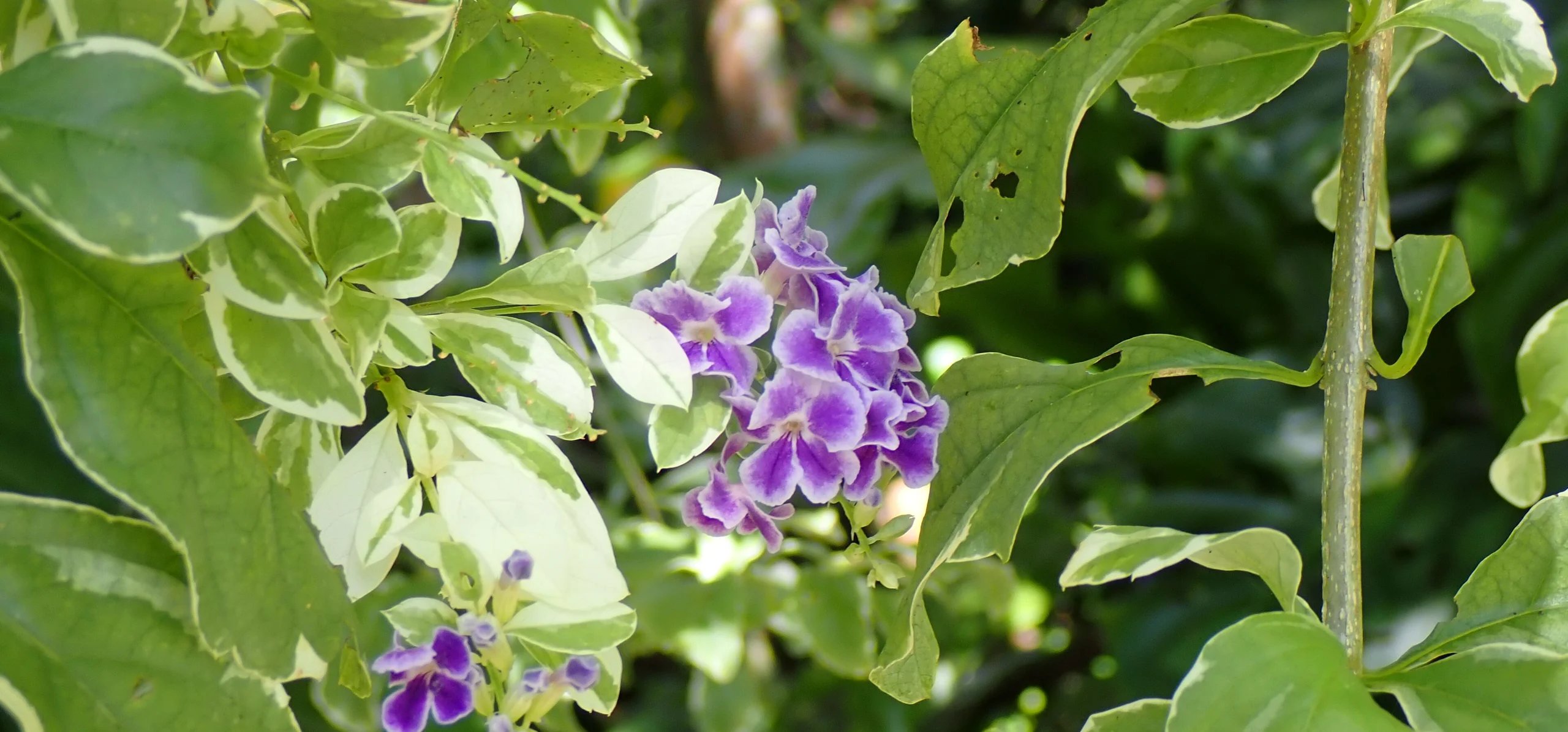
Golden Dewdrop
Duranta erecta
Family · Verbenaceae
Duranta erecta needs full sun, medium watering, and protection below USDA zone 10. It flowers blue-violet to white and forms golden berry clusters.
Duranta erecta
Plant profile
- WateringModerateWater every 7 days
- Light exposureFull sun
- Hardiness zoneUSDA 10–11
Growth
- Family
- Verbenaceae
- Life cycle
- Perennial
- Mature size
- 61–549 cm
- Spread
- 30–61 cm
- Flowering
- Blue-violet to white blooms, summer into fall
DormancyEvergreen, no true dormancy
Soil
- Soil types
- well-draining, fertile, moist
Light & Placement
- Origin
- Mexico to N. South America, Caribbean, S. Florida
- Where to place it
- Bright sunroom
- Sunniest window
- Hedge or border
- Trained as small standard
- Large container, moved indoors for winter
Safety
- Toxicity
- Not listed by the ASPCA; treat as unverified
- Pet safe
- No
Invasive speciesHigh invasion risk in Florida (UF/IFAS)
Data fromGBIFPlants of the World Online (Kew)Missouri Botanical GardenRHSUF/IFAS Assessment
Where it grows
World distribution
Golden Dewdrop is native to 24 countries: Antigua & Barbuda, Bahamas, Cayman Islands, Colombia, Costa Rica, Cuba, Dominican Republic, and El Salvador….GBIF records 19,450 documented identifications across 160 countries, with the largest concentrations in Mexico, United States, and Brazil.
- Antigua & Barbuda
- Bahamas
- Cayman Islands
- Colombia
- Costa Rica
- Cuba
- Dominican Republic
- El Salvador
- French Guiana
- Guatemala
- Guyana
- Haiti
Show 12 more countriesShow fewer countries
- Honduras
- Jamaica
- Mexico
- Myanmar (Burma)
- Nicaragua
- Panama
- Puerto Rico
- St. Lucia
- Suriname
- Trinidad & Tobago
- United States
- Venezuela
Yellow to orange dots: concentration of documented identifications per country. Green countries: sourced native range. Source: GBIFNative range from POWO (Kew).
Duranta erecta lands in most gardens already labeled Golden Dewdrop, and the name comes straight from what happens after the flowers fade: loose clusters of yellow-orange berries that hang on the stems like drops of gold well into autumn. In its native range it grows into a sprawling, thorny shrub or small tree reaching 4.5 to 5.5 m, but the plant sold at nurseries outside the tropics is almost always a pruned, container-friendly version kept between 60 cm and 1.2 m. Before anything else, check your climate zone: this is a plant built for USDA zones 10 to 11, and it will not survive an outdoor frost without protection.
Native Range and What Kind of Plant You Have
Plants of the World Online lists the native range of Duranta erecta as Mexico to northern South America, spreading through the Caribbean and into southern Florida. The Missouri Botanical Garden confirms the same broad picture, from Florida to Brazil and across the West Indies, with its own record of the species growing 15 to 18 feet (4.5 to 5.5 m) tall as a spreading, sometimes weeping shrub or small tree in that native habitat. Mature stems carry sharp axillary thorns, though young growth and most nursery-grown plants stay thornless until the wood hardens in its second or third year. The species belongs to the verbena family, Verbenaceae, and stays evergreen year-round, with light green, oval leaves rarely longer than 5 cm.
Light and Placement
Full sun is the baseline recommendation from the Missouri Botanical Garden, and it is the difference between a plant that flowers hard from summer into fall and one that sits green with few blooms. Light shade is tolerated, useful for a spot that only gets sun part of the day, but every hour lost to shade shows up later as fewer flower clusters. Outdoors, that means a south or west-facing bed or the sunniest side of a patio. Indoors or under glass over winter, push the pot as close to a bright window or sunroom as possible, since low indoor light is the fastest way to turn a flowering shrub into a leggy green stick.
Watering
The Missouri Botanical Garden rates Duranta erecta a medium water need, which in practice means keeping the soil moist through the growing season without letting a container sit in standing water.
How often to water your Golden Dewdrop
A newly potted or newly planted specimen needs more frequent checks until roots fill the container or bed. Once established, let the top few centimetres of soil dry between waterings, then increase frequency again during hot, dry stretches, when a full-sun position can pull moisture out of a pot within a day or two.
Soil and Potting
Moist, fertile, well-drained soil is what the Missouri Botanical Garden lists as ideal, and the species otherwise tolerates a wide range of soil types, part of why it shows up as a hedge plant across so many tropical and subtropical gardens. In containers, use a standard fertile potting mix with enough grit or perlite to keep water moving through rather than pooling around the roots, and choose a pot with real drainage holes: this is not a plant that forgives a saucer of standing water for more than a day.
Pruning and Training as a Hedge or Standard
The Missouri Botanical Garden lists Duranta erecta's typical uses as hedge, border plant, lawn specimen, or trained into a small standard tree in warm climates, and pruning is what makes all three possible. Because thorns appear mainly on older, mature wood, wear gloves once you are cutting back growth from a second season or later, even if the young stems handled at planting time were smooth. Shape after a flowering flush rather than before it: flowers form on new growth, and cutting back too early simply removes the buds that were about to open.
Overwintering Outside Zones 10 and 11
Winter hardiness stops at USDA zone 10, and the Missouri Botanical Garden's own growing notes describe container culture everywhere colder: bring the pot indoors before the first frost and keep it in a bright sunroom or the sunniest window available until temperatures are reliably above freezing again. Growth slows indoors over winter regardless of light, so ease off watering to match, and expect the plant to pick back up quickly once it returns outside in spring.
Flowers and the Golden Berries
Flower clusters open light blue, violet, or white, hanging in drooping racemes at the tips and joints of the stems through summer and into fall. They give way to the yellow-orange drupes that earned the plant its common name: dense, drooping clusters that stay showy on the stem well after the flowers themselves are gone. The ASPCA does not currently list Duranta erecta, or any of its common names (golden dewdrop, pigeon berry, skyflower), on its toxic or non-toxic plant lists, so there is no confirmed pet-safety verdict either way. Treat the berries as off-limits for pets and children until that changes: showy is not the same as verified safe to eat.
Pests and Its Invasive Streak in Florida
Pest pressure is genuinely low: the Missouri Botanical Garden reports no serious insect or disease problems beyond the occasional whitefly, a short list compared to most flowering shrubs. The bigger caution is regional rather than horticultural. The University of Florida's IFAS Assessment scores Duranta erecta as a high invasion risk across north, central, and south Florida, already naturalized in counties from Escambia to Miami-Dade, and does not recommend planting it there. Gardeners outside Florida rarely face that restriction, but it is worth a quick check of local invasive plant lists before adding this one to a hedge row, especially anywhere with a similar subtropical climate.


Test your plant knowledge
Tap a card to flip it and reveal the answer.
Mature Duranta erecta stems develop sharp thorns near the leaf joints. Tap to reveal ✓ True
This shrub survives outdoor winters below USDA zone 10 without protection. Tap to reveal ✕ False
Its flowers are always pure white. Tap to reveal ✕ False
The ASPCA has published a toxicity verdict for Duranta erecta. Tap to reveal ✕ False
UF/IFAS has assessed Duranta erecta as a high invasion risk in Florida. Tap to reveal ✓ True
Sources
References consulted for this guide
- GBIF - Duranta erectagbif.org
- Plants of the World Online (Kew) - Duranta erectapowo.science.kew.org
- Missouri Botanical Garden - Duranta erectamissouribotanicalgarden.org
- RHS - Duranta erectarhs.org.uk
- UF/IFAS Assessment - Duranta erectaassessment.ifas.ufl.edu
- Reference entity : Wikipédiaen.wikipedia.org