Common Buckthorn
Rhamnus cathartica
Family · Rhamnaceae
Identify Rhamnus cathartica by its thorn-tipped twigs and orange inner bark, understand why it is banned in several states, and remove it for good.
Rhamnus cathartica
Plant profile
- WateringModerateWater every 10 days
- Light exposurePartial sun
- Hardiness zoneUSDA 3–7
Growth
- Family
- Rhamnaceae
- Life cycle
- Perennial
- Growth speed
- 8/10
- Mature size
- 549–914 cm
- Spread
- 457–610 cm
- Flowering
- Small yellow-green flowers in spring, glossy black berries by late summer
- Propagation
- Seed
DormancyDeciduous, winter dormant
Time to maturityFlowers and fruits within a few years of establishment
Soil & climate
- Soil pH
- pH 6–8
- Soil types
- clay, loam, sand
- Drought tolerance
- Yes
Light & Placement
- Origin
- Europe to Xinjiang, northwest Syria and northwest Africa
- Where to place it
- Not recommended, invasive: do not plant
Safety
- Toxicity
- HumansToxic
Invasive speciesClassified as invasive or restricted across many northeastern and midwestern US states and several Canadian provinces; alternate host for oat crown rust and overwintering host for the soybean aphid
Data fromGBIF: Rhamnus cathartica L.Plants of the World Online (Kew): RhamnuNC State Extension Gardener Plant ToolboMissouri Botanical Garden Plant Finder: Iowa State University Extension: Common
Where it grows
World distribution
Common Buckthorn is native to 38 countries: Albania, Algeria, Austria, Belarus, Belgium, Bulgaria, China, and Croatia….GBIF records 290,200 documented identifications across 61 countries, with the largest concentrations in France, United Kingdom, and United States.
- Albania
- Algeria
- Austria
- Belarus
- Belgium
- Bulgaria
- China
- Croatia
- Czechia
- Denmark
- Estonia
- Finland
Show 26 more countriesShow fewer countries
- France
- Georgia
- Germany
- Greece
- Hungary
- Iran
- Ireland
- Italy
- Kazakhstan
- Kyrgyzstan
- Lebanon
- Morocco
- Netherlands
- Norway
- Poland
- Portugal
- Romania
- Russia
- Spain
- Sweden
- Switzerland
- Tajikistan
- Türkiye
- Ukraine
- United Kingdom
- Uzbekistan
Yellow to orange dots: concentration of documented identifications per country. Green countries: sourced native range. Source: GBIFNative range from POWO (Kew).
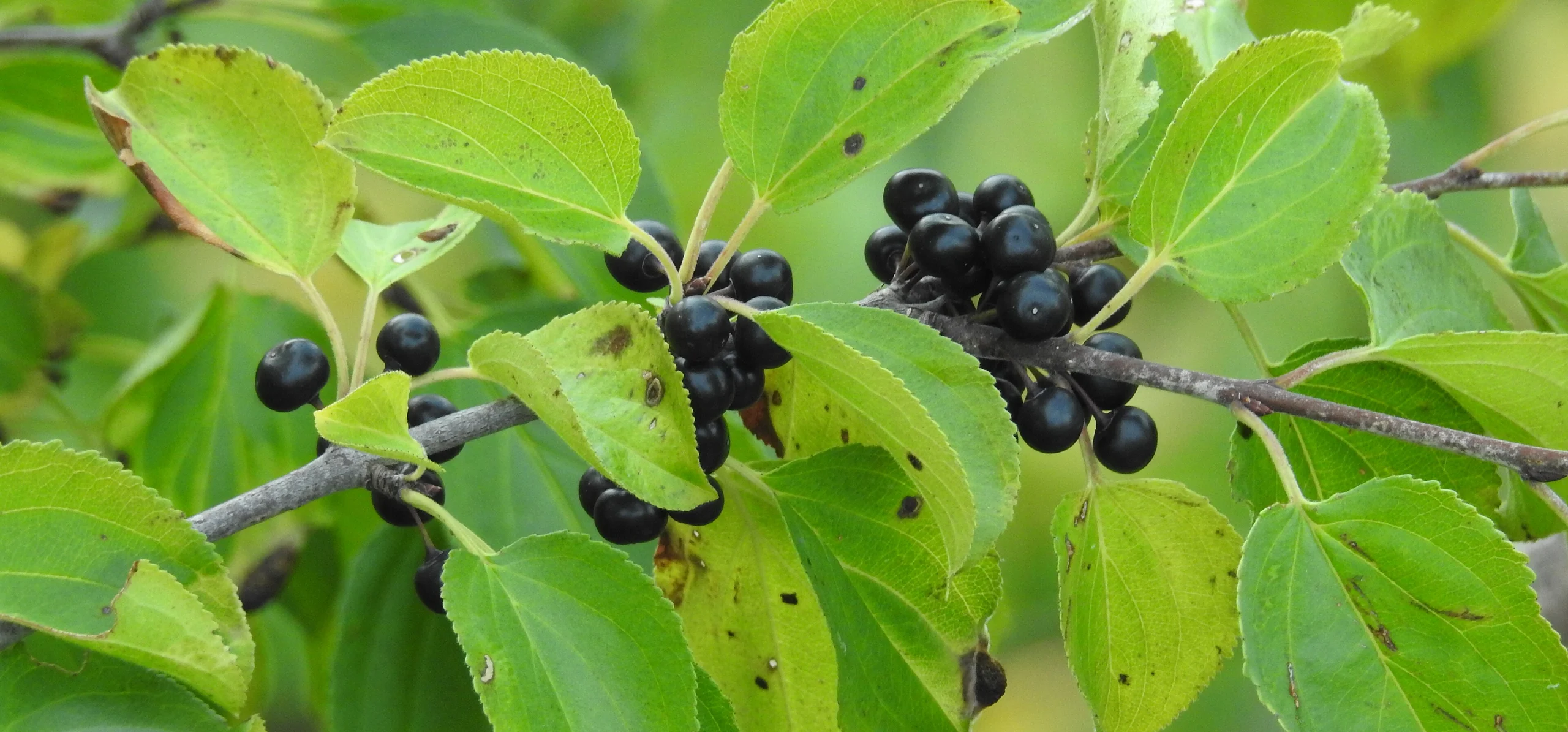
A shrub with glossy, finely toothed leaves, dark bark dotted with pale lenticels, and clusters of pea-sized black berries hanging from thorn-tipped twigs is very likely Rhamnus cathartica, common buckthorn. It was planted by the thousand as a hedge and windbreak across the northern United States and Canada in the 1800s and has since become one of the most aggressive invasive shrubs in the region, banned from sale in several states and listed as a noxious weed in many more. This guide covers how to identify it correctly against its lookalikes, why it spreads so fast, and how to remove it so it actually stays gone, because cutting the trunk down on its own is the single move most likely to make the problem worse.
Origin and How It Reached North America
Common buckthorn is native to a broad swath of Europe and western Asia, reaching east to Xinjiang and northwest Syria and south into northwest Africa. European settlers brought it to North America in the early 1800s specifically because it made a tough, dense hedge that tolerated pruning and poor soil without complaint. That same toughness let it slip out of gardens and windbreaks into open woods, fencerows and field edges, and it is now naturalized and expanding across the northeastern and midwestern United States as well as southern Canada, far beyond where anyone still plants it on purpose.
Identification: Leaves, Bark, Thorns and Berries
Leaves sit sub-oppositely to alternately along the stem, elliptical, 1 to 3 inches long, with finely toothed margins and 3 to 5 pairs of curved veins running toward the tip. They are dark, glossy green through summer, turn yellow in autumn, and are one of the last things to drop in the fall garden. The bark is dark brown to gray and peels in patches on older stems, speckled with vertical light-colored lenticels; slice into it and the inner bark and cambium show as a distinctive orange to yellow-orange layer, the fastest confirmation available. Most branch tips end in a small, sharp thorn. The plant is dioecious, so male and female flowers grow on separate shrubs: small, four-petaled, yellowish-green flowers open in spring in tight clusters at the leaf axils. Only female plants set fruit, glossy black drupes a quarter to half an inch wide holding 2 to 4 seeds, ripening from late summer into fall and eaten readily by birds.
Common Buckthorn vs Glossy Buckthorn and Native Lookalikes
Glossy buckthorn (Frangula alnus), a close relative and fellow invader, has leaves in strictly alternate arrangement with smooth, untoothed edges and 8 to 9 veins fanning out from the midrib, and its branches never end in a thorn. Native cherries and plums share a similar gray, lenticel-dotted bark and cause frequent misidentification, but their inner bark is not orange and their twigs lack the terminal spine. When in doubt, nick a twig: common buckthorn's bright orange-yellow inner bark, paired with the small terminal thorn and finely toothed sub-opposite leaves, separates it from every native shrub it gets mistaken for.


Why It Outcompetes Native Plants
Common buckthorn leafs out earlier in spring and holds its leaves later into fall than the native trees and shrubs around it, stretching its photosynthetic season on both ends. That extra window lets it shade out spring wildflowers and tree seedlings before they have even unfurled, while its own rapid, thicket-forming growth closes off the understory to almost everything else. Cutting a stem does not end the problem either: buckthorn sprouts vigorously from the stump and root crown, so a single trunk removed the wrong way often comes back as a cluster of new stems. Add a bird population happy to eat and disperse the berries over a wide radius, and one uncontrolled female shrub can seed an entire woodlot within a few seasons.
An Agricultural Problem, Not Just a Garden One
Buckthorn's reach extends into working farmland. It serves as the alternate host required by crown rust of oats (Puccinia coronata) to complete its life cycle, and it is the overwintering host for the soybean aphid, which lays its eggs at the base of buckthorn leaf buds each fall. A hedgerow or fencerow left uncleared near oat or soybean fields is not just an eyesore, it is a reservoir that can raise disease and pest pressure on the crop the following spring, which is why agricultural extension services track and recommend removing it as part of routine field-margin management.
Toxicity: Berries, Leaves and Livestock
The species name cathartica is not decorative: the berries and leaves contain glycosides with a purgative effect, and eating the fruit can cause nausea, vomiting and diarrhea in people, generally rated low severity but unpleasant. Livestock and pets are considered mildly toxic if they graze on it in quantity, so it is worth fencing animals away from a stand you have not yet cleared. The ASPCA does not list common buckthorn in its toxic or non-toxic plant database, so no sourced claim can be made specifically for cats, dogs or horses either way. Birds are unaffected by the berries and are the main reason the seed spreads as far and as fast as it does.
Legal Status and Regulation
Because of how readily it escapes and how much ecological damage a stand does once established, common buckthorn is classified as invasive, restricted or an outright noxious weed across a long list of northeastern and midwestern states, and in several Canadian provinces. In some jurisdictions it is illegal to sell, import, transport or knowingly plant it at all. If you inherited a hedge of it with a property, that history does not create an obligation to remove it overnight, but check your state or provincial noxious weed list before replacing a dead hedge plant with more buckthorn, and do not plant it anywhere out of habit.
How to Remove It Without Making It Worse
The method that actually works pairs cutting with herbicide applied directly to the freshly cut stump, not cutting alone. Fell the stem close to the ground and paint or spray a systemic herbicide onto the exposed cambium ring within minutes, ideally from late summer into fall when the plant is actively moving sugars down into the roots and will carry the herbicide with them. Small-diameter stems can also be treated with a basal bark application without cutting first. Hand-pulling works for seedlings and very young plants, but only when the soil is soft enough to lift the entire root system; any snapped root fragment left behind can resprout. Because seeds stay viable in the soil for years and nearby female shrubs keep reseeding the area, plan on monitoring the site and treating new seedlings and stump sprouts for several growing seasons, not one cleanup and done.
Common Mistakes
The most common error is cutting the shrub down without any herbicide, which reliably turns one trunk into a multi-stemmed thicket within a year. The second is treating in spring, when sugars are moving up into new growth rather than down into the roots, which wastes the herbicide on top growth alone. The third is misidentification in either direction: pulling a native cherry or plum mistaken for buckthorn, or leaving a real buckthorn alone because it was mistaken for one of those or for glossy buckthorn. The fourth is stopping after one season, when a female shrub two properties over, or a seed bank sitting quietly in the soil, keeps producing new seedlings for years after the original stand looked cleared.
Test your plant knowledge
Tap a card to flip it and reveal the answer.
Common buckthorn branches usually end in a small, sharp thorn, unlike the related glossy buckthorn. Tap to reveal ✓ True
Cutting a common buckthorn trunk to the ground is usually enough to kill the plant for good. Tap to reveal ✕ False
Common buckthorn leafs out earlier in spring and holds its leaves later in fall than most native trees. Tap to reveal ✓ True
The ASPCA lists common buckthorn as toxic to cats and dogs. Tap to reveal ✕ False
Common buckthorn can act as an overwintering host for the soybean aphid. Tap to reveal ✓ True
Sources
References consulted for this guide
- GBIF: Rhamnus cathartica L.gbif.org
- Plants of the World Online (Kew): Rhamnus catharticapowo.science.kew.org
- NC State Extension Gardener Plant Toolbox: Rhamnus catharticaplants.ces.ncsu.edu
- Missouri Botanical Garden Plant Finder: Rhamnus catharticamissouribotanicalgarden.org
- Iowa State University Extension: Common Buckthorncrops.extension.iastate.edu
- Reference entity : Wikipédiaen.wikipedia.org