Common Mullein
Verbascum thapsus
Family · Scrophulariaceae
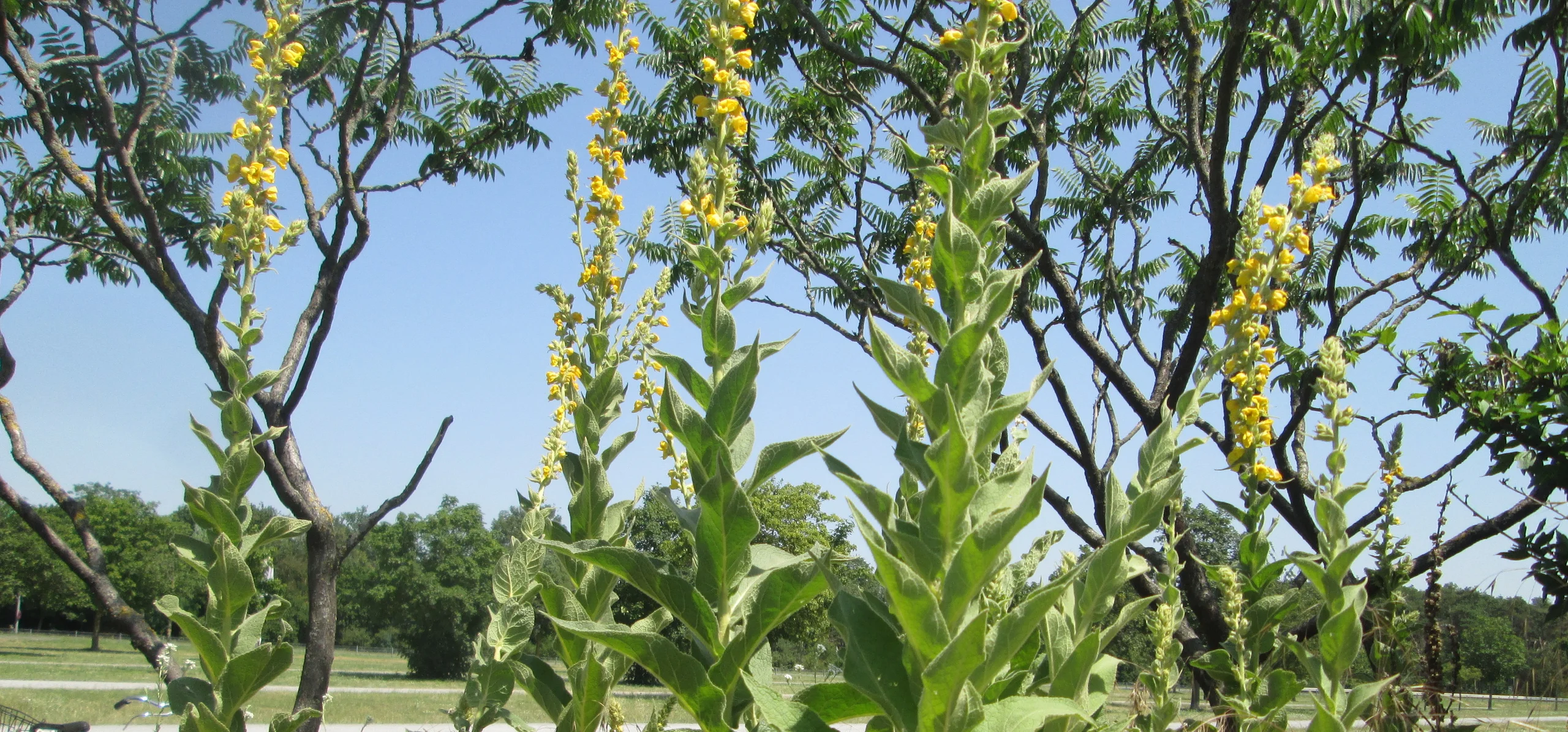
Common mullein forms a rosette in year one, a 2 to 3 metre spike in year two. Poor dry ground, surface sowing, and its noxious-weed status in parts of the US.
Verbascum thapsus
Plant profile
- WateringLittleWater every 14 days
- Light exposureFull sun
- Hardiness zoneUSDA 3–9
Growth
- Family
- Scrophulariaceae
- Life cycle
- Biennial
- Growth speed
- 6/10
- Mature size
- 90–300 cm
- Spread
- 60–90 cm
- Flowering
- Second-year spike, June to September
- Propagation
- Seed
Dormancynone as a bulb or root; overwinters as a semi-evergreen basal rosette through its first winter
Time to maturityforms a basal rosette in year one; sends up a flowering spike in year two, sets abundant seed, then dies
Soil & climate
- Soil pH
- pH 5.5–8
- Soil types
- clay, loam, sand, rocky
- Drought tolerance
- Yes
Light & Placement
- Where to place it
- waste ground and roadside verges
- sand or gravel bank
- sunny dry border
- wildlife or pollinator garden
- large, deep pot with very free-draining, gritty compost, for rosette-stage plants grown on before planting out
OriginAzores and Europe east to Siberia and the Himalaya; naturalized across North America, Australia and Hawaii
Safety
- Pet safe
- No
ToxicityNot listed by the ASPCA for cats, dogs or horses; the felted hairs on leaves and stems are a skin, eye and throat irritant to handle
Invasive specieslisted as a noxious weed in Colorado and Hawaii, and can spread densely enough on disturbed ground outside its native range to crowd out native species
Data fromVerbascum thapsus L., GBIF Backbone TaxoPOWO: Verbascum thapsus L.NC State Extension Gardener Plant ToolboRHS: Verbascum growing guideWisconsin Horticulture Extension: Common
Where it grows
World distribution
Common Mullein is native to 38 countries: Afghanistan, Austria, Belarus, Belgium, Bhutan, China, Croatia, and Czechia….GBIF records 353,029 documented identifications across 94 countries, with the largest concentrations in United States, United Kingdom, and France.
- Afghanistan
- Austria
- Belarus
- Belgium
- Bhutan
- China
- Croatia
- Czechia
- Denmark
- Estonia
- Finland
- France
Show 26 more countriesShow fewer countries
- Georgia
- Germany
- Hungary
- India
- Iran
- Ireland
- Italy
- Kazakhstan
- Kyrgyzstan
- Mongolia
- Nepal
- Netherlands
- Norway
- Pakistan
- Poland
- Portugal
- Romania
- Russia
- Spain
- Sweden
- Switzerland
- Tajikistan
- Türkiye
- Turkmenistan
- Ukraine
- United Kingdom
Yellow to orange dots: concentration of documented identifications per country. Green countries: sourced native range. Source: GBIFNative range from POWO (Kew).
A rosette of enormous, felted grey-green leaves lying flat against bare or gravelly ground in its first year is Verbascum thapsus doing exactly what it should: building the reserves for a single unbranched flower spike that can reach 2 to 3 metres the following summer, then setting tens of thousands of seeds and dying. It is a plant of waste ground, roadsides, sand and gravel banks, not of rich flower beds, and moving it into fertile, moist soil is the most common way to lose it to rot before the spike ever appears. Nothing about growing it is complicated once that two-year, poor-soil habit is respected: full sun, sharp drainage, seed pressed onto bare soil rather than buried, and a decision each year about how much self-seeding to allow.
Choosing Poor, Dry Ground Over a Rich Bed
Great mullein is native from the Azores and Europe east to Siberia and the Himalaya, always turning up on open, disturbed, sun-baked ground rather than in woodland or a damp meadow. The North Carolina State Extension Gardener Plant Toolbox lists it tolerating clay, loam, sand and shallow rocky soil across a pH range from acidic to neutral, and calls it drought tolerant once established, with sharp drainage mattering more than fertility. The RHS's general growing advice for the genus is blunt about the trade-off: verbascums are happy on poor or rocky ground and thrive on chalk, but a rich, moist bed makes the rosette lush and soft, and the flower spike that follows is more likely to rot at the base or need staking than one grown hard on a gravel bank or a sunny strip of waste ground. Full sun for at least six hours is worth insisting on; the plant tolerates a little shade, but the felted rosette stays smaller and the spike leans toward whatever light it can find.
Sowing on the Surface, Not Under a Layer of Compost
Mullein seed needs light to germinate, and the Wisconsin Horticulture Extension is specific that seed lying at or near the soil surface is what comes up, while anything buried in the seed bank simply waits. Scatter it thinly over gritty, free-draining compost or bare disturbed soil, press it down without covering it, and expect germination within two to three weeks in a warm spot. That same light requirement explains why the seed bank under an established colony can be extraordinary: seeds have germinated after 100 years in Michigan State University's long-running Beal seed viability experiment, and a single plant can set 100,000 to 240,000 of them. Digging a new bed or grading a verge years after every visible mullein plant is gone is often enough to bring a fresh flush up from a seed bank nobody knew was there.


Self-Seeding and Managing the Seedlings
Because the flowering rosette dies once it has set seed, a patch only continues if some of that seed is allowed to fall and germinate close by. Most of it does exactly that: dispersal is poor, with the bulk of seed landing within a few feet of the parent plant rather than travelling any distance, so a colony tends to thicken in place rather than roam a garden. Left alone on open ground it self-seeds readily enough to crowd out smaller neighbours; on a bed meant to stay tidy, leave one or two spikes to ripen fully for next year's rosettes and cut the rest back before they shed, then thin whatever seedlings do come up to a hand's width apart so each one bulks into a proper rosette instead of staying weak and crowded.
Mullein Moth Caterpillars and Powdery Mildew
The RHS lists the genus as susceptible to mullein moth caterpillars and powdery mildews, and Verbascum thapsus is the caterpillar's classic wild host plant. Cucullia verbasci lays eggs on the foliage from May to July, and the caterpillars that hatch, boldly marked in white, yellow and black, feed gregariously enough that a first-year rosette can be stripped to its ribs within days rather than weeks. Checking the rosette every few days through late spring and early summer and picking caterpillars off by hand is usually enough, since a plant growing hard on poor, dry ground rarely has the vigour to shrug off total defoliation and regrow. Powdery mildew shows up as the usual pale dusting on leaves in humid, still conditions or on a crowded plant; wider spacing and the same sharp drainage that keeps the roots healthy generally keep it a cosmetic problem rather than a serious one.
Where It Turns Into a Noxious Weed
Common mullein is not native to North America, Australia or Hawaii, and where it has naturalized it can behave very differently from the self-limiting biennial of a European roadside. It is officially listed as a noxious weed in Colorado and in Hawaii, where the state's Division of Forestry and Wildlife also names it one of the most invasive horticultural plants on the islands; introduced to the Kona district in the early 1900s, it has since spread up the slopes of Mauna Kea, Mauna Loa and Haleakala. The North Carolina State Extension notes more broadly that it can grow quickly and densely enough to crowd out native species on disturbed ground. Gardeners outside its native range, especially in the western United States, Hawaii, or similarly dry, open parts of Australia, should check local noxious-weed rules before planting it and should never let a garden colony seed into open wildland.
Torches, Tea and a Long History
The plant's folk names, hag's taper, candlewick plant, torches, come from a genuinely old practice: the dried flowering stalk, dipped in tallow or fat, burns slowly and evenly enough that it was used as a torch in antiquity, and the felted leaves alone have served as lamp wicks. Dried leaves have also long been steeped as a tea in folk herbalism; that is a historical use, not a medical recommendation, and the fine hairs covering every leaf and stem are an irritant to skin, eyes and the throat, so any leaf destined for a cup needs straining through cloth first, and gloves are worth wearing when handling the plant otherwise. Verbascum thapsus does not appear in the ASPCA's toxic and non-toxic plant database at all, which points to it not being a recognized poisoning risk for cats, dogs or horses, but the same coarse hairs that irritate human skin can cause mechanical irritation if a pet chews on the foliage, so it is not a plant to call carelessly safe either.
Pollinators, Goldfinches and Choosing a Garden Form
A flowering spike in full sun draws bees and hoverflies steadily through summer, and the seed heads that follow, left standing rather than cut down in autumn, are a genuine winter food source for finches, which work along a dry stalk long after the flowers themselves are gone. That wildlife value is one reason to grow the true species rather than only its garden hybrids: the RHS's Cotswold Group cultivars, bred from other Verbascum species and hybrids rather than from thapsus itself, top out around a metre in buff, apricot, pink and peach shades and behave as shorter-lived perennials rather than strict biennials, useful where a 2 to 3 metre felted grey spike would overwhelm a border. The species itself is easy to tell from dark mullein, Verbascum nigrum, a shorter plant to around a metre with green rather than grey-felted leaves and flowers marked with purple stamens; Verbascum thapsus stays taller, greyer and plainer yellow throughout.
Test your plant knowledge
Tap a card to flip it and reveal the answer.
Common mullein flowers in its first year from seed. Tap to reveal ✕ False
Mullein seed germinates best when left uncovered on the soil surface. Tap to reveal ✓ True
A mullein seed bank in the soil can still produce seedlings decades after the parent plants are gone. Tap to reveal ✓ True
Common mullein grows best in rich, consistently moist garden soil. Tap to reveal ✕ False
Common mullein is listed as a noxious weed in some US states, including Hawaii. Tap to reveal ✓ True
Sources
References consulted for this guide
- Verbascum thapsus L., GBIF Backbone Taxonomygbif.org
- POWO: Verbascum thapsus L.powo.science.kew.org
- NC State Extension Gardener Plant Toolbox: Verbascum thapsusplants.ces.ncsu.edu
- RHS: Verbascum growing guiderhs.org.uk
- Wisconsin Horticulture Extension: Common Mulleinhort.extension.wisc.edu
- Reference entity : Wikipédiaen.wikipedia.org