
Papaya
Carica papaya
Family · Caricaceae
Carica papaya care: pick a male, female, or hermaphrodite plant, give it full sun and even moisture, and shield the soft trunk from frost below 0C.
Carica papaya
Plant profile
- WateringModerateWater every 4 days
- Light exposureFull sun
- Hardiness zoneUSDA 9–12
Growth
- Family
- Caricaceae
- Life cycle
- Perennial
- Growth speed
- 9/10
- Mature size
- 180–600 cm
- Spread
- 90–450 cm
- Flowering
- Year-round in warmth; male, female, or hermaphrodite flowers
- Propagation
- Seed
Dormancynone; frost-tender
Soil & climate
- Soil types
- rich, well-drained loam, sandy loam, tolerates rocky soil if well drained
- Drought tolerance
- No
Light & Placement
- Origin
- Southern Mexico to Venezuela
- Where to place it
- bright room or greenhouse, winter protection only
- full sun, wind-sheltered garden bed
- large tub, moved under cover before frost
Safety
- Toxicity
- HumansSafe
Invasive speciesself-sows from dropped fruit in warm climates
Data fromGBIFPlants of the World Online (Kew)Missouri Botanical GardenUF/IFAS Gardening Solutions
Where it grows
World distribution
Papaya is native to 10 countries: Belize, Colombia, Costa Rica, El Salvador, Guatemala, Honduras, Mexico, and Nicaragua….GBIF records 29,062 documented identifications across 178 countries, with the largest concentrations in Mexico, United States, and Brazil.
- Belize
- Colombia
- Costa Rica
- El Salvador
- Guatemala
- Honduras
- Mexico
- Nicaragua
- Panama
- Venezuela
Yellow to orange dots: concentration of documented identifications per country. Green countries: sourced native range. Source: GBIFNative range from POWO (Kew).
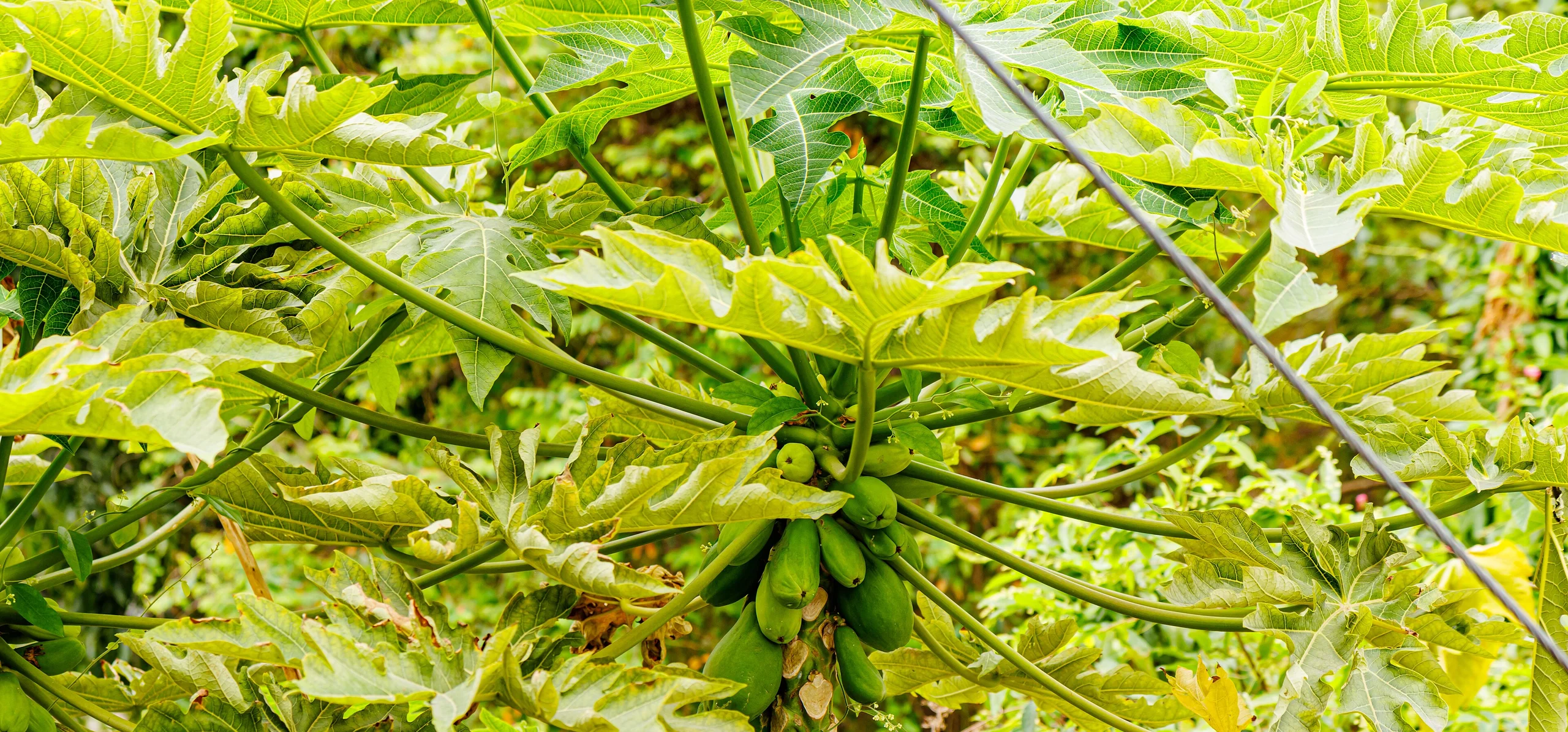
Carica papaya is not, botanically, a tree. Its single unbranched stem never forms true wood, which is why the reference work Hortus Third describes it as a giant herb rather than a woody plant, and that distinction shapes how you grow it: a stem that stays soft and pithy for its entire life cannot take the wind, cold, or waterlogged roots that an actual tree shrugs off. A papaya planted in full sun can reach 1.8 to 6 metres (6 to 20 feet) tall with a spread of roughly 1 to 4.5 metres, carrying clusters of melon-sized fruit hung directly against the trunk just under its crown of deeply lobed leaves. The single most useful thing to know before you plant one is which of its three sexes you actually have, because that decides whether it fruits at all.
Origin and Where It Behaves Like a Weed
Plants of the World Online places the native range of Carica papaya from southern Mexico down to Venezuela, the lowland tropics of Central America and the northern edge of South America. From there it has been carried into cultivation across nearly every frost-free region on earth, and in places like Florida it now also turns up as a feral volunteer, self-sowing from dropped fruit around old plantings; the University of Florida's IFAS Extension publishes guidance specifically on managing these feral populations. That willingness to self-seed is useful to a home grower, since one ripe fruit left to rot near a mature plant usually produces more seedlings than next season needs.
Male, Female, or Both: Choosing Your Plant
Unlike most fruiting plants sold at a nursery, papaya comes in three distinct sexes, and getting this wrong is the single most common reason a young plant never fruits. Male plants carry small flowers on long, dangling racemes and rarely set usable fruit even when they do. Female plants flower singly or in small clusters and need a male nearby to pollinate them. Hermaphrodite plants carry both parts in the same flower, pollinate themselves, and are the type behind most fruit sold commercially and most seedlings sold under named cultivars such as 'Red Lady', 'Maradol', or 'Tainung No. 1'. If you are starting from seed rather than buying a potted plant, grow at least two or three seedlings and watch the first flowers closely, since the sexes cannot be told apart before bloom. Solo-type varieties self-pollinate reliably but are noted as more susceptible to papaya ringspot virus than some other cultivars.
Light and Siting
Give papaya the sunniest, most open spot available. Missouri Botanical Garden rates it for full sun and notes that fruit quality drops once a plant is grown in shade rather than sited for production, while IFAS Extension puts a number on it: at least six hours of direct sun a day for reliable fruiting. Because the trunk is soft and the canopy top-heavy, choose a site sheltered from strong wind as well as from cold; both high winds and salt spray are listed among the conditions that measurably reduce a papaya's harvest.
Watering and Soil
Papaya wants frequent, even moisture and drops leaves, flowers, and fruit when watering turns irregular, but it is just as intolerant of the opposite extreme. Missouri Botanical Garden's own growing notes list root rot in overly moist soil as essentially the plant's only serious problem, so drainage matters as much as frequency. IFAS Extension describes papaya as tolerant of sand, loam, and even rocky soils across a range of pH levels, provided the spot drains well; where a garden floods, the advice is to plant on a raised mound of native soil rather than at grade. Consistently moist but free-draining, humus-rich loam is the target most growers should aim for.


Feeding a Fast, Hungry Grower
A papaya can go from seed to a plant taller than a person within a single warm growing season, and that pace has to be fed. Missouri Botanical Garden calls it a heavy feeder that needs regular fertiliser, and IFAS Extension's practical advice is to apply small amounts frequently rather than a few large doses, since a fast, non-woody stem cannot store nutrients the way a slower, woody tree can. Container-grown plants need this even more consistently than plants in open ground, since their whole root system depends on what is in the pot.
Cold Sensitivity and Winter Protection
Papaya is not cold-hardy in any meaningful sense. IFAS Extension rates it for USDA zones 9b through 11, with significant frost damage below about 31F (around -0.6C) and flowering that stalls once temperatures sit under roughly 59F (15C); Missouri Botanical Garden gives a slightly warmer working range of zones 10 to 12 and simply calls it intolerant of frost. Growers at the cooler edge of that range typically treat papaya as an annual or a heavily protected planting: starting the largest possible seedling in a container over winter, moving it outdoors once the weather warms, and accepting a short working life for the plant. Where winters are milder but still bring the odd cold night, a large tub that can be wheeled under cover, the way Missouri Botanical Garden describes for its own conservatory specimens, is more practical than trying to cover a ten-foot plant in place. Container plants raised this way typically need replacing every four to five years regardless of climate.
Pests, Diseases, and Other Common Mistakes
Papaya ringspot virus is the disease every grower should watch for: distinct rings on the fruit skin mean the plant is infected, and IFAS Extension's advice at that point is simply to remove and replace it rather than try to treat it. Nematodes are listed as a particularly stubborn problem in open ground, to the point that IFAS suggests container growing as a workaround on known nematode-infested sites. Beyond disease, the two mistakes that account for most failed papayas are planting in soil that stays wet, which brings on root rot within a season, and skipping the step of checking flower sex before committing a permanent spot to a single seedling, which wastes a year on a male plant that was never going to fruit.
Harvest and the Papain in Green Fruit
Ripe papaya fruit has smooth, thin skin over orange flesh with a central cavity of small black seeds; commercially sold fruit typically runs 6 to 8 inches long and about a pound, though Missouri Botanical Garden notes that fruit left to develop under ideal wild conditions can reach up to 20 pounds. The milky latex inside unripe, green fruit contains papain, an enzyme extracted commercially for use as a meat tenderiser and in a range of cosmetic and industrial products, which is also why growers who pick papaya green for cooking rather than letting it ripen on the plant handle it with gloves.
Test your plant knowledge
Tap a card to flip it and reveal the answer.
Papaya plants come in three sexes: male, female, and hermaphrodite. Tap to reveal ✓ True
Papaya tolerates sitting in waterlogged, boggy soil. Tap to reveal ✕ False
The papaya trunk is true woody tissue, like an apple or oak tree. Tap to reveal ✕ False
Papaya suffers significant frost damage at temperatures near 31F (about -0.6C). Tap to reveal ✓ True
A papaya grown in a large tub can be moved under cover before winter frost. Tap to reveal ✓ True
Sources
References consulted for this guide
- GBIF - Carica papayagbif.org
- Plants of the World Online (Kew) - Carica papayapowo.science.kew.org
- Missouri Botanical Garden - Carica papayamissouribotanicalgarden.org
- UF/IFAS Gardening Solutions - Papayagardeningsolutions.ifas.ufl.edu
- Reference entity : Wikipédiaen.wikipedia.org

