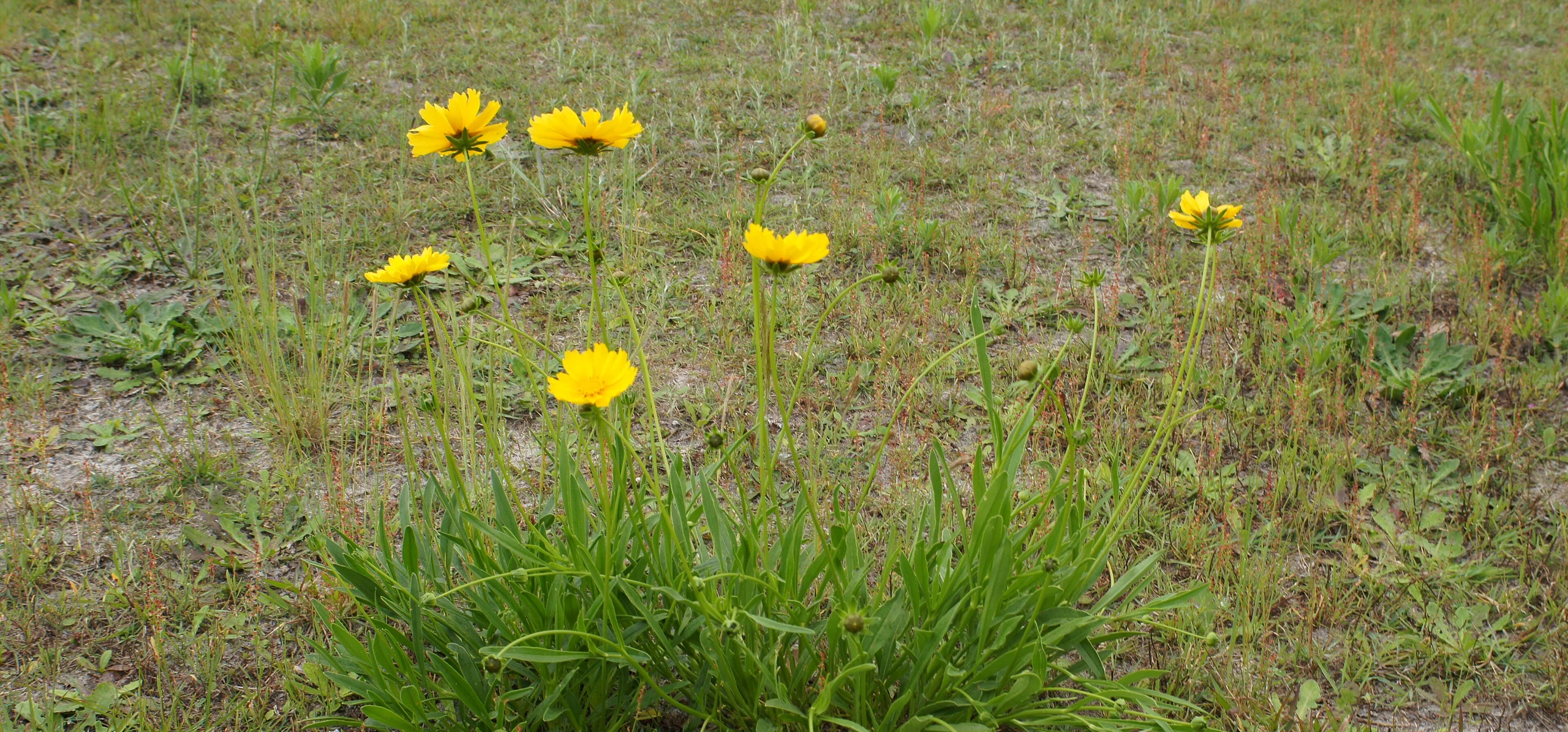
Lance-Leaved Coreopsis
Coreopsis lanceolata
Family · Asteraceae
Lance-leaved coreopsis thrives in poor, dry soil and full sun. Covers deadheading, the midsummer shear, dividing every 2-3 years, and its invasive status.
Coreopsis lanceolata
Plant profile
- WateringLittleWater every 10 days
- Light exposureFull sun
- Hardiness zoneUSDA 4–9
Growth
- Family
- Asteraceae
- Life cycle
- Perennial
- Growth speed
- 7/10
- Mature size
- 30–90 cm
- Spread
- 30–60 cm
- Flowering
- Late spring through summer, reblooms after shearing
- Propagation
- Seed
- Division
Dormancydies back to a low basal clump after the first hard frost, new growth resumes from the crown in spring
Time to maturity1 to 2 years to reach full flowering size
Soil & climate
- Soil pH
- pH 5.5–7.5
- Soil types
- loam, sand, rocky
- Drought tolerance
- Yes
Light & Placement
- Where to place it
- sunny border or bed with lean, fast-draining soil
- gravel or rock garden
- prairie or meadow planting
- roadside or slope for erosion control
- large container with a gritty, fast-draining mix
OriginSoutheastern Canada to central and eastern United States; widely naturalized elsewhere, invasive in Japan
Safety
- Toxicity
- CatsSafe
- DogsSafe
- HorsesSafe
Invasive speciesself-seeds freely and naturalizes into large colonies; officially designated an Invasive Alien Species in Japan since 2006, with a nationwide removal campaign, and naturalized in parts of Europe and elsewhere outside its North American range
Data fromCoreopsis lanceolata L., GBIF Backbone TPOWO: Coreopsis lanceolata L.ASPCA: Coreopsis toxicity to petsMissouri Botanical Garden Plant Finder: NC State Extension Gardener Plant Toolbo
Where it grows
World distribution
Lance-Leaved Coreopsis is native to 2 countries: Canada and United States.GBIF records 18,670 documented identifications across 69 countries, with the largest concentrations in United States, Australia, and South Korea.
- Canada
- United States
Yellow to orange dots: concentration of documented identifications per country. Green countries: sourced native range. Source: GBIFNative range from POWO (Kew).
Lance-leaved coreopsis, Coreopsis lanceolata, is the coreopsis built for the ground other perennials refuse: thin, sandy or rocky soil, baking full sun, and no irrigation once the roots are established. It grows a low tuft of narrow, lance-shaped leaves and then a scatter of wiry, mostly leafless flower stalks topped with bright yellow, notch-tipped daisies through late spring and summer. It is short-lived by perennial standards, most clumps fade out within three to seven years, but it makes up for that by self-seeding so readily that a single planting can turn into a naturalized colony within a couple of seasons. That same vigor has made it a listed invasive species in Japan and a naturalized escape in parts of Europe, so where you plant it matters almost as much as how.
Origin, Classification and a Species Built for Poor Ground
The GBIF backbone accepts Coreopsis lanceolata L. as the current name, in the daisy family Asteraceae, order Asterales, with no dispute from the ten synonyms recorded for it, including the older name Coreopsis crassifolia and a segregate once placed in Bidens. Plants of the World Online gives its native range as southeastern Canada to central and eastern USA, where it grows on prairies, glades, roadsides and other open, disturbed ground with little competition and even less fertility. That origin explains almost everything about how to grow it: this is a pioneer of poor soil, not a woodland or meadow plant that expects rich loam, and treating it like one is the most common way to lose it to flopping and crown rot.
Site, Soil and Sun
Give it full sun, six or more hours of direct light a day; in partial shade it survives but stretches for the light and flowers less freely. Soil matters less for fertility than for drainage: loam, sand or shallow rocky ground all suit it, from mildly acid to neutral, and the species is rated tolerant of drought, heat, humidity and poor soil. The one soil it dislikes is a rich, moisture-retentive bed. Extra fertility pushes soft, leafy growth that flops over and produces fewer flowers, so skip the feeding altogether and let the plant work with what is already there.
Watering and Drought Tolerance
New divisions or nursery plants need regular water for their first few weeks while roots establish, but a mature clump asks for very little after that. Its native habitat bred it to shrug off dry spells, and in most temperate gardens rainfall alone is enough once a plant is settled; step in with supplemental water only during an extended drought, or for anything grown in a pot, where the free-draining mix that keeps roots healthy also dries out fast. Overwatering in heavy, poorly drained soil is a far bigger risk than underwatering, since standing moisture around the crown invites rot.


Deadheading and the Midsummer Shear
Snap or snip off spent flower stalks as they fade. Prompt deadheading pushes out another round of buds and keeps the plant from pouring its energy into seed instead. Once the main flush slows in midsummer, cut the whole clump back by a quarter to half its height. It looks drastic and sacrifices the flowers and buds still on the plant, but a sheared clump is usually back in full bloom within about two weeks. This single cut is the most effective way to keep lance-leaved coreopsis flowering into late summer instead of stopping after one flush, and it also straightens up a clump that has started to sprawl.
Short-Lived, Self-Seeding and Sometimes Invasive
Treat this as a short-lived perennial, three to seven years is the typical lifespan of a single plant, rather than a permanent fixture of the border. It compensates by self-seeding freely: leave some flower heads to ripen instead of deadheading everything, and volunteer seedlings will keep a planting going indefinitely, forming dense colonies on their own in good conditions. That same vigor is a liability outside its native range. Japan designated Coreopsis lanceolata an Invasive Alien Species under its 2006 Invasive Alien Species Act, banned its cultivation and sale, and now runs organized removal campaigns after the plant spread along waterfronts and roadsides nationwide; it is also naturalized in parts of Europe and elsewhere well beyond eastern North America. Where it is not a documented problem locally, deadhead most flowers and let only a portion set seed to keep a colony from outrunning its bed.
Dividing Every Two to Three Years
Because individual plants are short-lived, division is less about propagation and more about keeping a planting going at all. Lift and split established clumps every two to three years, in spring or early autumn, discarding any woody or hollowed-out center and replanting the vigorous outer sections. Division is also the only reliable way to keep a named selection true, since seedlings from open pollination will not match the parent. Seed is the other propagation route, and it germinates readily when sown in spring after a period of cold, moist stratification.
Pollinators, Goldfinches and Pests
The open, daisy-form flowers draw a wide range of visitors, bees especially, across a long bloom season. Left standing into autumn, spent seed heads feed goldfinches and other seed-eating birds, one more reason to let a portion of the flowers go to seed rather than deadheading every last one. NC State Extension lists no significant insect pest or disease problems for the species; the main failure mode is crown rot in moist, poorly drained soil, not insects or fungus.
Toxicity to Pets
The ASPCA lists coreopsis, the tickseed genus this species belongs to, as non-toxic to cats, dogs and horses, so it is a reasonably low-risk choice in a garden shared with pets. A dog or cat that chews on the foliage in passing may still get mild, transient stomach upset from the plant material itself, as with almost any greenery, but there is no specific toxic principle on record for the genus.
Test your plant knowledge
Tap a card to flip it and reveal the answer.
Coreopsis lanceolata flowers best in rich, heavily fertilized soil. Tap to reveal ✕ False
Cutting the plant back by a quarter to a half in midsummer encourages a fresh flush of flowers. Tap to reveal ✓ True
An individual plant typically lives for decades once established. Tap to reveal ✕ False
Coreopsis lanceolata has been officially designated an invasive species in Japan. Tap to reveal ✓ True
The ASPCA lists coreopsis as toxic to cats and dogs. Tap to reveal ✕ False
Sources
References consulted for this guide
- Coreopsis lanceolata L., GBIF Backbone Taxonomygbif.org
- POWO: Coreopsis lanceolata L.powo.science.kew.org
- ASPCA: Coreopsis toxicity to petsaspca.org
- Missouri Botanical Garden Plant Finder: Coreopsis lanceolatamissouribotanicalgarden.org
- NC State Extension Gardener Plant Toolbox: Coreopsis lanceolataplants.ces.ncsu.edu
- Reference entity : Wikipédiaen.wikipedia.org