Common Ragweed
Ambrosia artemisiifolia
Family · Asteraceae
Common ragweed drives most late-summer hay fever in Europe and North America: how to identify it, tell it apart from mugwort, and remove it before it flowers.
Ambrosia artemisiifolia
Plant profile
- WateringLittleWater every 14 days
- Light exposurePartial sun
Growth
- Family
- Asteraceae
- Life cycle
- Annual
- Growth speed
- 7/10
- Mature size
- 30–183 cm
- Spread
- 90–122 cm
- Flowering
- Male flower spikes shed pollen from midsummer into fall, until the first hard frost
- Propagation
- Seed
DormancyNone; germinates from seed each spring, killed outright by the first hard frost
Time to maturityFlowers within its single growing season, from midsummer into fall
Soil & climate
- Soil types
- poor soil, dry soil, compacted soil, disturbed ground
- Drought tolerance
- Yes
Light & Placement
- Where to place it
- Waste ground
- Roadsides
- Field edges
- Disturbed soil
- Vegetable gardens left bare
OriginNative to North America (POWO: subarctic America to the U.S.A.); introduced and invasive across Europe
Safety
- Toxicity
- HumansToxic
Invasive speciesEU invasive alien species of Union concern since 2022; leading cause of late-summer hay fever in Europe and North America
Data fromGBIF: Ambrosia artemisiifolia L.Plants of the World Online (Kew): AmbrosNC State Extension Gardener Plant ToolboNC State Extension: Mugwort or ChrysanthUniversity of Maryland Extension: Managi
Where it grows
World distribution
Common Ragweed is native to 2 countries: Canada and United States.GBIF records 209,413 documented identifications across 110 countries, with the largest concentrations in France, United States, and Canada.
- Canada
- United States
Yellow to orange dots: concentration of documented identifications per country. Green countries: sourced native range. Source: GBIFNative range from POWO (Kew).
A weedy plant with deeply cut, fern-like leaves and reddish, hairy stems that showed up on its own in a flower bed, a vegetable patch, or a strip of disturbed soil along a driveway is very likely Ambrosia artemisiifolia, common ragweed. It produces no attractive flowers worth keeping: the small green spikes it throws up from midsummer on exist purely to shed windborne pollen, and that pollen is the main reason late-summer hay fever exists on both sides of the Atlantic. It is not toxic to the touch the way poison ivy is, but handling cut stems can irritate sensitive skin, and letting it flower anywhere near a garden means adding to a pollen load that is already heavy from midsummer into the first hard frost. The rest of this guide covers how to be sure it is ragweed and not one of its lookalikes, why the pollen causes so much trouble, and how to remove it before it seeds.
Origin and How It Became a Fixture Outside North America
Common ragweed is native to North America; Plants of the World Online (Kew) records its native range as subarctic America south to the United States. It reached Europe as a contaminant of imported seed and soil in the nineteenth century, then spread rapidly after the Second World War through contaminated bird seed, farm machinery, and soil movement along roads and railways. Its foothold is deepest in the Rhone valley in France, in northern Italy, and in Hungary, where it is now one of the dominant weeds of disturbed farmland. The European Union added it to the list of invasive alien species of Union concern in 2022, restricting its sale, cultivation, and deliberate release across all member states.
Identifying Common Ragweed
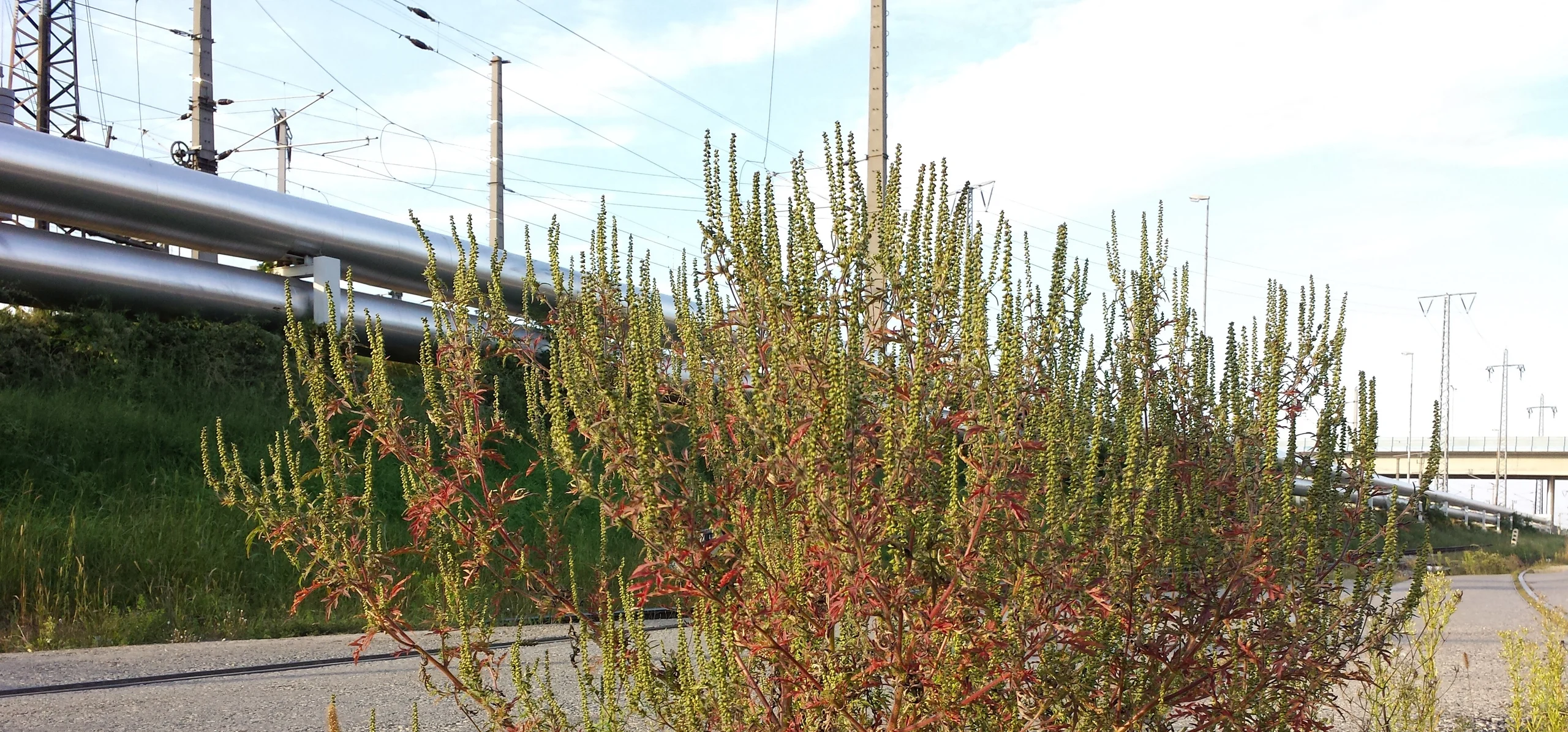
Look first at the leaves: they are deeply divided into narrow lobes, giving the whole leaf a fern-like or carrot-top look, typically 3 to 6 inches long and 1 to 3 inches wide, arranged oppositely low on the stem and alternately higher up. Stems are pinkish red and noticeably hairy. The plant is monoecious, carrying both sexes on the same individual: small green male flower heads crowd into narrow spike-like clusters at the tops of the stems and upper branches, while the far less visible female flowers sit in small clusters in the leaf axils just below those spikes. Neither sex produces anything resembling a showy flower; the whole point of the display is windborne pollen, not pollinator attraction. By late summer the fertilized female flowers harden into small, spiny, bur-like seed cases only a few millimetres long. A single plant usually reaches 1 to 6 feet tall with a 3 to 4 foot spread, though roadside or disturbed-ground specimens at the shorter end of that range are what most gardeners run into.
Ragweed vs Mugwort and Other Lookalikes
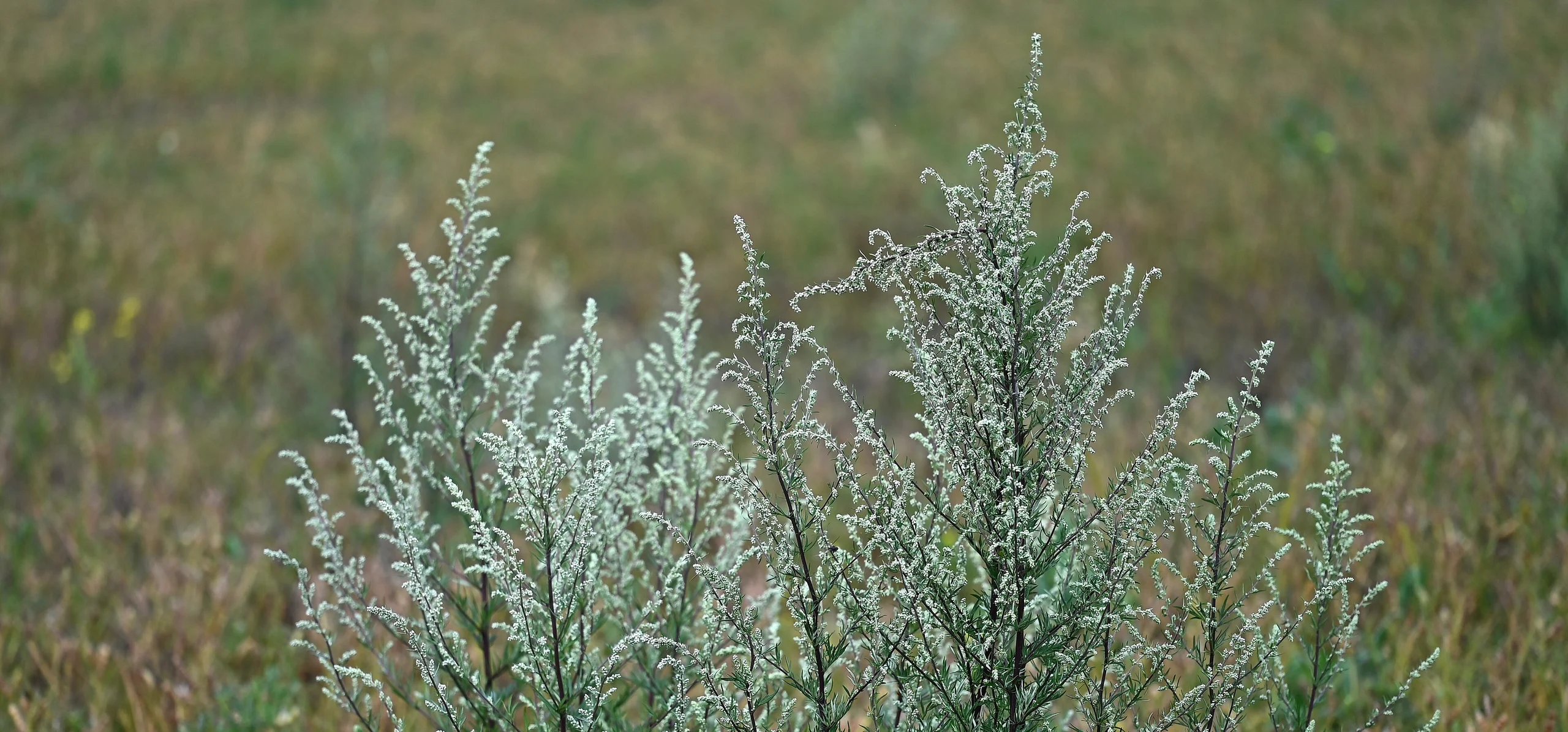
Mugwort, Artemisia vulgaris, is the plant most often confused with young ragweed, since both have deeply cut, fern-like foliage and both trigger hay fever. Flip a leaf over to tell them apart: mugwort has a dense, felty layer of silvery white hairs on the underside, while ragweed leaves are green on both sides with no such coating. Mugwort is also a spreading perennial with rhizomes and a strong herbal, chrysanthemum-like smell when crushed, whereas ragweed is a true annual that dies with the first hard frost and returns only from seed the following spring. Garden chrysanthemums can echo the divided-leaf look at a glance too, but again lack the white-haired underside that marks mugwort, and neither chrysanthemum nor mugwort produces ragweed's tight terminal spikes of tiny green flower heads.


Why Ragweed Pollen Causes So Much Trouble
Ragweed pollen is an unusually potent allergen, and the plant compensates for its inconspicuous flowers with sheer volume: a single vigorous plant can shed pollen literally by the billion before the season is over. Pollen release typically begins in early August across much of the temperate northern hemisphere, peaks around mid-September, and continues until the first hard frost kills the plants outright, so the season can run six to ten weeks depending on latitude and that year's first frost date. Counts are consistently highest on hot, dry, windy mornings, when pollen releases fastest and disperses furthest, and lowest after rain, which washes pollen out of the air. Because the pollen travels on the wind rather than depending on insects, removing ragweed from your own garden lowers your own exposure but does little about levels on a windy regional day if ragweed is established nearby.
Growth Habit, Habitat, and the Seed Bank Problem
This is a true summer annual: seed germinates once the soil warms in spring, and the plant puts the whole season into vegetative growth before flowering from midsummer into fall. It tolerates full sun to partial shade and is markedly drought and poor-soil tolerant, which is why it thrives on the ground gardeners neglect: compacted verges, gravel edges, construction fill, vegetable beds left bare after harvest, and any patch of disturbed soil with little competition. Seed stays viable in the soil for several years, so a single missed season of flowering can reseed a bed for years afterward even if every visible plant is pulled before the next spring. Birds eat the oil-rich seed, which is one reason isolated plants keep turning up under feeders even where none grew the year before.
Pulling and Mowing Ragweed Without Making It Worse
Hand-pulling works well while plants are young and the soil is soft enough to lift the whole root; wear gloves, since handling cut stems and foliage can trigger contact dermatitis in sensitive people, on top of the pollen risk if any flower heads are already open. The single biggest mowing mistake is a high, one-time cut that removes only the top few inches: ragweed responds by branching low and pushing out a shorter but still fully fertile flush of flower spikes, so a light mow can leave a lawn with more, not fewer, pollen-producing stems. Cutting it back hard, close to the ground, before flower spikes appear denies it that regrowth option and is far more effective than a single pass with a brush cutter set high. Either way, repeated attention through the season matters more than any single pass, since plants missed the first time keep flowering right up to frost.
Herbicide Control and a Growing Resistance Problem
Where mechanical control is not enough, most integrated programs pair a burn-down herbicide applied while ragweed is still under 3 to 4 inches tall with a soil-applied residual product carrying at least two effective sites of action, then follow up with a post-emergence application if seedlings keep coming. Resistance is a real and worsening constraint, not a theoretical one: University of Maryland Extension documents common ragweed populations first confirmed resistant to glyphosate and to ALS-inhibiting herbicides in 2014, with three-way resistance to PPO inhibitors, ALS inhibitors, and glyphosate confirmed in Delaware and on Maryland's Eastern Shore by 2017. Where resistance is suspected, rotating modes of action, combining residual and post-emergence products, and leaning more on mechanical removal and tillage matter more than reaching for a stronger dose of the same chemical.
Common Mistakes
The most common mistake is letting a young plant sit because the fern-like leaves look harmless, or even attractive; by the time the flower spikes are obvious, it has usually already been shedding pollen for days. The second is mowing high and calling it done, which as covered above often produces more flowering stems, not fewer. The third is misidentifying mugwort as ragweed or the reverse, based on leaf shape alone instead of checking the leaf underside. The fourth is treating one plant in isolation while ignoring the seed bank it has already built in the soil; a property clear of visible ragweed can still produce a fresh crop from seed dropped in previous years, so a follow-up check the next spring is part of the job, not optional.
Test your plant knowledge
Tap a card to flip it and reveal the answer.
Mugwort and common ragweed can be told apart by checking the underside of the leaf. Tap to reveal ✓ True
A single tall, one-time mow usually stops common ragweed from flowering for the rest of the season. Tap to reveal ✕ False
Common ragweed populations in the Mid-Atlantic United States have been confirmed resistant to both glyphosate and ALS-inhibiting herbicides. Tap to reveal ✓ True
The ASPCA lists common ragweed as toxic to cats and dogs. Tap to reveal ✕ False
Ragweed pollen counts are typically highest on hot, dry, and windy mornings. Tap to reveal ✓ True
Sources
References consulted for this guide
- GBIF: Ambrosia artemisiifolia L.gbif.org
- Plants of the World Online (Kew): Ambrosia artemisiifoliapowo.science.kew.org
- NC State Extension Gardener Plant Toolbox: Ambrosia artemisiifoliaplants.ces.ncsu.edu
- NC State Extension: Mugwort or Chrysanthemum Weed (Artemisia vulgaris)content.ces.ncsu.edu
- University of Maryland Extension: Managing Herbicide-Resistant Common Ragweed (FS-474)extension.umd.edu
- Reference entity : Wikipédiaen.wikipedia.org