White Snakeroot
Ageratina altissima
Family · Asteraceae
White snakeroot is a shade-tolerant woodland perennial with fluffy autumn flowers, a 'Chocolate' cultivar, and the tremetol toxin behind milk sickness.
Ageratina altissima
Plant profile
- WateringHighWater every 5 days
- Light exposureIndirect light
- Hardiness zoneUSDA 3–8
Growth
- Family
- Asteraceae
- Life cycle
- Perennial
- Growth speed
- 6/10
- Mature size
- 90–150 cm
- Spread
- 60–120 cm
- Flowering
- Late summer into autumn, September to frost
- Propagation
- Seed
- Division
Dormancydies back to the ground over winter, resprouting from the rootstock and rhizomes in spring
Soil & climate
- Soil types
- loam, humus-rich, well-drained
- Drought tolerance
- No
Light & Placement
- Where to place it
- woodland garden
- shade garden
- naturalized area
- rain garden
- cottage garden border
OriginEastern Canada to the United States, native to woodland habitats (POWO, Missouri Botanical Garden)
Safety
- Toxicity
- HorsesToxic
Invasive speciesspreads readily by rhizome and self-seeding; can become weedy in optimum woodland-edge growing conditions
Data fromAgeratina altissima (L.) R.M.King & H.RoPOWO: Ageratina altissima (L.) R.M.King Missouri Botanical Garden Plant Finder: ASPCA: Toxic and Non-Toxic Plants, White
Where it grows
World distribution
White Snakeroot is native to 2 countries: Canada and United States.GBIF records 62,703 documented identifications across 53 countries, with the largest concentrations in United States, Canada, and South Korea.
- Canada
- United States
Yellow to orange dots: concentration of documented identifications per country. Green countries: sourced native range. Source: GBIFNative range from POWO (Kew).
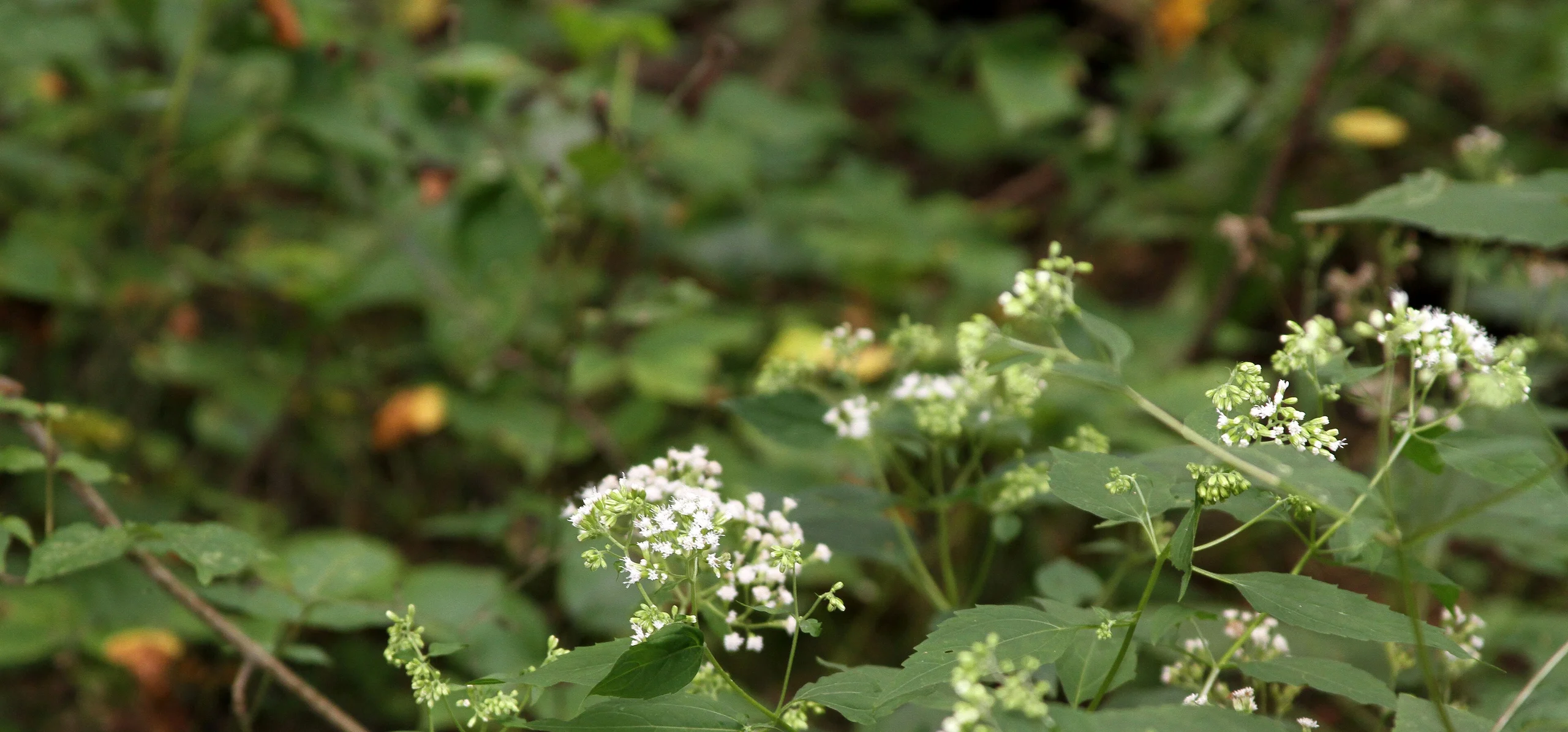
White snakeroot, Ageratina altissima, is the plant behind flat-topped clusters of small, fluffy white flowers that turn up at woodland edges and in shaded borders from late summer into frost, often when little else outdoors is still flowering. If you found it growing on its own along a hedge, streambank or the shady side of a garden, you are looking at a native North American perennial that spreads by rhizome and by self-sown seedlings, not an ornamental someone planted and forgot. If you bought a nursery pot labeled 'Chocolate', you have the same species in a selection bred for near-black foliage in shade. Either way, treat it with plain gardening caution rather than alarm: the whole plant carries a toxin called tremetol that matters for grazing livestock and has a real place in American history, but it is not a hazard from ordinary handling in the garden.
Origin, Classification and the Eupatorium Name You Might Still See
The GBIF backbone accepts Ageratina altissima (L.) R.M.King & H.Rob. as the current name, in the daisy family Asteraceae, order Asterales. For most of the 20th century it was known as Eupatorium rugosum or Eupatorium ageratoides, and older plant guides, nursery tags and even some garden books still use those names; Missouri Botanical Garden lists it as a direct synonym. GBIF records the common names White Snakeroot, Richweed and Snakeroot, while Missouri Botanical Garden adds deerwort, hardy age, milk ipecac, mist flower and white sanicle. The species epithet altissima simply means tall or highest, a reference to the height the flowering stems reach by late summer.
Native Range: Rich Woods and Woodland Edges
Plants of the World Online gives the native range as eastern Canada to the United States. Missouri Botanical Garden is more specific: it is native to woodland areas of the eastern United States and, in Missouri, is common in rich or rocky woods, thickets and wood margins, exactly the dappled, humus-rich ground the brief for this plant describes. Smooth stems typically rise 3 to 5 feet, topped from September to frost with loose, flattened flower clusters, corymbs 3 to 4 inches across, made up of small composite flowers with the ray florets absent, so what reads as fluffiness is really a mass of tiny disc florets. The paired leaves are long-stalked, sharp-toothed, taper-pointed, lance-shaped to elliptic-oval and nettle-like, 3 to 6 inches long.
Choosing 'Chocolate' for a Shade Border
'Chocolate' is a Mt. Cuba Center introduction from Greenville, Delaware, selected for leaves that emerge chocolate-tinted over shiny purple stems, 3 to 5 feet tall, with the same small white flowers from September into October. Missouri Botanical Garden rates it hardy in zones 4 to 8, slightly narrower than the species' zones 3 to 8, and makes one important point for anyone hoping to propagate it: 'Chocolate' will not come true from seed. A self-sown seedling underneath a 'Chocolate' plant will very likely revert to plain green foliage, so keeping the dark color in a border means propagating from the original plant rather than letting it seed around.


Light, Soil and Placement
Missouri Botanical Garden lists full sun to part shade, but is explicit that this species prefers part shade in moist, humusy soil and has decidedly better shade tolerance than most other Eupatorium relatives, while still doing reasonably well in drier soil. Average, medium to wet, well-drained ground suits it; heavy shade under mature trees is where it competes best with turf grass and shallow-rooted groundcovers. It is also listed as deer-tolerant, useful information if you are placing it at a woodland edge where deer browse is a real constraint on what else will survive there.
Self-Seeding: Why It Spreads and How to Rein It In
Missouri Botanical Garden describes this as a somewhat weedy perennial that can spread aggressively by rhizome and by self-seeding in optimum conditions, and its own cultural advice is direct: deadhead spent flower heads to avoid unwanted self-seeding. In practice that means cutting the flattened flower clusters off before the seed heads dry and disperse, rather than leaving them to stand through winter for structure. Where a colony has already established, pulling young seedlings while they are small and shallow-rooted is far easier than removing an established rhizome mat later, and a mowed or edged boundary around the planting keeps rhizome spread from reaching adjacent beds.
Dividing an Established Clump
Because this species grows from spreading rootstock and rhizomes, an established clump can be lifted and divided in spring as new growth emerges, which both controls its spread and produces new plants that are genetically identical to the parent. This is the reliable route to more 'Chocolate' plants with dark foliage intact, since division sidesteps the seed-grown reversion to green mentioned above. Replant divisions promptly into the same average to wet, humus-rich soil the species prefers, and expect them to reach flowering size within a season or two given reasonable moisture.
Autumn Flowers and Pollinators
Missouri Botanical Garden lists this species as attracting butterflies, and its flowering window, September to frost, places it among the last native nectar sources available in eastern woodland gardens before the growing season closes. The flowerheads are small individually, but a mature clump produces enough of them in flattened corymbs to make a dense, visible landing surface late in the year, at a point when many other perennials have already finished. Leaving at least part of a colony to flower rather than deadheading it entirely is a reasonable trade-off between feeding late-season pollinators and keeping self-seeding in check.
Tremetol, Milk Sickness and What ASPCA Confirms Today
The historic reputation of white snakeroot rests on tremetol, the toxin the ASPCA names as its toxic principle. Missouri Botanical Garden records the specific mechanism behind that reputation: settlers whose cows grazed on this plant and then drank the resulting milk often developed a serious, sometimes fatal illness called milk sickness, a well-documented hazard of 19th-century settlement in the wooded eastern and midwestern United States, before the plant and its toxin were identified as the cause. The ASPCA's current toxic-plant listing confirms the modern picture: white snakeroot is toxic to horses, with clinical signs across affected species including weakness, stiffness, tremors and collapse, and additional effects in horses of heart damage and difficulty swallowing. The ASPCA's page does not separately list cats or dogs for this species, so this guide does not claim a verified status for them either way; if you keep pets or livestock near a naturalized stand, treat the whole plant as unsafe to graze or ingest rather than assuming it is limited to horses.
Test your plant knowledge
Tap a card to flip it and reveal the answer.
White snakeroot flowers in spring, ahead of most other native woodland perennials. Tap to reveal ✕ False
The 'Chocolate' cultivar reliably keeps its dark foliage color when grown from its own seed. Tap to reveal ✕ False
The toxin tremetol can pass into the milk and meat of animals that graze on this plant. Tap to reveal ✓ True
The ASPCA lists white snakeroot as toxic to horses. Tap to reveal ✓ True
Deadheading the spent flower heads has no real effect on how many seedlings appear the following year. Tap to reveal ✕ False
Sources
References consulted for this guide
- Ageratina altissima (L.) R.M.King & H.Rob., GBIF Backbone Taxonomygbif.org
- POWO: Ageratina altissima (L.) R.M.King & H.Rob.powo.science.kew.org
- Missouri Botanical Garden Plant Finder: Ageratina altissimamissouribotanicalgarden.org
- Missouri Botanical Garden Plant Finder: Ageratina altissima 'Chocolate'missouribotanicalgarden.org
- ASPCA: Toxic and Non-Toxic Plants, White Snakerootaspca.org
- Reference entity : Wikipédiaen.wikipedia.org