Common Burdock
Arctium minus
Family · Asteraceae
The rosette turns into a burr-covered stalk in year two. Identify common burdock, separate it from greater burdock, and dig out the taproot before it seeds.
Arctium minus
Plant profile
- WateringLittleWater every 14 days
- Light exposurePartial sun
- Ideal temperature-30–35 °C
- Humidity30–80 %
- Hardiness zoneUSDA 3–9
Growth
- Family
- Asteraceae
- Life cycle
- Biennial
- Growth speed
- 7/10
- Mature size
- 30–183 cm
- Spread
- 30–90 cm
- Propagation
- Seed
FloweringSmall pink to purple flowerheads from midsummer into autumn, ripening into hooked burrs
DormancyOverwinters as a ground-level rosette after germinating from seed
Time to maturityRosette in year one; bolts, flowers and sets seed in year two
Soil & climate
- Soil pH
- pH 5.5–7.5
- Soil types
- poor soil, compacted soil, disturbed ground, nitrogen-rich soil
- Saline soil
- Partially tolerated
- Drought tolerance
- Yes
Light & Placement
- Where to place it
- Roadsides
- Field edges
- Fence lines
- Waste ground
- Neglected garden borders
OriginNative to Macaronesia, northwest Africa and Europe to Afghanistan; naturalized and weedy across North America
Safety
- Toxicity
- HumansSafe
Invasive speciesListed as a noxious weed in several US states, including Colorado and Wyoming; hooked burrs have been documented entangling and killing small birds and bats
Data fromGBIF: Arctium minus (Hill) Bernh.Plants of the World Online (Kew): ArctiuNC State Extension Gardener Plant ToolboMontana State University Extension: Comm
Where it grows
World distribution
Common Burdock is native to 36 countries: Afghanistan, Albania, Algeria, Austria, Belarus, Belgium, Bulgaria, and Croatia….GBIF records 371,243 documented identifications across 66 countries, with the largest concentrations in United Kingdom, France, and Netherlands.
- Afghanistan
- Albania
- Algeria
- Austria
- Belarus
- Belgium
- Bulgaria
- Croatia
- Czechia
- Denmark
- Estonia
- Finland
Show 24 more countriesShow fewer countries
- France
- Georgia
- Germany
- Greece
- Hungary
- Iran
- Iraq
- Ireland
- Italy
- Lebanon
- Morocco
- Netherlands
- Norway
- Palestinian Territories
- Poland
- Portugal
- Romania
- Russia
- Spain
- Sweden
- Switzerland
- Türkiye
- Ukraine
- United Kingdom
Yellow to orange dots: concentration of documented identifications per country. Green countries: sourced native range. Source: GBIFNative range from POWO (Kew).
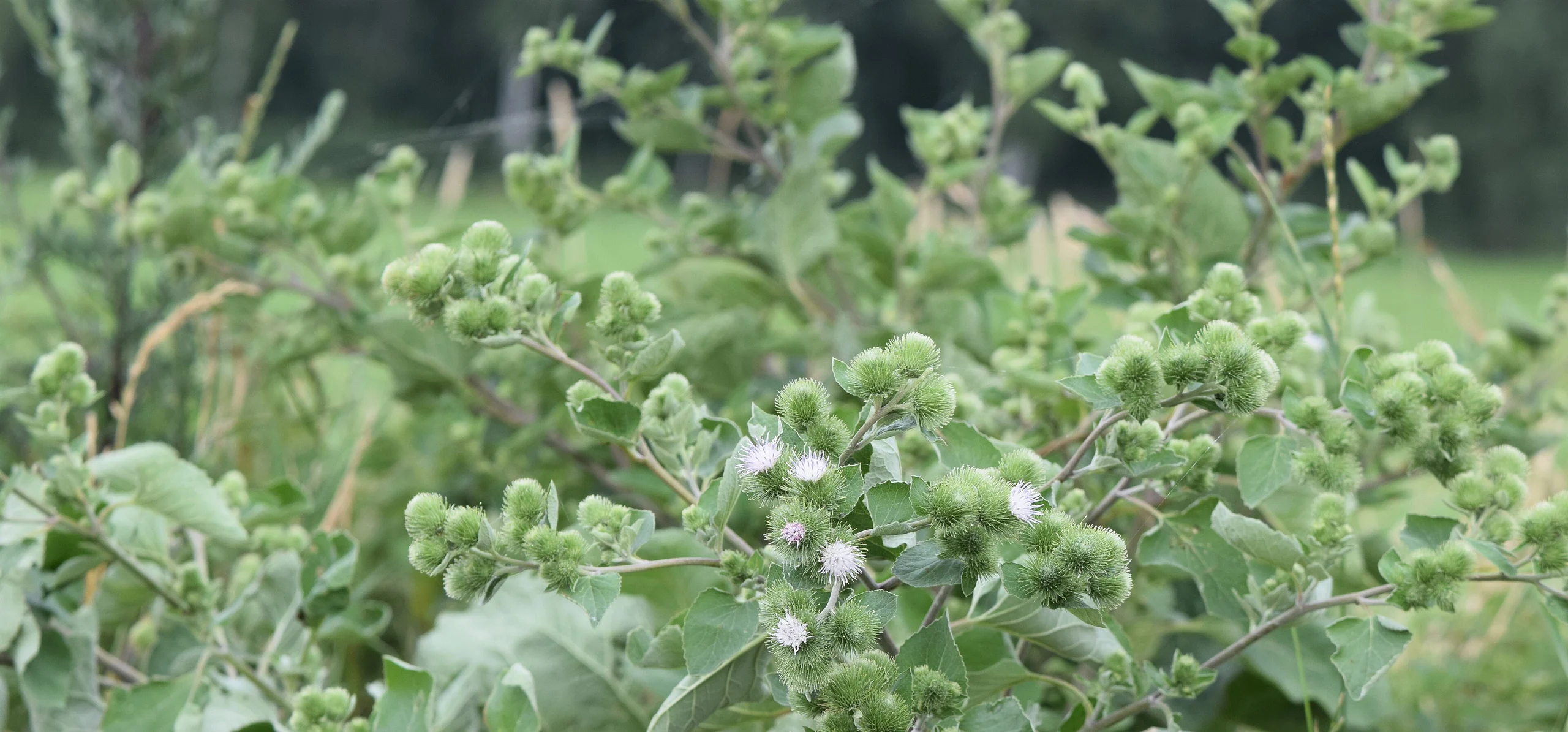
Common burdock (Arctium minus) spends its first year as an unremarkable rosette of large, wavy-edged leaves pressed flat to the ground, then in its second year bolts into a branching, cobwebby stalk 1.5 to 1.8 m tall that ends the season covered in hard, round burrs. Most people meet it the second way: as a mat of burrs stuck in a dog's coat or a sock after a walk through rough ground. It is not native to North America but arrived with European settlers and has since naturalized across most of the continent, thriving in exactly the disturbed, nitrogen-rich soil that farms, roadsides and neglected garden edges provide.
Identifying Common Burdock Season by Season
In its first year, common burdock produces only a low rosette: leaves up to 50 cm long, egg-shaped, dark green above and pale, felted grey-white beneath, with a wavy margin and no teeth. The leaf stalks are hollow, a detail worth remembering. In the second spring the plant bolts, sending up a coarse, grooved, often reddish stem that branches freely. From midsummer into autumn it opens small pink to purple thistle-like flowerheads, 1.5 to 2.5 cm across, arranged in loose, uneven clusters strung along the upper branches rather than gathered into a flat top. Each flowerhead is wrapped in a ball of stiff, hooked bracts that stay green and cobwebby while young, then dry to the familiar brown burr as the seed inside ripens.
Common Burdock vs Greater Burdock
Arctium minus is routinely confused with its larger relative, Arctium lappa (greater burdock), and the two do hybridize where they overlap. The one reliable field test takes ten seconds: slice a leaf stalk near its base. Common burdock's petiole is hollow inside; greater burdock's is solid and pithy. Size backs this up. Greater burdock can reach 2.75 m and holds its flowerheads in a flat-topped, umbrella-like cluster, while common burdock tops out around 1.5 to 1.8 m with flowerheads strung loosely along the stem rather than bunched at the top. If you only remember one thing, remember the hollow stalk.
Where It Thrives and Why It Spreads So Easily
Common burdock tolerates poor, compacted, and disturbed soil that stops most other weeds, which is why it colonizes barnyards, fence lines, ditches, vacant lots and the shady edge of a vegetable patch with equal ease. It is listed as a noxious weed in several US states, including Colorado and Wyoming, where seed sales are restricted. A single plant produces thousands of seeds, and because the burrs travel by hooking onto fur, feathers and clothing rather than falling straight to the ground, a burdock population can appear well outside where any plant was ever seen growing.

The Hooked Burr: A Seed Dispersal Machine
Under magnification, each bract on a burdock burr ends in a stiff, curved hook, hundreds of them packed onto a single seed head. That structure is efficient enough that a Swiss engineer named George de Mestral, pulling burrs off his dog after a walk in 1941, examined one under a microscope and spent the next several years turning the hook-and-catch idea into VELCRO fasteners. The burr's job in the wild is identical to what it does to a wool sweater: grip anything with a loop-like surface, ride along until it snags or is groomed off, and drop seed somewhere new.
A Real Hazard to Small Birds and Bats
Burdock's dispersal strategy has a documented downside. Small-bodied migrants that land to forage among the flowerheads, especially hummingbirds and other tiny songbirds, can get one wing or a foot caught in the hooks and be unable to work free; wildlife rehabilitators and naturalist groups in the northern United States and Canada record entangled birds and bats every autumn, a problem noted in ornithological literature going back to the early twentieth century. Bats are especially vulnerable because the hooks catch in fur even more readily than in feathers. It is one more reason to cut burdock stands back before the burrs mature, particularly near feeders, gardens and anywhere birds concentrate in late summer.
Removing Common Burdock for Good
Timing decides whether removal is a five-minute job or a season-long fight. Pull first-year rosettes by hand or with a narrow trowel while the taproot is still short; a young plant lifts out whole with a firm, steady pull rather than a yank, which tends to snap the root. Once a plant has bolted, dig rather than pull: the taproot runs deep and branches, and any piece left in the ground regrows a new rosette from the broken end. If digging the whole plant is not practical, cut the stalk at ground level after it bolts but before the flowerheads open; cutting later, once burrs have formed, just scatters the very seed you are trying to stop. Bag and dispose of cut plants that already carry burrs rather than composting them, since home compost rarely gets hot enough to kill the seed.
Common Mistakes
Mowing a burdock stand once and assuming it is finished is the most common error: cut stems below the growing point often resprout and can still flower low to the ground later in the season. Leaving even a short section of taproot in the soil is nearly as common, since any bud along the root can push up a fresh rosette. The third mistake is timing the cut for looks rather than for seed: a plant left standing until the burrs turn brown has already finished its job, and every burr on it is a fresh infestation waiting for a passing animal, sock or sweater.
Test your plant knowledge
Tap a card to flip it and reveal the answer.
Slicing a leaf stalk open is a reliable way to tell common burdock from greater burdock. Tap to reveal ✓ True
Common burdock flowers and produces burrs in its first year of growth. Tap to reveal ✕ False
Cutting a bolted burdock stalk down once is usually enough to stop it for the season. Tap to reveal ✕ False
Common burdock's hooked burrs have been documented entangling small birds and bats. Tap to reveal ✓ True
The ASPCA lists common burdock as toxic to cats and dogs. Tap to reveal ✕ False
Sources
References consulted for this guide
- GBIF: Arctium minus (Hill) Bernh.gbif.org
- Plants of the World Online (Kew): Arctium minuspowo.science.kew.org
- NC State Extension Gardener Plant Toolbox: Arctium minusplants.ces.ncsu.edu
- NC State Extension Gardener Plant Toolbox: Arctium lappaplants.ces.ncsu.edu
- Montana State University Extension: Common Burdock (Arctium minus)montana.edu
- Reference entity : Wikipédiaen.wikipedia.org