Jade Plant
Crassula ovata
Family · Crassulaceae
Jade plant care from the sources that matter: RHS watering and light figures, real hardiness limits, and why the ASPCA lists it as toxic to pets.
Crassula ovata
Plant profile
- WateringLittleWater every 18 days
- Light exposurePartial sun
- Hardiness zoneUSDA 11–12
Growth
- Family
- Crassulaceae
- Life cycle
- Perennial
- Growth speed
- 3/10
- Mature size
- 150–250 cm
- Spread
- 100–150 cm
- Propagation
- Seed
- Cutting
- Offsets
FloweringRarely blooms indoors; outdoor plants can produce star-shaped flowers in spring (NC State Extension)
DormancySemi-dormant in winter, when watering is cut back substantially (RHS)
Time to maturityReaches ultimate height and spread over 5 to 10 years (RHS)
Soil & climate
- Soil types
- loam
- Drought tolerance
- Yes
Light & Placement
- Where to place it
- Bright, sheltered south- or west-facing windowsill (RHS)
- Conservatory or greenhouse bench in full light (RHS)
- Full sun with afternoon shade, USDA zones 11a to 12b only (NC State Extension)
- Terracotta pot with drainage holes in a loam-based cactus mix (RHS)
OriginNative to southeastern Mozambique through to southeastern Cape Province, South Africa (POWO)
Safety
- Toxicity
- CatsToxic
- DogsToxic
- HorsesToxic
Data fromCrassula ovata (Mill.) Druce, GBIF BackbCrassula ovata (Mill.) Druce, Plants of RHS: Crassula ovata (jade plant)ASPCA: Toxic and Non-toxic Plants, Jade NC State Extension Gardener Plant Toolbo
Where it grows
World distribution
Jade Plant is native to 2 countries: Mozambique and South Africa.GBIF records 2,616 documented identifications across 46 countries, with the largest concentrations in South Africa, United States, and Spain.
- Mozambique
- South Africa
Yellow to orange dots: concentration of documented identifications per country. Green countries: sourced native range. Source: GBIFNative range from POWO (Kew).
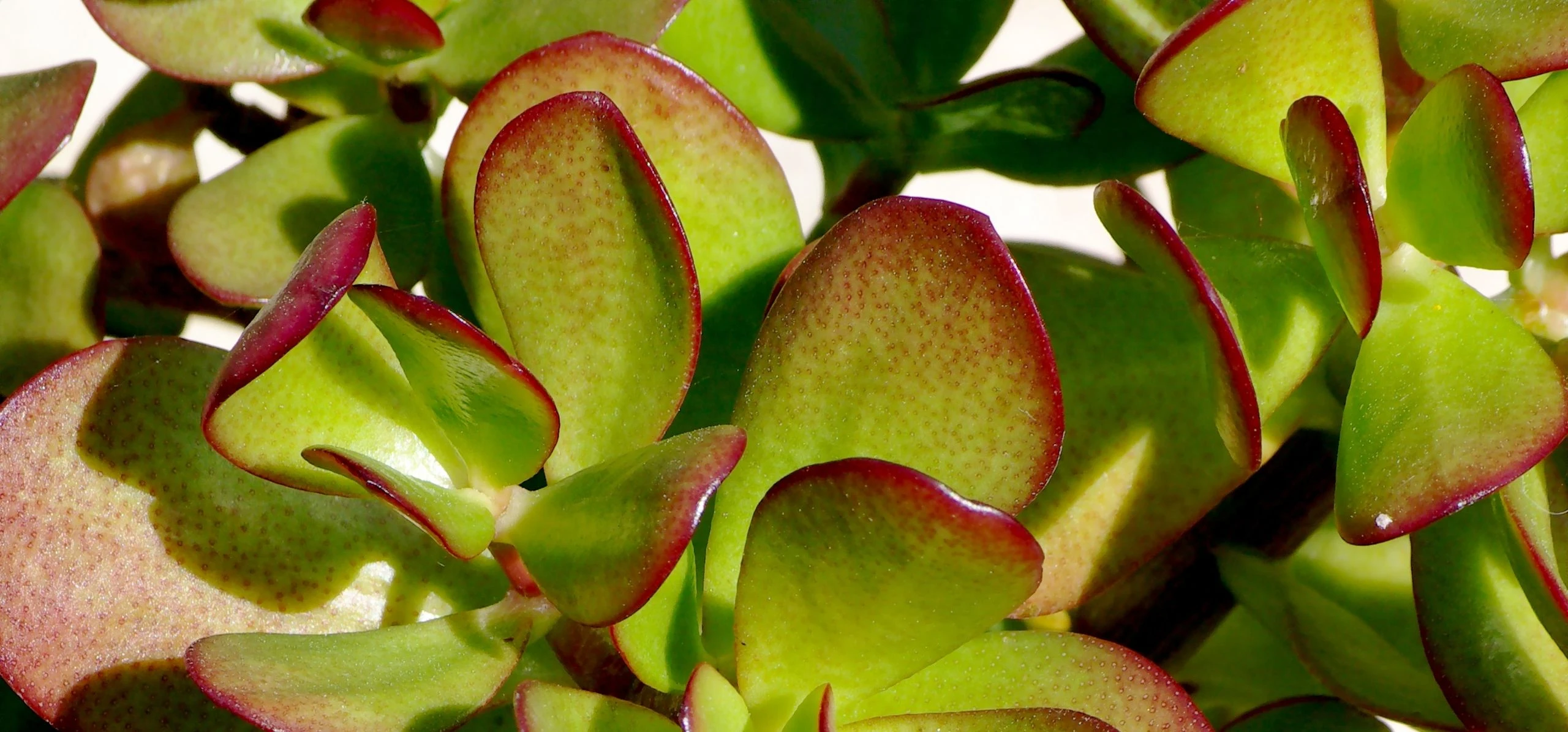
A stout, woody trunk carrying pairs of thick, glossy, oval leaves is what separates Crassula ovata from every other succulent on a garden centre shelf. GBIF records the accepted name as Crassula ovata (Mill.) Druce, in the stonecrop family Crassulaceae, and the plant is native to a narrow band of southern Africa that POWO describes as running from southeastern Mozambique to the southeastern Cape Province of South Africa. Sold under a long list of common names, jade plant, jade tree, lucky plant, money plant, baby jade, the plant that eventually forms a branching, tree-like trunk is the same species regardless of the label on the pot. Give it strong light and let it dry out between waterings and it asks for very little else.
How Big It Actually Gets, and How Slowly
The RHS lists an ultimate height of 1.5 to 2.5 metres with a spread of 1 to 1.5 metres, reached only after 5 to 10 years, which is a useful reminder that a jade plant is a long-term project rather than a fast filler. NC State Extension gives a more modest figure for the indoor form, 3 to 6 feet tall and 2 to 3 feet wide, rating its growth rate as medium rather than slow, a difference that mostly comes down to whether the plant is grown as a conservatory specimen or kept smaller as a houseplant. Either way, a young plant from a 10 cm pot will look much the same for the first year or two while its root system and trunk thicken before height really takes off.
Light: The Difference Between a Stocky Plant and a Leggy One
The RHS places Crassula ovata in full sun, on a south- or west-facing spot, sheltered from wind and cold draughts, and NC State Extension confirms it tolerates anywhere from full sun (six or more hours a day) down to partial shade (two to six hours). Indoors that translates to the brightest windowsill available, with a little protection from the most intense midday sun through glass, which can scorch leaves that have not been gradually acclimatised. In good light the leaves stay thick, compact, and close together on the stem; in a dim corner the internodes stretch, the trunk thins, and the whole plant leans toward the nearest window instead of standing upright.


Watering: Soak, Then Wait for Completely Dry Soil
RHS cultivation notes call for watering moderately during the growing season, enough to keep the compost lightly moist, then cutting back substantially once the plant enters winter dormancy. NC State Extension is more specific about the failure mode: it names leaf fall and root rot as the direct result of overwatering, and recommends reducing watering from fall through late winter rather than keeping to a fixed weekly schedule. In practice that means watering thoroughly until it runs from the drainage holes, then leaving the pot alone until the top few centimetres of soil are bone dry, a rhythm that will fall anywhere from two to four weeks depending on light, pot size, and the season.
Soil and Potting: Loam With Real Drainage
Both the RHS and NC State Extension specify a loam-based mix with good drainage, tolerant of occasionally dry to very dry conditions between waterings, and the RHS adds that pH is not fussy, acid, neutral or alkaline soil all work. A cactus and succulent compost, or an ordinary loam-based potting mix cut with coarse grit or perlite, satisfies both requirements. A terracotta pot with a drainage hole suits the plant better than a sealed decorative pot, since it lets excess moisture evaporate through the clay walls as well as the drainage hole, which matters most in the months when watering is already reduced.
Feeding, Pruning and the Bonsai-Style Trunk
The RHS recommends a general liquid fertiliser once a month from spring through summer, with nothing added over winter while growth has slowed. Pruning is not required for the plant's health, the RHS lists it as needing no routine pruning, but cutting back a stem just above a leaf pair in spring will encourage branching lower down, which is exactly how the thick, gnarled trunks that make older plants look like miniature trees are shaped over several years. A heavier pot than the plant seems to need also earns its keep once the trunk thickens, since a top-heavy jade plant in a light plastic pot topples easily.
Propagation From a Single Leaf or Stem
RHS notes seeds, offsets and cuttings as the standard propagation routes, and NC State Extension narrows the practical method down to leaf cuttings and stem cuttings, both described as easy. A healthy leaf twisted cleanly off the stem, or a short stem section, left to callus over for a day or two in open air, then set on the surface of gritty, barely damp mix, will root within a few weeks without any rooting hormone. The main way to fail at this is to plant a fresh, uncallused cut straight into wet soil, where it rots before it has the chance to root.
Pests and the Two Ways an Overwatered Plant Fails
The RHS lists mealybug, vine weevil and aphids as the pests to watch for, while NC State Extension adds scale and spider mites to that list; mealybugs in particular tend to hide in the tight joints between leaf pairs, where they show up as small white cottony clusters. Disease pressure is otherwise low, and NC State Extension is direct about the one real cause of trouble: leaf fall and root rot both come from overwatering rather than from pests or cold. A plant with soft, yellowing, translucent leaves that drop at a touch has wet roots, not a pest problem, and the fix is to stop watering and let the soil dry out fully before checking whether the roots underneath are still firm.
Is the Jade Plant Safe Around Pets?
It is not. The ASPCA lists Crassula ovata, under the older synonym Crassula argentea, as toxic to dogs, cats and horses, with vomiting, depression and poor coordination as the clinical signs of ingestion; the toxic principle itself is recorded as unknown. NC State Extension independently confirms the same three species are affected. Neither source lists a toxic dose or says the plant is dangerous to humans, but with three animal species confirmed and no safety data offered either way, a jade plant within reach of a chewing pet or a curious horse in a conservatory is worth moving rather than gambling on.
Test your plant knowledge
Tap a card to flip it and reveal the answer.
The RHS lists Crassula ovata's ultimate height as 1.5 to 2.5 metres, reached over 5 to 10 years. Tap to reveal ✓ True
NC State Extension names overwatering, not cold or pests, as the cause of leaf fall and root rot in jade plants. Tap to reveal ✓ True
A freshly cut jade leaf should be planted straight into moist soil for the fastest rooting. Tap to reveal ✕ False
The ASPCA lists the jade plant as toxic to dogs, cats and horses. Tap to reveal ✓ True
The RHS says Crassula ovata needs regular pruning to stay healthy. Tap to reveal ✕ False
Sources
References consulted for this guide
- Crassula ovata (Mill.) Druce, GBIF Backbone Taxonomygbif.org
- Crassula ovata (Mill.) Druce, Plants of the World Online, Kew Sciencepowo.science.kew.org
- RHS: Crassula ovata (jade plant)rhs.org.uk
- ASPCA: Toxic and Non-toxic Plants, Jade Plantaspca.org
- NC State Extension Gardener Plant Toolbox: Crassula ovataplants.ces.ncsu.edu
- Reference entity : Wikipédiaen.wikipedia.org