Tree Aeonium
Aeonium arboreum
Family · Crassulaceae
Aeonium arboreum care: how this tree-form succulent grows woody and leggy, rests dry through summer, and needs full sun to hold its 'Zwartkop' black leaves.
Aeonium arboreum
Plant profile
- WateringLittleWater every 21 days
- Light exposureFull sun
- Hardiness zoneUSDA 9–11
Growth
- Family
- Crassulaceae
- Life cycle
- Perennial
- Growth speed
- 4/10
- Mature size
- 100–150 cm
- Spread
- 100–150 cm
- Flowering
- Yellow, conical flower spikes
- Propagation
- Cutting
Dormancysummer dormant, winter growing
Soil & climate
- Soil types
- gritty, fast-draining, cactus/succulent mix
- Drought tolerance
- Yes
Light & Placement
- Origin
- Gran Canaria (Canary Islands), SW Morocco
- Where to place it
- sunny windowsill
- unheated bright greenhouse
- sheltered full sun, frost-free climates
- wide, sturdy pot for a top-heavy branching stem
Safety
- Toxicity
- Not evaluated by the ASPCA; toxicity undetermined
- Pet safe
- No
Data fromGBIFPlants of the World Online (Kew)RHSNC State ExtensionUC ANR
Where it grows
World distribution
Tree Aeonium is native to 2 countries: Morocco and Spain.GBIF records 5,441 documented identifications across 41 countries, with the largest concentrations in Spain, France, and United Kingdom.
- Morocco
- Spain
Yellow to orange dots: concentration of documented identifications per country. Green countries: sourced native range. Source: GBIFNative range from POWO (Kew).
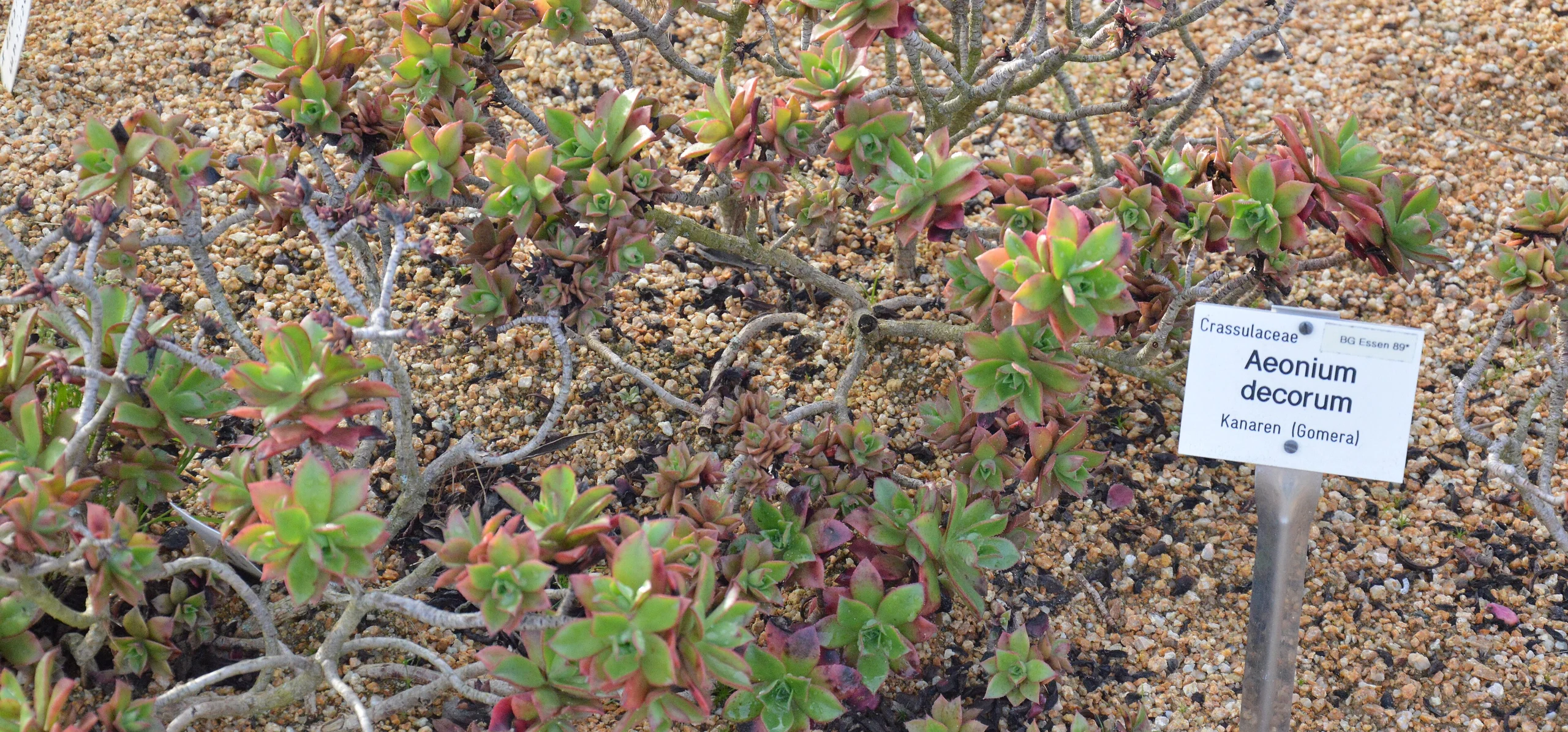
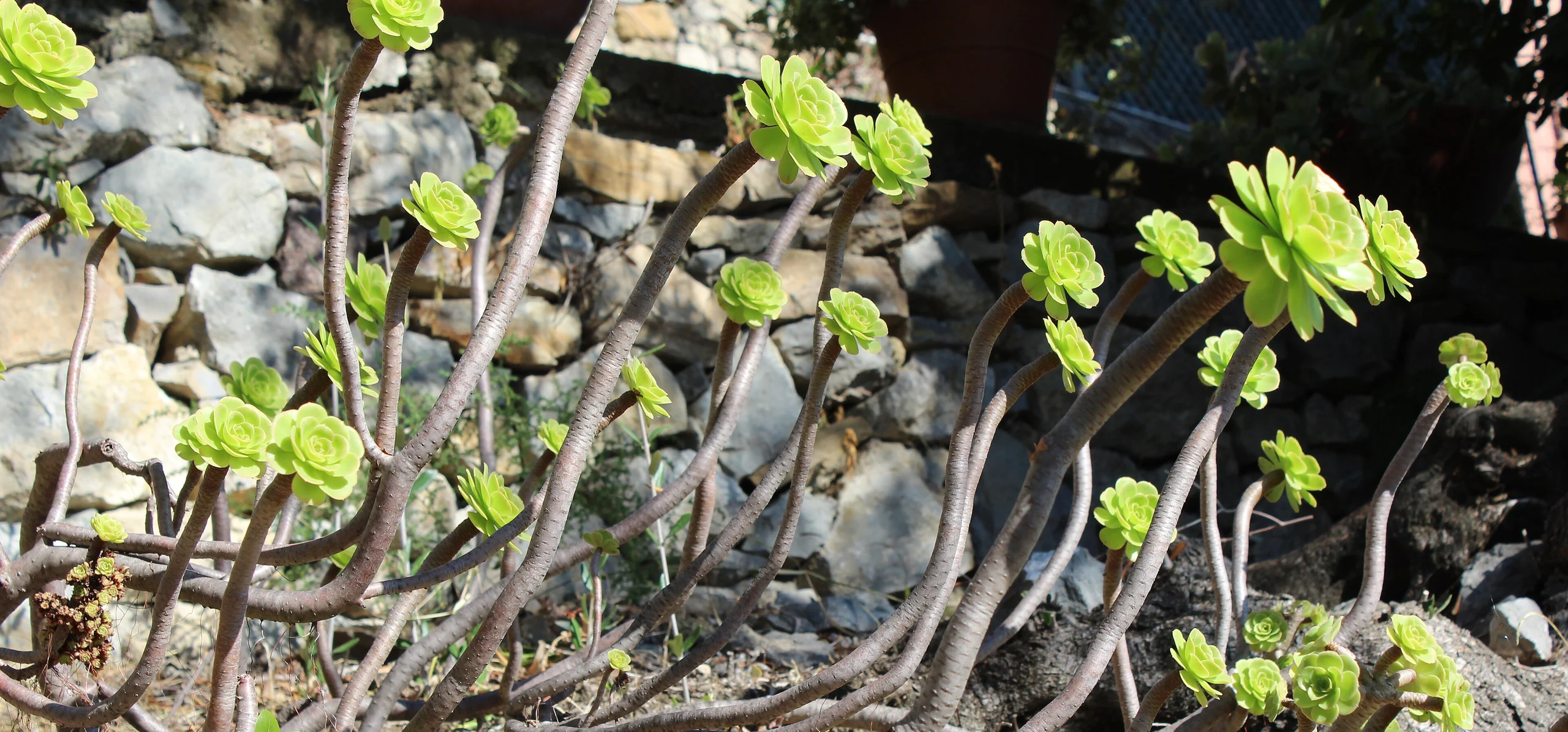
Aeonium arboreum is the tree-form relative behind most of the black-leaved succulents sold as 'Zwartkop' or 'Schwarzkopf': a branching, woody-stemmed subshrub that can reach a metre or more, topped with flat rosettes of spoon-shaped leaves. Left to its own habit it grows a thick central stem, then arches and branches as it ages, so a plant bought as a tidy single rosette will, within a couple of years, look more like a small gnarled tree than a typical windowsill succulent. It shares the reversed calendar of its relatives, growing through the cool months and shutting down in summer, but its size, its woody stems and the way individual rosettes flower once and die set it apart from smaller, mat-forming Aeoniums like Aeonium decorum.
Where Aeonium arboreum grows in the wild
Kew's Plants of the World Online places the wild range of Aeonium arboreum on Gran Canaria in the Canary Islands, with a separate subspecies, korneliuslemsii, native to the mountains of southwestern Morocco. Both populations grow on rocky, volcanic ground in a climate with wet, mild winters and long, dry summers, the same pattern that shapes the plant's growth cycle in cultivation. The species has been planted so widely along the Mediterranean and in California that it now looks naturalized almost everywhere with a similar climate, but its actual native range is narrow.
'Zwartkop' and other forms worth choosing
Most plants sold under this name are not the plain green species but a cultivar: 'Zwartkop' (Black Rose), whose large rosettes of pointed leaves turn dark burgundy to near-black in strong light, and stay green or bronze in shade. There is also subsp. holochrysum, with golden-bronze leaves and a lower, more clumping habit than the species, and the newer 'Voodoo' and 'Atropurpureum' selections, both darker forms sold alongside 'Zwartkop'. Whichever one you buy, the leaf color is the fastest way to judge whether it is getting enough light: a 'Zwartkop' that has faded to plain green has simply been indoors, or in shade, too long.
Light and color
Give it as much direct sun as the climate allows. The RHS rates it for a sheltered, south- or west-facing spot in full sun, and in cultivation the darkest cultivars only reach their full black or burgundy color under strong, direct light; the same plant kept indoors on an ordinary windowsill will hold noticeably greener leaves and a looser, more open rosette. Move a plant into stronger sun gradually over a week or two rather than all at once, since leaves that have adjusted to shade can scorch pale and papery if suddenly exposed to midday summer sun.


The winter-growing, summer-dormant cycle
Like the rest of the genus, Aeonium arboreum is a winter grower. University of California extension guidance on Aeoniums describes active growth through the cool season, with a summer dormancy in which the soil should stay dry and only light water given if the leaves begin to shrivel noticeably. Through autumn, winter and spring, water generously whenever the top of the mix has dried, then taper off sharply as the weather warms. A rosette that closes up and sits still through the hottest weeks of summer is not struggling, it is resting on the same schedule its ancestors kept on Gran Canaria's cliffs.
Soil, feeding and repotting
Use a gritty, fast-draining mix, such as a cactus and succulent blend cut with extra pumice or coarse sand, in a pot with a drainage hole. Feed lightly with a dilute balanced or cactus fertilizer during the active season from autumn to spring, and stop altogether once summer dormancy sets in. Because a mature plant develops a heavy, top-branching stem structure, repot into a wider, sturdier pot as it grows rather than a tall narrow one, and do the work in early autumn, just as new growth is about to resume, so disturbed roots have the whole growing season to recover.
Leggy stems: pruning, staking and cuttings
Leggy growth is not a fault in this species, it is the plant's natural tree-form habit, but bare, sprawling stems can outgrow their pot or topple under the weight of the rosettes. Pinch or cut back a stem just above a leaf node to force branching lower down, and stake a heavy, leaning stem loosely rather than letting it snap under its own weight. Every cutting from that pruning is a new plant: let the cut end dry and callus for two or three days out of direct sun, then press it into shallow, gritty mix and hold off watering until small roots have formed, checked with a gentle tug rather than by digging around. Cuttings taken in autumn root fastest, arriving right at the start of the growing season instead of heading into summer dormancy.
Cold limits and overwintering
The RHS rates Aeonium arboreum H1c, meaning it can only stay outdoors through the warmer months and needs a minimum of 5 to 10°C, with protection under glass once temperatures drop below that. It is listed as hardy in USDA zones 9a to 11b, and RHS guidance is explicit that this is a frost-tender subshrub with no meaningful tolerance for freezing weather. Where winters bring anything colder than that, grow it in a pot that can be moved onto a bright porch or into an unheated greenhouse before the first cold night, and keep it on the dry side while it is under cover, since cold, wet soil is what actually kills the stems, not the cold air alone.
Monocarpic rosettes and common mistakes
Individual rosettes of Aeonium arboreum are monocarpic: once a rosette sends up its conical spike of small yellow flowers, usually in spring, that particular rosette sets seed and then dies, while the rest of the branching stem carries on unaffected. On a mature, well-branched plant this barely shows, since side shoots simply replace the spent rosette, but on a young, single-stemmed plant it can look alarming the first time. The two real mistakes to avoid are watering on a fixed schedule through summer, which rots the stem base faster than almost anything else, and keeping the plant too dim, which turns a compact, colorful rosette into a stretched, pale one that no amount of later sun fully restores. Mealybugs occasionally settle into the tight leaf axils near the crown, where a cotton swab dipped in methylated spirit clears them before they spread.
Test your plant knowledge
Tap a card to flip it and reveal the answer.
Aeonium arboreum grows most actively in the cool winter months and rests in summer. Tap to reveal ✓ True
Aeonium arboreum tolerates hard, prolonged frost outdoors. Tap to reveal ✕ False
A single Aeonium arboreum rosette can flower repeatedly for years without dying. Tap to reveal ✕ False
'Zwartkop' needs strong, direct sun to hold its darkest, near-black leaf color. Tap to reveal ✓ True
Aeonium arboreum is commonly propagated by rooting a stem cutting with a rosette attached. Tap to reveal ✓ True
Sources
References consulted for this guide
- GBIF - Aeonium arboreumgbif.org
- Plants of the World Online (Kew) - Aeonium arboreumpowo.science.kew.org
- RHS - Aeonium arboreumrhs.org.uk
- NC State Extension - Aeoniumplants.ces.ncsu.edu
- UC ANR - Aeoniums (seasonal growth and watering)ucanr.edu
- Reference entity : Wikipédiaen.wikipedia.org