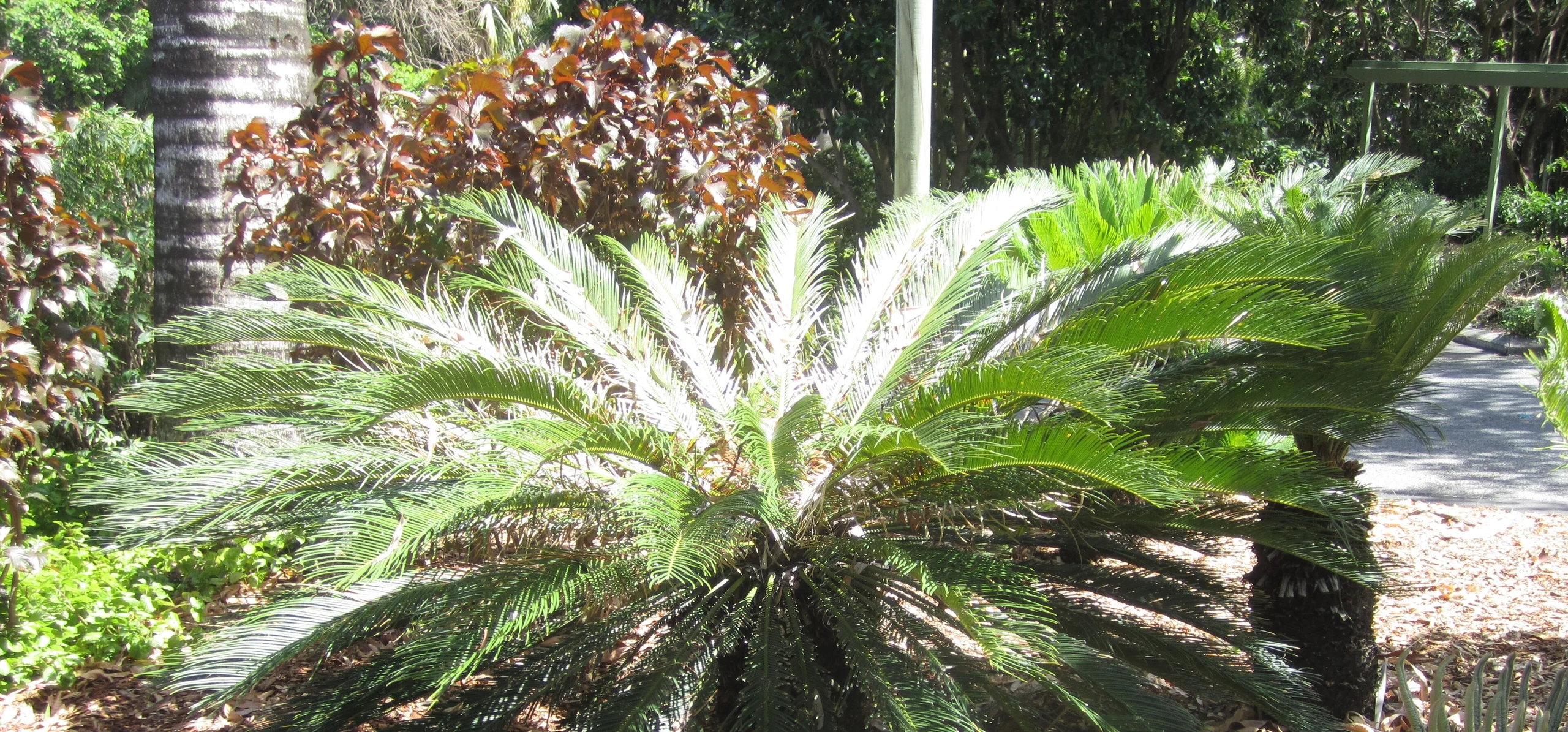
Sago Palm
Cycas revoluta
Family · Cycadaceae
Cycas revoluta is a cycad, not a palm: one leaf flush a year, gritty soil, manganese-linked yellowing, and cycasin that makes every part dangerous to pets.
Cycas revoluta
Plant profile
- WateringLittleWater every 14 days
- Light exposurePartial sun
- Hardiness zoneUSDA 8–10
Growth
- Family
- Cycadaceae
- Life cycle
- Perennial
- Growth speed
- 1/10
- Mature size
- 60–300 cm
- Spread
- 90–210 cm
- Propagation
- Seed
- Offsets
FloweringNo flowers; dioecious, mature plants bear a pollen cone (male) or a seed-bearing megasporophyll cluster (female)
DormancyNo true dormancy; growth pauses between annual leaf flushes and slows further in cool winters
Time to maturityRated extremely slow; a visible trunk can take five decades or more to develop (Missouri Botanical Garden)
Soil & climate
- Drought tolerance
- Yes
Soil typesGritty, fast-draining mix, Cactus or palm potting soil cut with coarse sand, perlite or pumice
Light & Placement
- Where to place it
- South- or west-facing window with direct or very bright light
- Full sun once acclimated
- Light shade in the hottest climates
- Pot with a drainage hole
- Cactus or palm potting mix
OriginSouthern Japan (Kyushu, Shikoku) to the Fujian coast of China and eastern Taiwan (POWO)
Safety
- Toxicity
- CatsToxic
- DogsToxic
- HorsesToxic
Data fromCycas revoluta Thunb., GBIF Backbone TaxCycas revoluta Thunb. | Plants of the WoToxic and Non-toxic Plants: Sago Palm, ACycas revoluta, Missouri Botanical GardeCycas revoluta | Japanese sago palm, RHS
Where it grows
World distribution
Sago Palm is native to 3 countries: China, Japan, and Taiwan.GBIF records 3,137 documented identifications across 99 countries, with the largest concentrations in Japan, United States, and China.
- China
- Japan
- Taiwan
Yellow to orange dots: concentration of documented identifications per country. Green countries: sourced native range. Source: GBIFNative range from POWO (Kew).
A sago palm that looks identical to last year's photo is not stalled, it is doing exactly what a cycad does. Cycas revoluta pushes out a single ring of new leaves once a year, sometimes only every other year in a stressed or shaded plant, then holds that crown unchanged until the next flush. The plant in front of you is old: even a small tabletop specimen with a trunk barely visible above the soil line can be a decade or more old, since each year adds one tier of fronds and a sliver of trunk rather than steady growth. Judge it by the health of its current crown and the condition of the emerging flush, not by how much bigger it got since spring.
A cycad, not a palm
The common name and the palm-like rosette of stiff, feathery fronds are misleading. GBIF's accepted classification places Cycas revoluta in the family Cycadaceae, order Cycadales, class Cycadopsida: an ancient lineage of cone-bearing seed plants that predates flowering plants by tens of millions of years, and has nothing to do with true palms, which are flowering monocots in an unrelated family. Cycads are dioecious, meaning individual plants are male or female. A mature male produces a narrow, upright cone of pollen; a mature female produces a looser, wooly dome of modified leaves called a megasporophyll cluster, each bearing exposed seeds along its edge rather than fruit. Most potted sago palms sold indoors never reach the size or age needed to cone, so this reproductive detail rarely shows up in a living room, but it explains why the plant looks nothing like a palm once it flowers.
One flush a year: growth rate and the new leaves
Everything about caring for this species follows from its growth rhythm. A healthy sago palm produces one flush of new leaflets a year, usually in warm weather, and the entire ring emerges together rather than one frond at a time. The new leaves come up pale, soft and tightly curled, unfurl over one to two weeks, and only harden into the stiff, dark green texture of mature fronds over roughly ten days after that. During this window the new flush is genuinely fragile: cold, direct hot sun, physical knocks or a heavy hand with fertiliser can scorch or deform leaflets permanently, and a damaged flush cannot be redone until the following year. Never cut, trim or pinch the new flush while it is soft, and hold off on repotting or heavy feeding until it has fully hardened. A frond removed at the wrong time is not a pruning choice, it is a year of growth lost.
Light and placement
Sago palm wants bright light and tolerates a fair amount of direct sun once acclimated, which is why it is a fixture of full-sun landscaping in warm climates. Indoors, a south or west-facing window with several hours of direct or very bright filtered light keeps the crown compact and the new flush emerging on schedule; a plant kept in low light stretches its fronds, produces a sparser flush, and can skip a year of growth entirely. Move a shade-grown or newly purchased plant into full outdoor sun gradually over a couple of weeks rather than all at once, since foliage grown indoors or under cover can scorch if it is moved straight into midday sun.
Watering, soil and rot
The trunk stores water and starch, which is why this species is far more likely to be killed by overwatering than by drought. Let the top several centimetres of a gritty, fast-draining mix dry out fully between waterings, water it through until it runs from the drainage holes, then leave it alone; a mix built from cactus or palm soil cut with coarse sand, perlite or pumice drains fast enough to prevent the constantly damp root zone that leads to trunk and root rot. Water noticeably less in winter, when growth has stopped, and always in a pot with a drainage hole, since a sago palm sitting in a saucer of water for days is one of the most common ways the trunk rots from the base up.


Feeding and yellowing fronds
Uniform yellowing across older fronds, especially with the newest leaves emerging pale yellow-green instead of the usual fresh green, is the classic sign of manganese deficiency, sometimes called frizzle top, a problem common in sandy or heavily leached soils and in pots that go years without repotting or feeding. It is corrected with a fertiliser containing manganese and other micronutrients, applied only after the current flush has hardened, since a leaf malformed by frizzle top will not recover and the fix is to prevent the next flush from coming in the same way. Yellowing paired with soft, mushy tissue at the base of the fronds or a soft trunk points the other direction, toward overwatering and rot rather than a nutrient gap, and calls for drying the soil out and checking the crown and roots rather than adding fertiliser.
Hardiness and growing outdoors
Cycas revoluta is native to southern Japan, from Kyushu and Shikoku, to the Fujian coast of China and eastern Taiwan (POWO), a subtropical range that explains its tolerance for brief cold snaps but not for hard freezes. In mild regions it survives outdoors to roughly -7°C for short spells, though the crown, the single growing point at the top of the trunk, needs protection from prolonged freezing since losing it can kill the whole plant. Missouri Botanical Garden rates it hardy in USDA zones 9 to 10, with possible survival in sheltered zone 8 sites, and notes that young plants often stay at 60 to 90 cm for years before a trunk several feet tall develops over five decades or more. Where winters run colder, treat it as a container plant that summers outdoors and comes in before the first hard frost.
Pests: scale insects
Armored scale insects are the recurring pest problem on this species, and one in particular is worth knowing by name: cycad aulacaspis scale (Aulacaspis yasumatsui), a small, white, crusty insect that colonises the undersides of leaflets and the trunk in dense colonies, feeding on sap and eventually killing fronds and, in heavy untreated infestations, the whole plant. Check the underside of leaflets and the base of the trunk regularly, since colonies are easy to miss until they have spread; horticultural oil or a systemic insecticide applied at the first sign of the white scale covers is far more effective than treating an infestation that has already coated the foliage. Isolate a newly acquired or visibly infested plant from other cycads before treating it, since this scale spreads readily between neighbouring plants.
Propagation: offsets
Mature sago palms frequently produce offsets, small rounded pups that form at the base of the trunk or along its sides, and separating a well-developed pup is a far faster route to a new plant than growing from seed. Wait until an offset has its own small cluster of leaves or clear growing points, cut it free from the parent trunk with a clean blade, let the cut surface callus and dry for several days in the open air, then pot it in the same gritty, fast-draining mix used for an adult plant and keep it on the dry side until roots establish. A freshly separated offset with no roots can sit for weeks before it shows any growth; resist the urge to water it heavily in the meantime, since a rot-prone cut surface sitting in damp soil is a more common failure than a slow start.
Toxicity and pet safety
The ASPCA lists sago palm among the most dangerous ornamental plants for cats and dogs: every part of the plant is toxic, with cycasin as the toxic principle, and the seeds carry the highest concentration, so that as few as one or two seeds can be fatal. Signs of ingestion include vomiting that often starts within minutes, bloody diarrhoea, lethargy, jaundice and progressive liver failure, and reported case fatality runs as high as half of ingestions even with treatment. Keep a sago palm, and especially any dropped seeds, completely out of reach of dogs and cats, and treat ingestion of any part of the plant as a veterinary emergency rather than something to watch and wait on.
Test your plant knowledge
Tap a card to flip it and reveal the answer.
Cycas revoluta is a true palm. Tap to reveal ✕ False
A healthy sago palm typically produces just one flush of new leaves per year. Tap to reveal ✓ True
It is fine to trim individual leaflets off the new flush while it is still soft to tidy the shape. Tap to reveal ✕ False
Uniform yellowing of older fronds is always a sign the plant needs more water. Tap to reveal ✕ False
The ASPCA lists sago palm as toxic to both dogs and cats. Tap to reveal ✓ True
Sources
References consulted for this guide
- Cycas revoluta Thunb., GBIF Backbone Taxonomygbif.org
- Cycas revoluta Thunb. | Plants of the World Online, Kew Sciencepowo.science.kew.org
- Toxic and Non-toxic Plants: Sago Palm, ASPCA Animal Poison Controlaspca.org
- Cycas revoluta, Missouri Botanical Garden Plant Findermissouribotanicalgarden.org
- Cycas revoluta | Japanese sago palm, RHSrhs.org.uk
- Reference entity : Wikipédiaen.wikipedia.org