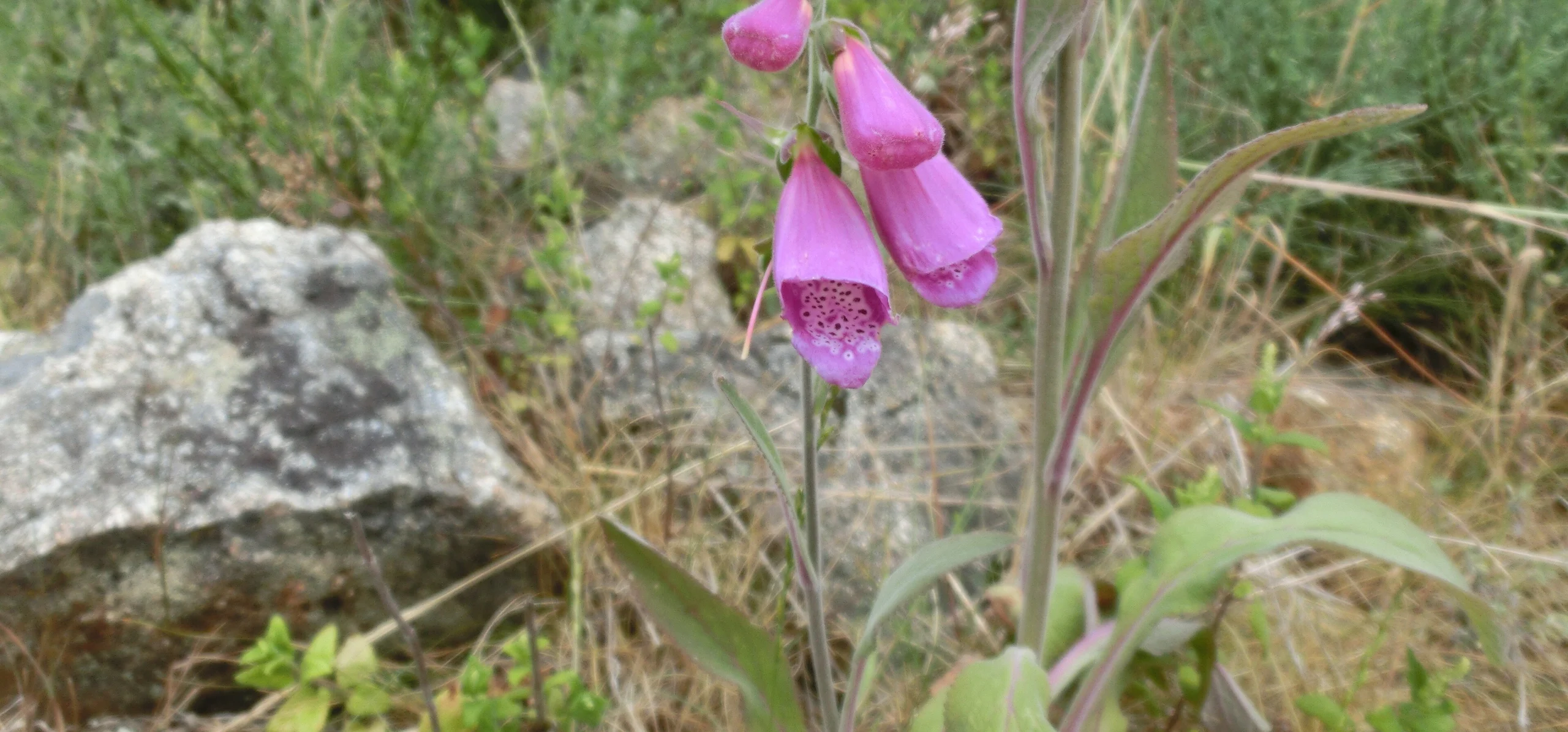
Foxglove
Digitalis purpurea
Family · Plantaginaceae
Foxglove flowers only in its second year. How the rosette-then-spike cycle works, surface sowing, part shade, cutting for side spikes, and the toxicity to know.
Digitalis purpurea
Plant profile
- WateringModerateWater every 7 days
- Light exposurePartial shade
- Hardiness zoneUSDA 4–9
Growth
- Family
- Plantaginaceae
- Life cycle
- Biennial
- Growth speed
- 5/10
- Mature size
- 150–250 cm
- Spread
- 10–50 cm
- Flowering
- Second-year spike, early summer into midsummer
- Propagation
- Seed
Dormancynone as a bulb or root; overwinters as a semi-evergreen basal rosette through its first winter
Time to maturityforms only a low rosette of leaves in year one; sends up a flowering spike in year two, sets seed, then usually dies
Soil & climate
- Soil types
- chalk, clay, loam, sand
- Drought tolerance
- No
Light & Placement
- Origin
- Western and southwestern Europe to northern Morocco
- Where to place it
- woodland edge
- dappled or part-shade border
- hedge bottom
- cottage garden bed
- large, deep container with humus-rich, moisture-retentive compost, to grow rosettes on before planting out
Safety
- Toxicity
- CatsToxic
- DogsToxic
- HorsesToxic
- HumansToxic
Invasive speciesself-seeds readily and can spread into surrounding disturbed or open ground, though it is not generally regulated as invasive
Data fromDigitalis purpurea L., GBIF Backbone TaxPOWO: Digitalis purpurea L.RHS: How to grow foxglovesClemson Cooperative Extension HGIC: FoxgASPCA: Toxic and Non-Toxic Plants, Foxgl
Where it grows
World distribution
Foxglove is native to 11 countries: Belgium, Czechia, France, Germany, Ireland, Italy, Morocco, and Portugal….GBIF records 565,013 documented identifications across 88 countries, with the largest concentrations in United Kingdom, France, and Netherlands.
- Belgium
- Czechia
- France
- Germany
- Ireland
- Italy
- Morocco
- Portugal
- Spain
- Sweden
- United Kingdom
Yellow to orange dots: concentration of documented identifications per country. Green countries: sourced native range. Source: GBIFNative range from POWO (Kew).
A foxglove that has just gone into the ground, whether bought as a small pot or found self-sown at the base of a hedge, will not flower this year unless it is already a mature second-year plant or one of the few strains bred to bloom from seed in a single season. What it will do first is sit as a rosette of soft, felted, oval leaves close to the ground, building up the root and crown it needs to throw up a flowering spike the following summer. That two-year rhythm, not any particular soil or feeding routine, is the one thing that decides almost everything else about how to place and manage it. Left alone at the edge of a border or a hedge line, one plant can turn into a self-renewing colony without ever being resown by hand.
A Two-Year Life: Rosette First, Spike Second
Digitalis purpurea is a true biennial. Clemson Cooperative Extension describes common foxglove forming a rosette of foliage in its first year from seed and flowering only in the second, after which the flowering rosette generally dies. There is no shortcut to this within the straight species: a plant that arrives as bare rosette in autumn or spring is being sold at exactly the stage it should be at, and it needs that full run to a following summer before a spike appears. Gardeners who want flowers every year without gaps usually keep two age groups going at once, sowing a fresh batch while last year's rosettes are about to send up their spikes, so one cohort is always flowering while the next is establishing.
Woodland Edge and Part Shade, Not a Sunny Border
Foxglove is native from western and southwestern Europe to northern Morocco, and its natural habitat, woodland clearings, hedge banks and shaded rides, explains why it performs best with dappled or part shade rather than a hot, open bed. The RHS growing guide places it in soil rich in organic matter, conditions close to a woodland floor, and the species tolerates chalk, clay, loam and sand as long as the pH runs neutral to alkaline rather than strongly acid. It will take full sun in cooler climates or damper soil, but a woodland edge or the shaded side of a border, sheltered from the wind that would otherwise catch a 1.5 to 2.5 metre spike, suits it better than open exposure.
Sowing on the Surface, Not Under a Layer of Compost
Foxglove seed is dust-fine and needs light to germinate, so the RHS growing guide is specific that it should be scattered thinly over moist compost and pressed gently onto the surface rather than covered. Sown in late spring or early summer, it germinates in two to three weeks at 10 to 15 degrees C, giving a rosette enough of the growing season left to size up before winter. Seedlings that come up too thickly, whether sown by hand or self-sown, need thinning or transplanting to roughly 30 to 35 cm apart; crowded rosettes stay small and produce a disappointing spike the following year.
Letting It Self-Seed to Keep a Colony Going
Because the flowering rosette dies after seeding, a foxglove patch only persists into future years if seed from this year's spikes reaches the soil. The RHS notes that foxgloves self-seed readily when flower spikes are left to mature and shatter rather than being deadheaded across the board. In practice this means treating deadheading as a choice rather than a routine: cut some spikes hard for tidiness or a second flush, but always leave at least one spike on a plant to ripen fully and drop seed nearby. Left undisturbed on open or lightly cultivated ground, that single habit is what turns one sown batch into a self-sustaining colony that reappears without further sowing.


Cutting the Main Spike for a Second Flush of Side Spikes
Once the lower third of flowers on the main spike has faded, cutting that spike back near its base is standard foxglove management: it redirects the plant's energy into smaller side spikes lower down the stem, extending flowering by several weeks rather than ending it once the top of the main spike finishes. The trade-off is the one described above, cut every spike this way and there is no seed set for next year, so on a plant grown for self-seeding it is worth leaving one strong spike untouched to mature fully while others are cut for a longer display.
Choosing a Strain: Excelsior, Camelot and Pam's Choice
The straight species carries purple-pink, spotted bells arranged down one side of the spike, but named seed strains widen the choice considerably. The Excelsior Group holds its tubular, orchid-shaped flowers out more horizontally all around the stem rather than to one side, in purple, pink, cream or white with spotted maroon throats, on spikes that can reach 200 cm. Camelot is an F1 hybrid bred for reliable first-year flowering as well as a strong second-year display, in cream, lavender, rose and white, with flowers held all around the spike and several sturdy secondary spikes extending bloom time. Pam's Choice, also sold as Elsie Kelsey, is a selection with pure white flowers so heavily spotted maroon-purple in the throat that the spots often merge into a solid blotch, on plants reaching around 120 cm. All three are grown, sown and self-seed the same way as the species itself.
Every Part Is Toxic: Handling It With Gloves
Foxglove owes its long history as a heart medicine, and its danger, to cardiac glycosides present throughout the plant, in leaves, stems, flowers and seed alike, fresh or dried. The ASPCA lists it as toxic to cats, dogs and horses, with signs including vomiting, diarrhea, weakness and dangerous heart arrhythmias, and the RHS warns it is toxic if eaten by people too and recommends wearing gloves when handling the plant or its seed. Site it out of reach of children who might be tempted by the flowers, keep cut spikes away from pets that chew foliage, and wash hands after deadheading or thinning seedlings, since the toxin does not need to be swallowed in quantity to cause harm.
Bumblebees, Pests and the Odd Problem
The deep, spotted bells are shaped for bumblebees, which push all the way inside to reach the nectar and pick up pollen on their backs in the process, a fit close enough that few other insects manage it as efficiently. Foxglove is otherwise fairly trouble-free: the RHS growing guide flags aphids clustering on flower spikes, easily washed off with a hose, slugs and snails targeting young seedlings, leaf and bud eelworm on foliage, and powdery mildew that tends to clear up on its own. None of these usually threaten an established planting, and a colony that is self-seeding well tends to have enough rosettes coming through that losing a few seedlings to slugs makes little difference to next year's display.
Test your plant knowledge
Tap a card to flip it and reveal the answer.
A common foxglove grown from seed will usually flower in its first year. Tap to reveal ✕ False
Foxglove seed should be sown on the surface and left uncovered, not buried in compost. Tap to reveal ✓ True
Every part of the foxglove plant, including dried leaves, is toxic. Tap to reveal ✓ True
A foxglove patch needs fresh seed bought and sown every single year to keep going. Tap to reveal ✕ False
Cutting off the main flower spike once its lower flowers fade can push a foxglove into producing smaller side spikes. Tap to reveal ✓ True
Sources
References consulted for this guide
- Digitalis purpurea L., GBIF Backbone Taxonomygbif.org
- POWO: Digitalis purpurea L.powo.science.kew.org
- RHS: How to grow foxglovesrhs.org.uk
- Clemson Cooperative Extension HGIC: Foxglovehgic.clemson.edu
- ASPCA: Toxic and Non-Toxic Plants, Foxgloveaspca.org
- Reference entity : Wikipédiaen.wikipedia.org