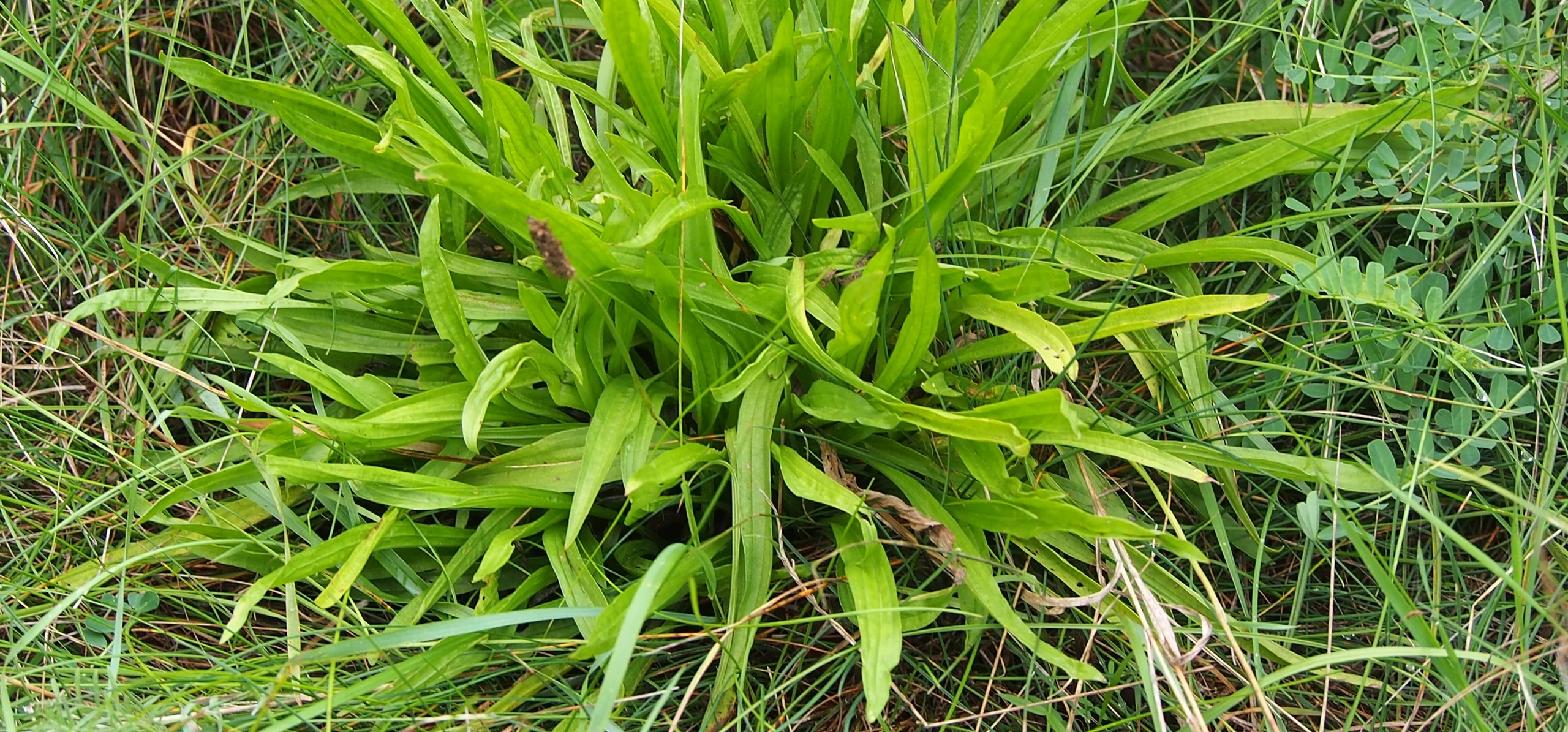
Ribwort Plantain
Plantago lanceolata
Family · Plantaginaceae
Narrowleaf plantain grows from a single taproot into a ribbed rosette, thrives in full sun on clay to sandy soil, and regrows fast after mowing or weeding.
Plantago lanceolata
Plant profile
- WateringLittleWater every 12 days
- Light exposureFull sun
- Hardiness zoneUSDA 5–9
Growth
- Family
- Plantaginaceae
- Life cycle
- Perennial
- Growth speed
- 6/10
- Mature size
- 15–46 cm
- Flowering
- Cone-shaped spikes with creamy white anthers, mainly summer into autumn (RHS)
- Propagation
- Seed
Soil & climate
- Soil types
- clay, loam, sand
- Drought tolerance
- Yes
Light & Placement
- Origin
- Native to Macaronesia, North Africa to Mauritania, and temperate Eurasia (POWO)
- Where to place it
- Sunny lawn or meadow
- Herb garden bed
- Path edge or disturbed bare ground
- Small pot or trough for the variegated ornamental cultivars
Safety
- Toxicity
- Not listed by the ASPCA for cats, dogs, or horses
- Pet safe
- No
Invasive speciesNC State Extension tags it a perennial weed that self-sows readily from its flower spikes and resprouts from the crown if the taproot is left in the ground.
Data fromGBIF: Plantago lanceolata L.Plants of the World Online (Kew): PlantaRHS: Plantago lanceolata (ribwort plantaNC State Extension Gardener Plant Toolbo
Where it grows
World distribution
Ribwort Plantain is native to 57 countries: Afghanistan, Albania, Algeria, Austria, Belarus, Belgium, Bhutan, and Bulgaria….GBIF records 1,933,126 documented identifications across 151 countries, with the largest concentrations in United Kingdom, France, and Netherlands.
- Afghanistan
- Albania
- Algeria
- Austria
- Belarus
- Belgium
- Bhutan
- Bulgaria
- China
- Croatia
- Cyprus
- Czechia
Show 45 more countriesShow fewer countries
- Denmark
- Estonia
- Faroe Islands
- Finland
- France
- Georgia
- Germany
- Greece
- Hungary
- Iceland
- India
- Iran
- Iraq
- Ireland
- Italy
- Kazakhstan
- Kuwait
- Kyrgyzstan
- Lebanon
- Libya
- Mauritania
- Mongolia
- Morocco
- Nepal
- Netherlands
- Norway
- Pakistan
- Palestinian Territories
- Poland
- Portugal
- Romania
- Russia
- Saudi Arabia
- Spain
- Sweden
- Switzerland
- Taiwan
- Tajikistan
- Tunisia
- Türkiye
- Turkmenistan
- Ukraine
- United Kingdom
- Uzbekistan
- Yemen
Yellow to orange dots: concentration of documented identifications per country. Green countries: sourced native range. Source: GBIFNative range from POWO (Kew).
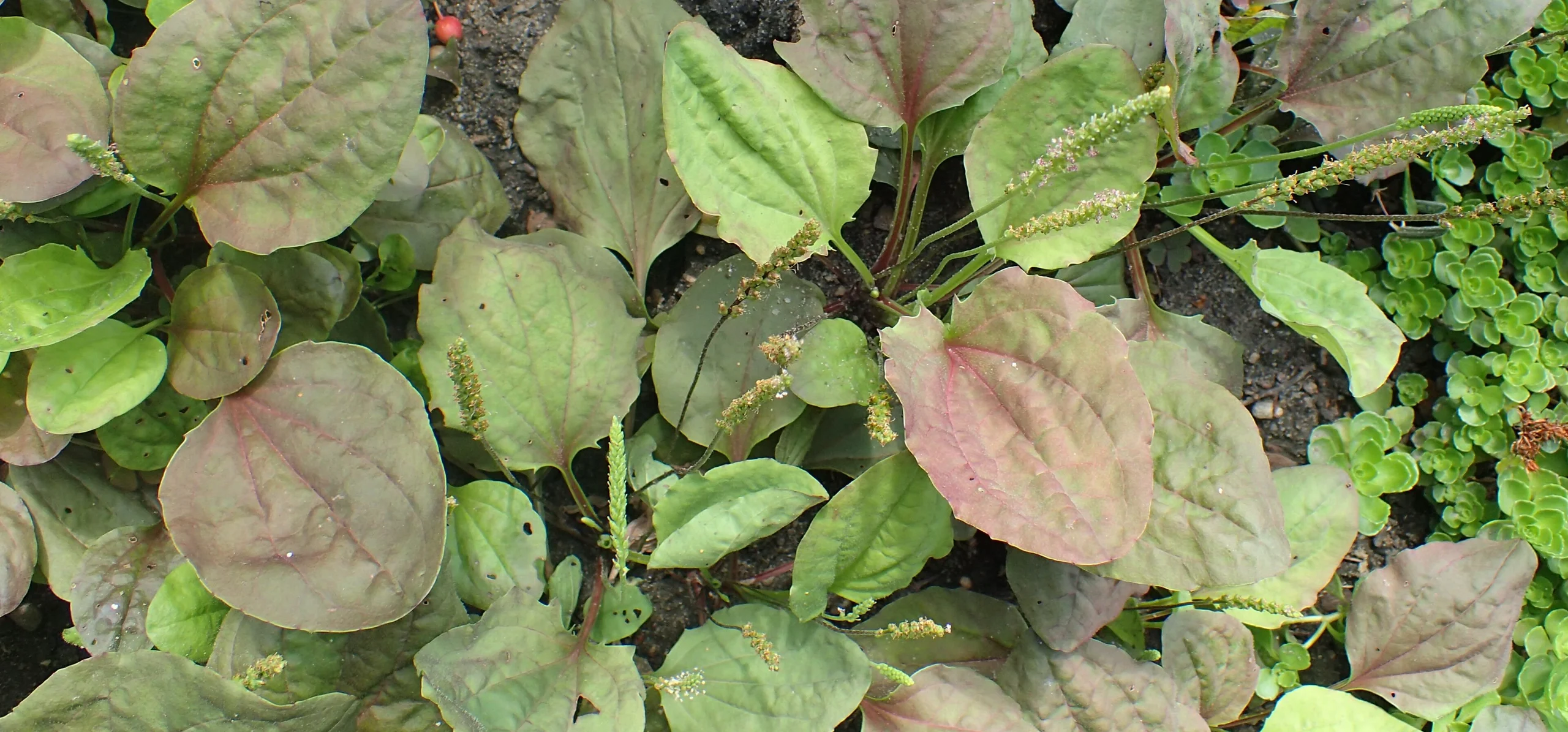
Pull a rosette of narrow, deeply ribbed leaves out of a lawn and you are holding the same plant that turns up as "ribwort plantain" or "narrowleaf plantain" on wildflower seed packets: Plantago lanceolata. Each leaf tapers into a long stalk and shows the parallel ribs that give the plant its common name, a shape that separates it at a glance from the broad, oval leaves of its relative Plantago major. Left to flower, it sends up wiry, hairy stalks topped with a tight, cone-shaped spike ringed in cream stamens, blooming through most of the growing season. Whether it arrived on its own or you sowed it in a border, the plant asks for very little once its taproot is down.
A Taproot, Not a Spreading Crown
Unlike broadleaf plantain, which persists from a shallow crown that keeps regrowing after mowing, ribwort plantain anchors itself with a single long taproot (RHS). It does not spread by rhizome or runner: every new rosette in a lawn or meadow started as a separate seed, since seed is the only propagation method NC State Extension lists for it. That matters for control and for cultivation alike. Mow or graze the top growth and the plant simply resprouts from the crown at soil level; only removing the taproot, or smothering the rosette long enough to exhaust it, gets rid of an individual plant. In a border grown on purpose, that same taproot is what carries it through a dry stretch without wilting.
Origin, and Where It Has Spread Since
Plants of the World Online lists the native range as Macaronesia, North Africa to Mauritania, and temperate Eurasia, which covers most of Europe and reaches into western Asia. It has since naturalised well beyond that range, most often riding along with grass and clover seed mixes into disturbed, mown, or grazed ground. NC State Extension classes it as a perennial weed of lawns, pastures, and roadsides in the United States, where it now grows about as freely as it does in its native range.
Light and Soil It Actually Needs
NC State Extension lists full sun, six or more hours of direct light a day, as what the species needs to grow well; it is not a plant for a shaded border. Soil is far more forgiving: the same source records it tolerating clay, loam, and sandy soils, provided drainage is good, and the RHS adds that it grows in all but the most acidic ground. That combination, a taproot below and full sun above, is exactly why it colonises compacted lawns and gravel-edged paths that many other plants avoid.


Watering: The Taproot Does the Work
There is no published watering schedule for the species because, once the taproot is established, it rarely needs one. The RHS grows it in open, well-drained positions with no irrigation notes attached, and NC State Extension's own description leans on drainage rather than moisture retention. In practice that means watering a newly sown or transplanted rosette until the first true leaves harden, then stepping back and letting the taproot take over: soil that stays wet around the crown is a bigger risk to this plant than soil that dries out between rains.
Flower Spikes and the Cream-Ringed Cone
The flowering stalks are leafless and covered in fine silky hairs, rising well above the rosette to a tight, cone-shaped spike, to about 8cm long, of small brown flowers ringed in creamy white anthers (RHS). They open through summer and, on many sites, from spring into autumn. Because the flowers sit close together and open in a ring working up the cone, a single spike can be shedding pollen at the top while the lower flowers are still setting seed, part of why one plant can look like it is flowering for months without ever finishing.
Growing It on Purpose: Cultivars Worth Choosing
Most gardeners meet this species as a weed, but the RHS lists several cultivated forms worth planting on purpose: 'Golden Spears', grown for gold-variegated foliage, and forms such as 'Freaky' and 'Dent's Downs Link' selected for unusual, fasciated flower heads rather than the plain wild type. NC State Extension also rates the young leaves as edible, which is why the species turns up in herb garden plantings as well as ornamental borders, not only as something to weed out of the lawn.
Common Mistakes and Telling It Apart from Broadleaf Plantain
The most common mistake is treating it like broadleaf plantain: pulling the visible rosette and assuming the plant is gone. Because the anchor is a taproot rather than a shallow crown, any piece of root left behind can regrow, so hand weeding needs a trowel under the crown, not just a firm tug on the leaves. The second mistake is misidentifying it in a lawn before it flowers: narrow, ribbed, upright leaves on a long stalk belong to Plantago lanceolata, while broad, oval leaves lying flat against the soil belong to Plantago major. Mixing the two up matters less for pulling weeds than for anyone gathering the leaves to eat or for a traditional poultice, since the two species are not used interchangeably despite the shared genus.
Test your plant knowledge
Tap a card to flip it and reveal the answer.
Ribwort plantain regrows from a single taproot rather than from spreading rhizomes. Tap to reveal ✓ True
Pulling off just the visible leaves is usually enough to remove the plant for good. Tap to reveal ✕ False
Narrow, ribbed leaves are what separate it from the broad, oval leaves of Plantago major. Tap to reveal ✓ True
Plantago lanceolata thrives in full sun and tolerates clay, loam, or sandy soil as long as it drains. Tap to reveal ✓ True
The ASPCA lists ribwort plantain as toxic to dogs. Tap to reveal ✕ False
Sources
References consulted for this guide
- GBIF: Plantago lanceolata L.gbif.org
- Plants of the World Online (Kew): Plantago lanceolatapowo.science.kew.org
- RHS: Plantago lanceolata (ribwort plantain)rhs.org.uk
- NC State Extension Gardener Plant Toolbox: Plantago lanceolataplants.ces.ncsu.edu
- Reference entity : Wikipédiaen.wikipedia.org