Common Toadflax
Linaria vulgaris
Family · Plantaginaceae
Butter-and-eggs spreads by creeping rhizome into colonies, needs a long-tongued bumblebee to open its flower, and is a regulated weed in the western US.
Linaria vulgaris
Plant profile
- WateringLittleWater every 12 days
- Light exposureFull sun
- Ideal temperature-20–-15 °C
Growth
- Family
- Plantaginaceae
- Life cycle
- Perennial
- Growth speed
- 7/10
- Mature size
- 10–50 cm
- Spread
- 10–50 cm
- Flowering
- Late spring to mid-autumn
- Propagation
- Seed
- Division
- Cutting
Dormancydies back to a below-ground rootstock and creeping rhizomes over winter, regrowing from root buds in spring
Time to maturityRHS lists 2 to 5 years to full garden maturity, though rhizome buds can widen a young clump into a visible colony within two or three growing seasons
Soil & climate
- Soil types
- loam, sand, gravel
- Drought tolerance
- Yes
Light & Placement
- Origin
- Europe to Siberia and Central Asia (POWO), now naturalised across North America
- Where to place it
- wildflower meadow
- roadside verge
- railway bank
- gravel garden
- waste ground
- cottage garden border
Safety
- Pet safe
- No
ToxicityNot listed in the ASPCA toxic and non-toxic plant database; Colorado State University Extension notes its glucosides are mildly poisonous to grazing livestock in quantity
Invasive speciesListed as a List B noxious weed under the Colorado Noxious Weed Act, and noted by North Carolina State University Extension as invasive in North Carolina and several other western US states
Data fromLinaria vulgaris Mill., GBIF Backbone TaPOWO: Linaria vulgaris Mill.RHS: Linaria vulgaris (common toadflax)North Carolina Extension Gardener Plant CSU Agricultural Biology: Yellow Toadfla
Where it grows
World distribution
Common Toadflax is native to 37 countries: Albania, Austria, Belarus, Belgium, Bulgaria, China, Croatia, and Czechia….GBIF records 558,508 documented identifications across 81 countries, with the largest concentrations in France, United Kingdom, and Netherlands.
- Albania
- Austria
- Belarus
- Belgium
- Bulgaria
- China
- Croatia
- Czechia
- Denmark
- Estonia
- Finland
- France
Show 25 more countriesShow fewer countries
- Georgia
- Germany
- Greece
- Hungary
- Ireland
- Italy
- Kazakhstan
- Kyrgyzstan
- Lebanon
- Mongolia
- Netherlands
- Norway
- Pakistan
- Poland
- Romania
- Russia
- South Korea
- Spain
- Sweden
- Switzerland
- Tajikistan
- Türkiye
- Ukraine
- United Kingdom
- Uzbekistan
Yellow to orange dots: concentration of documented identifications per country. Green countries: sourced native range. Source: GBIFNative range from POWO (Kew).
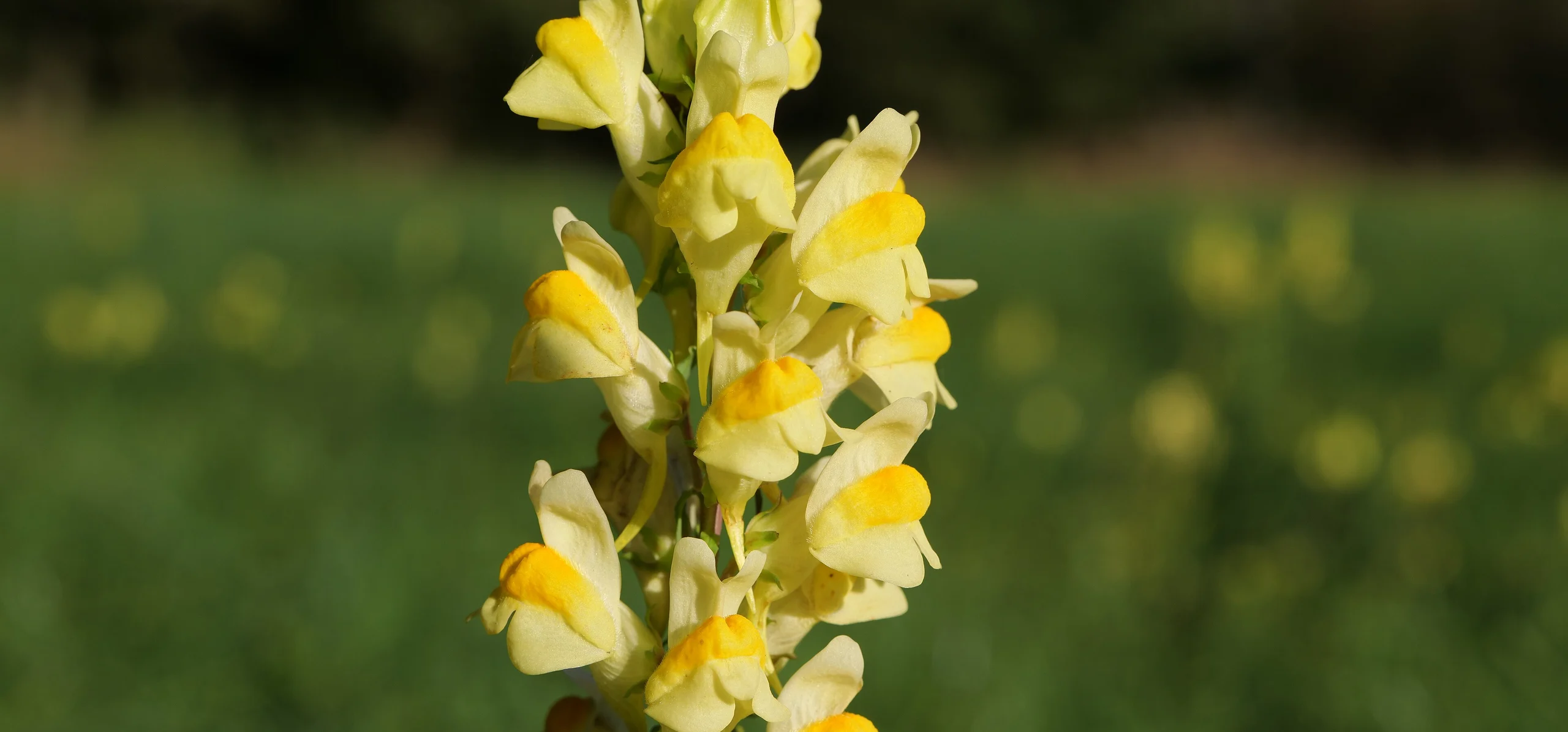
Common toadflax announces itself along a roadside verge or a railway embankment as a spike of pale yellow, snapdragon-shaped flowers with a raised orange-yellow throat, growing in a dense clump that, look closer, is rarely a single plant. Linaria vulgaris spreads by creeping underground rhizomes as readily as by seed, so the patch in front of you is usually one genetic individual that has pushed up dozens of shoots along its own root system. Its flowers stay sealed shut to most insects: only a bumblebee heavy and long-tongued enough to force the two lips apart can reach the nectar inside. That combination, a colonizing root system and a pollinator-specific flower, explains both why it is welcomed as a wildflower-meadow plant in Europe and regulated as a noxious weed across parts of western North America.
Origin and Where It Naturally Grows
Plants of the World Online places the native range of Linaria vulgaris across Europe to Siberia and Central Asia, where it grows on open, disturbed, often dry ground: field margins, riverbanks, waste ground and rocky slopes. It has since spread far beyond that range and, according to North Carolina State University Extension, now turns up from Alaska to Texas as well as in Canada, South Africa and southern South America, almost always in the same kind of disturbed, sunny habitat: verges, railway banks, gravel yards and abandoned lots rather than closed woodland or dense turf.
A Colony From One Plant: Creeping Rhizomes
What looks like a stand of toadflax is usually the work of one plant's root system rather than many separate seedlings. Colorado State University's Agricultural Biology program describes lateral roots that spread outward by around a metre a year, sending up new shoots as they go, and notes that root fragments as small as a centimetre can regenerate into an independent plant if disturbed. That is why hoeing off the top growth rarely gets rid of a patch: the rhizome network below keeps producing new stems. In a garden bed this same trait turns a single purchased plant into a spreading colony within two or three seasons, so anyone growing it deliberately, rather than tolerating it on a verge, is better off containing it in a large buried pot or a bottomless container sunk into the border, since a root barrier is the only reliable way to stop it colonizing the rest of the bed.
Only Long-Tongued Bumblebees Can Open the Flower
The flower's throat is a trap by design. Its two lips are pressed shut, and studies of this species describe the mouth staying closed until a bee heavy and strong enough forces its way in, which in practice limits legitimate pollination to long-tongued bumblebees such as Bombus hortorum and Bombus pascuorum, able to reach the nectar pooled in the flower's long spur. Shorter-tongued species, including the common Bombus terrestris, cannot reach that far and instead bite a hole through the base of the spur to rob the nectar without ever touching the pollen-bearing anthers, so a visit from one of those bees does nothing for seed set. It is a neat illustration of how a flower shape filters its own pollinators rather than simply attracting whichever insect happens by.


Sun and Poor, Dry Soil
The RHS rates common toadflax for full sun on a south or west facing spot, in loam or sandy soil that drains freely, tolerating acid, neutral or alkaline ground and both exposed and sheltered positions. It is rated H6 hardy, surviving winter lows of -20 to -15C across the UK and northern Europe without protection. None of this calls for feeding or improving the soil: this is a plant of gravel verges and rubble banks, and rich, moisture-retentive ground only encourages soft, floppy growth and more aggressive spread. If you are growing it on purpose, poor, lean soil and a spot that bakes in summer sun will keep it closer to its wild, self-supporting habit.
A Regulated Weed in Western North America
The same rhizome spread that makes it easy to establish makes it a liability once it escapes a garden. Colorado's Noxious Weed Act lists yellow toadflax as a List B species, one that land managers are required to control or contain, and North Carolina State University Extension notes it has become invasive in several other western states as well. Colorado State University Extension also flags a grazing risk: the plant contains glucosides that are mildly poisonous to livestock if eaten in quantity, part of why it is discouraged from rangeland and pasture edges rather than left to spread through grazed ground. Seed adds to the problem: Colorado State University Extension records 15,000 to 30,000 seeds from a single plant, staying viable in the soil for eight to ten years, so a site cleared of visible plants can still resprout from the seed bank for a decade afterward.
Self-Seeding and a Place in the European Wildflower Meadow
In its native range, the same seed output and rhizome spread that make it a pest abroad are exactly why it earns a spot in a European wildflower meadow. The RHS lists common toadflax as a UK native suited to wildflower meadows, cottage gardens and wildlife borders, and awards it its Plants for Pollinators mark for the bumblebees, solitary bees and moths it supports through a long flowering season, from late spring to mid-autumn. Left to self-seed in an unmown or once-a-year-cut meadow strip, it will hold its place among grasses without needing replanting, though in a smaller, tended border the same self-seeding habit means deadheading spent spikes before they set seed if you want to keep the colony from expanding past where you put it.
Is It Safe Around Pets? Checking the ASPCA List
A search of the ASPCA's toxic and non-toxic plant database turns up no entry for toadflax or Linaria vulgaris, so it is best treated as not formally listed rather than confirmed safe. That is a different question from the livestock toxicity noted above: the ASPCA's pet database covers cats, dogs and horses specifically, and its silence on this species is not the same as a clean bill of health, since Colorado State University's grazing guidance was written with cattle and rangeland in mind, not household pets. If a dog or cat shows any signs of illness after chewing on it, that is still worth a call to a vet: absence from the ASPCA list is proof only that this species has not been formally assessed, not proof of safety.
Common Mistakes
The most common mix-up is with Linaria purpurea, the taller, purple-flowered garden toadflax sold for borders: it self-seeds freely too but does not run by rhizome the way Linaria vulgaris does, so treating the wild yellow species as equally well-behaved is how a bed ends up overrun. The second mistake is planting it straight into open, fertile border soil expecting it to behave like a well-mannered perennial: without a root barrier, the same lateral roots that colonize a roadside verge will just as happily work through a flower bed. Finally, cutting back top growth alone, whether by hand or mower, controls flowering for a season but leaves the rhizome network intact underground, so a patch that seems to disappear in autumn is usually back the following spring.
Test your plant knowledge
Tap a card to flip it and reveal the answer.
Only bees strong and long-tongued enough to force open the flower's closed lips can reach Linaria vulgaris's nectar. Tap to reveal ✓ True
A Linaria vulgaris plant stays where it germinated, spreading only by dropping seed nearby. Tap to reveal ✕ False
The ASPCA's toxic and non-toxic plant database lists toadflax (Linaria vulgaris) by name. Tap to reveal ✕ False
Yellow toadflax is classified as a List B noxious weed under Colorado's Noxious Weed Act. Tap to reveal ✓ True
The RHS recommends common toadflax for wildflower meadows and lists it as a UK native. Tap to reveal ✓ True
Sources
References consulted for this guide
- Linaria vulgaris Mill., GBIF Backbone Taxonomygbif.org
- POWO: Linaria vulgaris Mill.powo.science.kew.org
- RHS: Linaria vulgaris (common toadflax)rhs.org.uk
- North Carolina Extension Gardener Plant Toolbox: Linaria vulgarisplants.ces.ncsu.edu
- CSU Agricultural Biology: Yellow Toadflaxagsci.colostate.edu
- Reference entity : Wikipédiaen.wikipedia.org