Broadleaf Plantain
Plantago major
Family · Plantaginaceae
Broadleaf plantain grows where soil is compacted, survives mowing from a low crown, and banks thousands of seeds: identification, control, two ornamental forms.
Plantago major
Plant profile
- WateringModerateWater every 10 days
- Light exposurePartial sun
Growth
- Family
- Plantaginaceae
- Life cycle
- Perennial
- Growth speed
- 5/10
- Mature size
- 5–50 cm
- Spread
- 13–30 cm
- Propagation
- Seed
FloweringDense, narrow greenish-brown flower spikes from April to September (NC State Extension)
Time to maturitySeedling stage lasts roughly 8 to 15 weeks before the plant reaches a mature crown (UC IPM)
Soil & climate
- Soil types
- clay, loam
- Saline soil
- Not tolerated
- Drought tolerance
- No
Light & Placement
- Where to place it
- compacted lawn or path edge
- disturbed bare ground
- border or container for the ornamental forms
- small pot or trough, mainly for the ornamental cultivars 'Rubrifolia' and 'Rosularis'
OriginNative to temperate Eurasia to the Arabian Peninsula, Macaronesia, and northern and southern Africa (POWO)
Safety
- Toxicity
- Not listed by the ASPCA for cats, dogs or horses
- Pet safe
- No
Invasive speciesNC State Extension and UC IPM both describe it as a persistent lawn and garden weed that spreads by heavy seed production and resists mowing, hand-pulling and hoeing because of its crown
Data fromGBIF: Plantago major L.Plants of the World Online (Kew): PlantaNC State Extension Gardener Plant ToolboUC IPM (UC ANR): Plantains
Where it grows
World distribution
Broadleaf Plantain is native to 60 countries: Afghanistan, Albania, Algeria, Austria, Belarus, Belgium, Bulgaria, and Cape Verde….GBIF records 1,337,667 documented identifications across 188 countries, with the largest concentrations in United Kingdom, France, and Netherlands.
- Afghanistan
- Albania
- Algeria
- Austria
- Belarus
- Belgium
- Bulgaria
- Cape Verde
- China
- Croatia
- Cyprus
- Czechia
Show 48 more countriesShow fewer countries
- Denmark
- Egypt
- Estonia
- Finland
- France
- Georgia
- Germany
- Greece
- Hungary
- India
- Iran
- Iraq
- Ireland
- Italy
- Japan
- Kazakhstan
- Kyrgyzstan
- Lebanon
- Lesotho
- Libya
- Mongolia
- Morocco
- Namibia
- Nepal
- Netherlands
- Norway
- Oman
- Pakistan
- Palestinian Territories
- Poland
- Portugal
- Romania
- Russia
- Saudi Arabia
- South Africa
- South Korea
- Spain
- Sweden
- Switzerland
- Taiwan
- Tajikistan
- Tunisia
- Türkiye
- Turkmenistan
- Ukraine
- United Kingdom
- Uzbekistan
- Yemen
Yellow to orange dots: concentration of documented identifications per country. Green countries: sourced native range. Source: GBIFNative range from POWO (Kew).
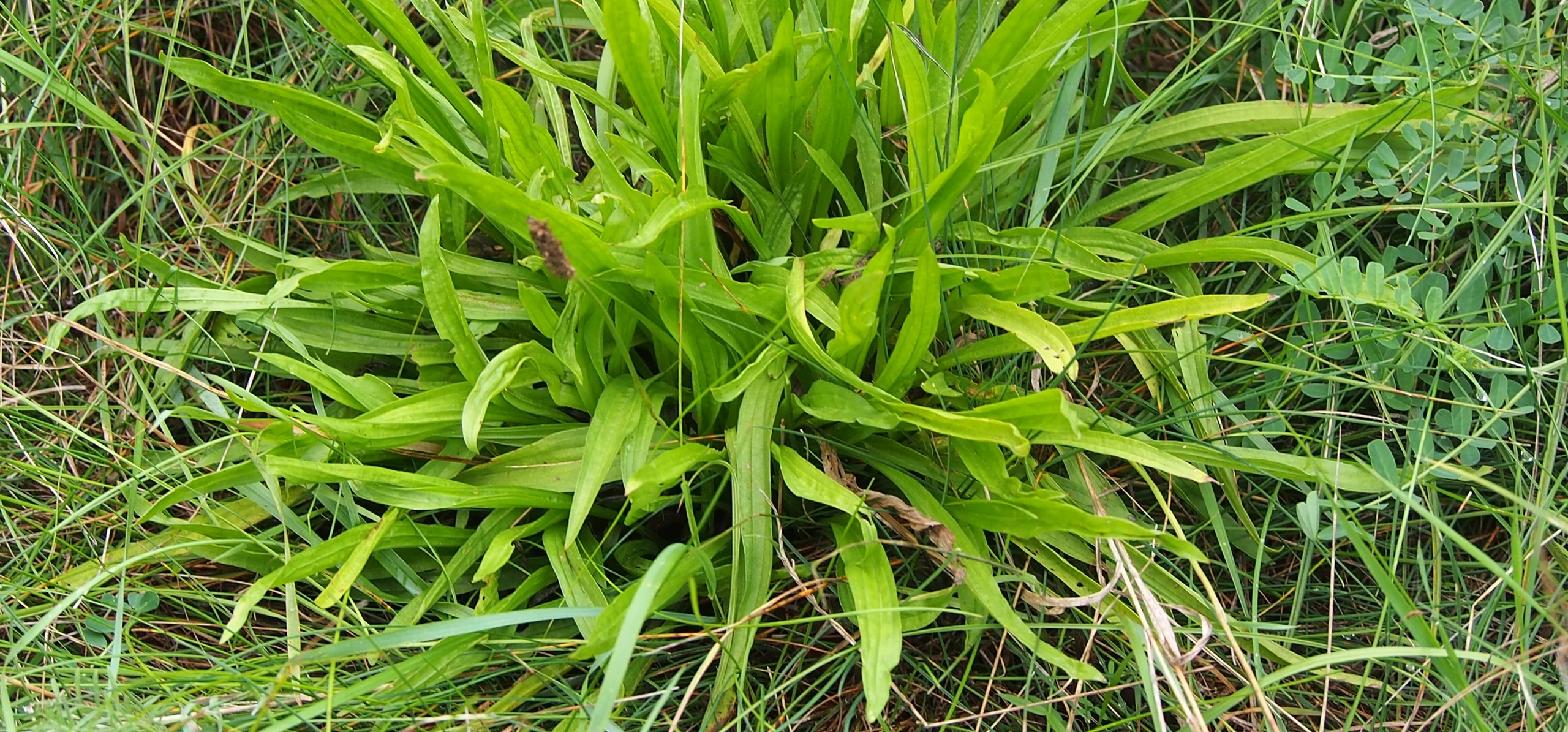
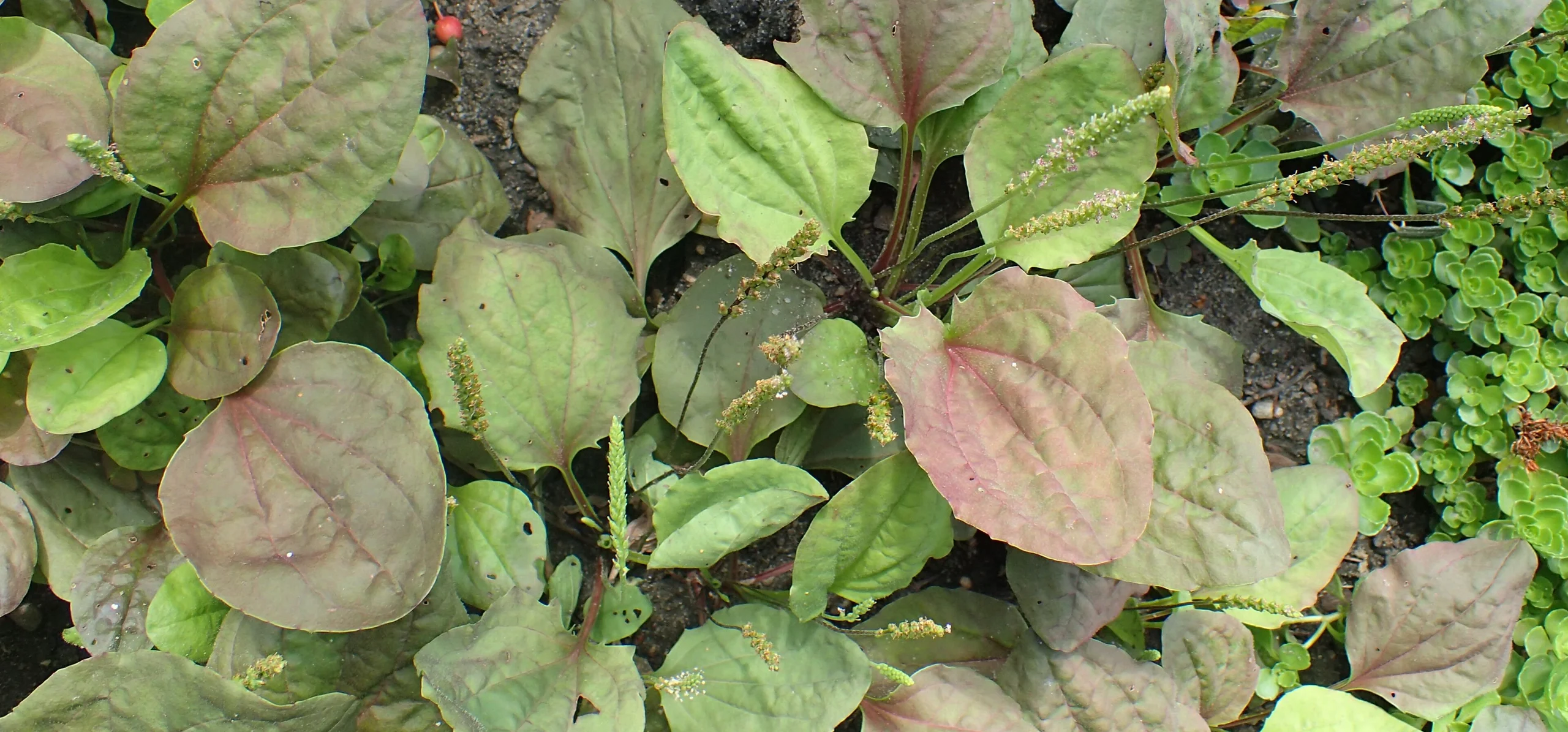
A flat rosette of broad, oval leaves lying close to the ground, with one or more slender green spikes of tiny flowers rising from the middle, is almost always Plantago major, broadleaf plantain, also called common or greater plantain. GBIF records the accepted name as Plantago major L., in the plantain family Plantaginaceae. It rarely turns up in a tended border first; it shows up in the packed dirt beside a gate, the worn strip down the middle of a path, or the thin patch of lawn that gets walked on every day, and NC State Extension notes it does particularly well in exactly that kind of compacted or disturbed soil. That habit is the single most useful thing to know about this weed: it is not there by accident.
A Compaction Indicator, Not a Random Weed
UC IPM lists broadleaf plantain as an indicator weed of soils with low fertility and compaction, most often in moist ground under full sun or partial shade. Most turf grasses and border plants need loose, aerated soil to root well; compaction squeezes the air and drainage out of the top few inches, and species that cannot cope simply thin out. Plantain's shallow, wide crown and fibrous roots ask for almost none of that, so where competition drops out on hard-packed ground, plantain moves in and holds the space. Seeing a solid patch of it in a lawn is a reasonably reliable sign that the ground underneath has been compacted, whether by foot traffic, a parked vehicle, or heavy machinery.
Reading the Rosette: Leaves and Seed Spikes
UC IPM describes the leaf blades as smooth and oval, 2 to 7 inches long, with several veins that run parallel to the leaf margin and converge at the base into a broad petiole; NC State Extension gives a similar 2- to 8-inch length with five to seven prominent veins. All of the leaves originate from the crown at ground level, never from an upright stem. The flowering stalks are leafless and can reach up to 15 inches according to UC IPM, each topped with a dense, narrow, cylindrical spike of small greenish-brown flowers that NC State Extension records blooming from April to September; the capsules that follow split into two segments holding six to twenty seeds apiece. The similarly common Plantago lanceolata, buckhorn plantain, is easy to confuse it with at a glance, but its leaves are narrow and lance-shaped rather than broad and oval, a difference visible even before either plant flowers.
Why Mowing Never Slows It Down
UC IPM is direct about the mechanism: plantains grow from the crown area at the soil surface, which allows the plant to persist after defoliation or mowing, and the leaves lie close enough to the ground that a mower blade set at any normal cutting height passes over the rosette without touching it. Removing a flower spike costs the plant one season's seed from that stalk, but the crown underneath sends up another within weeks. A lawn mown every week all summer can carry a thriving population of broadleaf plantain that has never once had its growing point damaged.


Digging Out the Crown, Not Just the Leaves
UC IPM describes the crown as tough, short and fibrous-rooted, thickening to 6 to 10 inches across on a mature plant, and states plainly that mature plantain is difficult to control by hand-pulling, digging or hoeing alone because of that persistent crown. Grabbing the rosette and pulling usually snaps the leaves off at the crown and leaves the crown itself intact underground, ready to push up new growth. A garden fork or a long-bladed weeding knife worked down alongside the crown, angled to lift the whole root mass rather than tug at the top, is what actually removes the plant. Because plantain is a symptom of compacted soil, taking out the crown without loosening the ground around it just clears space for the next seed to germinate in the same compacted patch; aerating that section of lawn or working organic matter into a border bed addresses the condition the weed was responding to in the first place.
A Seed Bank That Outlasts One Weeding Session
NC State Extension puts seed production at up to 20,000 seeds from a single plant in one season, each capsule splitting into two segments of six to twenty seeds. Only a fraction of that germinates immediately; the rest settles into the soil as a reserve that can resurface for years after the parent plant is gone. That is why a patch of broadleaf plantain that seems to vanish after a thorough weeding often reappears the following spring in the same spot: the visible rosette was removed, but the seed bank underneath it was not touched by pulling a single plant.
A Traditional Poultice, Not a Modern Remedy
NC State Extension notes that the leaves were historically used to treat bites, stings, cuts, sore feet, and ailments of the eyes, tongue and mouth, typically crushed or chewed and applied directly to the skin as a poultice, and that young leaves were also eaten as a vegetable similar to spinach. The same source records that ingesting large quantities can cause a drop in blood pressure. Those are historical and traditional uses recorded by an extension source, not a recommendation, and nothing here substitutes for medical advice.
Ornamental Forms: 'Rubrifolia' and 'Rosularis'
Two selections turn the same species into a deliberate garden plant. 'Rubrifolia' keeps the broad rosette shape of the wild plant but replaces the plain green leaves with bronze, burgundy or near-black foliage, the color usually deepening further into autumn. 'Rosularis', sometimes sold as rose plantain, is stranger: instead of the usual slender flower spike, the flowering stem produces a tight rosette of ruffled green bracts, a curiosity that was reportedly grown in English and European cottage gardens as far back as Medieval times. Both are grown for their foliage or flower-head novelty rather than for any practical use, and both keep the parent species' tolerance for ordinary garden soil.
Common Mistakes, and Who Actually Eats the Seed
The most frequent identification mistake is calling any low rosette weed with a flower spike broadleaf plantain without checking the leaf shape against buckhorn plantain's narrower, lance-shaped leaves. The most frequent control mistake is pulling only the top growth and assuming the plant is gone, when the crown left in the ground can resprout within the same season. It is also worth not treating every patch as pure nuisance: NC State Extension notes that birds eat the seeds, which are high in oil, making an unweeded patch a minor but real food source through late summer. On the safety side, a search of the ASPCA's toxic and non-toxic plant lists turns up no entry for Plantago major or broadleaf plantain, so this guide records the ASPCA status as not-listed rather than confirmed safe for cats, dogs or horses, and keeps the profile free of any toxicity claim the ASPCA has not actually made.
Test your plant knowledge
Tap a card to flip it and reveal the answer.
Broadleaf plantain often shows up in the exact spot where soil is most compacted. Tap to reveal ✓ True
Regular mowing kills broadleaf plantain within a season or two. Tap to reveal ✕ False
Pulling off the visible leaves is usually enough to remove a plantain plant for good. Tap to reveal ✕ False
A single broadleaf plantain plant can produce thousands of seeds in one season. Tap to reveal ✓ True
The ASPCA lists broadleaf plantain as confirmed non-toxic to cats and dogs. Tap to reveal ✕ False
Sources
References consulted for this guide
- GBIF: Plantago major L.gbif.org
- Plants of the World Online (Kew): Plantago majorpowo.science.kew.org
- NC State Extension Gardener Plant Toolbox: Plantago majorplants.ces.ncsu.edu
- UC IPM (UC ANR): Plantainsipm.ucanr.edu
- Reference entity : Wikipédiaen.wikipedia.org