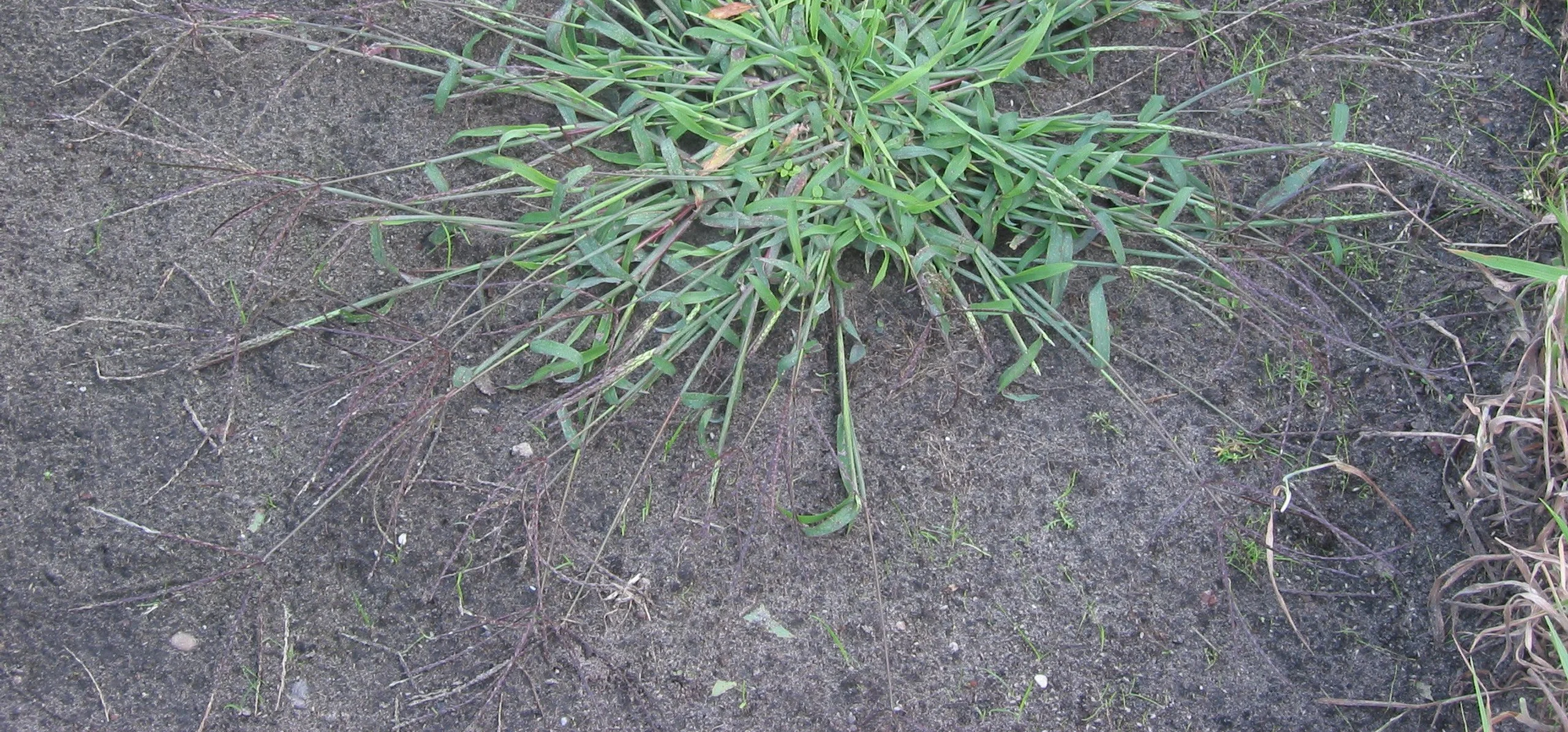
Hairy Crabgrass
Digitaria sanguinalis
Family · Poaceae
Digitaria sanguinalis germinates once soil hits about 13 degrees C, thrives in thin, short-mown, drought-stressed lawns, and dies at the first fall frost.
Digitaria sanguinalis
Plant profile
- WateringLittleWater every 7 days
- Light exposureFull sun
Growth
- Family
- Poaceae
- Life cycle
- Annual
- Growth speed
- 9/10
- Mature size
- 3–60 cm
- Propagation
- Seed
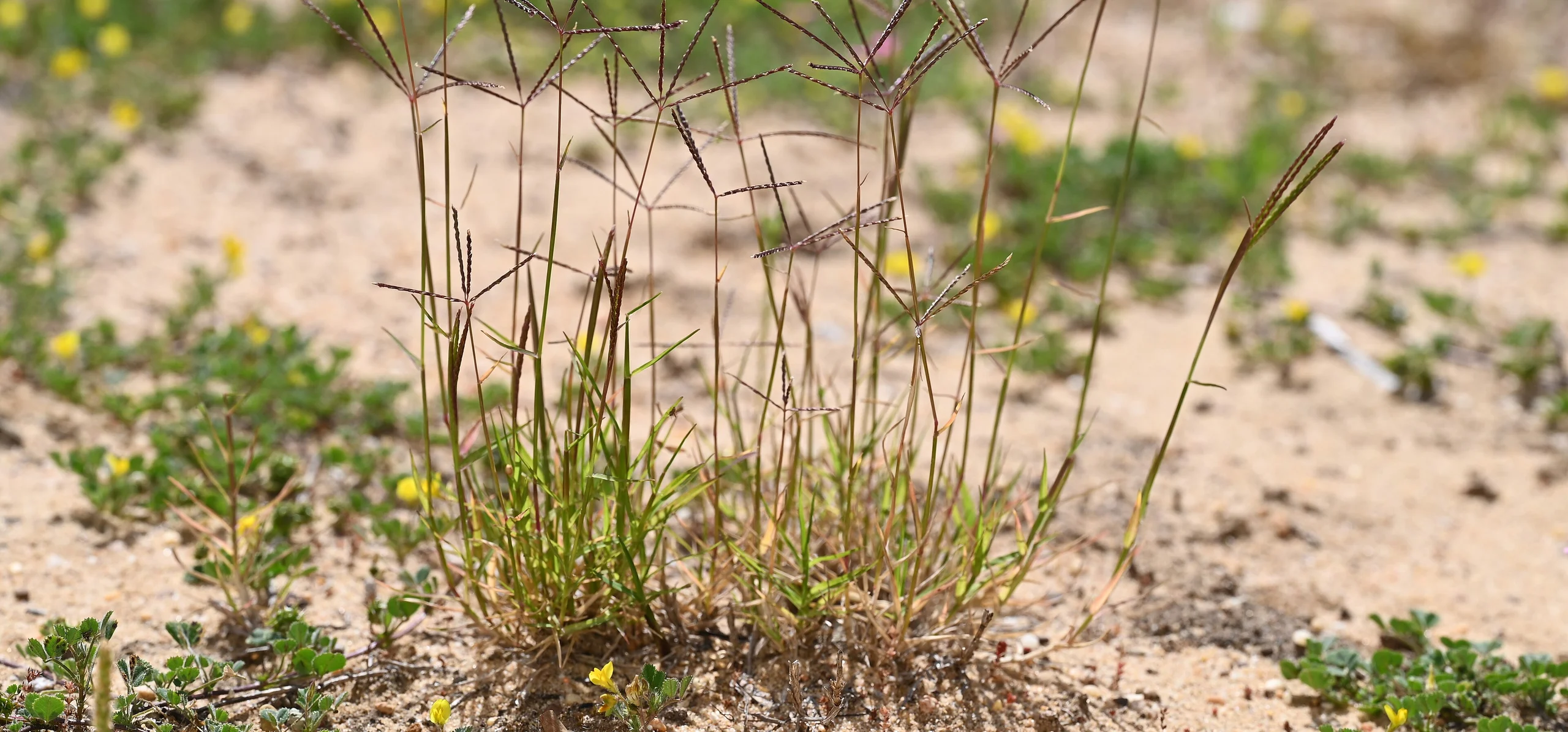
FloweringFinger-like seed heads of 2 to 8 spikelet-covered branches from midsummer into fall, opening continuously as long as the plant keeps growing
Dormancynone, killed outright by first frost
Time to maturitysets seed within weeks of germination
Soil & climate
- Soil types
- compacted, dry, poor
- Drought tolerance
- Yes
Light & Placement
- Where to place it
- thin, sun-exposed lawn turf
- bare or compacted soil, path edges and garden beds
OriginNative to the Mediterranean, Central Asia and Malesia (POWO); now naturalized worldwide as a summer lawn and crop weed, including most of temperate North America
Safety
- Pet safe
- No
ToxicityNot listed in the ASPCA toxic or non-toxic plant database under Digitaria sanguinalis or hairy crabgrass
Invasive speciesregulated in practice as a common summer annual weed of turf, cropland and disturbed ground across most of temperate and warm North America, spreading almost entirely by seed rather than by persistent roots (UC Statewide IPM Program)
Data fromGBIF: Digitaria sanguinalis (L.) Scop.University of Maryland Extension: CrabgrUniversity of Maryland Extension: Corn GPenn State Extension: Lawn and TurfgrassUC Statewide IPM Program: Crabgrass
Where it grows
World distribution
Hairy Crabgrass is native to 48 countries: Afghanistan, Albania, Algeria, Bangladesh, Bhutan, Bulgaria, Burundi, and Cape Verde….GBIF records 145,592 documented identifications across 169 countries, with the largest concentrations in France, Belgium, and Germany.
- Afghanistan
- Albania
- Algeria
- Bangladesh
- Bhutan
- Bulgaria
- Burundi
- Cape Verde
- Chad
- China
- Croatia
- Cyprus
Show 36 more countriesShow fewer countries
- Egypt
- France
- Georgia
- Greece
- Hungary
- India
- Iran
- Iraq
- Italy
- Kazakhstan
- Kyrgyzstan
- Lebanon
- Libya
- Malaysia
- Maldives
- Morocco
- Myanmar (Burma)
- Pakistan
- Palestinian Territories
- Papua New Guinea
- Philippines
- Portugal
- Romania
- Russia
- Saudi Arabia
- Spain
- Sudan
- Taiwan
- Tajikistan
- Tunisia
- Türkiye
- Turkmenistan
- Ukraine
- United Arab Emirates
- Uzbekistan
- Vietnam
Yellow to orange dots: concentration of documented identifications per country. Green countries: sourced native range. Source: GBIFNative range from POWO (Kew).
A Summer Grass Built to Exploit Bare, Weak Turf
Hairy crabgrass, Digitaria sanguinalis, is the sprawling, reddish-stemmed grass that shows up in lawns every July and August as a pale green rosette pressed flat against the soil, its stems rooting wherever a node touches bare ground. GBIF records the accepted name as Digitaria sanguinalis (L.) Scop., in the grass family Poaceae, with a long list of older synonyms, Digitaria aegyptiaca among them, still turning up in older weed keys. Unlike the turfgrass around it, crabgrass is a true summer annual: it germinates from seed each spring, grows fast through the heat of summer, sets seed continuously, and dies outright at the first fall frost, leaving nothing behind but seed in the soil.
Why It Wins in Thin, Short-Mown, Drought-Stressed Lawns
Crabgrass rarely invades a dense, well-fed lawn; it exploits the gaps one leaves for it. Penn State Extension notes it is most prevalent in sites with ample sunlight and thinning turf, and once a seedling is established it tolerates dry, compacted soil that leaves cool-season turfgrass struggling, according to Wisconsin Horticulture Extension. Mowing too short is, in that same extension's words, a common lawn care mistake that is a primary reason leading to crabgrass infestations: a low cut opens the canopy to sunlight at soil level, exactly what a crabgrass seed needs to germinate, while starving the desirable grass of the leaf area it needs to recover from drought and foot traffic. The result is a feedback loop: stress thins the lawn, a thin lawn lets in more crabgrass, and more crabgrass out-competes what turf is left.
Germination: Waiting for the Soil to Hit About 13 Degrees C
Crabgrass seed does not germinate on a calendar date; it waits for the soil itself to warm. University of Maryland Extension puts the threshold at soil temperatures above 55 degrees F, about 13 degrees C, for at least three consecutive days, and Penn State Extension gives an almost identical figure of 55 to 58 degrees F at daybreak for four to five days, given adequate moisture. That narrow window, typically reached in the top inch of soil in mid to late spring, is what makes crabgrass control a timing problem rather than a one-time treatment: treat too early and the seed simply waits it out; miss the window and the weed is already up before anyone gets to it. Wisconsin Horticulture Extension adds that fresh seed keeps germinating in flushes into early or mid-summer before tapering off by August.
Timing a Pre-Emergent, and the Corn Gluten Question
Because crabgrass only germinates once soil temperature clears that threshold, a pre-emergent herbicide has to already be down and active in the soil before germination starts, not after. Penn State Extension recommends applying it roughly 10 to 14 days ahead of the earliest expected local germination window, since a barrier that goes down after the first seedlings have emerged does nothing for them. Corn gluten meal is the organic option most often reached for instead of a synthetic herbicide: its protein interferes with root development in a newly germinated seedling, causing it to desiccate. University of Maryland Extension is candid, though, that results are mixed and that corn gluten is ineffective where weed pressure is already high; the extension does not officially recommend it over a program built on a genuinely dense, well-fed lawn, with a synthetic pre-emergent kept as a last resort where cultural control alone has fallen short.


Mowing High and Growing Dense Turf: The Real Cure
Every extension source agrees on the one change that matters most, and it costs nothing at the garden center. University of Maryland Extension recommends mowing at 3 to 4 inches through the growing season, and Wisconsin Horticulture Extension calls raising the mowing height a simple yet highly effective tool to reduce crabgrass problems. A taller canopy shades the soil surface, keeping it cooler and darker exactly when crabgrass seed needs light and warmth to germinate, and gives the desirable turf enough leaf area to out-compete seedlings that do come up. Reversing the conditions that invite an infestation, thin turf and a too-low mowing height, by mowing high and keeping density up through steady feeding and deep, infrequent watering rather than light, frequent watering, does more over a season than any single herbicide application.
Hand-Pulling Before It Sets Seed
For a handful of plants, or for anyone unwilling to spray, pulling crabgrass by hand remains a genuinely viable option; University of Maryland Extension lists it as a viable option at the beginning of an infestation and on young weeds, when the shallow root system lifts cleanly with the crown. Timing is what makes hand-pulling worth the effort: a single plant left to mature can produce, per the UC Statewide IPM Program, seed production exceeding 100,000 seeds, so pulling a rosette before its seed heads open is worth far more than pulling ten plants after they have already shed. The prostrate stems root again wherever a node touches soil, so grasp the plant at its crown rather than a single stem, and lift the whole rooted mat instead of snapping off the visible growth on top.
First Frost Ends It, and Leaves Bare Patches to Overseed
Because crabgrass is a true annual with no perennial root to fall back on, the first hard frost of autumn kills the entire plant outright. University of Maryland Extension states plainly that crabgrass dies after the first frost in the fall, and by then the bare, thinned patches it leaves behind are the real problem still to solve, not the dead grass itself. Overseeding those spots with a desirable turfgrass in early fall, while soil is still warm enough for germination but the current season's crabgrass has already finished, gives the lawn a head start on next spring's competition for light and space before the germination window opens again.
Is Hairy Crabgrass Toxic to Pets?
A search of the ASPCA's toxic and non-toxic plant database turns up no entry for Digitaria sanguinalis or hairy crabgrass under either name, so it counts as not-listed rather than confirmed non-toxic. In practice it is treated the same way as most lawn grasses: a dog or cat that nibbles a blade or two in passing is not considered at meaningful risk, though any lawn just treated with a pre-emergent or a postemergence herbicide should be kept off-limits to pets for whatever re-entry interval the product label specifies.
Test your plant knowledge
Tap a card to flip it and reveal the answer.
Digitaria sanguinalis is a true summer annual that is killed outright by the first fall frost. Tap to reveal ✓ True
Crabgrass seed germinates as soon as spring arrives, regardless of soil temperature. Tap to reveal ✕ False
A single crabgrass plant can produce more than 100,000 seeds in one season. Tap to reveal ✓ True
Corn gluten meal reliably prevents crabgrass in every lawn it is applied to. Tap to reveal ✕ False
Raising the mowing height is one of the most effective ways to reduce a crabgrass infestation. Tap to reveal ✓ True
Sources
References consulted for this guide
- GBIF: Digitaria sanguinalis (L.) Scop.gbif.org
- University of Maryland Extension: Crabgrassextension.umd.edu
- University of Maryland Extension: Corn Gluten for Crabgrass Controlextension.umd.edu
- Penn State Extension: Lawn and Turfgrass Weeds, Smooth Crabgrass and Large Crabgrassextension.psu.edu
- UC Statewide IPM Program: Crabgrassipm.ucanr.edu
- Reference entity : Wikipédiaen.wikipedia.org