Lemongrass
Cymbopogon citratus
Family · Poaceae
Lemongrass roots from a grocery stalk in water, then wants full sun and heavy watering in summer, dividing every few years and a dry, frost-free winter indoors.
Cymbopogon citratus
Plant profile
- WateringHighWater every 3 days
- Light exposureFull sun
- Hardiness zoneUSDA 8–11
Growth
- Family
- Poaceae
- Life cycle
- Perennial
- Growth speed
- 8/10
- Mature size
- 61–122 cm
- Spread
- 61–91 cm
- Flowering
- Rarely flowers in cultivation
- Propagation
- Seed
- Cutting
- Division
Dormancygrowth slows and largely stops indoors over winter in cool climates
Time to maturity2-5 years
Soil & climate
- Soil types
- loam
- Drought tolerance
- No
Light & Placement
- Origin
- South India and Sri Lanka
- Where to place it
- bright south-facing windowsill
- conservatory or greenhouse
- warm sheltered sunny border
- sunny patio
- wide, heavy container with good drainage
Safety
- Toxicity
- CatsToxic
- DogsToxic
- HorsesToxic
- HumansSafe
Data fromCymbopogon citratus (DC.) Stapf, GBIF BaCymbopogon citratus (DC.) Stapf, Plants ASPCA: Lemon Grass toxicity to petsRHS: How to grow lemongrassNC State Extension Gardener Plant Toolbo
Where it grows
World distribution
Lemongrass is native to 2 countries: India and Sri Lanka.GBIF records 2,940 documented identifications across 133 countries, with the largest concentrations in Brazil, Mexico, and Ecuador.
- India
- Sri Lanka
Yellow to orange dots: concentration of documented identifications per country. Green countries: sourced native range. Source: GBIFNative range from POWO (Kew).
Rooting a Stalk From the Grocery Bag
A bundle of lemongrass bought for a curry is the easiest way into growing the plant. Pick stalks with the base intact rather than sliced flush, trim off any dried leaf tips, and stand the bulbous ends in about 2.5 cm (1 inch) of water in a jar, cut side down. Change the water every day or two so it does not turn cloudy and grow fungus, and set the jar on a bright windowsill. New roots push out from the base within about two weeks, and once they reach a couple of centimetres, the stalk is ready to move into potting mix, buried to the same depth it sat in the water.
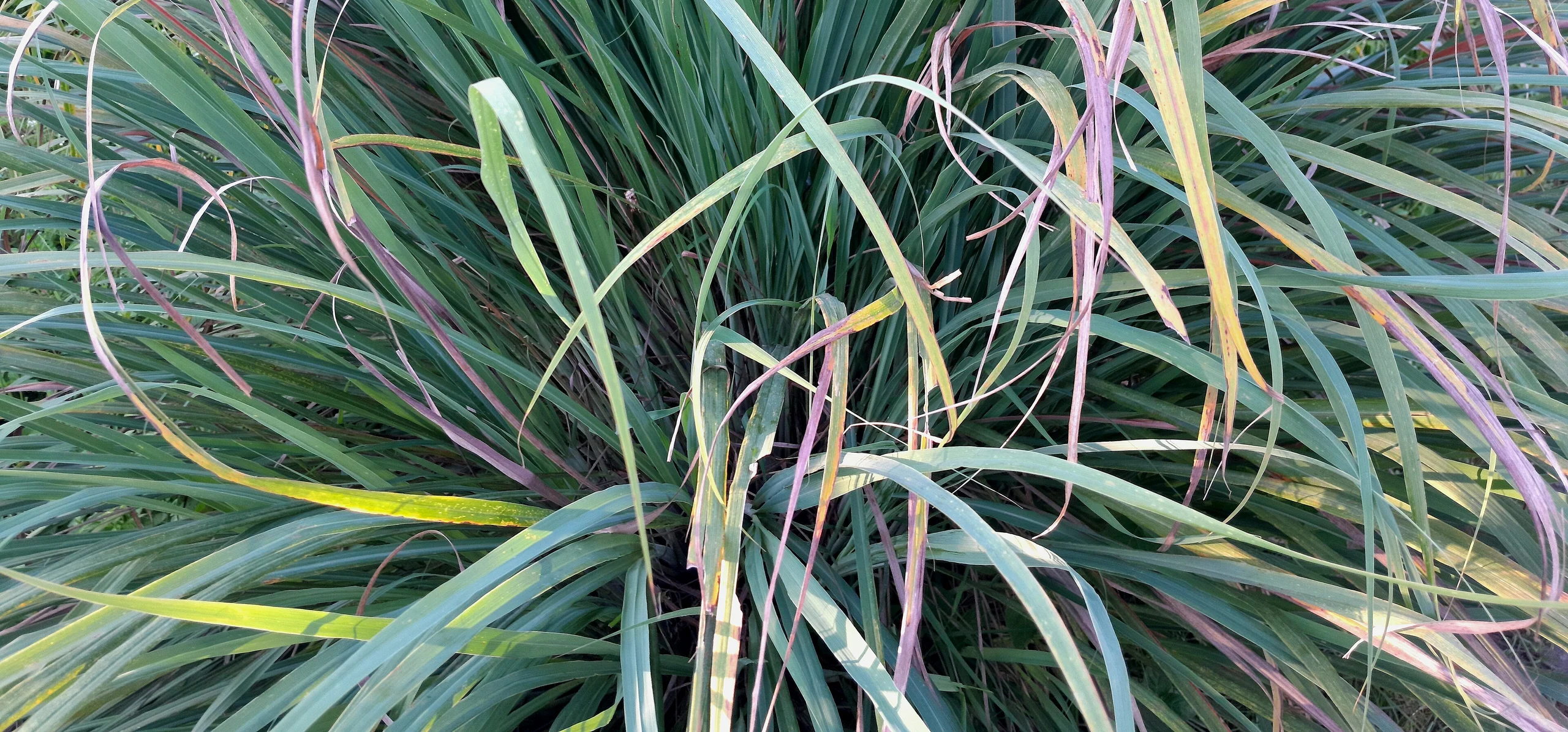
Cymbopogon citratus is a tender, clump-forming perennial grass native to South India and Sri Lanka. Outside a tropical climate it survives outdoors year-round only in the mildest zones; everywhere else it is grown as a container plant that spends summer outside and winter under cover, or simply replanted each spring as an annual.
A Sunny Spot and the Right Container
Lemongrass wants full sun, six hours or more of direct light a day, and a warm, sheltered position. A shaded patio corner or a north-facing balcony produces a thin, floppy clump instead of the dense fan of leaves the plant is capable of. In cooler climates a container is the practical choice over open ground, since it can follow the sun in summer and come indoors before the first frost. Choose a wide, heavy pot rather than a tall narrow one: the clump spreads outward from a shallow crown of overlapping bulbous bases, and real width gives the roots room to multiply before the plant needs dividing. Plastic or glazed ceramic holds moisture better than terracotta, which matters given how much water this grass drinks through summer.
How often to water your Lemongrass
Heavy Watering While It Is Actively Growing
Through spring and summer, lemongrass wants the compost kept consistently moist, not waterlogged but never allowed to dry out between waterings. In a container outdoors on a hot day this can mean checking the pot daily, since a wide, leafy clump in full sun pulls moisture out of a small volume of compost fast. Ground-planted stalks in warm climates need less frequent attention once established but still benefit from regular watering during dry spells rather than being left to fend for themselves. The moment growth slows in autumn, cut back hard on water: an overwintering plant kept as wet as its summer self is far more likely to rot at the crown than one left to run nearly dry between waterings.
Soil and Feeding
A moist, well-drained, humus-rich loam suits lemongrass best. Heavy, waterlogged clay encourages rot at the base of the clump, while thin sandy soil dries out too fast to keep pace with summer demand. Working garden compost or well-rotted manure into the planting hole or potting mix before planting gives the clump organic matter to draw on as it bulks up. A balanced liquid feed every few weeks through the growing season keeps the leaves a strong blue-green rather than pale and thin, though a plant topped up yearly with compost often needs little supplementary feeding at all.
Overwintering Indoors When Nights Turn Cold
Cymbopogon citratus has no frost tolerance, and gardeners outside the tropics need a plan for it before the first cold night of autumn, not after. Bring container plants indoors once nights threaten to drop close to 7°C (45°F), well ahead of an actual frost, and set the pot in the brightest spot available, a south-facing windowsill or a cool conservatory. Water sparingly over winter, just enough to keep the compost from turning bone dry, since growth all but stops in low light and a wet crown sitting cold and dim is the most common way an otherwise healthy clump is lost between autumn and spring. New growth resumes as days lengthen, and the plant can go back outside once nights are reliably above that same 7°C mark.
Dividing an Established Clump
A clump that has filled its pot, or a garden planting left two or three years, benefits from being split rather than left to crowd itself into a tangle of thin stems. In spring, once new growth has started, tip the whole plant out, or lift it from the ground, and use a sharp spade or a large knife to cut the rootball into sections, each with a healthy set of roots and several strong stems attached. Replant the divisions immediately at the same depth they were growing before and water thoroughly to settle the soil around the roots. Dividing does double duty: it renews an ageing, overcrowded clump and produces two or three plants from one, the cheapest way to expand a lemongrass patch beyond a single pot.
Harvesting the Swollen Stem Base
The part of the plant that ends up in a curry paste is not the long leaf blade but the pale, swollen base of an outer stem, the section that sits below the leaves and just above the roots. From late spring through summer, once stems have thickened to roughly a finger's width, twist and pull an outer stem sideways at its base, or cut it at ground level, rather than harvesting from the crowded centre of the clump. Strip away the tough outer leaves to reveal the tender, aromatic core, which can be sliced, crushed or left whole to infuse a broth. The long leaves removed in the process are not wasted, they can be dried or steeped for tea, though they stay too fibrous to eat.
Sharp Leaves and a Caution for Pets
Every leaf blade on this grass carries a fine, saw-like edge capable of slicing skin as cleanly as paper, so handling a mature clump bare-handed is a good way to collect a row of small cuts across the fingers and forearms. Wear gloves and long sleeves when dividing, harvesting or cutting the plant back, and keep that in mind before placing a floor-standing pot somewhere children or pets brush past regularly. The ASPCA lists lemongrass as toxic to cats, dogs and horses: its essential oils and cyanogenic compounds can cause stomach upset in cats and dogs, and reported effects in horses include difficulty breathing and weakness. A curious nibble on a stray leaf is unlikely to be a household emergency, but a pot within easy reach of a cat that likes chewing grass is worth moving, and any suspected ingestion is worth a call to a vet.


Test your plant knowledge
Tap a card to flip it and reveal the answer.
A fresh lemongrass stalk from the grocery store can be rooted in a jar of water. Tap to reveal ✓ True
Lemongrass needs less water in summer than it does in winter. Tap to reveal ✕ False
The part of the plant used in cooking is the swollen stem base, not the long leaves. Tap to reveal ✓ True
Lemongrass leaves have smooth edges and are safe to handle without gloves. Tap to reveal ✕ False
Lemongrass is listed by the ASPCA as toxic to cats, dogs and horses. Tap to reveal ✓ True
Sources
References consulted for this guide
- Cymbopogon citratus (DC.) Stapf, GBIF Backbone Taxonomygbif.org
- Cymbopogon citratus (DC.) Stapf, Plants of the World Online, Kew Sciencepowo.science.kew.org
- ASPCA: Lemon Grass toxicity to petsaspca.org
- RHS: How to grow lemongrassrhs.org.uk
- NC State Extension Gardener Plant Toolbox: Cymbopogon citratusplants.ces.ncsu.edu
- Reference entity : Wikipédiaen.wikipedia.org