American Persimmon
Diospyros virginiana
Family · Ebenaceae
Diospyros virginiana is dioecious, tolerates poor soil and drought once established, and its fruit turns sweet only when fully soft, not after a frost.
Diospyros virginiana
Plant profile
- WateringLittleWater every 10 days
- Light exposurePartial sun
- Hardiness zoneUSDA 4–9
Growth
- Family
- Ebenaceae
- Life cycle
- Perennial
- Growth speed
- 3/10
- Mature size
- 914–2438 cm
- Spread
- 610–1067 cm
- Flowering
- Greenish-white flowers in late spring; fruit ripens September into winter
- Propagation
- Seed
- Cutting
- Grafting
Dormancydeciduous, dormant in winter
Time to maturityseed-grown trees fruit in 4 to 9 years; grafted trees in about 3 years
Soil & climate
- Soil pH
- pH 5–8
- Soil types
- clay, loam, sand
- Drought tolerance
- Yes
Light & Placement
- Origin
- Central and eastern United States
- Where to place it
- Full sun in an open lawn, orchard row or woodland edge
- Tolerates partial shade with reduced fruiting
Safety
- Toxicity
- Not ASPCA-listed; unripe fruit is astringent, not poisonous
- Pet safe
- No
Invasive speciesNative to its eastern and central US range; not documented as invasive
Data fromDiospyros virginiana L., GBIF Backbone TDiospyros virginiana L., Plants of the WDiospyros virginiana (American PersimmonDiospyros virginiana, Missouri BotanicalPucker Up for Persimmon, the First Frost
Where it grows
World distribution
American Persimmon is native to a single country: United States.GBIF records 38,352 documented identifications across 41 countries, with the largest concentrations in United States, Portugal, and France.
- United States
Yellow to orange dots: concentration of documented identifications per country. Green countries: sourced native range. Source: GBIFNative range from POWO (Kew).
A young persimmon growing wild at a fence line, or bought as a bare-root sapling, looks unremarkable for years: slow, upright, plain oval leaves, nothing to suggest the blocky, alligator-hide bark or the orange fruit to come. Diospyros virginiana is dioecious, so a lone seedling may turn out male and never fruit at all, and even a female seedling usually needs four to nine years before it flowers for the first time. The fruit has a reputation problem too: bite into one before it is fully soft and the tannins will pucker your mouth for an hour, which is why plenty of people write off a genuinely good native fruit tree after one bad experience with an unripe one. None of this makes the species hard to grow, it just rewards patience and a clear read on sex and ripeness that most orchard fruit never demands.
Bark, Growth Habit and Size
The bark is the fastest way to name this tree in winter, when nothing else is distinctive: thick, dark gray to nearly black, broken into small rectangular blocks that look like alligator hide, a texture no other tree in its native range quite matches. Growth is slow and the crown stays narrow and oval for years before rounding out. Left to its own devices in good soil, a mature tree reaches 9 to 24 m (30 to 80 ft) tall with a spread of 6 to 11 m (20 to 35 ft), though a tree competing with forest neighbors or growing on poor ground often stalls as a shrubby 4 to 5 m thicket for decades. Underneath, it puts almost all its early energy into a single deep taproot rather than a wide fibrous mat, which is why a persimmon left in the ground for more than a season or two is genuinely difficult to move; buy small, container-grown stock and plant it where it can stay.
Male, Female or Self-Fruitful: Choosing What to Plant
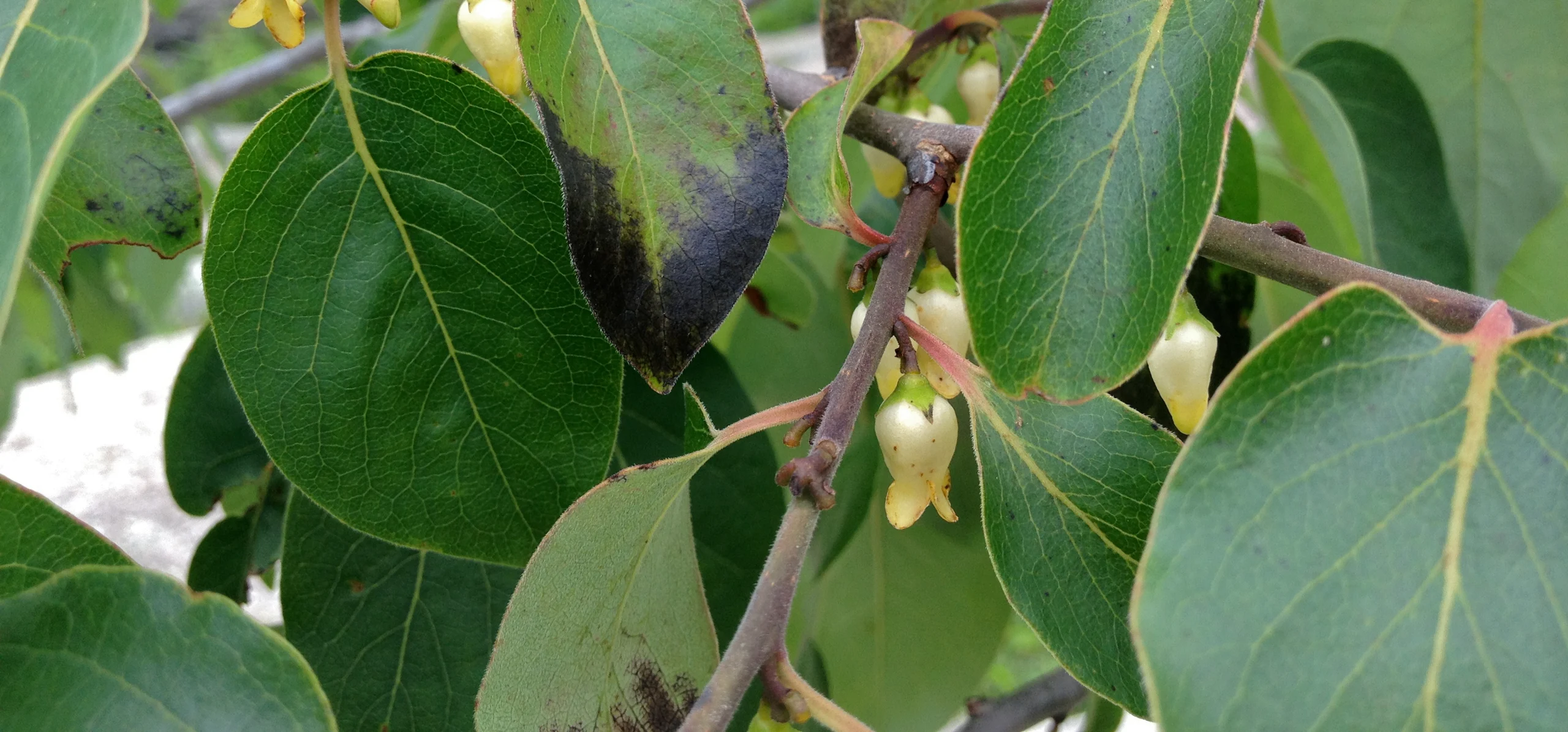
Small, bell-shaped, greenish-white to pale yellow flowers open in late spring, and on a wild seedling you cannot tell which sex you have until the tree finally blooms years later. Straight species trees are dioecious: a female needs a male within bee range to set a full crop, and a male never fruits at all, which is the single most common reason a backyard persimmon "does nothing" for a decade. Grafted, named cultivars remove the guesswork. Female selections such as 'Early Golden', 'John Rick' or 'Killen' are chosen and propagated precisely because their sex and fruit quality are known, and they still need a male pollinator planted nearby. A handful of cultivars, including 'Meader' and 'Prok', are parthenocarpic and set seedless fruit on their own with no male required, which is the simplest option for a single-tree yard. Grafted trees also fruit far sooner, typically within about three years, against four to nine years for a seedling grown from a pit.
Planting and Site Selection
Give it full sun for the heaviest fruit set; the tree tolerates partial shade down to a couple of hours of direct light, but flowering and fruiting both drop off noticeably in shade. Soil is rarely the limiting factor: this species is documented growing in clay, loam or sand, across acid, neutral and alkaline ground, and it shrugs off heat, drought, poor urban soil and wind better than most fruiting trees. The one condition worth respecting is the taproot: choose the planting site with the tree's eventual spread in mind, since transplanting a maturing tree later is a poor option. Space free-standing trees at least 6 to 8 m apart to give the crown room to reach its full 6 to 11 m width.


Watering and Feeding
A newly planted tree needs a deep, generous soak weekly through its first two growing seasons, while that taproot is still working its way down and the tree has little else to draw on in a dry spell. After establishment, drought tolerance is one of this species' real strengths and supplemental water is rarely needed outside an extended dry summer. Feeding is light-touch: a balanced fertilizer in early spring for the first few years helps a young tree size up, but mature trees growing in reasonable soil rarely need more than an annual mulch layer, kept clear of the trunk, to hold moisture and add organic matter as it breaks down.
Ripening and Harvest: Ignore the "Wait for Frost" Rule
The old advice to wait for a frost before picking is backwards: astringency in persimmon fruit drops as a function of time and ripening, not temperature, and a hard freeze hitting fruit that is still firm just ruins it in place rather than sweetening it. Fruit typically colors up from green to yellow-orange from September into early winter, and color is not the test that matters, since a fully colored fruit can still be mouth-puckering if it has any firmness left. Wait until it is fully soft, almost jelly-like through the skin, sometimes with a slightly wrinkled or translucent look, and only then is it reliably sweet. Fruit that drops on its own has usually reached that point; fruit that fights to stay on the branch has not. Picking a slightly underripe batch is not a lost cause: sealed in a paper bag with a ripe apple or banana for a few days, the ethylene the companion fruit gives off will finish the job.
Pests, Diseases and Wildlife
This is a comparatively trouble-free tree. Persimmon psyllid and the clay-colored leaf beetle turn up as cosmetic leaf feeders most seasons without needing intervention, and an occasional leaf spot fungus thins the canopy late in the season without doing lasting harm. The one disease worth watching for is persimmon wilt, caused by the fungus Cephalosporium diospyri: leaves wilt and brown from the top of the canopy down, often within a single season, and an infected tree typically dies within one to two years as the fungus streaks the wood brown to black. There is no cure once a tree is infected; remove and destroy it promptly, avoid wounding healthy trees nearby, and seal any accidental bark damage, since the spores spread on wind and through fresh wounds. On the wildlife side, ripe fruit is a magnet for opossums, raccoons, foxes, deer and a long list of birds, which is where the old folk name "possumwood" comes from, and the foliage hosts luna moth caterpillars among others.
Common Mistakes
The most common failure is planting one unnamed seedling, waiting years, and getting either no flowers or flowers with no fruit, because nobody checked whether a pollinator partner or a self-fruitful cultivar was in the picture from the start. The second is judging ripeness by color or by the calendar instead of by feel: a fully orange fruit that still has any give-resistant firmness will still be astringent. Third, resist moving an established tree once it has been in the ground more than a season or two; the taproot rarely survives the disturbance. Finally, keep a heavy-dropping tree away from horse or livestock pasture if possible: animals are drawn to the fallen fruit, and eating a large quantity of unripe, high-tannin persimmons has been documented to form a hard, digestion-blocking mass in the gut, a real veterinary problem distinct from ordinary toxicity.
Test your plant knowledge
Tap a card to flip it and reveal the answer.
A straight-species Diospyros virginiana needs both a male and a female tree nearby to set fruit, unless the cultivar is parthenocarpic. Tap to reveal ✓ True
A hard frost is what turns astringent persimmon fruit sweet. Tap to reveal ✕ False
The dark, blocky bark of Diospyros virginiana is a reliable way to identify the tree in winter. Tap to reveal ✓ True
An established American persimmon transplants easily because of a shallow, fibrous root system. Tap to reveal ✕ False
Persimmon wilt, caused by Cephalosporium diospyri, can kill an infected tree within one to two years. Tap to reveal ✓ True
Sources
References consulted for this guide
- Diospyros virginiana L., GBIF Backbone Taxonomygbif.org
- Diospyros virginiana L., Plants of the World Online (Kew)powo.science.kew.org
- Diospyros virginiana (American Persimmon), NC State Extension Gardener Plant Toolboxplants.ces.ncsu.edu
- Diospyros virginiana, Missouri Botanical Garden Plant Findermissouribotanicalgarden.org
- Pucker Up for Persimmon, the First Frost Fruit, University of Missouri Extensionextension.missouri.edu
- Reference entity : Wikipédiaen.wikipedia.org