Wax Plant
Hoya carnosa
Family · Apocynaceae
Hoya carnosa reflowers from the same waxy spurs for years, but only with bright light and dry spells between waterings; cut a spur and that bloom point is gone.
Hoya carnosa
Plant profile
- WateringLittleWater every 12 days
- Light exposurePartial sun
- Ideal temperature10–27 °C
Growth
- Family
- Apocynaceae
- Life cycle
- Perennial
- Growth speed
- 5/10
- Mature size
- 400–800 cm
- Spread
- 100–150 cm
- Propagation
- Seed
- Cutting
- Layering
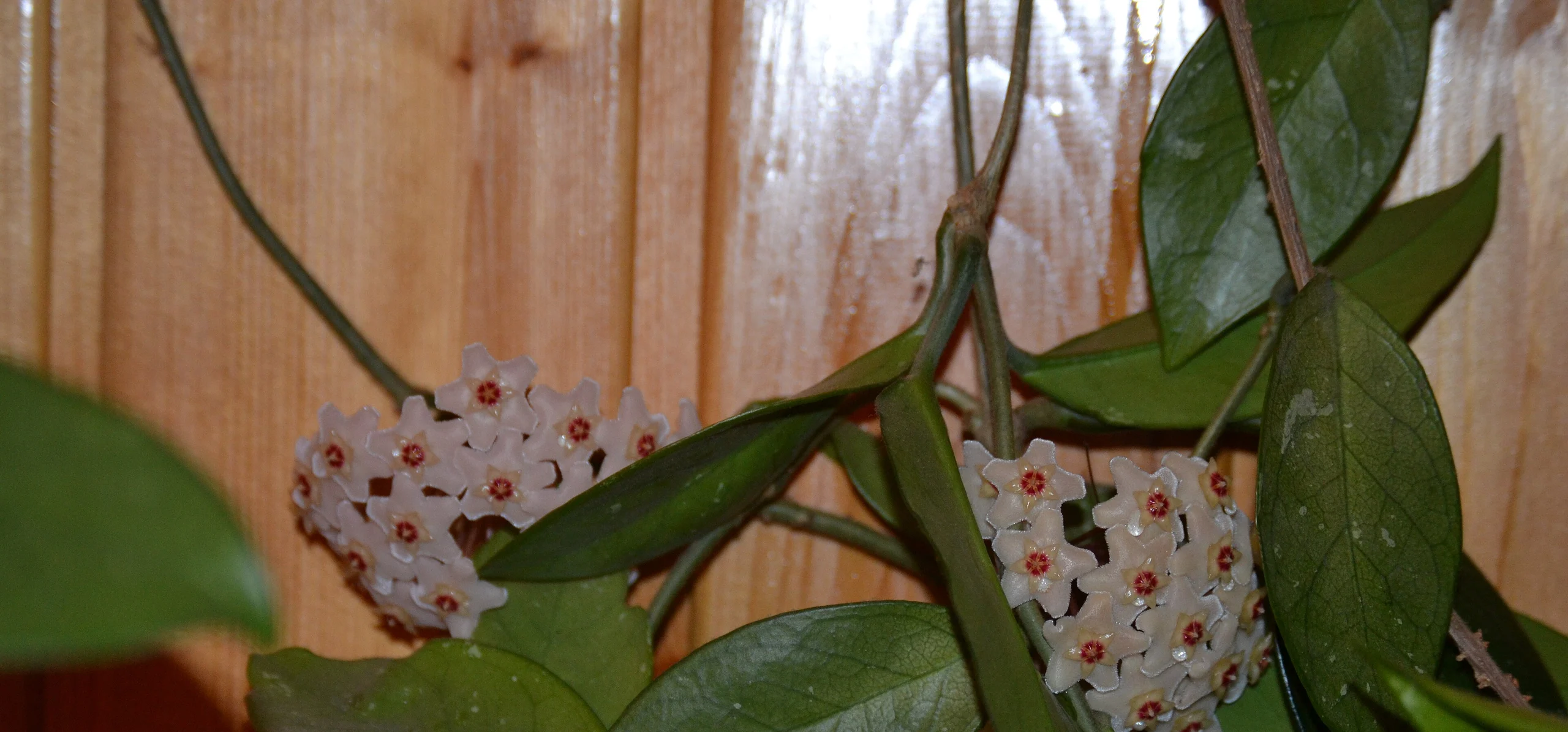
FloweringUmbels of night-scented, waxy, red-centred white to pale pink flowers around 15 mm across, reflowering from the same spurs (RHS)
DormancyNo true dormancy; growth slows markedly in a cooler, drier winter rest
Time to maturityYears of vegetative growth before the first flowers; 10-20 years to reach full climbing size (RHS)
Soil & climate
- Drought tolerance
- Yes
Soil typesOrchid bark, peat-free compost and coarse perlite in equal parts (RHS), Cactus compost with added perlite (RHS)
Light & Placement
- Origin
- South China to Laos, and from Japan (South Kyushu) to Taiwan (POWO)
- Where to place it
- Unshaded east- or west-facing window
- South-facing window filtered by sheer curtain
- Sheltered south- or west-facing wall, frost-free climates only (RHS)
- Hanging basket or pot fitted with a trellis or hoop for the climbing stems
- A snug pot that does not stay wet long after watering
Safety
- Toxicity
- CatsSafe
- DogsSafe
- HorsesSafe
Data fromHoya carnosa (L.fil.) R.Br., GBIF BackboHoya carnosa (L.f.) R.Br. | Plants of thHoneyplant | Hoya carnosa, ASPCA Toxic aHow to grow hoya, RHS Growing GuideHoya carnosa | wax plant, RHS Plants
Where it grows
World distribution
Wax Plant is native to 6 countries: Bhutan, China, Japan, Laos, Myanmar (Burma), and Taiwan.GBIF records 2,626 documented identifications across 66 countries, with the largest concentrations in Taiwan, Japan, and China.
- Bhutan
- China
- Japan
- Laos
- Myanmar (Burma)
- Taiwan
Yellow to orange dots: concentration of documented identifications per country. Green countries: sourced native range. Source: GBIFNative range from POWO (Kew).
A Hoya carnosa that has just opened its first cluster of waxy, red-centred flowers is not a beginner's plant that got lucky, it is a mature vine that has finally been given enough light to bloom. The thick, succulent leaves and twining stems store water more like a cactus than a leafy houseplant, which is why the classic mistake is treating it like a pothos and keeping it constantly damp in a dim corner. Every flower cluster grows from the same short, leafless spur left behind after the previous bloom, so a plant that gets deadheaded or pruned hard every year can go for years without ever building the spurs it needs. Left alone on a bright windowsill with something to climb, the same vine keeps reflowering from those same spurs for seasons, sometimes years, without producing a single new one.
Why a young hoya refuses to flower
The RHS is explicit that insufficient light is the main reason a Hoya carnosa fails to flower: it wants a bright position, ideally an unshaded east or west window or a south window filtered by sheer curtain, with only the harshest midday summer sun screened off. A vine kept on a low shelf or a few feet back from a north window grows perfectly healthy foliage indefinitely and never buds, because flowering is triggered by light intensity, not age alone. That is also why a young plant or a cutting recently moved to brighter conditions can mean a long wait: RHS growing notes give the species ten to twenty years to reach its full climbing size of four to eight metres with a spread of one to one and a half metres in cultivation, and a vine needs real length of mature stem, not just leaves, before it sets its first spurs. A hoya kept in a pot rather than allowed to climb stays far smaller and slower to mature than that outdoor maximum, but the same rule holds: more light and more established stem, not more fertiliser, is what brings on the first flowers.
Watering like a semi-succulent, not a tropical foliage plant
Hoya carnosa's thick leaves are a water reserve, and the RHS recommends keeping the compost moist but not waterlogged through spring and summer, then cutting back hard from October to February so the mix dries out fairly between waterings without ever going fully bone dry. Overwatering, not underwatering, is the failure mode to worry about: waterlogged compost causes root rot and blackened stem dieback, and a plant with rotted roots rarely recovers, the RHS advises taking cuttings from whatever is left rather than trying to save the original. In practice this means checking the pot by weight or by pushing a finger into the mix before watering rather than watering on a fixed schedule, and erring toward an extra dry week over a week of wet feet.


An airy, chunky mix and repotting
Because it grows as a climber with aerial, stem-rooting habits rather than a plant rooted in dense garden soil, Hoya carnosa needs a potting mix that drains and airs out fast. The RHS recommends equal parts orchid bark, peat-free multi-purpose compost, and coarse perlite, or a cactus compost with extra perlite mixed in, either of which lets water pass through quickly while still holding some moisture around the roots. Repot only once roots have filled the current pot, generally in spring, and hold off feeding for five or six weeks afterwards while new roots establish; a balanced, urea-free orchid feed every two weeks in spring and summer, dropping to monthly over autumn and winter, is enough, with an occasional plain-water flush to clear salt buildup from the bark mix.
Never cut the flower spurs
The single most damaging habit a new grower brings over from other houseplants is deadheading. Once a Hoya carnosa umbel finishes flowering, the short woody stalk it grew from, the peduncle or spur, stays on the stem and produces a new cluster from that same point the following season, sometimes for years in a row. The RHS is direct about this: resist the temptation to deadhead, because cutting away the spent flower stalk removes the exact tissue the next bloom depends on. Pruning is still useful, but only in late winter and only to remove weak or damaged shoots, cutting back to just above a healthy side shoot; a hoya that has outgrown its space is better replaced or trained onto a larger support than cut back hard, which sets flowering back rather than improving the shape.
Waxy star flowers, dripping nectar, and a night scent
Each umbel carries a cluster of small, five-pointed, wax-textured flowers about 15mm across, white to pale pink with a deeper red centre, according to the RHS. They are night-scented, part of why the species is still sometimes sold under the older common name honeyplant, and a well-flowered vine can perfume a whole room after dark. The flowers also produce visible droplets of nectar that can drip onto furniture or a windowsill below a hanging plant, which is normal rather than a sign of a pest problem, though it is worth setting a saucer or mat under a heavily flowering hanging basket.
Choosing a variety: Compacta, Krimson Queen, and Tricolor
'Compacta', sold as the Hindu rope hoya, has the same waxy leaves and flowers twisted into a tight, contorted curl along a much more compact vine, and it stays slower and more forgiving of a small pot than the species. 'Krimson Queen' and 'Tricolor' cause more confusion than they should: both names are used in the nursery trade for the same variegated sport, a green-centred leaf with a cream-to-pink margin that colours up strongest on new growth in bright light, so buying both expecting two different plants is a common and avoidable disappointment. The cultivar with the reversed pattern, a pink-and-cream centre inside a plain green edge, is sold separately as 'Krimson Princess'.
Propagation from a stem cutting
The RHS lists seed, semi-ripe cuttings, and layering as propagation methods for hoyas, and a stem cutting is by far the easiest for a home grower. Take a cutting in spring or early summer with at least one healthy node, the swollen point on the stem where a leaf pair and the fine aerial roots emerge, since new roots form from the node rather than from bare stem. Standing the cutting in water for two to three weeks until roots appear, then potting it into the same peat-free, perlite-heavy mix used for mature plants, works more reliably than pushing a bare cutting straight into compost. Layering a low, still-attached stem, pegging a node into a second pot of moist mix until it roots and only then severing it from the parent, avoids the risk of losing a cutting and suits a vine that already has plenty of length to spare.
Mealybugs and toxicity to pets
Mealybugs are the pest the RHS flags most often on hoyas, tucked into leaf joints and the base of flower umbels where their white waxy coating goes unnoticed until a colony has built up; scale insects and glasshouse whitefly turn up occasionally as well, feeding the same way. Wiping visible clusters off with a cotton swab dipped in rubbing alcohol, checking again every few days, controls a light infestation on a plant usually kept close to living spaces where a systemic spray is less appealing. On safety, the ASPCA lists Hoya carnosa, under the common name honeyplant, as non-toxic to dogs, cats, and horses, which makes it one of the more forgiving flowering houseplants to keep within reach of curious pets.
Test your plant knowledge
Tap a card to flip it and reveal the answer.
Cutting off a leafless flower spur after it finishes blooming encourages the plant to flower again sooner. Tap to reveal ✕ False
Hoya carnosa should be watered like a semi-succulent, allowed to dry out fairly between waterings. Tap to reveal ✓ True
Insufficient light is a common reason a young hoya never produces flowers. Tap to reveal ✓ True
'Krimson Queen' and 'Tricolor' are two genetically distinct hoya cultivars with different variegation patterns. Tap to reveal ✕ False
The ASPCA lists Hoya carnosa as toxic to cats and dogs. Tap to reveal ✕ False
Sources
References consulted for this guide
- Hoya carnosa (L.fil.) R.Br., GBIF Backbone Taxonomygbif.org
- Hoya carnosa (L.f.) R.Br. | Plants of the World Online, Kew Sciencepowo.science.kew.org
- Honeyplant | Hoya carnosa, ASPCA Toxic and Non-Toxic Plantsaspca.org
- How to grow hoya, RHS Growing Guiderhs.org.uk
- Hoya carnosa | wax plant, RHS Plantsrhs.org.uk
- Reference entity : Wikipédiaen.wikipedia.org