Mother of Thousands
Kalanchoe daigremontiana
Family · Crassulaceae
Kalanchoe daigremontiana drops rooting plantlets from every leaf edge, flowers once then dies, and is toxic to cats and dogs, per the ASPCA.
Kalanchoe daigremontiana
Plant profile
- WateringLittleWater every 14 days
- Light exposurePartial sun
- Hardiness zoneUSDA 9–11
Growth
- Family
- Crassulaceae
- Life cycle
- Perennial
- Growth speed
- 6/10
- Mature size
- 30–90 cm
- Spread
- 30–60 cm
- Propagation
- Seed
- Offsets
FloweringPink to lavender bell flowers, late winter to early spring, then the plant dies (NC State Extension)
Dormancygrowth slows in winter with less water; declines permanently after flowering
Time to maturityflowers once after about two to three years, then dies (NC State Extension)
Soil & climate
- Soil types
- sandy or loamy, well-drained, cactus/succulent mix
- Drought tolerance
- Yes
Light & Placement
- Origin
- Southwest Madagascar (POWO)
- Where to place it
- bright south or west facing windowsill
- full sun to partial shade in warm, dry climates, containers only
- its own pot, isolated from other plants
- wide pot with drainage; saucer to catch fallen plantlets
Safety
- Toxicity
- CatsToxic
- DogsToxic
Invasive speciesNaturalized on Florida's coastal dunes, on the main Hawaiian islands, and recorded as a minor environmental weed in Queensland and New South Wales, Australia; keep to containers outside its native range.
Data fromGBIFPlants of the World Online (Kew)ASPCANC State ExtensionFlorida Plant Atlas (University of South
Where it grows
World distribution
Mother of Thousands is native to a single country: Madagascar.GBIF records 1,366 documented identifications across 82 countries, with the largest concentrations in United States, Spain, and Mexico.
- Madagascar
Yellow to orange dots: concentration of documented identifications per country. Green countries: sourced native range. Source: GBIFNative range from POWO (Kew).
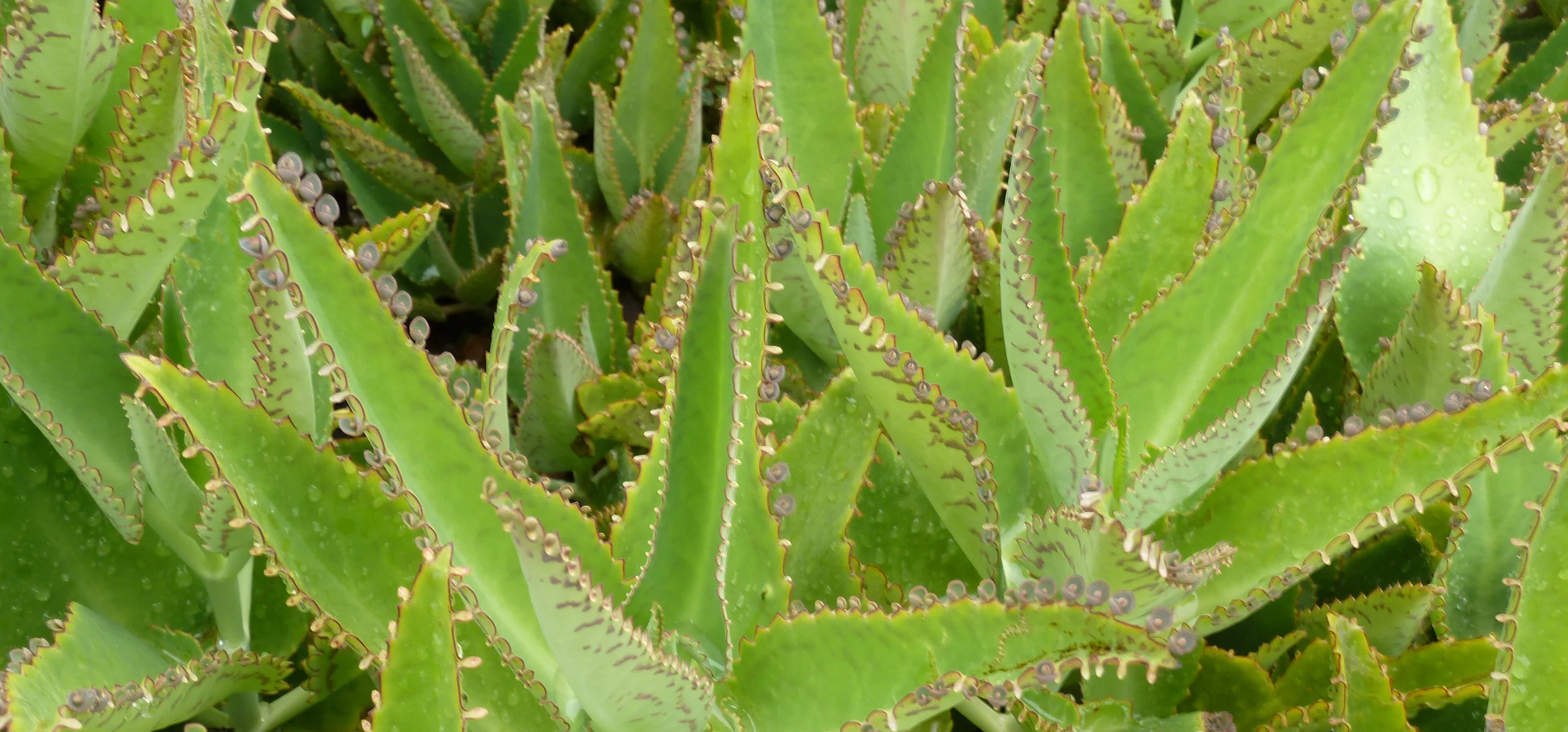
Kalanchoe daigremontiana is easy to recognize by what happens along the edges of its long, pointed leaves: rows of tiny, fully formed plantlets, each one a miniature clone ready to drop and root the moment it touches soil. That habit is why growers call it Mother of Thousands, and why greenhouse staff often treat it as a pest rather than a houseplant, since one leaf left resting on a bench can seed a small colony within weeks. The plant itself asks for very little, bright light and soil that dries out between waterings, but it repays that neglect with a short, dramatic life: most specimens flower once after two or three years, then die, having already scattered enough offspring to keep going indefinitely. Give it its own pot, kept away from open soil and from pets.
One plant, two genus names
GBIF's accepted name for this species is Kalanchoe daigremontiana Raym.-Hamet & H.Perrier, in the family Crassulaceae, but plenty of older tags and nursery catalogs still list it as Bryophyllum daigremontianum, a synonym that persists because the genus Bryophyllum was only folded back into Kalanchoe relatively recently. Both names point to the same plant, so a label reading either one is correct. The species is also frequently confused in cultivation, and even in some botanical records, with the hybrid Kalanchoe x houghtonii and with Kalanchoe laetivirens, both of which share the marginal-plantlet trick; the surest way to tell Kalanchoe daigremontiana apart is the leaf shape, long, narrow, and mottled with dark blotches on the underside, tapering to a point rather than staying broad and rounded.
Bright light and soil that never stays wet
This is a succulent from a dry part of Madagascar, and it grows best with several hours of direct or bright filtered light a day; a south or west facing windowsill suits it indoors, though leaves that have softened over a cloudy stretch can scorch if moved straight into harsh midday sun. Pot it in a sandy or loamy mix that drains fast, a bagged cactus and succulent blend is the simplest option, and water only once the soil has dried out completely, checking with a finger rather than a calendar. Cut watering back further once flowering starts, since a plant that is already dying back from age needs far less than one still putting out new leaves. New growth unfurls pale green and takes on its grey-green, blotched coloring as it hardens over the following week or two.


Why the leaf margins turn into a nursery
Each notch along the scalloped edge of a mature leaf carries a cluster of dormant plantlets, tiny but complete, with their own leaves and root buds, that only need contact with moist soil or even damp air to take off. This is what makes the species notorious in greenhouses: a single dropped leaf, a pot brushed against a neighboring tray, or plantlets shaken loose while repotting is enough to start new plants in places nobody intended. Keeping this plant in isolation, its own pot, on its own saucer, not standing directly on open benches or garden soil, is the only reliable way to stop it from spreading. Growers who want to multiply it on purpose can simply lift a few plantlets onto damp cactus mix; they root within days and need almost no aftercare.
A plant built to flower once and be done
Kalanchoe daigremontiana is monocarpic: the main rosette typically lives two to three years, then sends up a single tall flowering stalk topped with clusters of small, bell-shaped, pink to lavender flowers in late winter or early spring, and dies once that bloom finishes. Houseplants kept indoors often skip flowering altogether if the light is too low, in which case the plant simply persists and keeps producing plantlets instead. Once a stalk does appear, the leaves lower down tend to yellow and drop as the plant channels everything into the flowers, which looks alarming but is normal end-of-life behavior rather than a care mistake; by the time the parent plant is gone, its own plantlets have usually already rooted nearby.
From windowsill succulent to roadside weed
Grown outdoors in a warm climate, the same trait that makes this plant easy to over-propagate on a shelf makes it a genuine problem in the ground. It has naturalized on Florida's coastal dunes, where its shallow, weak root system does nothing to stabilize the sand while its plantlets crowd out native dune vegetation; the University of South Florida's Florida Plant Atlas lists it as not native to the state. It is likewise established on the main Hawaiian islands, often on dry cliffs alongside other naturalized succulents, and it is recorded as a minor environmental weed in Queensland and New South Wales in Australia. None of this is a reason to avoid it as a houseplant, but in any of these regions, or anywhere with a similarly mild, dry climate, it belongs in a container and nowhere near open ground, roadside verges, or compost that ends up outdoors.
Toxic to pets, and worth keeping from livestock too
The ASPCA lists Kalanchoe as toxic to both cats and dogs, with bufadienolide compounds as the toxic principle; reported effects range from drooling and vomiting to abnormal heart rhythm, and severe cases can be fatal. Every part of the plant carries these compounds, not just the flowers, and handling it can also irritate skin, so it is worth wearing gloves when repotting or removing spent leaves. The same class of toxin is well documented in the scientific literature as a cause of livestock losses in Kalanchoe-infested pasture in South Africa and Australia, particularly when animals turn to it after other forage runs short, so this is not a plant to let spread into a paddock or grazing field even where it is not yet officially listed as toxic to horses specifically.
The mistakes that actually happen with this species
Overwatering is the most common one: soil that stays wet rots the roots and the base of the stem far faster than underwatering ever will, and a saucer left full of standing water after each watering has the same effect over time. The second is planting it straight into a garden bed in a warm climate on the assumption that a succulent must be harmless outdoors; given a Florida or Hawaii winter, it will not stay where it was planted. The third is treating the bare, leafless stem left after flowering as a dead plant to throw out, when in fact any of the plantlets it dropped over the previous year, or even a stem cutting from before it flowered, will start a new rosette in a matter of weeks.
Test your plant knowledge
Tap a card to flip it and reveal the answer.
The plantlets along the leaf edges grow from seeds formed after flowering. Tap to reveal ✕ False
Kalanchoe daigremontiana usually flowers once and then dies. Tap to reveal ✓ True
Bryophyllum daigremontianum and Kalanchoe daigremontiana are the same plant under two different names. Tap to reveal ✓ True
This species prefers soil that stays constantly moist. Tap to reveal ✕ False
The ASPCA lists this plant as toxic to cats and dogs. Tap to reveal ✓ True
Sources
References consulted for this guide
- GBIF - Kalanchoe daigremontianagbif.org
- Plants of the World Online (Kew) - Kalanchoe daigremontianapowo.science.kew.org
- ASPCA - Toxic and Non-toxic Plants: Kalanchoeaspca.org
- NC State Extension - Kalanchoe daigremontianaplants.ces.ncsu.edu
- Florida Plant Atlas (University of South Florida) - Kalanchoe daigremontianaflorida.plantatlas.usf.edu
- Reference entity : Wikipédiaen.wikipedia.org