American Sweetgum
Liquidambar styraciflua
Family · Altingiaceae
American sweetgum needs acid to neutral soil, spring planting that protects its taproot, and clearance from paving before roots and spiky seed balls take hold.
Liquidambar styraciflua
Plant profile
- WateringLittleWater every 10 days
- Light exposurePartial sun
- Ideal temperature-29–38 °C
- Hardiness zoneUSDA 5–9
Growth
- Family
- Altingiaceae
- Life cycle
- Perennial
- Growth speed
- 6/10
- Mature size
- 1800–3000 cm
- Spread
- 1200–1500 cm
- Flowering
- Inconspicuous spring flowers; spiny gumball seed balls persist into winter
- Propagation
- Seed
- Grafting
Dormancydeciduous, dormant in winter
Time to maturitybark develops full alligator-ridge texture by 20 to 25 years old
Soil & climate
- Soil pH
- pH 3.7–6.8
- Soil types
- clay, loam, sand
- Saline soil
- Partially tolerated
- Drought tolerance
- Yes
Light & Placement
- Origin
- Central and eastern United States to Central America
- Where to place it
- shade tree
- specimen tree
- parks and large gardens
Safety
- Toxicity
- Not listed by the ASPCA for cats, dogs or horses
- Pet safe
- No
Data fromGBIF Backbone Taxonomy: Liquidambar styrPlants of the World Online (Kew): LiquidNC State Extension Gardener Plant ToolboRHS: Liquidambar styraciflua (sweet gum)Yale Nature Walk: American Sweetgum (Liq
Where it grows
World distribution
American Sweetgum is native to 7 countries: Belize, El Salvador, Guatemala, Honduras, Mexico, Nicaragua, and United States.GBIF records 105,082 documented identifications across 60 countries, with the largest concentrations in United States, Germany, and Mexico.
- Belize
- El Salvador
- Guatemala
- Honduras
- Mexico
- Nicaragua
- United States
Yellow to orange dots: concentration of documented identifications per country. Green countries: sourced native range. Source: GBIFNative range from POWO (Kew).
A young American sweetgum with star-shaped, five- to seven-lobed leaves and a single straight leader is a tree built for speed and spectacle: once established it commonly reaches 18 to 30 metres tall and 12 to 15 metres wide, and no two trees colour the same way in autumn, often carrying yellow, orange, red and purple on the same crown at once. The trade-off for that vigour is a taproot that resents disturbance, spiky woody seed balls that litter the ground from December through April, and a strict intolerance of lime that turns young leaves yellow between the veins. Get the planting site and the soil pH right in the first year and Liquidambar styraciflua asks for very little afterward.
Origin, Family and Classification
The GBIF Backbone Taxonomy places the accepted name as Liquidambar styraciflua L., in the family Altingiaceae, order Saxifragales, class Magnoliopsida. Plants of the World Online (Kew) gives its native range as Central and eastern USA to Central America, and the species is genuinely widespread there, its aromatic resin used historically by the Cherokee and Choctaw long before settlers gave it the name sweetgum. One of its GBIF vernacular names, Alligator-wood, points at a feature that develops with age: bark that is smooth on young stems thickens into deep, corky ridges reading like alligator skin by the time the tree is 20 to 25 years old.
Star-Shaped Leaves, Alligator Bark and the Sweetgum's Resin
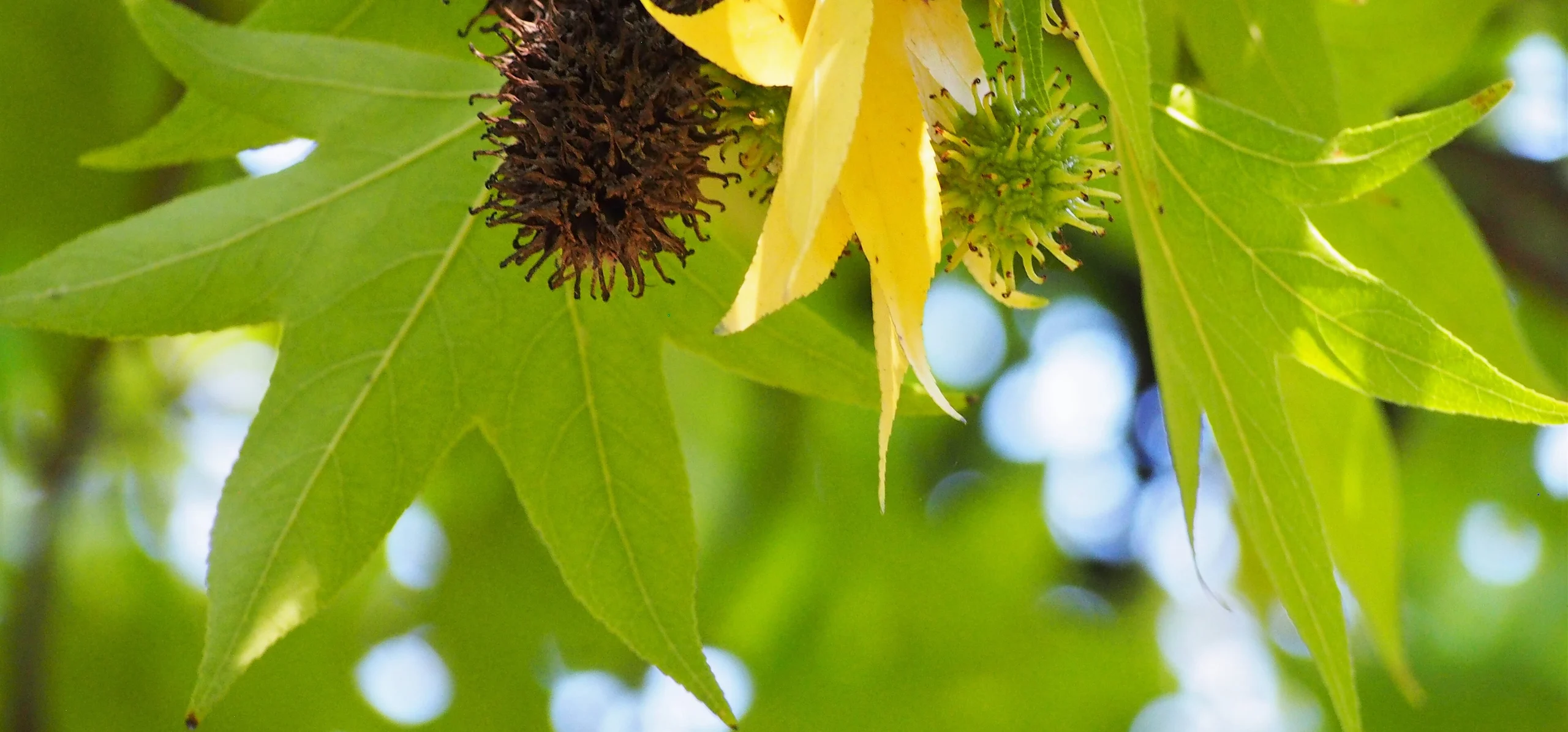
The leaves are the easiest identification point: glossy, dark green, star-shaped with five to seven sharply pointed lobes, roughly 10 to 20 cm across, and aromatic when crushed. Twigs often carry corky, wing-like ridges, another feature that separates a young sweetgum from a maple planted nearby with a similarly lobed leaf, since no maple has that corked bark or a spiny fruit. The genus name, from the Latin for liquid amber, refers to the aromatic resin, historically called American storax, that seeps from a wounded trunk; it was hardened into a folk chewing gum, used as a wound salve, and later processed into soaps and adhesives during both World Wars. None of that history changes how the tree is grown today, but it explains why one ordinary shade tree carries two unrelated common names, sweetgum and alligator-wood, both accurate.
Autumn Colour and the Spiky Seed Balls
Full sun brings out the best display: a single tree can carry yellow, orange, red and burgundy simultaneously, which is the main reason it is planted as an ornamental far outside its native range. The fruit is the flip side of that ornamental value. Pollinated flowers develop into woody, spiny seed balls, commonly called gumballs, that ripen greenish yellow, darken to brown, and often persist on the tree through winter before dropping in quantity from December to April. On a lawn or a path that drop is a genuine maintenance job, not a minor nuisance, and it is the single biggest complaint gardeners raise about the straight species.


Choosing a Variety: Fruitless and Space-Saving Cultivars
| Cultivar | Why grow it | Approx. size |
|---|---|---|
| 'Rotundiloba' | Seedless selection with rounded leaf lobes, few or no gumballs | 18 to 23 m tall, 6 to 12 m wide |
| 'Worplesdon' | RHS Award of Garden Merit, reliable orange-to-purple autumn colour | Over 12 m tall and 8 m wide, reached in 10 to 20 years |
| 'Slender Silhouette' | Columnar habit for narrow gardens and screening | 15 to 18 m tall, only 1 to 2.5 m wide |
'Rotundiloba', selected near Pinehurst, North Carolina around 1930 by Rassie E. Wicker and now a North Carolina Extension recommendation for street and park planting, is the choice for anyone who wants the tree without the seed-ball cleanup; it can still set an occasional fruit, so it is described as fruitless rather than guaranteed seedless. 'Worplesdon' is not smaller than the species by the time it reaches full size, but it is a known, reliable size for a garden rather than the towering, unpredictable growth of a seed-grown tree. 'Slender Silhouette' solves a different problem: it keeps most of the height of a full-size sweetgum in a footprint narrow enough for a border or a tight side garden.
Planting: Timing, the Taproot and Keeping Roots Away From Paving
Sweetgum builds a deep taproot beneath a wider mat of fleshy surface roots, and that combination is exactly why it is considered difficult to transplant once established: extension guidance recommends moving it young, in spring, as container-grown or balled-and-burlapped stock, since roots take several months to recover from the shock of transplanting regardless of size. Give it room from the start. Extension sources place its surface roots among the more aggressive of common shade trees, capable of lifting curbs, sidewalks and driveways, and recommend keeping paving at least 2.4 to 3 metres clear of the trunk rather than treating a young tree's modest first years as a guide to where it is safe to build.
Soil, pH and Chlorosis on Lime
This is the one condition sweetgum does not tolerate: soil that turns distinctly alkaline. University extension figures put its comfortable pH range at roughly 3.7 to 6.8, and the RHS lists it simply as needing acid or neutral soil; on alkaline or chalky ground the leaves develop iron chlorosis, a yellowing between the veins caused by soil pH locking up iron the roots would otherwise absorb without trouble. Otherwise it is an easy tree: clay, loam and sandy soils are all tolerated as long as drainage is reasonable, and once established it copes with both an occasional dry spell and periodically wet ground.
Pests and Common Problems
Sweetgum is not a pest magnet. University of Illinois Extension lists scale insects, among them sweetgum scale, cottony cushion scale and walnut scale, as its most common insect problem, alongside occasional webworms, bagworms and tent caterpillars recorded by other extension services; the RHS describes it as generally pest-free in garden conditions, with honey fungus the main disease risk. Much of the visible trouble on a stressed tree traces back to the soil rather than an insect: chlorosis from alkaline ground weakens the canopy and makes it more susceptible to everything else on that list, one more reason to get the planting site right rather than treat problems after the fact.
Toxicity to Pets
American sweetgum does not appear on the ASPCA's toxic or non-toxic plant lists for cats, dogs or horses, so its status for pets is undocumented rather than confirmed safe. The practical risk is mechanical rather than chemical: a dog that works through a quantity of fallen, woody gumballs can develop vomiting or gastrointestinal upset from the foreign material itself, quite apart from any toxic principle, so raking up fruit drop where a persistent chewer has access to it is worth doing regardless of what a poison database says.
Test your plant knowledge
Tap a card to flip it and reveal the answer.
The 'Rotundiloba' cultivar was selected because it rarely produces sweetgum's spiky seed balls. Tap to reveal ✓ True
American sweetgum performs equally well in strongly alkaline soil. Tap to reveal ✕ False
A mature sweetgum with an established taproot transplants easily at any age. Tap to reveal ✕ False
The ASPCA lists American sweetgum on its toxic or non-toxic plant databases. Tap to reveal ✕ False
'Slender Silhouette' is a narrow, columnar sweetgum bred for tight garden spaces. Tap to reveal ✓ True
Sources
References consulted for this guide
- GBIF Backbone Taxonomy: Liquidambar styraciflua L.gbif.org
- Plants of the World Online (Kew): Liquidambar styraciflua L.powo.science.kew.org
- NC State Extension Gardener Plant Toolbox: Liquidambar styracifluaplants.ces.ncsu.edu
- RHS: Liquidambar styraciflua (sweet gum)rhs.org.uk
- Yale Nature Walk: American Sweetgum (Liquidambar styraciflua)naturewalk.yale.edu
- Reference entity : Wikipédiaen.wikipedia.org