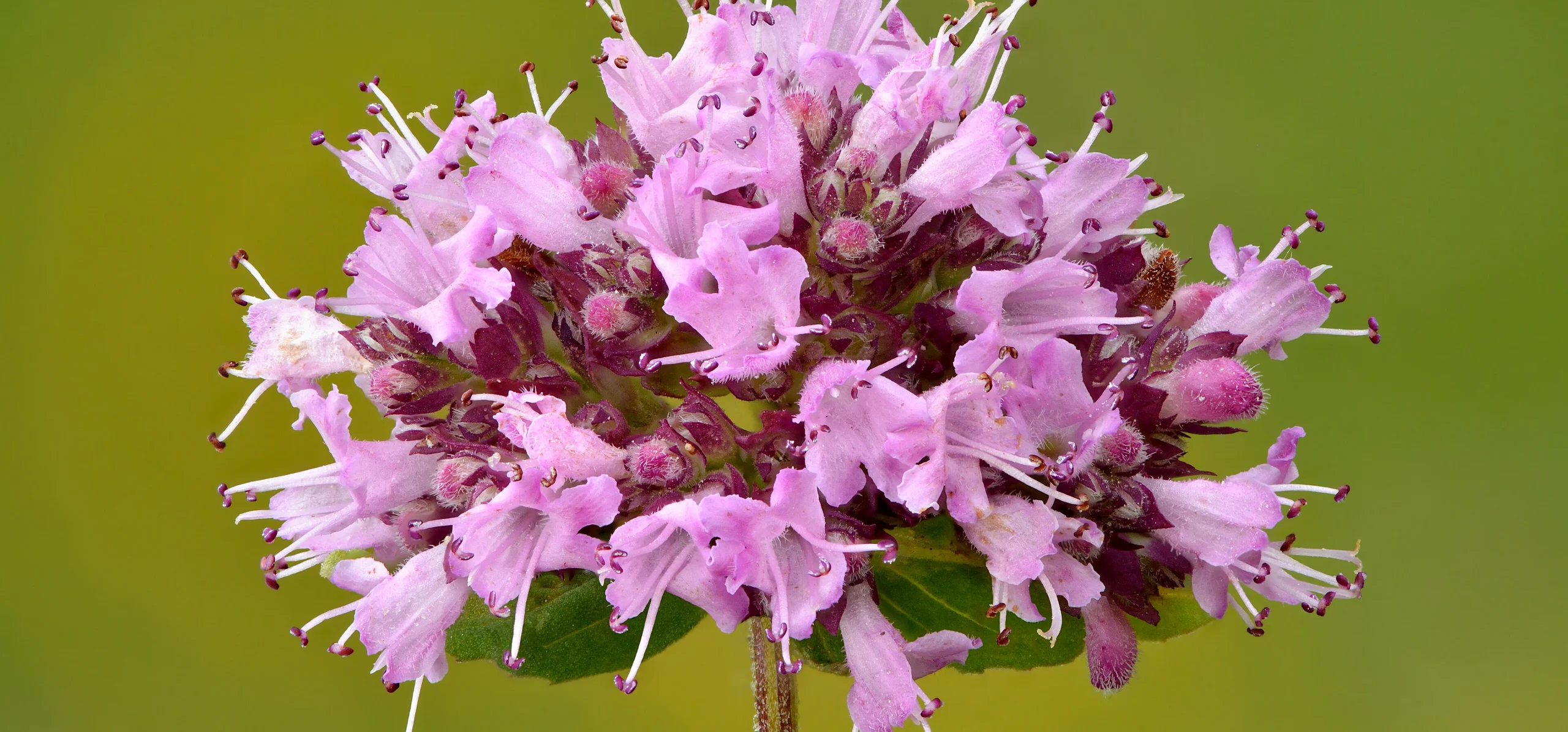
Oregano
Origanum vulgare
Family · Lamiaceae
Origanum vulgare thrives in lean, well-drained soil and full sun. Covers watering, pinching for bushy growth, harvest timing, and winter dieback.
Origanum vulgare
Plant profile
- WateringLittleWater every 12 days
- Light exposureFull sun
- Ideal temperature10–30 °C
- Hardiness zoneUSDA 4–8
Growth
- Family
- Lamiaceae
- Life cycle
- Perennial
- Growth speed
- 6/10
- Mature size
- 30–90 cm
- Spread
- 30–80 cm
- Flowering
- July to October
- Propagation
- Seed
- Cutting
- Division
DormancyDies back in cold winters, resprouts from rhizomes in spring
Time to maturityUsable leaf within one growing season
Soil & climate
- Soil pH
- pH 6.5–7
- Soil types
- Well-drained, lean soil, Sandy or gritty mix
- Drought tolerance
- Yes
Light & Placement
- Origin
- Macaronesia to China
- Where to place it
- Sunny south-facing windowsill
- Open bed in full sun
- Herb garden border
- Terracotta pot with drainage holes
Safety
- Toxicity
- CatsToxic
- DogsToxic
- HorsesToxic
Invasive speciesSpreads by rhizomes and can turn aggressive in the ground; contain with edging or grow in a pot
Data fromOriganum vulgare, GBIF Backbone TaxonomyOriganum vulgare L., Plants of the WorldOregano toxicity, ASPCA Animal Poison CoOriganum vulgare, Missouri Botanical GarHerb Garden Plants: Oregano, Penn State
Where it grows
World distribution
Oregano is native to 49 countries: Afghanistan, Albania, Algeria, Austria, Belarus, Belgium, Bhutan, and Bulgaria….GBIF records 444,963 documented identifications across 98 countries, with the largest concentrations in France, Germany, and United Kingdom.
- Afghanistan
- Albania
- Algeria
- Austria
- Belarus
- Belgium
- Bhutan
- Bulgaria
- China
- Croatia
- Cyprus
- Czechia
Show 37 more countriesShow fewer countries
- Denmark
- Estonia
- Finland
- France
- Georgia
- Germany
- Greece
- Hungary
- India
- Iran
- Iraq
- Ireland
- Italy
- Kazakhstan
- Kyrgyzstan
- Morocco
- Myanmar (Burma)
- Nepal
- Netherlands
- Norway
- Pakistan
- Poland
- Portugal
- Romania
- Russia
- Spain
- Svalbard & Jan Mayen
- Sweden
- Switzerland
- Taiwan
- Tajikistan
- Tunisia
- Türkiye
- Turkmenistan
- Ukraine
- United Kingdom
- Uzbekistan
Yellow to orange dots: concentration of documented identifications per country. Green countries: sourced native range. Source: GBIFNative range from POWO (Kew).
Origanum vulgare is the wild oregano species behind most of the herb pots sold at garden centers, a rhizomatous Mediterranean perennial that spreads by underground runners rather than staying in a tidy clump. It wants the harshest spot in the garden: full sun, lean soil, and irregular water, conditions that would stress a vegetable bed but concentrate the essential oils that give the leaves their peppery bite. The plant labeled culinary oregano is usually Origanum vulgare subsp. hirtum, a stronger-flavored form of this same species, while true marjoram, Origanum majorana, is a separate and more tender relative often confused with it on seed packets. Give it a spot it can spread into, or a container to hold it back, and it will outlast most of what grows around it.
Sun and soil
Full sun for six to eight hours produces the most flavorful leaves; in partial shade the plant still grows but the oil content drops and the taste turns flat. Soil should drain fast and stay on the lean side, oregano grown in rich, amended beds puts out soft, watery growth with a weaker aroma. Penn State Extension lists a target pH around 6.8, so slightly acidic to neutral ground suits it better than the alkaline soil some references suggest for other Mediterranean herbs. In containers, a gritty mix with extra perlite or sand and a terracotta pot that wicks moisture away from the roots reproduces those rocky-hillside conditions closely enough.
Watering that respects a drought-tolerant plant
Once established, oregano gets by on rainfall alone in most temperate climates, and the Missouri Botanical Garden rates it for good heat and drought tolerance. Water new transplants regularly through their first month, then taper off and let the top few centimeters of soil dry completely between waterings. A plant that wilts a little at midday on a hot afternoon and perks back up by evening is behaving normally, not asking for the hose. The far more common failure is the opposite: soil kept damp through a wet spring encourages root rot, and a plant that yellows and thins at the base is usually drowning, not thirsty.


Feeding and pinching for a bushy plant
Oregano needs almost no feeding, a single light application of balanced fertilizer in spring is enough, and skipping it entirely rarely shows. Nitrogen-heavy feed pushes the same soft, pale growth that rich soil does, trading flavor for volume. What actually shapes the plant is pinching: once young growth reaches about 15 cm, pinch the stem tips back to the nearest pair of leaves to force side branches, and repeat every few weeks through the growing season. Left unpinched, oregano grows into a few long, leggy stems that flop and produce far less usable leaf than a plant pinched into a dense mound.
Harvesting without weakening the plant
Flavor peaks just before flowering, when essential oil concentration in the leaves is highest, typically mid to late summer depending on climate. Cut in the morning once dew has dried, and a healthy, established clump can lose up to three-quarters of its current season's growth in one harvest without setting the plant back. Tie the cut stems into small loose bundles and hang them in a ventilated paper bag out of direct light; dried this way, oregano keeps its aroma in an airtight container for up to six months. Freezing whole sprigs or running leaves through a dehydrator works just as well and skips the bundle-hanging step for anyone harvesting a larger crop at once.
Winter dieback and the rhizome problem
Origanum vulgare is a hardy perennial through USDA zones 4 to 8 per the Missouri Botanical Garden, dying back to the ground in cold winters and resprouting from its rhizomes the following spring rather than needing to be replanted. In milder zones it can stay evergreen or semi-evergreen through winter. The same rhizomes that make it so reliably hardy also make it spread, and the Missouri Botanical Garden notes it can turn aggressive or weedy under good growing conditions, colonizing well past where it was planted. An edging strip sunk into the soil, or growing it in a pot set into the bed, keeps it contained. Every three to four years the center of an established clump turns woody and stops producing much foliage; digging up the plant, discarding the dead middle, and replanting the vigorous outer sections resets it, and Penn State Extension suggests treating oregano plants as due for full replacement on roughly that same four-year cycle.
Propagation: cuttings, division, and seed
Seed germinates in around four days in warm soil, but named culinary strains such as hirtum do not come true from seed, so a plant grown for flavor should be started from a cutting or a division of a plant you already know tastes right. Softwood cuttings 8 to 13 cm long, cut at a 45-degree angle in late spring with the lower leaves stripped off, root readily in a sandy medium within a few weeks. Division is faster still: lift a section of an established clump in spring or autumn, each rooted piece becomes an independent plant, which is also the easiest way to multiply a specific variety for a hedge or border edge.
Pests, common mistakes, and pets
Established oregano's strong-scented foliage tends to repel aphids, spider mites, and whiteflies, though young seedlings without that concentration of oils are more vulnerable to all three. The problems more likely to show up on a mature plant are fungal: mint rust and root rot, both worse in soil that stays wet, along with leaf miners, thrips, and cutworms feeding on foliage or stems. The most common mistake is treating oregano like a thirsty vegetable, rich soil and frequent watering produce a bigger but blander plant and eventually root rot, while a spot that is too shaded thins the growth and mutes the flavor either way. The ASPCA lists oregano as toxic to cats, dogs, and horses, with gastrointestinal irritants in the plant causing mild vomiting and diarrhea if a pet eats a meaningful amount of raw foliage; keep pots out of reach of a chewing dog or cat, though the small quantities used in cooking are not a concern.
Test your plant knowledge
Tap a card to flip it and reveal the answer.
Origanum vulgare grows best in full sun with lean, well-drained soil. Tap to reveal ✓ True
Established oregano needs frequent watering to stay healthy. Tap to reveal ✕ False
Pinching young stems back encourages a bushier plant. Tap to reveal ✓ True
Seed-grown oregano reliably tastes the same as its parent plant. Tap to reveal ✕ False
The ASPCA lists oregano as toxic to cats, dogs, and horses. Tap to reveal ✓ True
Sources
References consulted for this guide
- Origanum vulgare, GBIF Backbone Taxonomygbif.org
- Origanum vulgare L., Plants of the World Online (Kew)powo.science.kew.org
- Oregano toxicity, ASPCA Animal Poison Controlaspca.org
- Origanum vulgare, Missouri Botanical Garden Plant Findermissouribotanicalgarden.org
- Herb Garden Plants: Oregano, Penn State Extensionextension.psu.edu
- Reference entity : Wikipédiaen.wikipedia.org