Bugleweed
Ajuga reptans
Family · Lamiaceae
Bugleweed carpets shady beds with rooting runners, colors best with some direct sun, and rots at the crown in wet, heavy soil: cultivars, care and containment.
Ajuga reptans
Plant profile
- WateringModerateWater every 7 days
- Light exposureIndirect light
- Hardiness zoneUSDA 3–10
Growth
- Family
- Lamiaceae
- Life cycle
- Perennial
- Growth speed
- 8/10
- Mature size
- 10–50 cm
- Spread
- 50–100 cm
- Flowering
- Deep blue flower spikes in late spring into early summer (RHS)
- Propagation
- Seed
- Division
DormancyEvergreen; the RHS records the foliage persisting year-round rather than dying back to bare ground
Time to maturity2 to 5 years to reach full spread (RHS)
Soil & climate
- Soil types
- clay, loam, sand
- Drought tolerance
- Yes
Light & Placement
- Origin
- Native from Europe to N. Iran and NW. Africa (POWO)
- Where to place it
- woodland-edge shade bed
- north-, west- or east-facing border
- underneath deciduous shrubs or trees
- edged bed near a path where runners can be contained
Safety
- Toxicity
- Not listed by the ASPCA for cats, dogs or horses
- Pet safe
- No
Invasive speciesNC State Extension flags it as weedy and aggressive in turf, listed as invasive in other parts of the US for its quick growth and spreading habit, and recommends avoiding planting it near lawns or perennial beds it could invade
Data fromGBIF: Ajuga reptans L.RHS: Ajuga reptans (bugle)RHS: Ajuga reptans 'Atropurpurea'RHS: Ajuga reptans 'Burgundy Glow' (v)NC State Extension Gardener Plant Toolbo
Where it grows
World distribution
Bugleweed is native to 31 countries: Albania, Algeria, Austria, Belarus, Belgium, Bulgaria, Croatia, and Czechia….GBIF records 721,658 documented identifications across 87 countries, with the largest concentrations in France, United Kingdom, and Germany.
- Albania
- Algeria
- Austria
- Belarus
- Belgium
- Bulgaria
- Croatia
- Czechia
- Denmark
- Estonia
- France
- Georgia
Show 19 more countriesShow fewer countries
- Germany
- Greece
- Hungary
- Iran
- Ireland
- Italy
- Netherlands
- Norway
- Poland
- Portugal
- Romania
- Russia
- Spain
- Sweden
- Switzerland
- Tunisia
- Türkiye
- Ukraine
- United Kingdom
Yellow to orange dots: concentration of documented identifications per country. Green countries: sourced native range. Source: GBIFNative range from POWO (Kew).
A Creeping Mint That Roots Wherever It Touches Soil
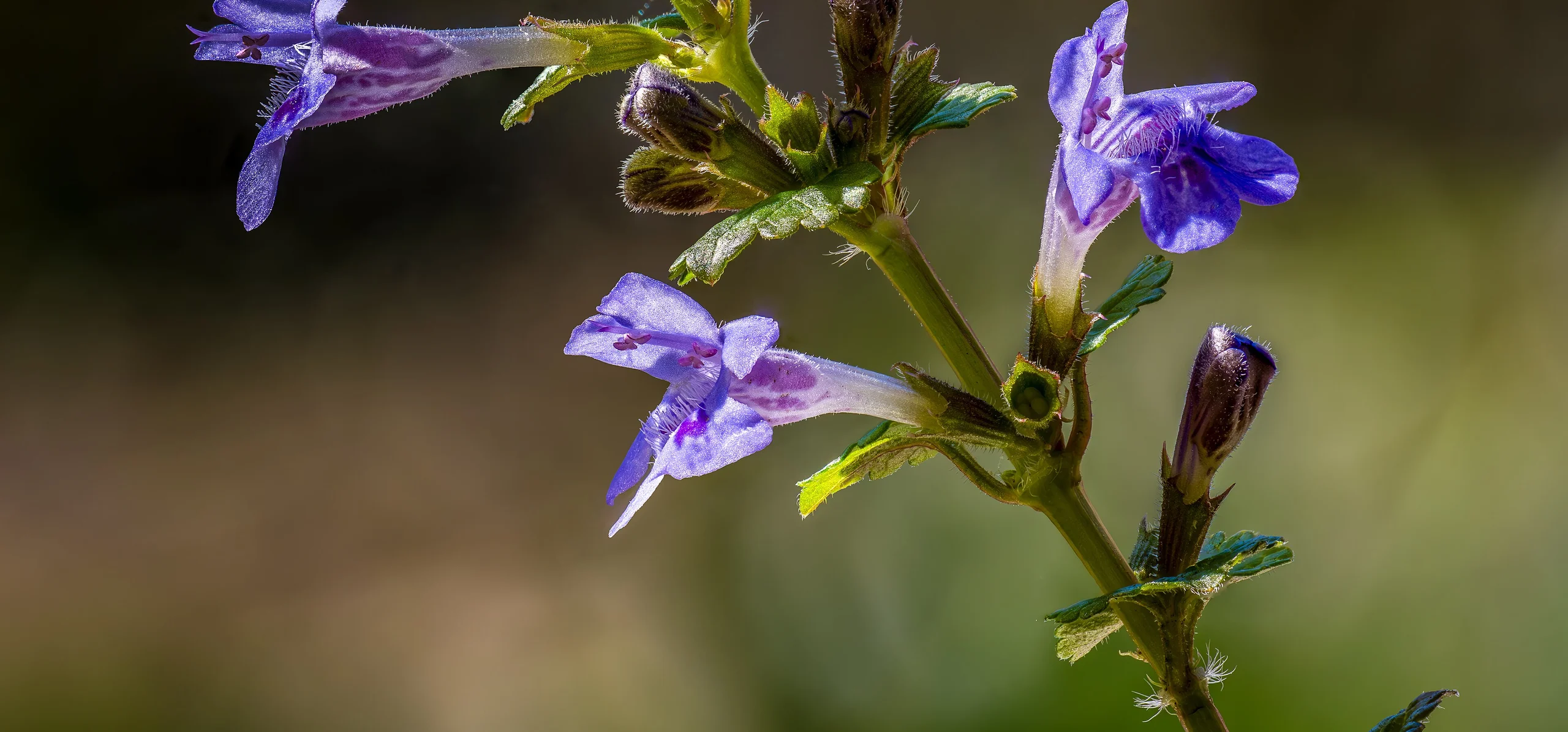
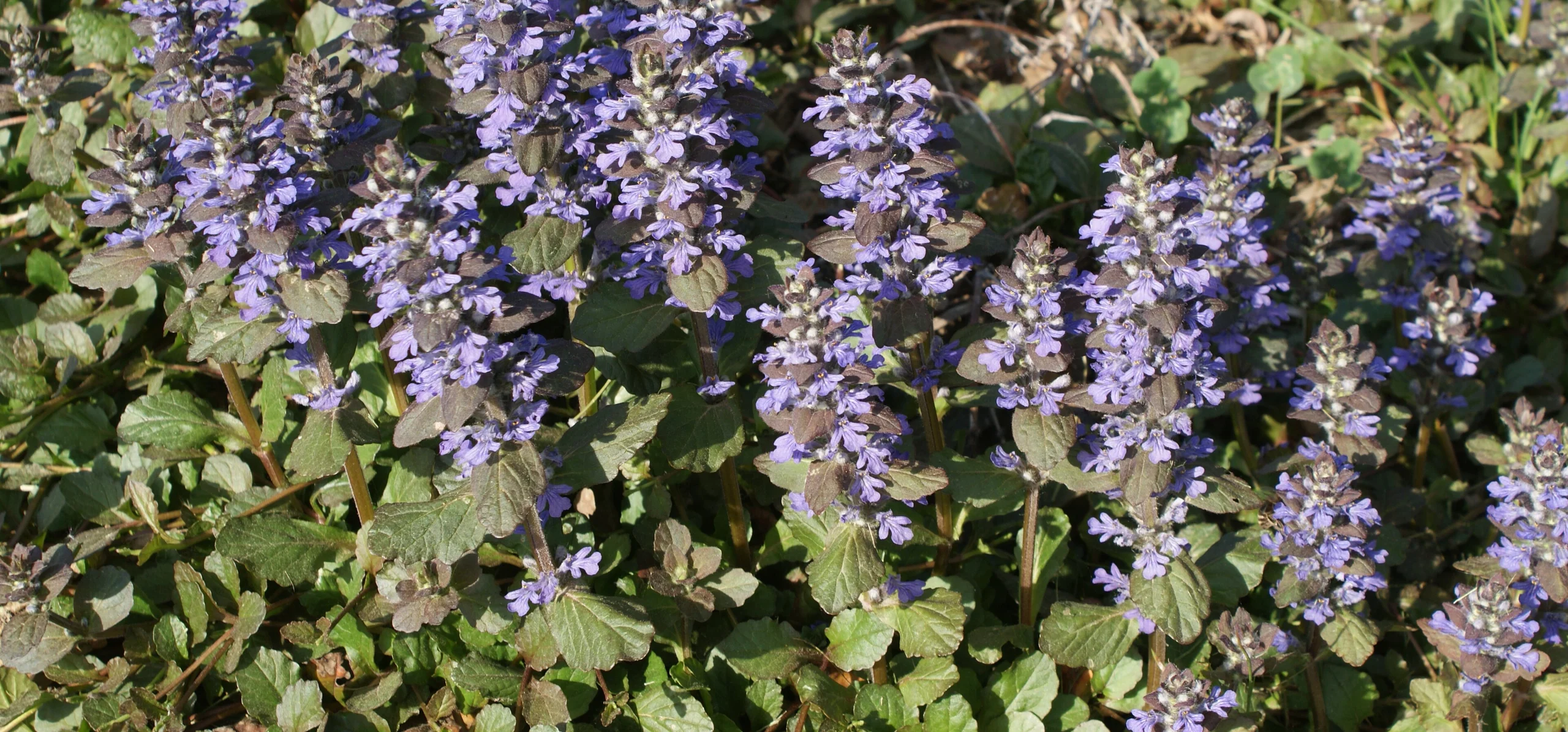
A low mat of glossy, spoon-shaped leaves throwing up short spikes of blue flowers in spring is almost certainly Ajuga reptans, bugleweed, also sold as bugle or carpet bugle. GBIF records the accepted name as Ajuga reptans L., in the mint family Lamiaceae alongside lavender and selfheal, and the square stems and two-lipped flowers give away that relationship at a glance. Its native range runs from Europe to N. Iran and NW. Africa, where it grows as woodland-edge cover in the partial shade the RHS also lists as its preferred aspect. Most gardeners meet it as a purchased pot of a named cultivar rather than the plain green wild species, because the colored-leaf forms sell far better as ground cover.
Choosing a Cultivar: Plain Green, 'Atropurpurea', or 'Burgundy Glow'
The wild species has plain dark green leaves, but two cultivars dominate the trade. The RHS describes 'Atropurpurea' as having deep bronze-purple, spoon-shaped leaves, with color depending on light: a partly shaded spot with some direct sun brings out the purple, while deeper shade lets the foliage relax back toward green. 'Burgundy Glow' carries silvery-green leaves suffused with wine-red, an effect that reads as three tones in the same mat rather than the near-solid purple of 'Atropurpurea'. Both are rated H7 by the RHS, hardy in the severest European continental winters below -20°C, and both reach the same 10 to 50 cm height and 50 cm to 1 m spread as the plain species, so the choice between them is about how much purple or variegation a bed can carry rather than any difference in hardiness.
Light and Placement: Shade-Tolerant, But Color Needs Some Sun
The RHS lists bugleweed's preferred aspect as north, west, or east-facing in a sheltered spot with partial shade, tolerating part-day sun as long as the soil stays moist; the NC State Extension goes further, rating it tolerant of everything from full sun to deep shade. That range explains a common disappointment: a plant moved into heavier shade for the sake of easy cover keeps growing, but the colored cultivars lose their purple or wine-red cast and drift back toward plain green, exactly as the RHS notes for 'Atropurpurea'. For a purchased cultivar to actually look like the label, it needs at least some part-day direct sun, not only bright indirect light.


Soil and Watering: Staying on the Right Side of Crown Rot
The RHS records moisture needs as moist but well-drained or poorly-drained ground, on clay or loam, across acid, neutral, or alkaline pH; the NC State Extension adds that it tolerates sand as well and copes with moderately dry soil once established, a real range but not permission to let a new planting dry out while it is still rooting in. The plant's actual failure point runs the other way: the NC State Extension names crown rot as a documented problem in very humid conditions and in heavy soils, exactly the combination of constant moisture and poor drainage that moist-but-well-drained is meant to avoid. Watering deeply but infrequently, and choosing loam over unamended clay where there is a choice, keeps the mat on the moist side of that line without tipping into waterlogged.
Reading Crown Rot Before It Wipes Out a Patch
Crown rot in bugleweed tends to show up as isolated wilted or blackened patches within an otherwise healthy mat rather than a uniform decline, because it starts where drainage is worst, a compacted low spot, the base of a downspout, ground that stays soggy after rain, rather than spreading evenly across the bed. The NC State Extension notes that some newer cultivars carry resistance to phytophthora, leaf spot, and fusarium wilt, so a patch that keeps rotting in the same unnamed green bugleweed is worth replacing with one of those resistant selections rather than replanting identical stock into the same wet spot. Once a patch has collapsed, lifting and discarding the dead crowns and improving drainage under that specific area matters more than treating the whole bed, since the rot is a symptom of local soil conditions rather than a disease that necessarily travels through the mat via the runners.
Planting and Containing the Runners
Bugleweed is, per the RHS, a spreading stoloniferous perennial, meaning it advances by runners that root at each node as they touch soil, the same growth habit that lets a single division fill a wide patch of bed within the two-to-five-year maturation window the RHS records. That is an asset in a woodland-edge bed meant to be solid cover and a liability at the edge of a lawn, a path, or a neighboring perennial that cannot compete with a rooting mat arriving from underneath. A physical edge, a mowed strip, a paver path, or a sunken edging strip set a few centimetres below soil level stops runners far more reliably than periodic pulling, because any rooted node left behind restarts the spread from that point.
When Bugleweed Escapes Into the Lawn
The NC State Extension flags bugleweed as weedy and aggressive in turf and lists it as invasive in other parts of the country because of its quick growth and spreading habit, even while rating it a low threat to native plant communities specifically in North Carolina. The practical read is that mowing does not control it the way it controls an upright weed, since the rooting mat sits below blade height and keeps sending up new flower spikes after every cut. The Extension's own advice is to avoid planting it near perennial beds or lawns where its spreading nature could pose removal problems, which is really a planning note as much as a warning: bugleweed belongs in a bed with a hard edge, not loose against turf it is expected to leave alone.
Common Mistakes
The most common mistake is planting bugleweed directly against a lawn or a bed of less vigorous perennials with no physical barrier, on the assumption that a low ground cover will stay put; without an edge, it does not. The second is watering it like a fully drought-tolerant plant from day one, when the NC State Extension's drought tolerance applies to soil that has already had time to establish, not to a new planting still rooting in. The third is blaming a spreading, browning patch on the wrong cause, pulling it out and replanting the same spot the same way, when the NC State Extension's own notes point to crown rot from poor drainage as the more likely culprit, a soil problem that replanting identical stock in the identical low spot will not fix.
Test your plant knowledge
Tap a card to flip it and reveal the answer.
Bugleweed spreads mainly through runners that root at each node rather than from seed alone. Tap to reveal ✓ True
Purple-leaved cultivars like 'Atropurpurea' keep their deepest color in dense, full shade. Tap to reveal ✕ False
The ASPCA lists bugleweed as toxic to cats and dogs. Tap to reveal ✕ False
Bugleweed can develop crown rot in humid conditions and heavy, poorly drained soil. Tap to reveal ✓ True
Mowing a patch of bugleweed growing in a lawn permanently kills it. Tap to reveal ✕ False
Sources
References consulted for this guide
- GBIF: Ajuga reptans L.gbif.org
- RHS: Ajuga reptans (bugle)rhs.org.uk
- RHS: Ajuga reptans 'Atropurpurea'rhs.org.uk
- RHS: Ajuga reptans 'Burgundy Glow' (v)rhs.org.uk
- NC State Extension Gardener Plant Toolbox: Ajuga reptansplants.ces.ncsu.edu
- Reference entity : Wikipédiaen.wikipedia.org