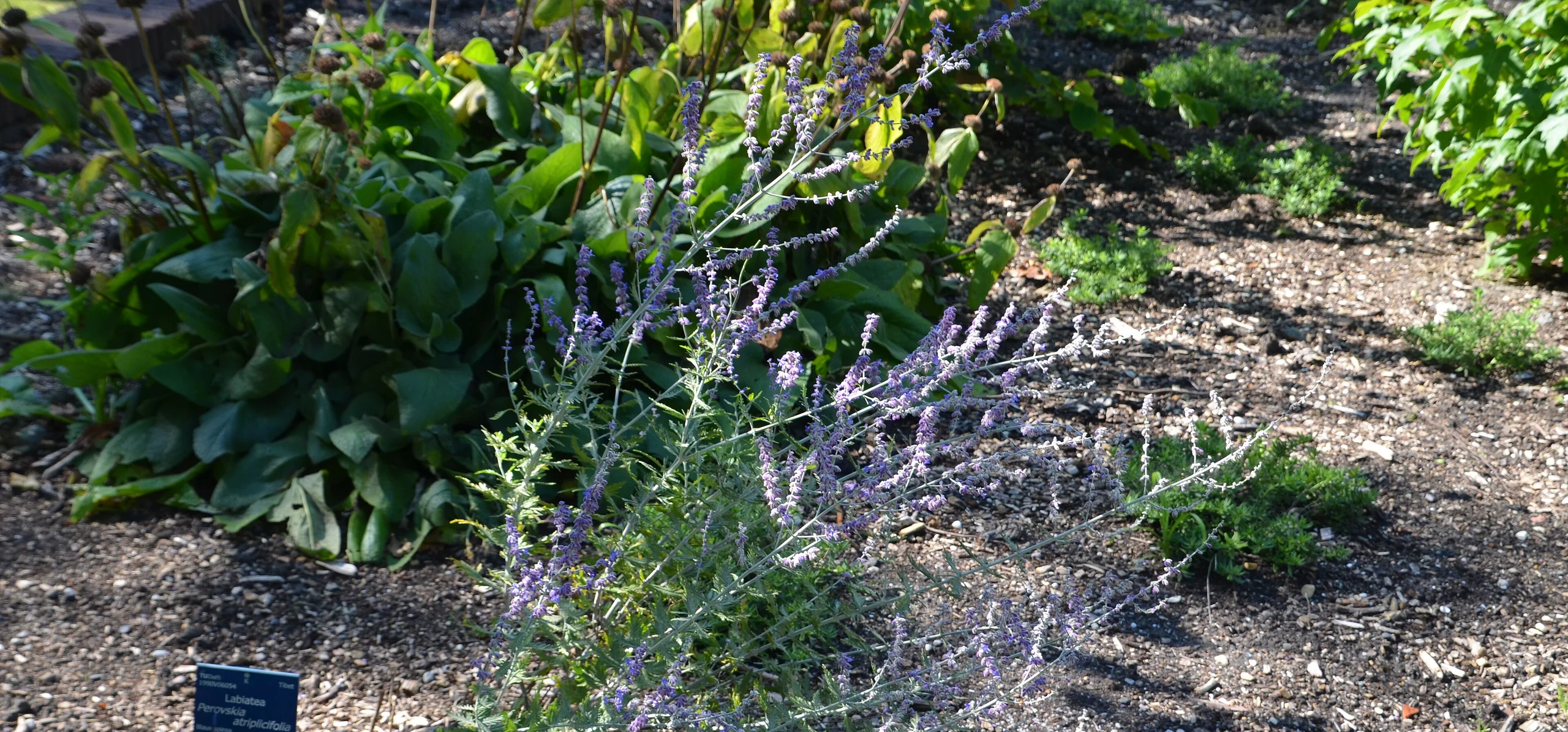
Russian Sage
Salvia yangii
Family · Lamiaceae
Russian sage, now botanically Salvia yangii, wants full sun and lean, well-drained soil. Covers siting, pruning, propagation, common mistakes and pet safety.
Salvia yangii
Plant profile
- WateringLittleWater every 12 days
- Light exposureFull sun
- Hardiness zoneUSDA 4–9
Growth
- Family
- Lamiaceae
- Life cycle
- Perennial
- Growth speed
- 7/10
- Mature size
- 100–150 cm
- Spread
- 50–100 cm
- Flowering
- Late summer into early autumn
- Propagation
- Seed
- Cutting
- Division
Dormancydeciduous, dies back to a woody framework in cold winters
Time to maturity2-5 years
Soil & climate
- Soil types
- chalk, loam, sand
- Saline soil
- Partially tolerated
- Drought tolerance
- Yes
Light & Placement
- Origin
- Afghanistan to W. China
- Where to place it
- sunny border
- gravel garden
- coastal garden
- mixed perennial border
- large container with a sharp-draining, gritty mix
Safety
- Toxicity
- CatsSafe
- DogsSafe
Data fromSalvia yangii, GBIF Backbone TaxonomyRHS: Perovskia atriplicifolia (Russian sASPCA: Fall Plants, Hazardous or HarmlesWisconsin Horticulture Extension: RussiaMissouri Botanical Garden: Perovskia atr
Where it grows
World distribution
Russian Sage is native to 4 countries: Afghanistan, China, India, and Pakistan.GBIF records 841 documented identifications across 26 countries, with the largest concentrations in Afghanistan, United States, and Switzerland.
- Afghanistan
- China
- India
- Pakistan
Yellow to orange dots: concentration of documented identifications per country. Green countries: sourced native range. Source: GBIFNative range from POWO (Kew).
From Perovskia to Salvia: What You're Actually Growing
The plant tag on this pot almost certainly still says Perovskia atriplicifolia, but GBIF's accepted taxonomy now places it in the sage genus as Salvia yangii, following DNA work published in 2017 that folded the whole Perovskia group into Salvia. The plant itself hasn't changed: stiff, upright, whitish square stems carry finely cut, aromatic grey-green leaves, and from midsummer they push up airy, branched spikes of tiny tubular purple-blue flowers that open from the top down. Crush a leaf and the sharp, sage-like scent confirms the mint-family stems, four-sided if you roll one between your fingers. It comes from dry, rocky ground in Afghanistan and western China, often at real elevation, which explains why it shrugs off poor soil and baking sun but sulks in anything rich or shaded.
Sun and Site Selection
Give it full sun, a south or west-facing spot with at least six hours of direct light. Cut the light back and the stems etiolate: they stretch toward the gap, thin out and flop under the weight of the flower spikes before the display is even finished, a problem often blamed on wind or rain when the real cause is shade. Good air movement around the base matters almost as much as sun exposure, a plant wedged between a wall and a dense shrub holds humidity in its foliage and is where the rare mildew issue turns up first. Open borders, gravel gardens and the front of a mixed perennial bed all suit it.
Soil, Planting and Coastal Tolerance
Russian sage wants the opposite of a rich vegetable bed: average to poor, sharply drained soil, whether that's chalk, loam or sand, and it handles acid, neutral or alkaline ground without complaint. If you're planting into clay, work coarse grit into the top 20 cm or set the crown slightly proud of grade so winter water doesn't pool against it. Space plants roughly 45 to 60 cm apart to give the eventual 0.5 to 1 m spread room to fill in. It also tolerates coastal exposure and salt-laden wind better than most silver-leaved perennials, useful if a seaside bed has already defeated lavender.


Watering: Establish Deep, Then Step Back
Water new plants regularly through their first growing season, this is what builds the deep root system that later tolerance depends on. After that, treat it like a plant that would rather be too dry than too wet: established Russian sage needs supplemental water only every 10 to 14 days in a dry summer, and the single most common way to kill it is a fixed irrigation schedule that keeps the crown damp through a wet spring. Check that the top 5 to 8 cm of soil has dried before watering again, and if the bed drains slowly after rain, that's the detail to fix before adding another plant.
Pruning: Cutting Back Hard Every Spring
Leave the bare stems standing through autumn and winter, they add structure to the border and give the crown some frost protection, then cut the whole plant down to about 30 cm as new grey shoots appear at the base in early spring. Skip this and the plant turns woody and gappy within a couple of seasons, flowering only from a thin shell of stems at the edge. This is the same treatment gardeners give Buddleja or Caryopteris: a hard annual reset on a shrub that flowers on the current season's growth.
Propagation from Cuttings, Seed and Division
Named cultivars such as 'Blue Spire' or the more compact 'Little Spire' don't come true from seed, so take 3 to 4 inch softwood cuttings in early summer, strip the lower leaves and root them in a free-draining mix, this is the reliable way to bulk up a good plant or replace one that has died. Species seed germinates in one to four months at 60 to 65 degrees F, and a cold spell of roughly 35 to 44 degrees F for ten days to six weeks beforehand improves germination. Division works but the woody crown resents disturbance and recovers slowly, it's a last resort rather than a first choice.
Flopping, Overcrowding and Other Common Mistakes
Young plants, and any plant sited in soil richer or shadier than it wants, tend to flop outward under the weight of their own flower spikes rather than standing upright, stake lightly through the first season or plant it close enough to a neighbour that the neighbour does the supporting. Feeding is the other frequent misstep: this species was named Perennial Plant of the Year by the Perennial Plant Association in 1995 precisely because it performs on neglect, added fertiliser pushes soft, floppy growth instead of the wiry, self-supporting habit it's known for.
Pests, Disease and Pet Safety
Once established, Russian sage is close to trouble-free, Wisconsin Horticulture Extension describes it as having essentially no disease or insect problems in the garden. The one real risk is root and crown rot in soil that stays wet over winter, which comes back to the drainage requirements above rather than any pathogen worth naming. For households with animals, an ASPCA fall-plants guide names Russian sage directly as non-toxic to pets, so a curious cat or dog brushing past the foliage isn't a poisoning concern the way many other silver-leaved border plants are.
Test your plant knowledge
Tap a card to flip it and reveal the answer.
Russian sage needs full sun to stay upright and flower well. Tap to reveal ✓ True
Once established, Russian sage should still be watered daily through summer. Tap to reveal ✕ False
Cutting the plant back hard in early spring keeps it from turning woody and sprawling. Tap to reveal ✓ True
"Perovskia atriplicifolia" is still the botanical name accepted by taxonomists today. Tap to reveal ✕ False
The ASPCA lists Russian sage as non-toxic to cats and dogs. Tap to reveal ✓ True
Sources
References consulted for this guide
- Salvia yangii, GBIF Backbone Taxonomygbif.org
- RHS: Perovskia atriplicifolia (Russian sage)rhs.org.uk
- ASPCA: Fall Plants, Hazardous or Harmless (Russian sage)aspca.org
- Wisconsin Horticulture Extension: Russian Sagehort.extension.wisc.edu
- Missouri Botanical Garden: Perovskia atriplicifolia Plant Findermissouribotanicalgarden.org
- Reference entity : Wikipédiaen.wikipedia.org