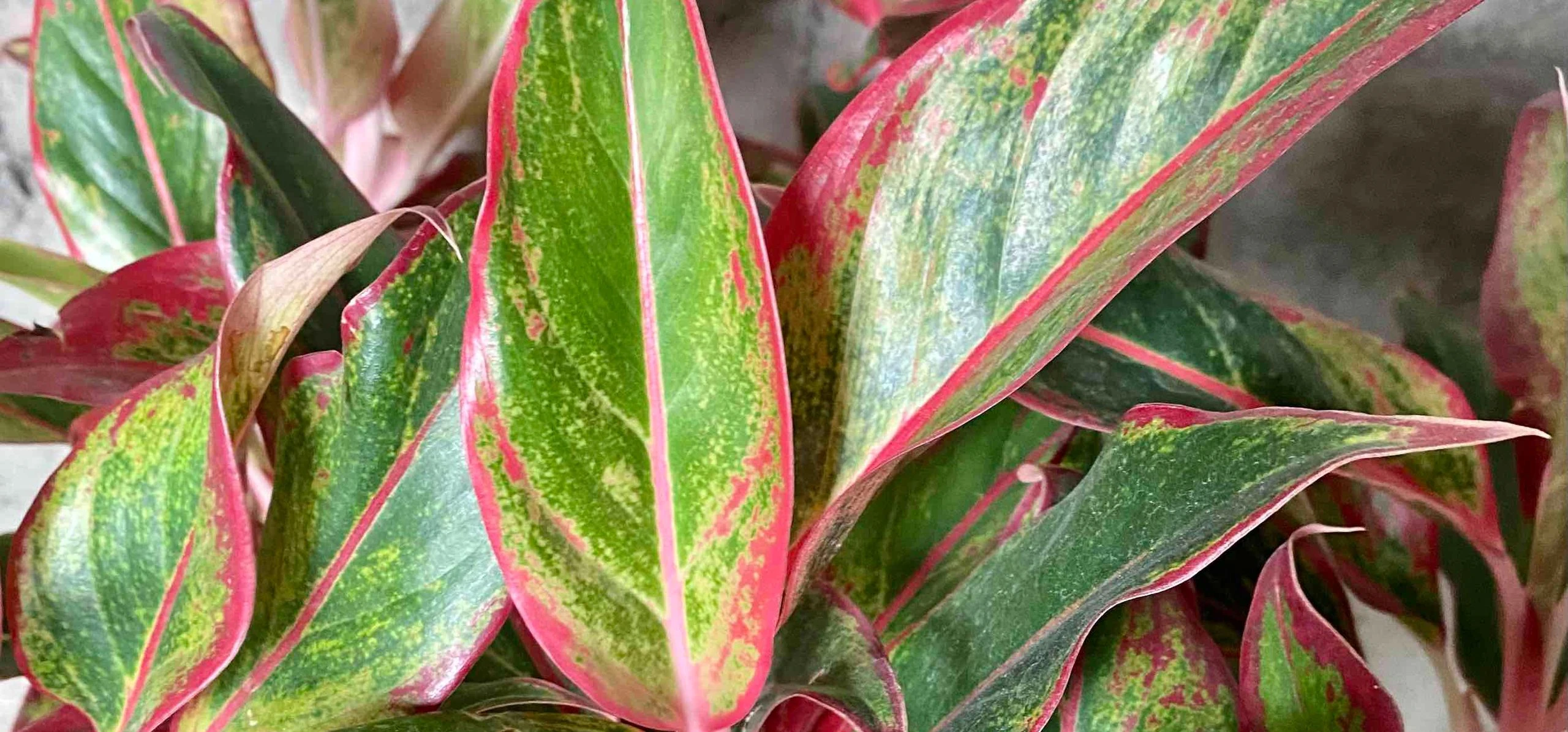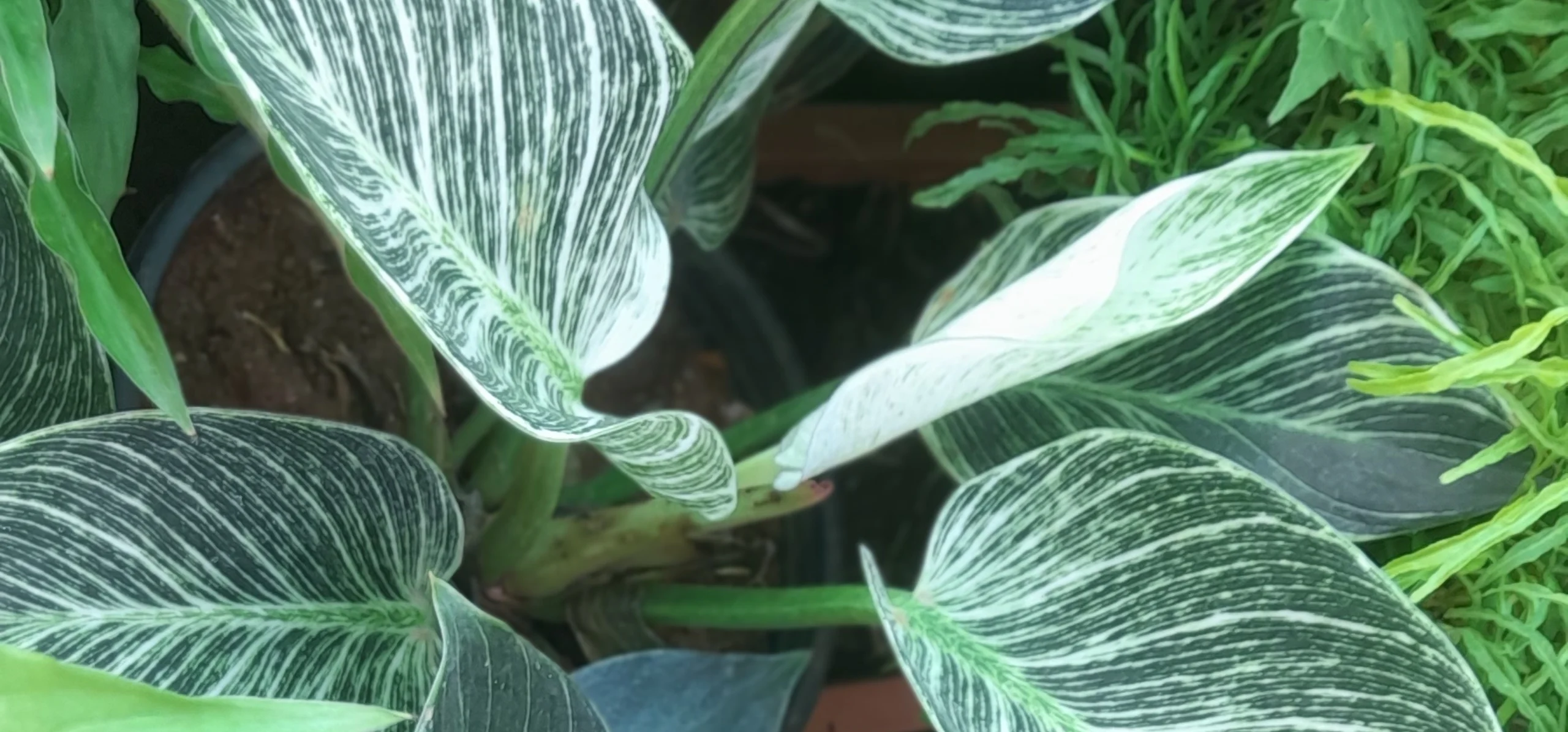
Philodendron 'Birkin'
Philodendron
Family · Araceae
Philodendron 'Birkin' is a striped Rojo Congo mutation that needs bright indirect light, steady moisture and pruning to stop stems reverting to green.
Philodendron
Plant profile
- WateringModerateWater every 8 days
- Light exposureIndirect light
- Ideal temperature18–29 °C
- Humidity50–60 %
- Hardiness zoneUSDA 10–12
Growth
- Family
- Araceae
- Life cycle
- Perennial
- Growth speed
- 3/10
- Mature size
- 15–90 cm
- Spread
- 15–90 cm
- Flowering
- Rarely flowers indoors
- Propagation
- Cutting
- Division
Dormancyno true dormancy; growth slows in winter with cooler temperatures and lower light
Time to maturityreaches a mature, clumping habit within one to two years
Soil & climate
- Soil types
- loam, sand
- Saline soil
- Not tolerated
- Drought tolerance
- No
Light & Placement
- Where to place it
- east-facing windowsill
- bright bathroom shelf away from direct sun
- standard houseplant pot with drainage holes
- hanging planter
OriginCultivar mutation from production nurseries; parent genus Philodendron is native to Mexico and tropical America
Safety
- Toxicity
- CatsToxic
- DogsToxic
- HorsesToxic
- HumansToxic
Data fromGBIF Backbone Taxonomy: Philodendron SchPlants of the World Online (Kew): PhilodRHS: Philodendron 'Birkin'NC State Extension Gardener Plant ToolboASPCA: Heartleaf Philodendron
Where it grows
World distribution
GBIF records 105,345 documented identifications across 111 countries, with the largest concentrations in Brazil, Colombia, and Ecuador.
Yellow to orange dots: concentration of documented identifications per country. Green countries: sourced native range. Source: GBIF.
The plant you brought home is not a wild species you can look up by a two-word Latin name, it is a mutation that appeared in a production nursery and has since been cloned by the million. That single fact explains almost everything odd about it: why every leaf carries a slightly different pattern of white pinstripes, why a stem can suddenly start pushing out plain green leaves, and why no botanist has ever collected it in a forest. Understood as a cultivar rather than a species, Philodendron 'Birkin' is an easy, compact houseplant that rewards steady, moderate care far more than fussing.
A cultivar mutation, not a species from the wild
Philodendron 'Birkin' first turned up as a spontaneous chimeric mutation in tissue culture, most likely on the popular hybrid cultivar Philodendron 'Rojo Congo'. North Carolina State University Extension notes the exact parentage is still unsettled: it is either a rare mutation of 'Rojo Congo' or a hybrid between the cultivars 'Congo' and 'Imperial Green'. A chimeric mutation happens when a single cell near the growing tip loses the ability to make chlorophyll and every cell that descends from it does the same, so new leaves emerge striped rather than solid green. Because that mutation lives only in cloned tissue, there is no accepted botanical binomial for it, and GBIF's backbone taxonomy resolves the name no further than the genus Philodendron, which Plants of the World Online (Kew) records as native to Mexico through tropical America. Slug and product listings sometimes shorten the plant to just "Birkin", but the correct cultivar name keeps the single quotes: Philodendron 'Birkin'.
Light and placement
The Royal Horticultural Society recommends bright, filtered or indirect light for this cultivar, and warns that direct sun scorches the leaves. An east-facing sill with a few hours of gentle morning sun works well; a south or west window needs a sheer curtain or two metres of distance from the glass. Light does more than keep the plant alive here, it also controls how crisp the variegation looks. In light that is too dim, new leaves emerge mostly dark green with only faint pinstripes, since the plant prioritises chlorophyll-rich tissue when energy is scarce. Move a pale, under-lit plant somewhat closer to a window and the next two or three leaves usually come back with much stronger white striping.
Watering and humidity
Water when the top inch (about 2.5 cm) of the potting mix has dried out, then water thoroughly until it runs from the drainage holes and empty the saucer afterwards. North Carolina State Extension lists a preference for moist, well-drained soil and warns that overwatering leads to root rot and yellowing leaves, so err on the side of letting the surface dry rather than keeping the mix constantly wet. The same source gives a comfortable range of 65 to 85 degrees Fahrenheit (about 18 to 29 degrees Celsius) and a relative humidity target of 50 to 60 percent, noting that brown, crispy leaf tips are the plant's usual way of signalling that the air is too dry. A pebble tray, a nearby humidifier, or grouping it with other houseplants all raise local humidity without the daily misting some guides suggest, which wets the leaf surface but does little for the surrounding air.


Soil, potting and feeding
A loose, well-drained mix suits this plant best. North Carolina State Extension describes its preferred growing medium as moist, well-drained, slightly acidic soil built on loam and sand, and a standard houseplant or aroid mix with a handful of perlite folded in reproduces that structure reliably. The pot needs drainage holes; without them, the same overwatering risk that damages the roots in heavy garden soil shows up just as fast in a container. The RHS recommends a balanced liquid fertiliser applied monthly through the growing season, with watering scaled back to moderate outside that period, and repotting only every two to three years since this is a slow, compact grower that does not quickly outgrow its container.
Propagation by stem cuttings
Because the variegation is a chimeric mutation rather than a stable genetic trait, seed is not a reliable way to reproduce it, commercial growers multiply Philodendron 'Birkin' by tissue culture instead. At home, stem cuttings are the practical option: cut a section that includes at least one leaf node, let the cut end dry for an hour, then set it in water or a barely damp mix. Roots typically appear within two to four weeks at the humidity and temperature levels described above. Take cuttings only from stems that still show the normal balance of green and white, a cutting taken from a fully reverted, all-green stem will simply grow on as plain green.
Stopping the plant from reverting
The same instability that produced the pinstripe pattern in the first place means individual stems can mutate again, usually back toward solid green, occasionally toward almost pure white. Growers report this is a well-known quirk of the cultivar: a stem quietly drops its variegation over a few leaves and, left alone, out-competes the rest of the plant because unstriped tissue photosynthesises more efficiently. As soon as a stem produces two consecutive all-green leaves, prune it back to just above the last leaf that still shows white striping, this redirects the plant's energy to the variegated growth points rather than letting the plain green stem take over. The opposite failure is just as final: a stem or leaf that turns almost entirely white has too little chlorophyll to feed itself and usually weakens and dies, so there is nothing to preserve by leaving it in place.
Pests, diseases and pet safety
Indoors, the pests to watch for are the usual houseplant trio: mealybugs and scale, which show up as small white or brown clusters at leaf joints and along stems, and spider mites, which favour the same warm, dry air that also causes brown leaf tips. Wipe visible pests off with a cotton swab dipped in isopropyl alcohol and treat the whole plant with insecticidal soap or neem oil if the infestation spreads, repeating every five to seven days for two or three rounds. Root rot from overwatering is the more serious risk and shows up as wilting despite moist soil, with mushy, dark roots on inspection. On safety, North Carolina State Extension lists Philodendron 'Birkin' as toxic to humans, cats and dogs, and the ASPCA's entries for the genus attribute this to insoluble calcium oxalate crystals present throughout the plant, which cause oral irritation, drooling and vomiting if chewed and can irritate skin on contact, so gloves are worth wearing when pruning or repotting, and the plant is best kept out of reach of pets and small children.
Test your plant knowledge
Tap a card to flip it and reveal the answer.
Philodendron 'Birkin' is a wild species collected from a rainforest and grown from seed. Tap to reveal ✕ False
Direct sun can scorch Philodendron 'Birkin', so bright, filtered or indirect light suits it best. Tap to reveal ✓ True
If a stem starts producing solid green leaves, it should be pruned back to the last variegated leaf. Tap to reveal ✓ True
This plant tolerates constantly soggy soil with no risk of root rot. Tap to reveal ✕ False
Philodendron 'Birkin' is safe to keep within reach of cats and dogs. Tap to reveal ✕ False
Sources
References consulted for this guide
- GBIF Backbone Taxonomy: Philodendron Schottgbif.org
- Plants of the World Online (Kew): Philodendron Schottpowo.science.kew.org
- RHS: Philodendron 'Birkin'rhs.org.uk
- NC State Extension Gardener Plant Toolbox: Philodendron 'Birkin'plants.ces.ncsu.edu
- ASPCA: Heartleaf Philodendronaspca.org
- Reference entity : Wikipédiaen.wikipedia.org