Giant Taro
Alocasia macrorrhizos
Family · Araceae
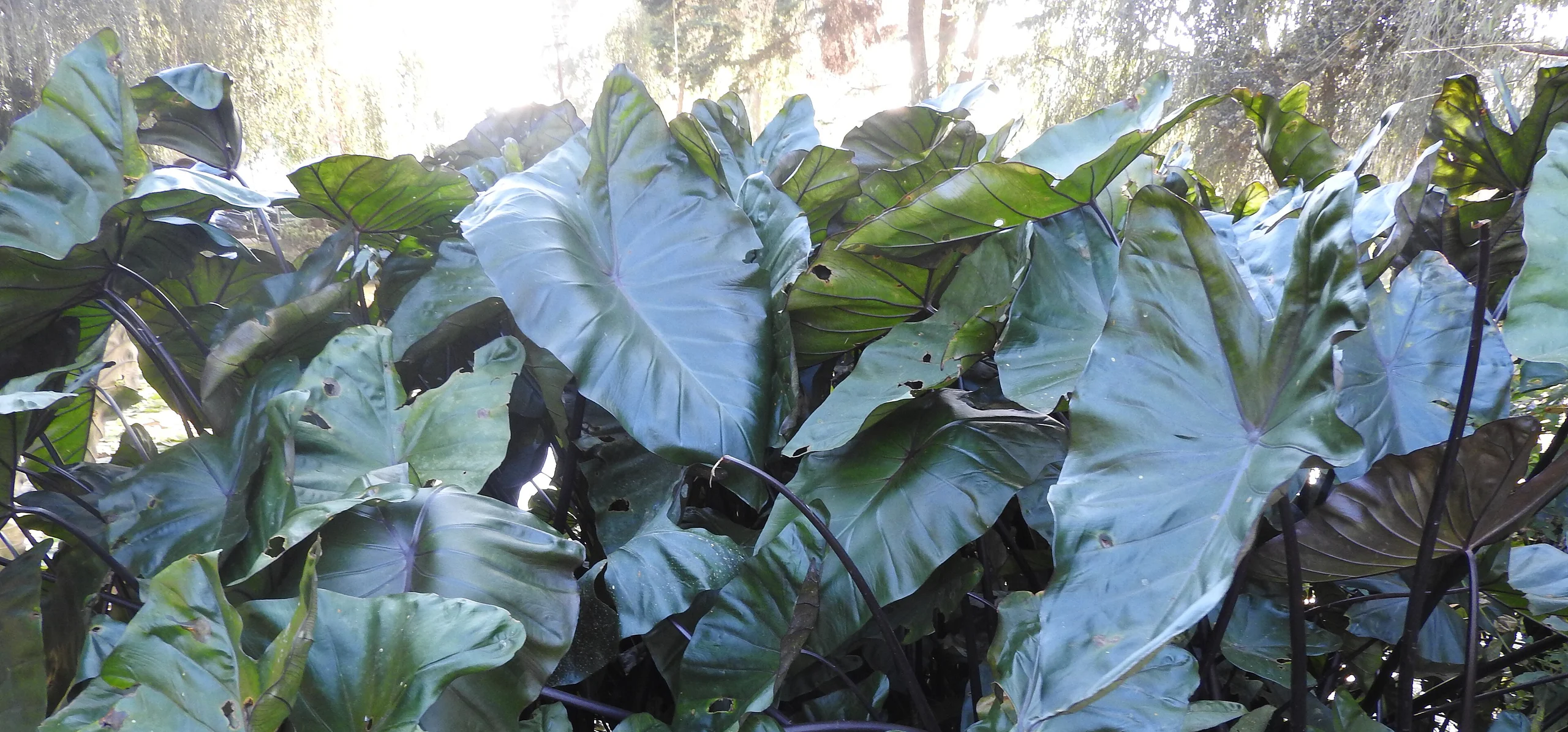
Alocasia macrorrhizos grows leaf blades over a metre long on upright stalks. Here is the light, water, warmth and pot size this giant taro really needs.
Alocasia macrorrhizos
Plant profile
- WateringHighWater every 5 days
- Light exposureIndirect light
- Ideal temperature15–29 °C
- Humidity60–80 %
- Hardiness zoneUSDA 9–11
Growth
- Family
- Araceae
- Life cycle
- Perennial
- Growth speed
- 8/10
- Mature size
- 150–250 cm
- Spread
- 150–250 cm
- Flowering
- Rare and insignificant in cultivation
- Propagation
- Division
- Offsets
DormancySlows or dies back below about 10 degrees Celsius
Time to maturityReaches full size over about 2 to 3 growing seasons
Soil & climate
- Soil types
- Loam, Sand
- Saline soil
- Not tolerated
- Drought tolerance
- No
Light & Placement
- Origin
- Central Malesia to Queensland
- Where to place it
- Bright room near an east or west window
- Humid conservatory or greenhouse
- Sheltered, part-shaded bed or patio out of strong wind
- Wide, stable pot with drainage holes
Safety
- Toxicity
- CatsToxic
- DogsToxic
- HorsesToxic
- HumansToxic
Invasive speciesNaturalised and considered invasive in wet disturbed sites in parts of Florida and other warm regions
Data fromAlocasia macrorrhizos (L.) G.Don, PlantsAlocasia macrorrhizos, GBIF Backbone TaxAlocasia, ASPCA Animal Poison ControlAlocasia macrorrhizos, RHS
Where it grows
World distribution
Giant Taro is native to 6 countries: Australia, Indonesia, Malaysia, Papua New Guinea, Philippines, and Solomon Islands.GBIF records 3,627 documented identifications across 111 countries, with the largest concentrations in United States, China, and Philippines.
- Australia
- Indonesia
- Malaysia
- Papua New Guinea
- Philippines
- Solomon Islands
Yellow to orange dots: concentration of documented identifications per country. Green countries: sourced native range. Source: GBIFNative range from POWO (Kew).
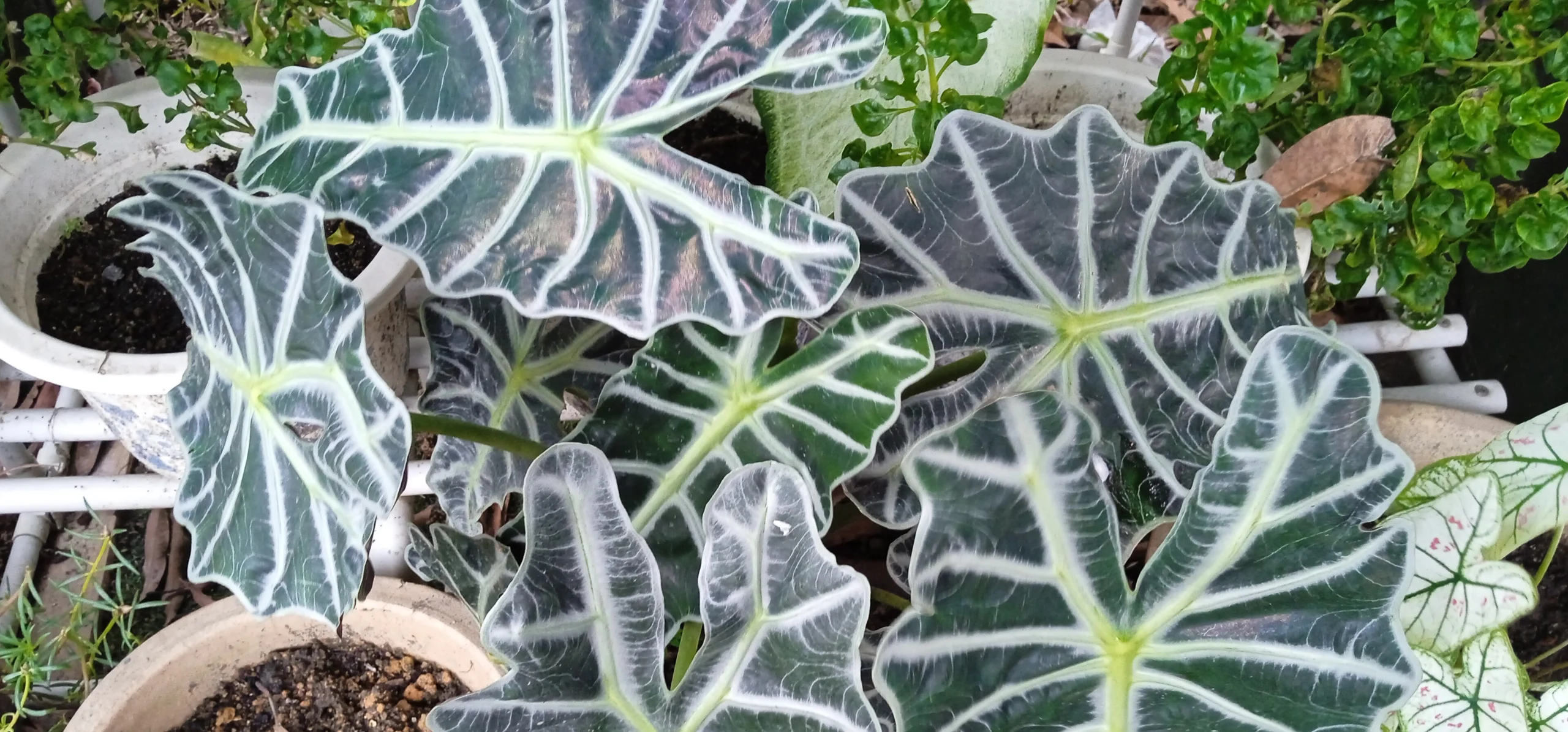
Alocasia macrorrhizos is the aroid behind most of the oversized, glossy, upward-pointing leaves sold as giant taro or upright elephant ear. A young plant in a nursery pot looks modest, but give it warmth, humidity and room for its rhizome and it will throw leaf blades a metre or more long within a couple of growing seasons. The two things that make or break it are moisture consistency and cold protection: this is a plant of wet tropical margins, not a desert succulent, and a single cold, wet winter can rot the corm outright. Get the basics right and it rewards you with new leaves that unfurl every few weeks through the warm months.
Origin and how to tell it from Colocasia
Plants of the World Online lists the native range of Alocasia macrorrhizos as Central Malesia to Queensland, including the Murray Islands group, where it grows along riverbanks, forest margins and other disturbed, permanently damp ground rather than deep closed-canopy shade. Pacific communities have carried the corm across the region for centuries as a backup starch crop, which is why it now turns up naturalised well outside that original range, including parts of Florida, where it is treated as a weed in wet disturbed sites.
Garden centres often mix it up with Colocasia esculenta, the true taro, because both get called elephant ear. The reliable way to tell them apart is the leaf attachment: on Alocasia the leaf stalk meets the blade at the notch, so the point of the leaf faces upward, while on Colocasia the stalk attaches nearer the centre of the blade, so the leaf hangs with its point downward and sheds water off the tip. Alocasia macrorrhizos also holds its leaves on stiffer, more upright stalks than most smaller Alocasia hybrids sold as houseplants.
Light and placement
Outdoors in warm climates this species wants part shade or filtered sun; the huge leaves scorch quickly in unbroken midday sun, and strong wind shreds them just as fast, so a sheltered spot with dappled light is the priority when siting it in a garden bed. Indoors or in a conservatory it wants the brightest indirect light you can give it, close to an east or west window, since a leaf grown too dark comes in small and pale on a thin, stretched stalk. Direct sun through south-facing glass at midday is the one exposure to avoid, it bleaches patches into the leaf surface within a day.
Watering
This is not a plant to let dry out between waterings. In its native wet margins the roots sit in permanently moist ground, so indoors the soil should stay evenly damp through the growing season, watered again as soon as the top few centimetres start to feel dry rather than on a fixed weekly schedule. A pot that dries fully shows it fast: the lower leaves droop and the newest one may fail to open properly. Ease off sharply once temperatures drop in autumn, since cold, wet soil around a dormant corm is the single fastest way to lose the plant to rot.


Soil and potting
The RHS lists loam and sand as the soil types this species performs best in, kept moist but well drained, which in a container translates to a rich, humus-heavy mix cut with perlite or coarse sand so water moves through freely instead of pooling around the rhizome. Because a mature plant is heavy and top-loaded with wide leaves, choose a broad, stable pot rather than a tall narrow one, and make sure it has real drainage holes. Repot in spring once roots circle the base or once offsets crowd the rim, moving up only one pot size at a time.
Temperature and humidity
Giant taro has no cold tolerance below about 10 degrees Celsius, and the RHS rates it H1a, meaning it needs to stay above 15 degrees Celsius to keep growing rather than sulking. The comfortable range for active growth sits closer to 18 to 29 degrees Celsius. Where winters drop below that, growers in cooler regions commonly treat it as a container plant that comes indoors before the first frost, or lift and store the corm dry over winter the way a dahlia tuber is stored, replanting once the ground warms again. Humidity matters almost as much as temperature: dry indoor air browns the leaf edges, so aim for above 60 percent, helped by grouping plants together, a pebble tray, or a humidifier in heated rooms.
Feeding, growth rate and propagation
Feed with a balanced, water-soluble fertiliser every four to six weeks through spring and summer, then stop almost entirely once growth slows in autumn and winter; feeding a dormant or semi-dormant plant just builds up salts in soil the roots are not actively using. A well-fed plant in warmth pushes a new leaf on a steady cycle through the growing season, each one rolled tight and pale on emergence before it unfurls and darkens to a deep matte green over the following days. Slow, small, pale new leaves in summer usually mean the plant is hungry or underlit, not overwatered. The easiest way to make more plants is division of the offsets, or pups, that form around the base of the rhizome once it is established: wait until a pup has its own few leaves and visible roots before separating it with a clean cut, then pot it individually in the same free-draining mix and keep it warm and humid until it re-establishes. A larger rhizome can also be cut into sections at repotting time, each with at least one growing point, though this sets the plant back further than removing an already-rooted offset.
Pests, diseases and common mistakes
Spider mites and mealybugs are the recurring problems indoors, both favoured by dry air and both worth checking for at the leaf axils and undersides where they hide first. Outdoors the bigger risks are physical: torn leaves from wind exposure and scorch from sun the plant was not hardened to. The most common mistake growers make is treating this like a small houseplant Alocasia and keeping it in a cramped pot on a dry windowsill; it is a rhizomatous plant built to grow large fast, and it punishes both drought and a pot that is too small with stunted, undersized leaves. The second most common mistake is leaving a dormant corm sitting wet and cold over winter, which invites rot before spring growth even has a chance to start.
Toxicity: why the corm has to be cooked
Every part of Alocasia macrorrhizos contains needle-shaped calcium oxalate crystals, and chewing raw leaf, stem or corm delivers an intense burning sensation in the mouth and throat within seconds. The ASPCA lists Alocasia as toxic to cats, dogs and horses, with oral irritation, drooling and vomiting among the signs of ingestion, so keep pets from chewing on the stalks and wash your hands and any tools after cutting the plant, since the sap alone can irritate skin. Despite this, the corm has been eaten as a staple and famine food across parts of the Pacific for generations, but only after thorough cooking, which breaks down the crystals; raw corm is never safe to eat regardless of preparation time.
Test your plant knowledge
Tap a card to flip it and reveal the answer.
Alocasia macrorrhizos leaves point upward from where the stalk meets the blade, unlike Colocasia, where the leaf points downward. Tap to reveal ✓ True
It is fine to let the potting mix dry out completely between waterings. Tap to reveal ✕ False
The raw corm and leaves can be eaten straight from the plant without any preparation. Tap to reveal ✕ False
Alocasia macrorrhizos is listed by the ASPCA as toxic to cats, dogs and horses. Tap to reveal ✓ True
This plant tolerates temperatures below 10 degrees Celsius without damage. Tap to reveal ✕ False
Sources
References consulted for this guide
- Alocasia macrorrhizos (L.) G.Don, Plants of the World Online (Kew)powo.science.kew.org
- Alocasia macrorrhizos, GBIF Backbone Taxonomygbif.org
- Alocasia, ASPCA Animal Poison Controlaspca.org
- Alocasia macrorrhizos, RHSrhs.org.uk
- Reference entity : Wikipédiaen.wikipedia.org