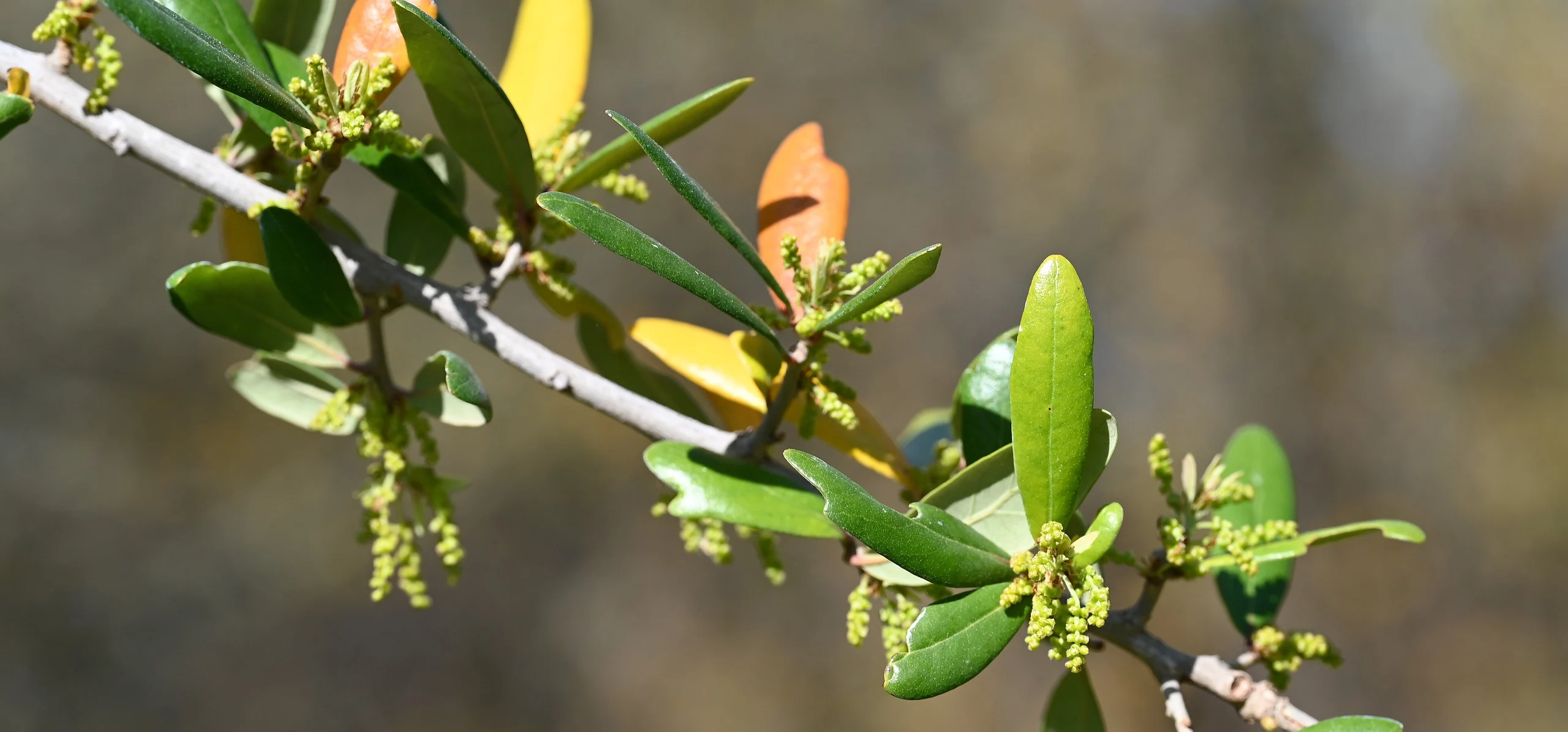
Southern Live Oak
Quercus virginiana
Family · Fagaceae
Southern live oak spreads wider than it stands tall, shrugs off salt spray and hurricane winds, and needs early structural pruning plus caution around oak wilt.
Quercus virginiana
Plant profile
- WateringLittleWater every 14 days
- Light exposureFull sun
- Hardiness zoneUSDA 7–10
Growth
- Family
- Fagaceae
- Life cycle
- Perennial
- Growth speed
- 5/10
- Mature size
- 1830–2440 cm
- Spread
- 1830–3660 cm
- Flowering
- Inconspicuous spring catkins; acorns mature within one growing season
- Propagation
- Seed
Dormancysheds old leaves in a short window in early spring
Time to maturitydecades to centuries
Soil & climate
- Soil types
- clay, loam, sand, chalk
- Saline soil
- Tolerated
- Drought tolerance
- Yes
Light & Placement
- Origin
- Southeastern and south-central United States
- Where to place it
- open lawn
- parkland
- coastal planting
- street tree
- large garden
Safety
- Toxicity
- CatsSafe
- DogsSafe
- HorsesToxic
Data fromGBIF Backbone Taxonomy: Quercus virginiaPlants of the World Online (Kew): QuercuRHS: Quercus virginiana (southern live oNC State Extension Gardener Plant ToolboUF/IFAS Extension: Quercus virginiana, SASPCA: Toxic and Non-Toxic Plants, Oak
Where it grows
World distribution
Southern Live Oak is native to a single country: United States.GBIF records 13,398 documented identifications across 21 countries, with the largest concentrations in United States, Cuba, and Mexico.
- United States
Yellow to orange dots: concentration of documented identifications per country. Green countries: sourced native range. Source: GBIFNative range from POWO (Kew).
A Southern live oak planted today is a gift to someone else's grandchildren: this is a tree that takes decades to look like anything and centuries to reach the cathedral-canopy shape it is known for, so the first questions to answer are how much room it has and how its young trunk will be trained, not how often to water it. Quercus virginiana holds most of its leaves through winter, tolerates salt spray and hurricane-force wind better than almost any other broadleaf tree, and needs almost no coddling once established. The two things that actually demand attention are structural pruning in its first decade and, in parts of its range, oak wilt.
A Coastal Giant Built to Outlive Its Planter
According to the GBIF Backbone Taxonomy, Quercus virginiana belongs to the beech family, Fagaceae, in the order Fagales. Plants of the World Online lists its native range as the southeastern and south-central United States, where it dominates the coastal plain from Virginia around the Gulf to Texas. The University of Florida IFAS Extension gives a mature size of 60 to 80 feet tall with a spread of 60 to 120 feet, meaning a healthy specimen is usually wider than it is tall, and growth is moderate at roughly three feet a year while young. Despite the common name, live oak is not a true evergreen: old leaves drop in a short window in early spring, right as new growth and inconspicuous catkins emerge, so a tree that looks half bare for two or three weeks in March or April is behaving normally rather than dying.
Site, Soil and Salt: Where a Live Oak Thrives
Give it full sun and room to spread; the RHS lists it as suitable only for very large gardens or parkland, tolerant of chalk, clay, loam and sand from acid through alkaline. NC State Extension and UF/IFAS both rate its aerosol salt tolerance as high, which is why it dominates the front line of coastal dunes and barrier islands where salt-sensitive trees cannot compete, and both note very good wind resistance once established, the product of a deep, wide-spreading root system and unusually strong wood that lets old live oaks survive hurricanes that flatten pines around them. That same root system is the reason planting distance matters: keep a live oak well back from driveways, sidewalks and foundations, since surface roots on a mature tree will eventually lift paving. Water regularly through the first two or three growing seasons to establish the root system; after that it is drought-tolerant and rarely needs supplemental irrigation outside genuine drought.


Structural Pruning in the First Ten Years
A live oak left completely unpruned when young often develops two or three codominant trunks of nearly equal size instead of one dominant leader, a structure that splits apart under its own weight or storm load decades later when it is too large to fix. Extension guidance on young-tree pruning recommends starting as soon as two to three years after planting: pick the strongest, most upright stem as the permanent leader, and shorten or remove competing leaders and any branch that is more than half the trunk's diameter, rather than waiting until the tree is large and the same cuts become major wounds. Early corrective cuts on pencil-thin wood heal within a season; the identical structural correction made on a twenty-year-old tree leaves a scar that never fully closes.
Oak Wilt, and Why 'Lethal Bronzing' Is the Wrong Name for It
The disease that actually threatens live oak is oak wilt, caused by the fungus Bretziella fagacearum, which clogs the tree's water-conducting vessels. Texas A&M Forest Service explains that sap beetles carrying fungal spores are most active in late winter and early spring, and are drawn to fresh pruning wounds and storm damage, which is why the safe pruning window for oaks runs from July through January, not February through June, and why any wound made outside that window should be painted immediately rather than left open. On live oaks the first visible sign is veinal necrosis, veins turning yellow then brown while the tissue between them stays green, a pattern some people describe loosely as leaf bronzing. That is a genuinely different problem from lethal bronzing disease, a phytoplasma infection of ornamental palms in Florida that has nothing to do with oaks; the similar-sounding names cause real confusion but the two diseases, hosts and treatments do not overlap. Because live oaks growing close together are often root-grafted into a single connected grove, oak wilt can move underground from tree to tree at roughly 75 feet a year once it establishes, which is why isolated infected trees in central Texas have taken down entire neighborhood mottes.
Spanish Moss and Resurrection Fern on the Limbs
The gray drifts of Spanish moss and the small, curling mats of resurrection fern that colonize old live oak limbs are both epiphytes, plants that use the tree only as a physical perch and take no water or nutrients from its tissue, so neither is parasitic and neither damages a healthy tree. Resurrection fern is the more dramatic of the two: it can lose the great majority of its water content in a dry spell, shriveling to a brown, curled husk that looks dead, then unfurl bright green again within hours of the next rain. Both plants thrive on the rough, moisture-holding bark and wide horizontal limbs that only an old, open-grown live oak provides, which is one more reason to give a young tree the space to develop that broad architecture rather than crowding or over-pruning it into a narrow shape.
Growing a Southern Live Oak Outside the Gulf Coast
UF/IFAS places live oak's hardiness at USDA zones 7B through 10B, and the RHS grows and lists it in the UK as a tree for very large gardens or parkland in full sun on moist, well-drained soil, so it is possible in the milder, closer-to-the-coast parts of Europe, particularly the Atlantic seaboard of Iberia and France and equivalent mild coastal pockets around the Mediterranean. Outside its native Gulf Coast heat and humidity it grows slower and generally reaches a smaller ultimate size, and young trees are more vulnerable to hard, prolonged frost than the coastal Georgia and Florida populations that made the species famous, so a sheltered site and protection through the first few winters matter more the further the tree is planted from its native range.
Acorns: A Wildlife Feast, a Horse Hazard
Live oak belongs to the white oak group, and its acorns mature within a single growing season rather than the two years red oaks need, falling and often germinating almost immediately if the ground is warm and moist; they carry less bitter tannin than red oak acorns and are heavily used by deer, squirrels and wild turkey. The ASPCA lists oak, genus Quercus, as toxic to horses, with gallotannin causing abdominal pain, diarrhea and, in a severe case, colic from acorns obstructing the digestive tract; the same ASPCA listing does not carry this toxic marking for dogs or cats. In practice that means keeping fallen acorns raked up and away from horse pasture and stalls is worth the effort under a mature live oak, even though the tree poses little day-to-day risk to household pets.
Test your plant knowledge
Tap a card to flip it and reveal the answer.
A mature Southern live oak is usually wider than it is tall. Tap to reveal ✓ True
Southern live oak drops all its leaves in autumn like a typical deciduous oak. Tap to reveal ✕ False
Pruning wounds on live oak should be painted immediately, and pruning is safest from July through January. Tap to reveal ✓ True
The ASPCA lists oak (Quercus species) as toxic to dogs and cats but not to horses. Tap to reveal ✕ False
Spanish moss and resurrection fern growing on a live oak's limbs are parasites that damage the tree. Tap to reveal ✕ False
Sources
References consulted for this guide
- GBIF Backbone Taxonomy: Quercus virginiana Mill.gbif.org
- Plants of the World Online (Kew): Quercus virginiana Mill.powo.science.kew.org
- RHS: Quercus virginiana (southern live oak)rhs.org.uk
- NC State Extension Gardener Plant Toolbox: Quercus virginiana (Southern Live Oak)plants.ces.ncsu.edu
- UF/IFAS Extension: Quercus virginiana, Southern Live Oak (ENH-722/ST564)ask.ifas.ufl.edu
- ASPCA: Toxic and Non-Toxic Plants, Oakaspca.org
- Texas A&M Forest Service: Prevent the Spread of Oak Wilt in Texastfsweb.tamu.edu
- Reference entity : Wikipédiaen.wikipedia.org