English Oak
Quercus robur
Family · Fagaceae
Growing pedunculate oak from acorn: the mature spread it needs, bare-root planting, 'Fastigiata' for small gardens, processionary moth, galls and acute decline.
Quercus robur
Plant profile
- WateringLittleWater every 10 days
- Light exposurePartial sun
- Hardiness zoneUSDA 5–8
Growth
- Family
- Fagaceae
- Life cycle
- Perennial
- Growth speed
- 4/10
- Mature size
- 2000–4000 cm
- Spread
- 800–2100 cm
- Propagation
- Seed
- Grafting
FloweringInconspicuous catkins in spring before the leaves, followed by acorns on long stalks in autumn
Dormancydeciduous, bare in winter
Time to maturityreaches ultimate height in about 20 to 50 years (RHS); full girth and canopy over centuries
Soil & climate
- Soil types
- chalk, clay, loam, sand
- Drought tolerance
- Yes
Light & Placement
- Origin
- Europe to Iran
- Where to place it
- parkland or large garden
- wildlife garden
- woodland edge
- boundary or specimen tree
- 'Fastigiata' for streets or narrow plots
Safety
- Toxicity
- HorsesToxic
Invasive speciesNC State Extension notes potential invasiveness in some natural areas, though naturalization outside cultivation is rare
Data fromGBIF Backbone Taxonomy: Quercus robur L.RHS: Quercus robur (common oak)RHS: Oak Decline (acute and chronic)ASPCA: Toxic and Non-Toxic Plants, OakNC State Extension Gardener Plant Toolbo
Where it grows
World distribution
English Oak is native to 30 countries: Albania, Austria, Belarus, Belgium, Bulgaria, Croatia, Czechia, and Denmark….GBIF records 1,725,528 documented identifications across 99 countries, with the largest concentrations in France, United Kingdom, and Germany.
- Albania
- Austria
- Belarus
- Belgium
- Bulgaria
- Croatia
- Czechia
- Denmark
- Estonia
- Finland
- France
- Georgia
Show 18 more countriesShow fewer countries
- Germany
- Greece
- Hungary
- Iran
- Ireland
- Italy
- Netherlands
- Norway
- Poland
- Portugal
- Romania
- Russia
- Spain
- Sweden
- Switzerland
- Türkiye
- Ukraine
- United Kingdom
Yellow to orange dots: concentration of documented identifications per country. Green countries: sourced native range. Source: GBIFNative range from POWO (Kew).
An acorn that fits in a coat pocket and a tree that eventually shades a small field are the same species, and that gap in scale catches out more people than any pest or disease ever does with Quercus robur. GBIF's Backbone Taxonomy accepts the name Quercus robur L. for what is commonly called English oak or pedunculate oak, a tree that germinates readily from a fresh autumn acorn, tolerates almost any soil the RHS lists, chalk, clay, loam or sand, acid through alkaline, and eventually needs a footprint well over eight metres wide and more than twelve metres tall. It is a genuinely easy tree to start and a genuinely difficult one to place correctly, which is why the decisions that matter happen before the acorn ever touches soil.
Origin and Classification
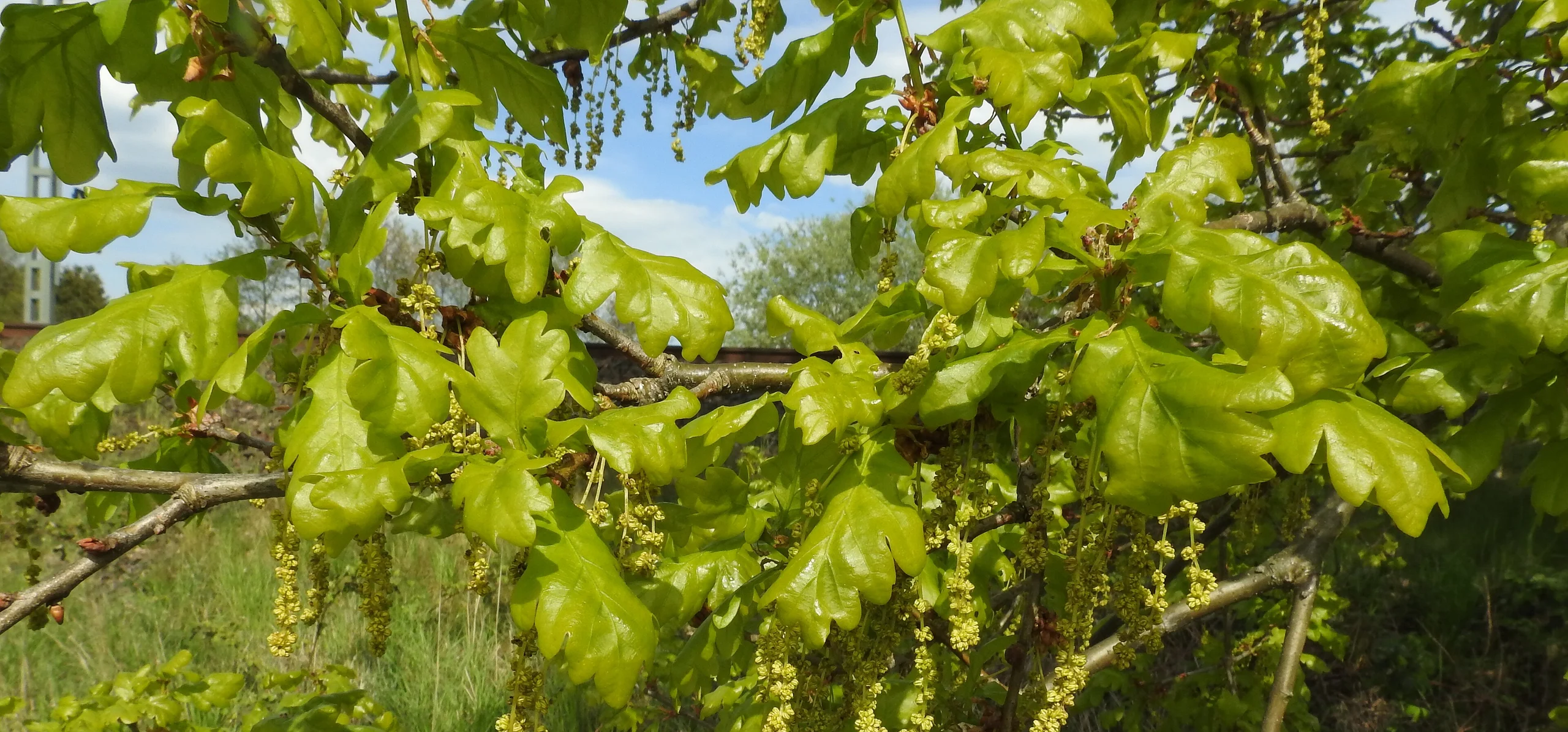
Quercus robur belongs to the beech family, Fagaceae, within the order Fagales, following GBIF's Backbone Taxonomy. Plants of the World Online gives its native range as Europe to Iran, spanning Britain and Ireland across the continent to the Caucasus, with recognised subspecies extending that range into the Balkans, Crimea and northwestern Iran. GBIF lists Pedunculate Oak alongside English Oak and European Oak as accepted vernacular names, and the pedunculate part is a genuine identification aid: this species carries its acorns on long stalks, unlike the closely related sessile oak (Quercus petraea), whose acorns sit almost stalkless against the twig.
Growing an Oak from an Acorn
Acorns lose viability once they dry out, so the RHS recommends sowing seed as soon as it is ripe, direct into a pot or cold frame rather than storing it over winter. Push each acorn onto its side an inch or so into free draining, gritty compost, keep it moist but never waterlogged, and expect a shoot within a few weeks to a couple of months; a wire mesh cage over the pot is worth the trouble, since squirrels and jays account for most acorns that never make it to a seedling. Growth in the first year goes mostly into the root, so a young oak often looks like it is doing nothing above ground while it establishes below it, patience here pays off later.
The Space a Mature Oak Actually Needs
The RHS rates this species' ultimate height above 12 metres, noting a potential of 20 to 40 metres, and its ultimate spread as wider than 8 metres; NC State Extension gives a more typical cultivated size of 12 to 21 metres tall and equally wide, reached over 20 to 50 years at a medium growth rate. Either figure rules out most suburban plots as a permanent home for a full sized specimen: the canopy needs room to clear buildings and power lines, and the root system spreads well beyond the drip line, close enough to a house to affect foundations and drains on shrinkable clay over time. Anyone planting an acorn with a specific garden in mind should measure that garden against the tree it will become in fifty years, not the seedling it is now.


Planting and Establishing Bare-Root Whips
Bare-root whips are planted in the dormant season, from autumn through late winter while the ground is workable, with organic matter worked into the backfill and the soil firmed gently around the roots rather than compacted hard. Water thoroughly at planting and through dry spells for the first two to three years while the root system establishes, since this is the period an oak is least drought tolerant; NC State rates the established tree as good at resisting drought, but a first season whip has none of that resilience yet. A sturdy stake with a soft tie, set low on the trunk to let the top move in the wind, anchors the roots without stopping the trunk flex that builds strong wood; remove it once the tree no longer rocks at the base, usually within a couple of growing seasons.
'Fastigiata' for Smaller Gardens and Streets
The straight species is not a small-garden tree, but named upright forms sold as Quercus robur f. fastigiata or under the Fastigiata Group keep the same lobed foliage and acorns on a narrow, columnar crown rather than a broad, spreading one. The RHS lists the popular 'Koster' selection as reaching around 20 metres tall but only about 3 metres wide at maturity, still a substantial tree but one that fits a boundary line or a street verge that a spreading standard never would. Because the fastigiate habit does not reproduce reliably from acorns, nurseries maintain named forms like 'Koster' as grafted, clonal stock rather than raising them from seed, so buying a named cultivar is the only way to guarantee the narrow shape rather than a broad-crowned oak ten years on.
Oak Processionary Moth and Powdery Mildew
Oak processionary moth caterpillars feed almost exclusively on oak and are unmistakable once seen: dark, hairy caterpillars 20 to 25 mm long that move nose to tail in processions and shelter in white, silk nests on the trunk and branches from late spring. The RHS is explicit that homeowners should not touch the caterpillars or their nests, since the fine hairs cause skin rashes and can trigger respiratory irritation in people and pets; the recommended response is to report a sighting through TreeAlert and leave removal to a licensed contractor. Powdery mildew is a far more routine problem: both the RHS and NC State list Quercus robur as susceptible, appearing as a fine white coating on young leaves and shoots in humid summers. It disfigures foliage and can stunt new growth on young trees but rarely threatens an established oak's survival the way a processionary moth outbreak or acute decline can.
Galls and Acute Oak Decline
Oaks host more gall-forming cynipid wasps than any other British tree, upwards of 70 species according to the RHS, and the results, knopper galls turning acorns into ridged, woody lumps, spongy oak apples on twigs, hard marble galls and tiny disc-shaped spangle galls under the leaves, look alarming but cause little or no lasting harm to the tree. Acute oak decline is a different matter: the RHS describes dark fluid weeping from cracks 5 to 10 cm long in the bark, appearing in patches from ground level into the canopy, a symptom linked to bacterial pathogens and the native beetle Agrilus biguttatus, and a tree showing it can die within four to five years. The practical distinction for anyone tending an oak is that galls are cosmetic and can be ignored, while active bleeding lesions on the trunk are worth reporting to a professional rather than pruning away.
Toxicity and Wildlife Value
The ASPCA's toxic and non-toxic plant listing for oak names horses specifically, with gallotannin as the toxic principle and abdominal pain, constipation followed by diarrhoea, depression and jaundice among the clinical signs; acorns can also physically obstruct the digestive tract. The same ASPCA listing does not include cats or dogs, so English oak has no confirmed toxicity to either, though a dog that gorges on fallen acorns can still get an upset stomach from the tannins regardless of what the poison list says. What the tree gives back easily outweighs that caution: the RHS credits oaks like this one as an important food and shelter source for a wide range of birds, small mammals and insects, from the gall wasps living in its galls to the acorns that feed jays and squirrels each autumn, making a single mature specimen one of the highest-value wildlife trees a garden can hold.
Test your plant knowledge
Tap a card to flip it and reveal the answer.
Oak processionary moth caterpillars and their nests should be left alone rather than removed by a homeowner. Tap to reveal ✓ True
English oak tolerates chalk, clay, loam and sandy soils across acid to alkaline pH. Tap to reveal ✓ True
Knopper and oak apple galls seriously weaken the long-term health of the tree they grow on. Tap to reveal ✕ False
Acute oak decline can kill a mature tree within about four to five years once weeping bark lesions appear. Tap to reveal ✓ True
The ASPCA lists English oak as toxic to cats and dogs as well as horses. Tap to reveal ✕ False
Sources
References consulted for this guide
- GBIF Backbone Taxonomy: Quercus robur L.gbif.org
- RHS: Quercus robur (common oak)rhs.org.uk
- RHS: Oak Decline (acute and chronic)rhs.org.uk
- ASPCA: Toxic and Non-Toxic Plants, Oakaspca.org
- NC State Extension Gardener Plant Toolbox: Quercus roburplants.ces.ncsu.edu
- Reference entity : Wikipédiaen.wikipedia.org