Pin Oak
Quercus palustris
Family · Fagaceae
Pin oak thrives in wet clay but turns yellow fast on alkaline soil, keeps a strict pruning window against oak wilt, and drops acorns horses should avoid.
Quercus palustris
Plant profile
- WateringHighWater every 10 days
- Light exposurePartial sun
- Hardiness zoneUSDA 4–8
Growth
- Family
- Fagaceae
- Life cycle
- Perennial
- Growth speed
- 7/10
- Mature size
- 1500–2100 cm
- Spread
- 1200–1800 cm
- Propagation
- Seed
FloweringInconspicuous catkins in spring before the leaves, followed by small, bitter acorns in autumn
Dormancydeciduous, marcescent on young growth and lower branches
Time to maturityreaches full size over several decades; first acorns at 15 to 20 years
Soil
- Soil types
- clay, loam, sand
Light & Placement
- Origin
- S. Ontario to north-central and eastern United States
- Where to place it
- street tree
- park
- low wet ground
- lawn specimen
Safety
- Toxicity
- HorsesToxic
Data fromGBIF Backbone Taxonomy: Quercus palustriPlants of the World Online (Kew): QuercuNC State Extension Gardener Plant ToolboASPCA Toxic and Non-Toxic Plants: OakUniversity of Minnesota Extension: Preve
Where it grows
World distribution
Pin Oak is native to 2 countries: Canada and United States.GBIF records 151,103 documented identifications across 42 countries, with the largest concentrations in United States, Germany, and Belgium.
- Canada
- United States
Yellow to orange dots: concentration of documented identifications per country. Green countries: sourced native range. Source: GBIFNative range from POWO (Kew).
A pin oak growing in a low, damp corner of the yard is exactly where the species wants to be: Quercus palustris is one of the few oaks that shrugs off wet, heavy clay and occasional flooding, and it grows into its pyramidal, ground-sweeping shape on its own without training. If the leaves are turning bright yellow between the veins by midsummer while the veins themselves stay green, that is iron chlorosis from alkaline soil, not a watering problem, and it is the single most common complaint about this tree. The upside of a young pin oak is that it is one of the easiest large trees to move: its fibrous, shallow root system transplants far more reliably than the deep taproot of a white oak or bur oak.
Origin and a Fast-Growing Red Oak
Quercus palustris belongs to the beech family, Fagaceae, in the genus Quercus, according to the GBIF Backbone Taxonomy. Plants of the World Online lists its native range as southern Ontario south through the north-central and eastern United States, where it grows naturally in bottomland and floodplain forest, on the wet, poorly drained ground its common name refers to (palustris means marsh-loving). Within the red oak group it is unusually fast for an oak, which along with its tolerance of difficult ground is why it became one of the most widely planted street and park trees across the eastern half of North America and, later, temperate cities worldwide.
Shape: Pyramidal Young, Drooping Below
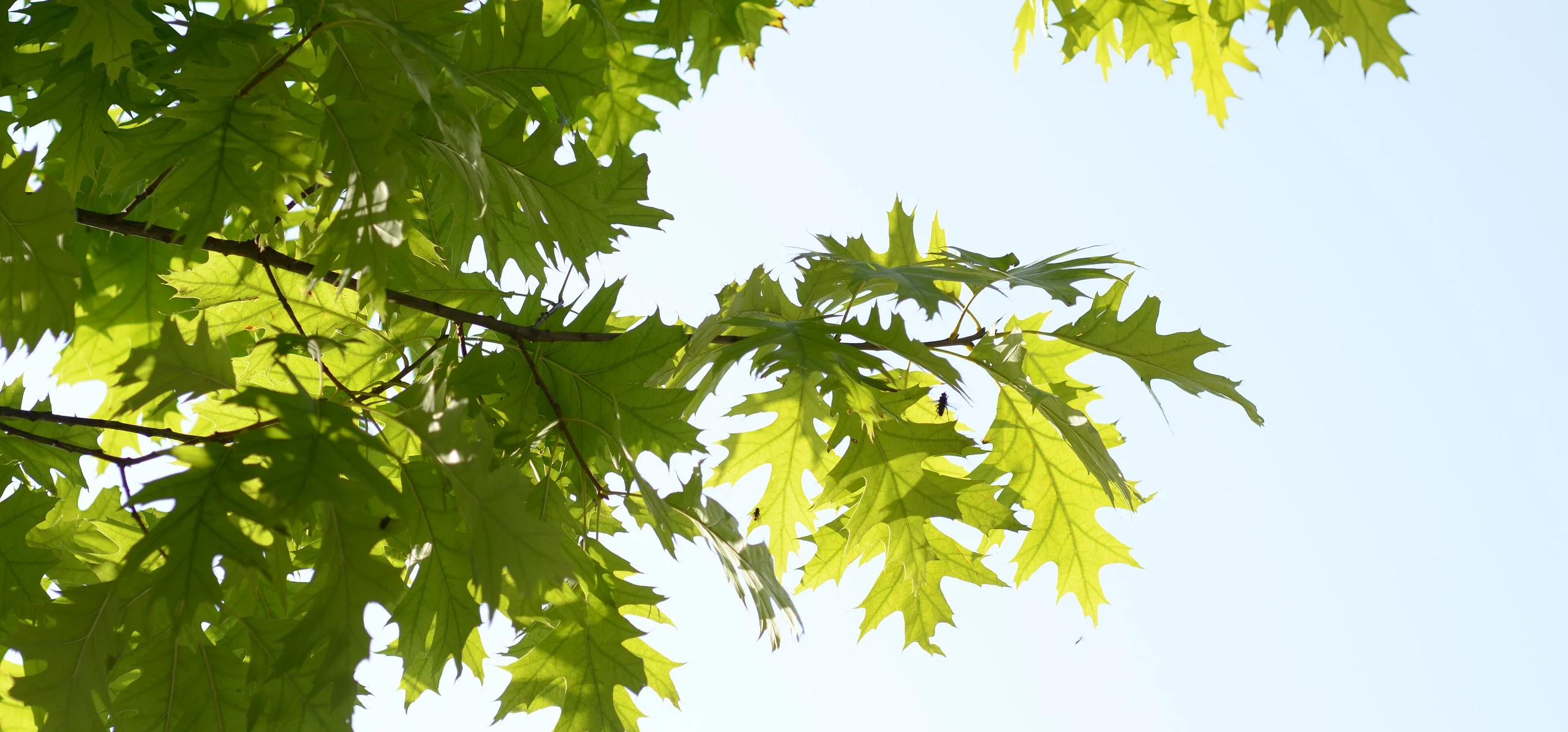
The branching habit is distinctive enough to identify the tree from a distance in winter: upper branches ascend, middle branches run roughly horizontal, and lower branches point down toward the ground, sometimes low enough to graze a lawn on an open-grown specimen. That gives a young pin oak a tight, formal pyramid that municipal arborists favor for street planting, though the crown broadens and rounds out with age, eventually reaching 15 to 21 m tall and 12 to 18 m wide. Left unpruned, the lower drooping branches eventually need to be raised for street clearance or foot traffic, a job best done on the dormant-season schedule described below rather than as an emergency in summer.


Wet Clay Tolerance and Soil Preference
Pin oak tolerates clay, loam or sandy soil and ground that stays occasionally wet or floods briefly, conditions that would stunt or kill many other oak species. What it cannot tolerate is alkaline or chalky soil: it wants acidic ground, below roughly pH 6, and performs best on moist, naturally acidic bottomland soil similar to where it grows wild. Planted on the neutral to alkaline clay common around new construction, particularly where builders have limed the soil or concrete runoff has raised the pH near foundations and sidewalks, it struggles from the first season.
Iron Chlorosis: The Classic Yellow Pin Oak
Interveinal chlorosis, yellow leaf tissue between still-green veins, is pin oak's signature problem on alkaline soil, caused by iron becoming chemically unavailable to the roots once the pH climbs too high rather than by a lack of iron in the soil itself. Left uncorrected over several seasons it spreads from the newest growth down through the tree, weakens it, and can eventually kill it outright. A soil test before planting is the real fix: on ground that reads alkaline, choosing a different oak is more reliable than trying to acidify a large planting site indefinitely with sulfur or chelated iron treatments that only manage the symptom.
Marcescence: Leaves That Refuse to Fall
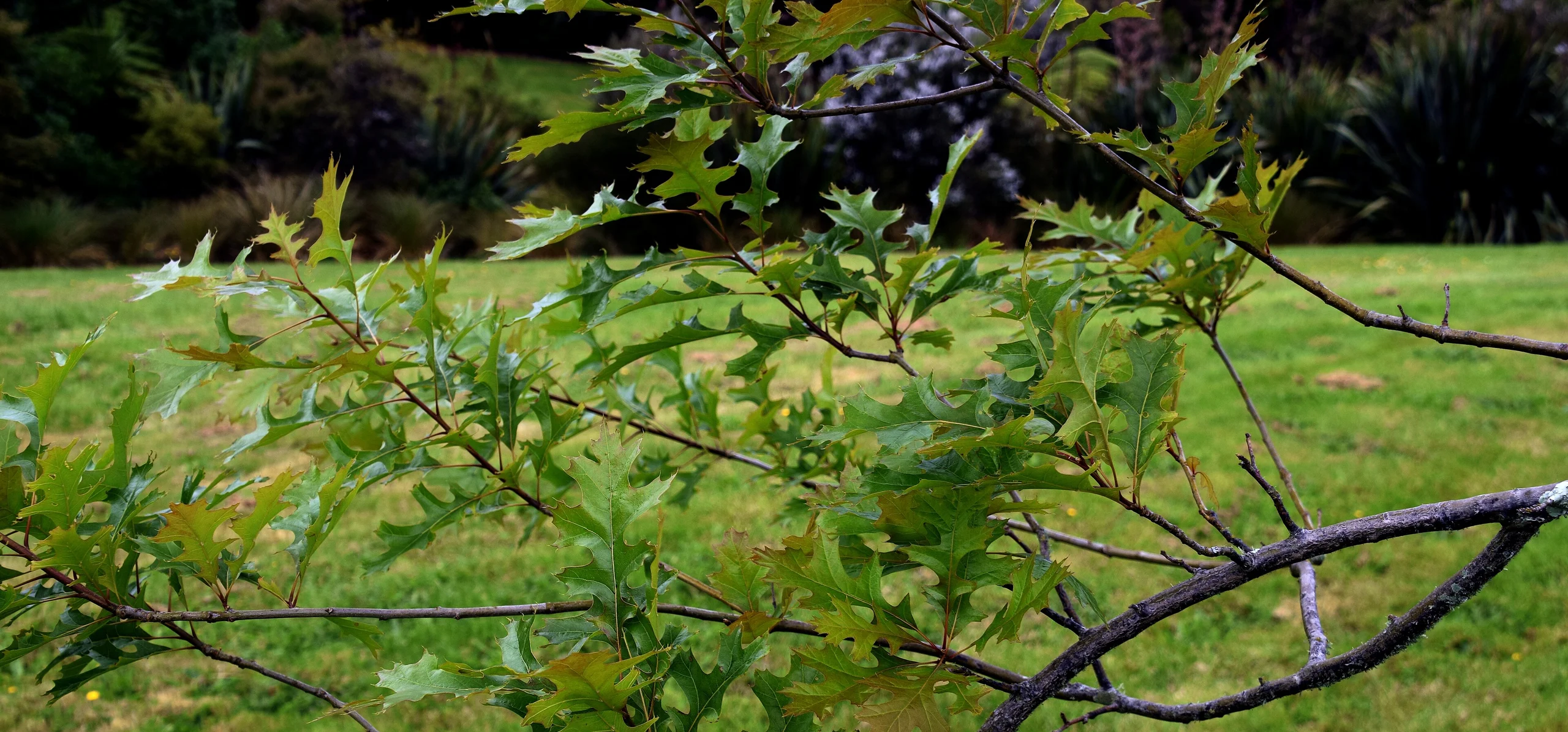
Young pin oaks, and the lower branches of older ones, commonly hold onto dead, tan leaves through winter instead of dropping them cleanly in autumn, a trait called marcescence that pin oak shares with beech and hornbeam. It fades as the tree matures, and the upper crown usually sheds normally well before the lower limbs do, so a mature specimen shows bare upper branches over a skirt of rattling brown leaves lower down until new spring growth finally pushes the old ones off.
Oak Wilt and When to Prune
Pin oak sits in the red oak group, which develops and spreads oak wilt faster and with more severe symptoms than white oaks once infected; a mature tree can lose most of its canopy within weeks of infection. Extension foresters treat spring as the highest-risk pruning window because the sap-feeding beetles that carry the fungus are most active from roughly April through July, and a fresh pruning wound left unsealed during that stretch is an open invitation. Prune pin oak in the dormant season, November through March, and if a branch must be cut or is broken during the growing season, seal the cut immediately with pruning paint rather than leaving it bare.
Pests, Other Diseases and Common Mistakes
Beyond oak wilt and chlorosis, pin oak is prone to oak leaf blister, pin oak blight and Dothiorella canker, and it hosts the usual oak-feeding insects, including gall wasps that raise round galls on twigs and leaves, along with gypsy moth, sawflies and assorted caterpillars, none of which are usually serious enough to warrant spraying on an established tree. The most common planting mistake is putting a pin oak in a small, hard-surfaced tree pit or a parking lot island with alkaline, compacted fill soil, exactly the setting where it looks fine for a few years and then declines from chlorosis; give it room in naturally acidic, moisture-retentive ground instead.
Acorns: Toxic to Horses, Bitter for Everyone Else
Pin oak acorns and foliage contain gallotannins that the ASPCA lists as toxic specifically to horses, causing digestive upset, colic-like symptoms and, in quantity, kidney stress; the risk is highest in spring when horses browse young buds and leaves, or in a drought year when pasture forage runs short and animals turn to fallen acorns. The same acorns are far too bitter and tannic for people to eat raw, though the tannins can be leached out with the same soaking and boiling methods used for other red oak acorns. Dogs that gorge on a large amount of any acorn face a genuine impaction and digestive risk, but pin oak itself is not on the ASPCA's evaluated toxic list for dogs or cats.
Test your plant knowledge
Tap a card to flip it and reveal the answer.
Pin oak tolerates wet, poorly drained clay soil better than most other oaks. Tap to reveal ✓ True
Yellow, chlorotic pin oak leaves in summer usually mean the soil is too acidic. Tap to reveal ✕ False
Because pin oak has a shallow, fibrous root system, it is easier to transplant than oaks with a deep taproot. Tap to reveal ✓ True
Pruning a pin oak in April, May or June carries the highest risk of spreading oak wilt. Tap to reveal ✓ True
The ASPCA lists pin oak acorns as toxic to dogs and cats. Tap to reveal ✕ False
Sources
References consulted for this guide
- GBIF Backbone Taxonomy: Quercus palustris Münchh.gbif.org
- Plants of the World Online (Kew): Quercus palustris Münchh.powo.science.kew.org
- NC State Extension Gardener Plant Toolbox: Quercus palustrisplants.ces.ncsu.edu
- ASPCA Toxic and Non-Toxic Plants: Oakaspca.org
- University of Minnesota Extension: Prevent oak wiltextension.umn.edu
- Reference entity : Wikipédiaen.wikipedia.org