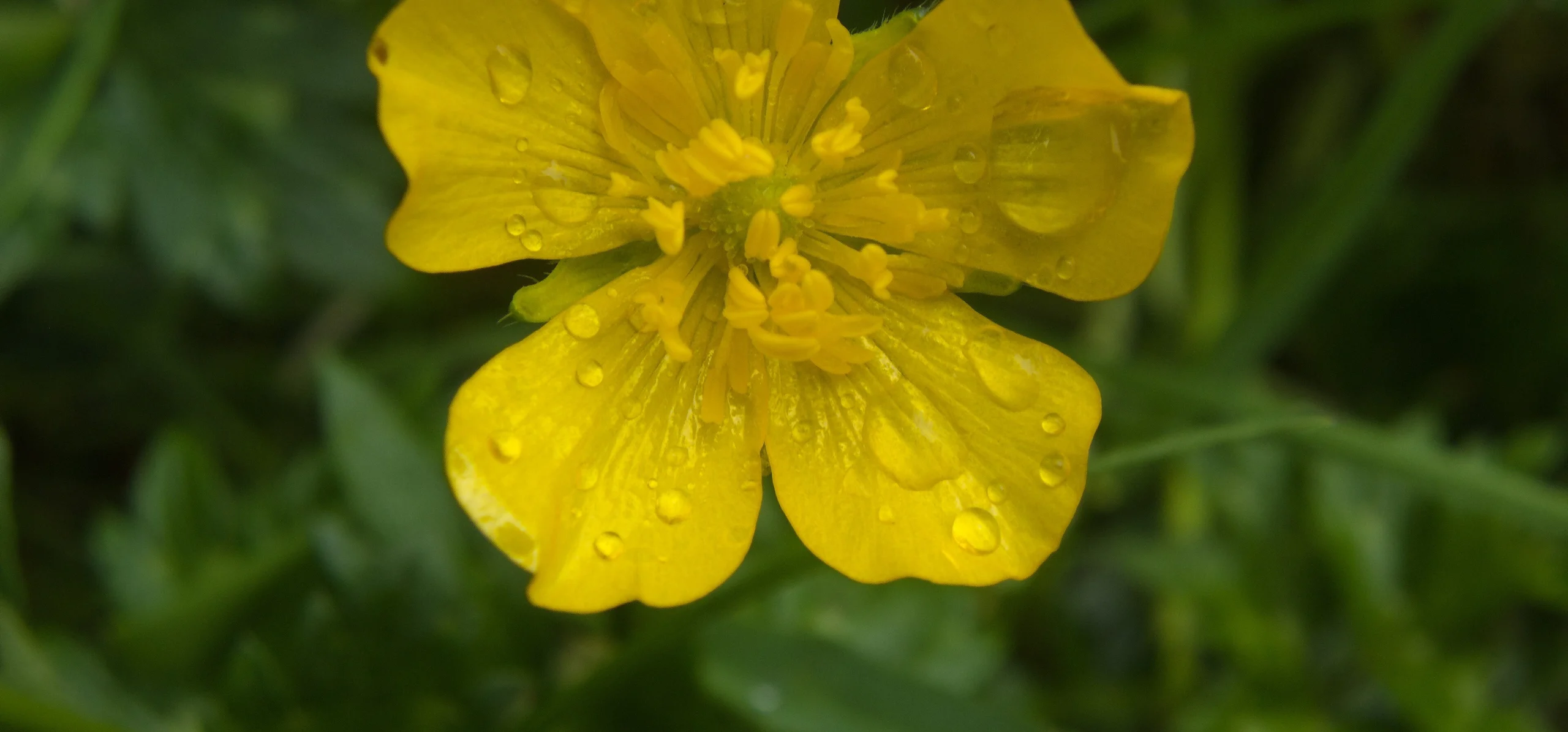
Creeping Buttercup
Ranunculus repens
Family · Ranunculaceae
Creeping buttercup spreads by rooted runners in damp soil and is toxic to pets and horses. How to identify, grow deliberately or remove it for good.
Ranunculus repens
Plant profile
- WateringHighWater every 5 days
- Light exposurePartial sun
Growth
- Family
- Ranunculaceae
- Life cycle
- Perennial
- Growth speed
- 8/10
- Mature size
- 10–50 cm
- Spread
- 10–50 cm
- Flowering
- Late spring to summer
- Propagation
- Seed
- Division
Dormancydies back in cold winters
Time to maturityfull spread in 1-2 years
Soil & climate
- Soil types
- clay, loam
- Drought tolerance
- No
Light & Placement
- Origin
- Macaronesia, North Africa and temperate Eurasia; naturalized worldwide
- Where to place it
- damp lawn or wildflower meadow
- pond margin or ditch bank
- wildlife garden bed, contained
Safety
- Toxicity
- CatsToxic
- DogsToxic
- HorsesToxic
- HumansToxic
Invasive speciesinvasive weed in parts of North America
Data fromRanunculus repens L., Plants of the WorlRanunculus repens, GBIF Backbone TaxonomRHS: Ranunculus repens (creeping buttercASPCA: Buttercup (Ranunculus spp.) toxicCreeping Buttercup, Oregon State Univers
Where it grows
World distribution
Creeping Buttercup is native to 44 countries: Albania, Algeria, Austria, Belarus, Belgium, Bulgaria, China, and Croatia….GBIF records 1,680,468 documented identifications across 95 countries, with the largest concentrations in United Kingdom, France, and Netherlands.
- Albania
- Algeria
- Austria
- Belarus
- Belgium
- Bulgaria
- China
- Croatia
- Cyprus
- Czechia
- Denmark
- Estonia
Show 32 more countriesShow fewer countries
- Faroe Islands
- Finland
- France
- Georgia
- Germany
- Greece
- Hungary
- Iceland
- Iran
- Ireland
- Italy
- Japan
- Kazakhstan
- Kyrgyzstan
- Mongolia
- Morocco
- Netherlands
- Norway
- Pakistan
- Poland
- Portugal
- Romania
- Russia
- South Korea
- Spain
- Sweden
- Switzerland
- Tajikistan
- Türkiye
- Ukraine
- United Kingdom
- Uzbekistan
Yellow to orange dots: concentration of documented identifications per country. Green countries: sourced native range. Source: GBIFNative range from POWO (Kew).
What You're Looking At
If shiny, five-petalled yellow flowers keep opening low in a damp lawn or border no matter how often you mow, you are almost certainly dealing with Ranunculus repens, creeping buttercup. It belongs to the buttercup family, Ranunculaceae, and spreads by tough, rooting runners rather than by seed alone, which is why pulling the visible top growth rarely gets rid of it for long. The compound, three-lobed leaves are dark green, often marked with pale blotches, and sit on hairy stems that creep flat along the soil before turning upright to flower from late spring through summer. Whether you want to encourage it in a wet corner for wildlife or dig it out of a border, the plant behaves the same way everywhere: fast, low, and rooted at every joint it touches.
Native Range and How It Spread
Plants of the World Online lists the native range of Ranunculus repens as Macaronesia, North Africa and temperate Eurasia. From there it has naturalized across most of the temperate world, including large parts of North America, where it now grows in lawns, roadsides, croplands and disturbed ground far from its origin. GBIF's Backbone Taxonomy accepts the name Ranunculus repens L. without qualification, so unlike many garden plants there is no confusing synonym problem to untangle before you look anything up.
Habitat, Site and Soil
In the wild this is a plant of damp grassland, and it carries that preference into cultivation. The RHS rates it hardy to H7, tolerating winters below -20 degrees Celsius, and lists it growing in clay or loam that stays moist but well-drained, or even poorly-drained, across acid, neutral or alkaline soil. Full sun produces the densest flowering; partial shade is tolerated without much loss of vigour. What it will not do gracefully is dry out: on a free-draining slope in summer the runners stall and the foliage thins, while in a damp hollow or alongside a pond it fills in within a single season.
Watering and Moisture
Established plantings growing in naturally damp ground rarely need supplemental water, the site sets the schedule for you. In a border or container where drainage is sharper than the plant would like, check the top few centimetres of soil and water whenever it starts to dry, rather than on a fixed calendar. Overly dry conditions do not kill the plant outright, buttercup roots are resilient, but they do slow the runners and reduce flowering, which defeats the point of growing it deliberately.


Growing It on Purpose in a Wildlife Garden
The RHS lists creeping buttercup as a valuable plant for pollinators and names it as suitable for wildflower meadows and wildlife gardens, despite its reputation as a lawn weed. Propagate it by seed or by division, lifting a rooted section of runner with its own leaves and planting it directly into damp ground; the RHS notes it typically reaches its mature spread within one to two years. If you are introducing it intentionally, contain it: a buried edging strip or a bottomless container sunk into the soil stops runners from crossing into neighbouring beds, since nothing about this plant slows down on its own once it is established.
Controlling an Unwanted Patch
Oregon State University Extension recommends thorough physical removal for small infestations: dig out the entire plant, including every root and stem fragment, since any node left behind can root again. For larger patches, herbicides containing dicamba, 2,4-D, sulfentrazone, quinclorac or iron HEDTA are listed as effective. Either approach needs monitoring over several seasons, buried seed and missed fragments both produce fresh plantlets long after the visible patch looks gone, and replanting the cleared area promptly denies new seedlings the bare, disturbed soil they need to establish.
Toxicity to Pets, Horses and Skin Contact
The ASPCA lists Ranunculus species, the buttercup genus that includes this one, as toxic to dogs, cats and horses, with vomiting, diarrhea, drooling, oral ulcers and a wobbly gait among the reported signs of ingestion. Oregon State University Extension adds that all parts of the fresh plant are poisonous and that the sap can irritate human skin on contact, which is why the RHS advises wearing gloves when handling it. Grazing livestock generally avoid it, the taste is acrid, but will eat it when better forage is scarce, so a paddock with a heavy patch is worth fencing off or clearing rather than trusting animals to leave it alone. Drying in hay neutralizes the irritant compounds, which is one reason buttercup-heavy hay is considered safer than fresh grazing.
Common Mistakes and Look-Alikes
The most common mistake is treating this as a one-time weeding job: because every rooted node can regrow, a single dig-over in spring without follow-up almost always leaves the patch back to full size by the following year. The second is composting pulled runners in a cool heap, they root again in the compost itself and get redistributed with it. In the garden, creeping buttercup is easy to confuse with other yellow-flowered Ranunculus such as meadow buttercup, R. acris, or bulbous buttercup, R. bulbosus; the flat, ground-hugging runners rooting at each leaf joint are the surest way to tell R. repens apart from both, since neither of those species spreads that way.
Test your plant knowledge
Tap a card to flip it and reveal the answer.
Creeping buttercup spreads mainly through runners that root at each leaf node. Tap to reveal ✓ True
The plant thrives best in fast-draining soil that is allowed to dry out between waterings. Tap to reveal ✕ False
Digging out the visible plant once in spring is usually enough to remove it for good. Tap to reveal ✕ False
The ASPCA lists Ranunculus species as toxic to dogs, cats and horses. Tap to reveal ✓ True
Handling fresh creeping buttercup bare-handed carries no risk to skin. Tap to reveal ✕ False
Sources
References consulted for this guide
- Ranunculus repens L., Plants of the World Online (Kew)powo.science.kew.org
- Ranunculus repens, GBIF Backbone Taxonomygbif.org
- RHS: Ranunculus repens (creeping buttercup)rhs.org.uk
- ASPCA: Buttercup (Ranunculus spp.) toxicity to pets and horsesaspca.org
- Creeping Buttercup, Oregon State University Extensionsolvepestproblems.oregonstate.edu
- Reference entity : Wikipédiaen.wikipedia.org