Old Man's Beard
Clematis vitalba
Family · Ranunculaceae
Clematis vitalba, wild traveller's joy of chalk hedgerows, is rarely planted on purpose. Reading its seed heads, cutting it off a hedge, and its pet toxicity.
Clematis vitalba
Plant profile
- WateringModerateWater every 10 days
- Light exposurePartial sun
- Ideal temperature-20–-15 °C
Growth
- Family
- Ranunculaceae
- Life cycle
- Perennial
- Growth speed
- 8/10
- Mature size
- 400–800 cm
- Spread
- 250–400 cm
- Flowering
- Creamy-white flowers midsummer to early autumn, then feathery seed heads into winter
- Propagation
- Seed
- Cutting
Dormancydeciduous, bare in winter
Time to maturity5 to 10 years to reach ultimate height (RHS)
Soil & climate
- Soil types
- chalk, clay, loam, sand
- Drought tolerance
- No
Light & Placement
- Origin
- Europe to Afghanistan (POWO)
- Where to place it
- hedgerow
- fence
- large trellis
- woodland edge
Safety
- Toxicity
- CatsToxic
- DogsToxic
- HorsesToxic
- HumansToxic
Invasive speciesNaturalized and invasive outside its native range: one of New Zealand's most damaging invasive plants (introduced before 1922, per CABI), and naturalized in parts of the US Pacific Northwest (Oregon, Washington), with smaller populations in Maine and California.
Data fromGBIF Backbone Taxonomy: Clematis vitalbaPlants of the World Online (Kew): ClematRHS: Clematis vitalba (traveller's joy)ASPCA Toxic and Non-Toxic Plants: ClematCABI: Biological Control of Old Man's Be
Where it grows
World distribution
Old Man's Beard is native to 27 countries: Afghanistan, Albania, Algeria, Austria, Belgium, Bulgaria, Croatia, and Czechia….GBIF records 545,558 documented identifications across 84 countries, with the largest concentrations in France, United Kingdom, and Germany.
- Afghanistan
- Albania
- Algeria
- Austria
- Belgium
- Bulgaria
- Croatia
- Czechia
- France
- Georgia
- Germany
- Greece
Show 15 more countriesShow fewer countries
- Hungary
- Iran
- Italy
- Laos
- Lebanon
- Morocco
- Netherlands
- Portugal
- Romania
- Russia
- Spain
- Switzerland
- Türkiye
- Ukraine
- United Kingdom
Yellow to orange dots: concentration of documented identifications per country. Green countries: sourced native range. Source: GBIFNative range from POWO (Kew).
Almost nobody buys Clematis vitalba from a nursery. It arrives on its own, seeded in by wind from a hedgerow or a neighbor's fence, and within a couple of seasons it is climbing over whatever it reached first. The plant most people meet is already established, already fruiting, and already smothering something, which is why the useful questions are not about siting a specimen but about identifying it, understanding why it grows the way it does, and cutting it back without wasting a season.
A Hedgerow Native from Britain to Afghanistan
Plants of the World Online gives its native range as Europe to Afghanistan, and that stretch matches its habitat everywhere it grows wild: chalk and limestone hedgerows, woodland margins, scrub and roadside verges, on soils it does not need coddled. The Royal Horticultural Society lists it tolerating chalk, clay, loam and sand, in full sun through to full shade, and rates it hardy to between -20 and -15 degrees Celsius, RHS hardiness rating H6, hardy through all of the UK and northern Europe. Left alone it reaches 4 to 8 meters with a 2.5 to 4 meter spread, taking 5 to 10 years to get there, which sounds slow until the growth is happening sideways through a hedge rather than upward on a support.
Flowers, Then the Fluffy Seed Heads That Name It
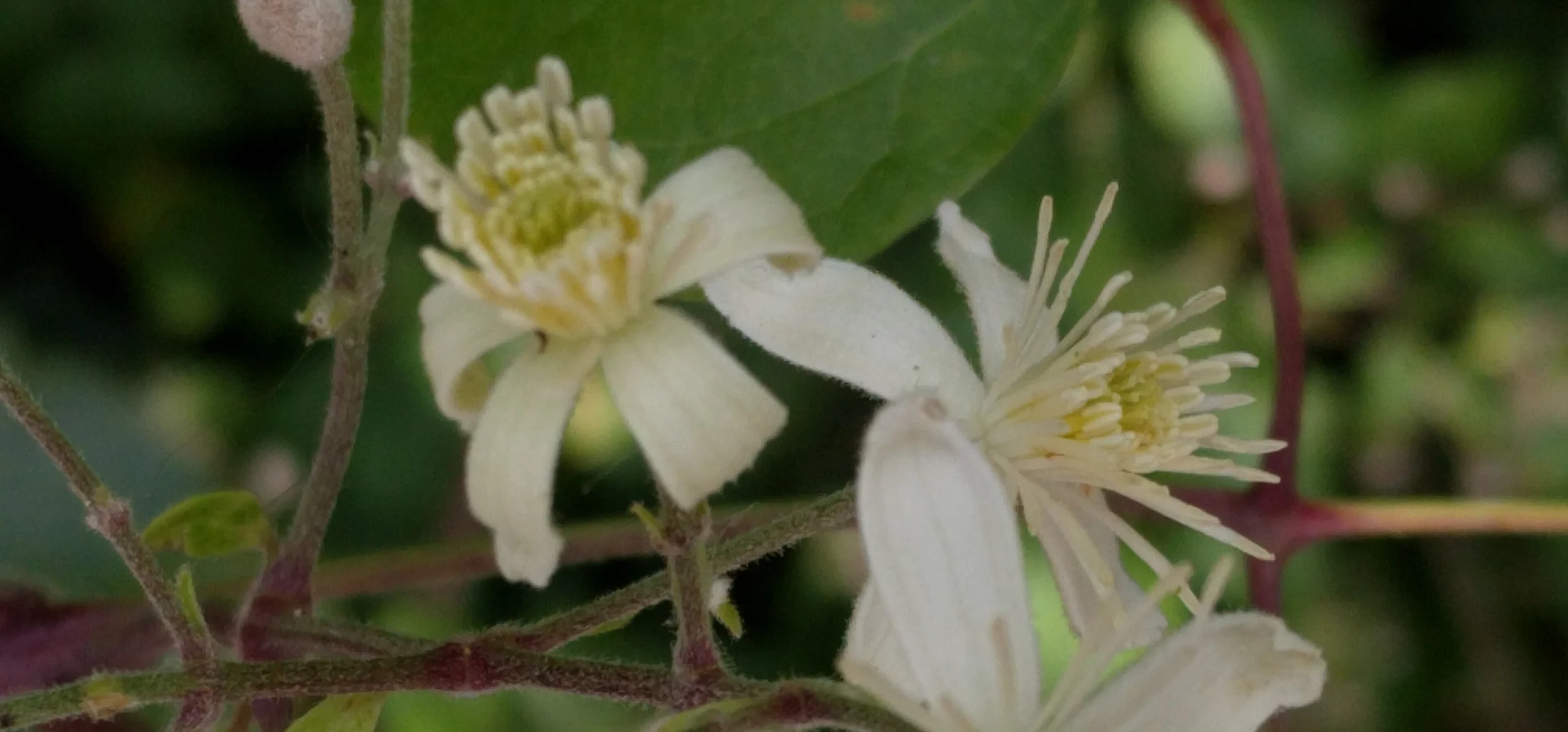
The flowers themselves are modest: four creamy-white sepals around a dense cluster of pale stamens, scented, opening from midsummer into early autumn. What people actually notice is what comes after. Each flower sets a cluster of single-seeded fruits, and every one of those fruits carries a long, silvery, feathered style attached to it, a leftover part of the flower that lengthens and turns silky as the seed ripens. Seen in mass over a whole plant, these feathered tails are the beard, persisting on the bare stems long after the leaves drop in winter, which is also how you tell the vine apart from evergreen climbers like ivy occupying the same hedge.


Why It Is Rarely Planted on Purpose
Garden centers sell clematis by the hundred, but almost none of it is the species. What is sold is large-flowered hybrids bred for a single showy bloom color, in a fraction of the space this one needs. Clematis vitalba's own flowers are small and greenish-white rather than the flat, colorful blooms buyers want, and its habit works against a border: an RHS ultimate spread of several meters, on a plant that roots and layers wherever a trailing stem touches soil, means it wants a native hedge or a windbreak that can absorb that vigor, not a trellis by the door. RHS also flags it as a skin irritant, gloves recommended for handling, which is one more reason it stays a wild plant rather than a stocked one.
The Pruning-Group Logic Behind Controlling It
RHS sorts garden clematis into three pruning groups by when and on what wood they flower. Group one flowers in spring on last year's growth and is barely pruned at all; group two is the large-flowered type that blooms on short shoots from the previous season and takes only a light trim; group three flowers on the current season's growth and can be cut back hard, to a low pair of buds, in late winter without losing that year's flowers. Clematis vitalba blooms from midsummer into autumn on wood it made earlier that same year, which puts its own logic squarely with group three: because next summer's flowers come from stems that have not grown yet, cutting the whole plant back hard in late winter costs nothing in bloom. That is exactly the fact that makes control possible rather than just cosmetic.
Cutting It Back Where It Is Already Swallowing a Hedge
The practical version of that pruning logic: in late winter, sever every stem near ground level rather than trying to unpick individual strands out of the host hedge or tree. The severed top growth will not resprout once cut from its roots, but it also will not fall away on its own, since the vine has been tying itself into the canopy for years; pull or cut it down in sections instead of leaving it hanging, because any live stem left resting on soil can root again where it touches. The root crown itself regrows readily from a single cut, so a repeat cut the following winter, or a follow-up herbicide treatment on the fresh regrowth, is normally needed before it stops coming back. Seed already shed into the soil below stays viable for years, so watch the same spot for seedlings well after the original vine looks gone.
An Aggressive Invader Outside Its Native Range
Everywhere it is native, this balance of vigor and control is manageable. Where it was introduced as an ornamental, it has not been. CABI records it reaching New Zealand before 1922 as a garden plant and calls it since one of the country's most damaging invasive species: it forms a thick blanket over native forest canopy, blocking the light that seedlings need to establish underneath, to the point that the New Zealand government now funds ongoing mechanical and herbicide control along with research into fungal biological control agents from its native European range. In the United States it has naturalized well beyond gardens in parts of the Pacific Northwest, notably Oregon and Washington, with smaller populations reported in Maine and California; in each case the same mechanism applies, wind-carried, feathery seed and a stem that roots wherever it lies on the ground, moving it from hedgerow companion to canopy-smothering weed the moment there is no grazing, mowing or hedge-laying to keep it in check.
Sap Irritation and Toxicity to Pets
The same compound responsible for the RHS skin-irritant warning, protoanemonin, is what makes this plant a genuine hazard rather than just an unwanted guest. It is an irritant glycoside common across the buttercup family, Ranunculaceae, released when leaves or stems are bruised or chewed rather than present in a stable form beforehand, which is why brief handling is fine but crushing foliage with bare hands or letting an animal chew on it is not. The ASPCA lists Clematis as toxic to cats, dogs and horses, with protoanemonin as the toxic principle and salivation, vomiting and diarrhea as the clinical signs; wear gloves when cutting it back and keep cut stems and prunings away from grazing animals and pets that browse foliage.
Wildlife Value It Still Carries at Home
None of this cancels out what the plant does for wildlife where it belongs. Its foliage feeds the larvae of several moth species found nowhere else in a British hedgerow, its late-summer flowers draw bees and hoverflies at a point in the season when many hedgerow plants have already finished, and the same fluffy seed heads that give it its name are stripped by finches through winter and used by small birds as nesting material. In a native hedge alongside dog rose and hawthorn it is doing exactly the job a hedgerow plant should; the same vigor that makes it a nuisance on a garden fence or in a New Zealand forest is, in its own habitat and kept in check, the reason it earns a place there at all.
Test your plant knowledge
Tap a card to flip it and reveal the answer.
Clematis vitalba flowers on wood it grew earlier that same year, which is why hard winter pruning does not cost it that year's bloom. Tap to reveal ✓ True
The ASPCA lists Clematis as non-toxic to cats and dogs. Tap to reveal ✕ False
The silvery strands that give 'old man's beard' its name are the plant's flower petals persisting after bloom. Tap to reveal ✕ False
Old man's beard was introduced to New Zealand as an ornamental garden plant before it became invasive there. Tap to reveal ✓ True
RHS advises handling Clematis vitalba bare-handed since it poses no risk to skin. Tap to reveal ✕ False
Sources
References consulted for this guide
- GBIF Backbone Taxonomy: Clematis vitalba L.gbif.org
- Plants of the World Online (Kew): Clematis vitalba L.powo.science.kew.org
- RHS: Clematis vitalba (traveller's joy)rhs.org.uk
- ASPCA Toxic and Non-Toxic Plants: Clematisaspca.org
- CABI: Biological Control of Old Man's Beardcabi.org
- Reference entity : Wikipédiaen.wikipedia.org