Dog Rose
Rosa canina
Family · Rosaceae
Dog rose scrambles through a hedge on thorny stems, flowers once on old wood, and needs pruning only to shape it, plus how to strain hips safely for syrup.
Rosa canina
Plant profile
- WateringLittleWater every 10 days
- Light exposurePartial sun
Growth
- Family
- Rosaceae
- Life cycle
- Perennial
- Growth speed
- 6/10
- Mature size
- 250–400 cm
- Spread
- 150–250 cm
- Propagation
- Seed
- Cutting
- Layering
- Grafting
FloweringSingle pale pink to near-white flowers in June, followed by orange-red hips through autumn and winter
Dormancydeciduous, bare in winter
Time to maturityreaches full size in 5 to 10 years
Soil & climate
- Soil types
- chalk, clay, loam, sand
- Drought tolerance
- Yes
Light & Placement
- Origin
- Madeira, North-West Africa, Europe to Central Asia and Pakistan
- Where to place it
- hedgerow
- boundary hedge
- hedge bank
- woodland edge
Safety
- Toxicity
- CatsSafe
- DogsSafe
- HorsesSafe
Data fromGBIF Backbone Taxonomy: Rosa canina L.Plants of the World Online (Kew): Rosa cRHS: Rosa canina (S) (dog rose)RHS: Plant a bare-root mixed wildlife heASPCA: Toxic and Non-Toxic Plants, Rose
Where it grows
World distribution
Dog Rose is native to 44 countries: Afghanistan, Albania, Algeria, Austria, Belarus, Belgium, Bulgaria, and Croatia….GBIF records 441,609 documented identifications across 94 countries, with the largest concentrations in France, United Kingdom, and Germany.
- Afghanistan
- Albania
- Algeria
- Austria
- Belarus
- Belgium
- Bulgaria
- Croatia
- Cyprus
- Czechia
- Denmark
- Estonia
Show 32 more countriesShow fewer countries
- Finland
- France
- Georgia
- Germany
- Greece
- Hungary
- Iran
- Iraq
- Ireland
- Italy
- Kazakhstan
- Kyrgyzstan
- Lebanon
- Morocco
- Netherlands
- Norway
- Pakistan
- Palestinian Territories
- Poland
- Portugal
- Romania
- Russia
- Spain
- Sweden
- Switzerland
- Tajikistan
- Tunisia
- Türkiye
- Turkmenistan
- Ukraine
- United Kingdom
- Uzbekistan
Yellow to orange dots: concentration of documented identifications per country. Green countries: sourced native range. Source: GBIFNative range from POWO (Kew).
A dog rose along a hedge bank is easy to place once you know the shape: long arching stems studded with hooked thorns, scrambling through hawthorn and blackthorn rather than standing upright on their own, with single five-petalled flowers in pale pink or near white that open for a few weeks in June. Rosa canina is not grown for a long flowering season or a tidy outline, it earns its place as structure and food: hips through autumn and winter for birds and mammals, dense thorny cover for nesting, and almost no maintenance beyond an annual look-over. Anyone who has found one self-sown in an existing hedge, or is planting a young whip to fill a gap, gets a shrub that tolerates poor soil, hard weather and years of neglect better than most cultivated roses ever will.
Origin and Native Range
Plants of the World Online records the native range of Rosa canina as Madeira, North-West Africa, and Europe east to Central Asia and Pakistan, and the RHS lists it as native to Great Britain and Ireland as well as continental Europe, North Africa and South-West Asia. It is the wild rose of the European hedgerow: scrub, woodland edges, roadside banks, and any hedge bottom left to grow a little wild, usually on the same free-draining, unimproved ground that suits hawthorn and blackthorn. Garden roses have been bred from it and grafted onto it for centuries, more on that below, but the wild species itself has never needed cultivation to thrive.
Planting in a Mixed Native Hedge
Dog rose earns its place in a native hedge mix rather than as a specimen shrub: the RHS names dog rose, alongside Scotch rose, as a native choice to work into a bare-root wildlife hedge planted with hawthorn, blackthorn, field maple, guelder rose, spindle and buckthorn, rather than as a solid run on its own. RHS spacing for hedging generally runs 30 to 60cm between plants within the row, tightening towards the lower end for a denser barrier sooner, or widening it out where dog rose's naturally arching habit needs room to spread sideways rather than being clipped into a flat face. Because it does not self-support the way hawthorn or blackthorn does, plant it where neighbouring shrubs give the long stems something to lean and scramble through, or accept that a pure dog rose hedge always looks looser and more informal.
Soil, Site and Hardiness
The RHS gives dog rose an H7 hardiness rating, hardy through the severest European winters, and lists it as tolerant of chalk, clay, loam and sand in full sun or partial shade, provided drainage is reasonable; it copes with poor, thin soil that would leave a modern shrub rose sulking. Left unpruned it reaches an ultimate height of 2.5 to 4 metres with a spread of 1.5 to 2.5 metres over five to ten years, though stems scrambling through a tree can run considerably longer. Once established it needs no feeding and little watering beyond its first season or two.


Flowers and Pollination
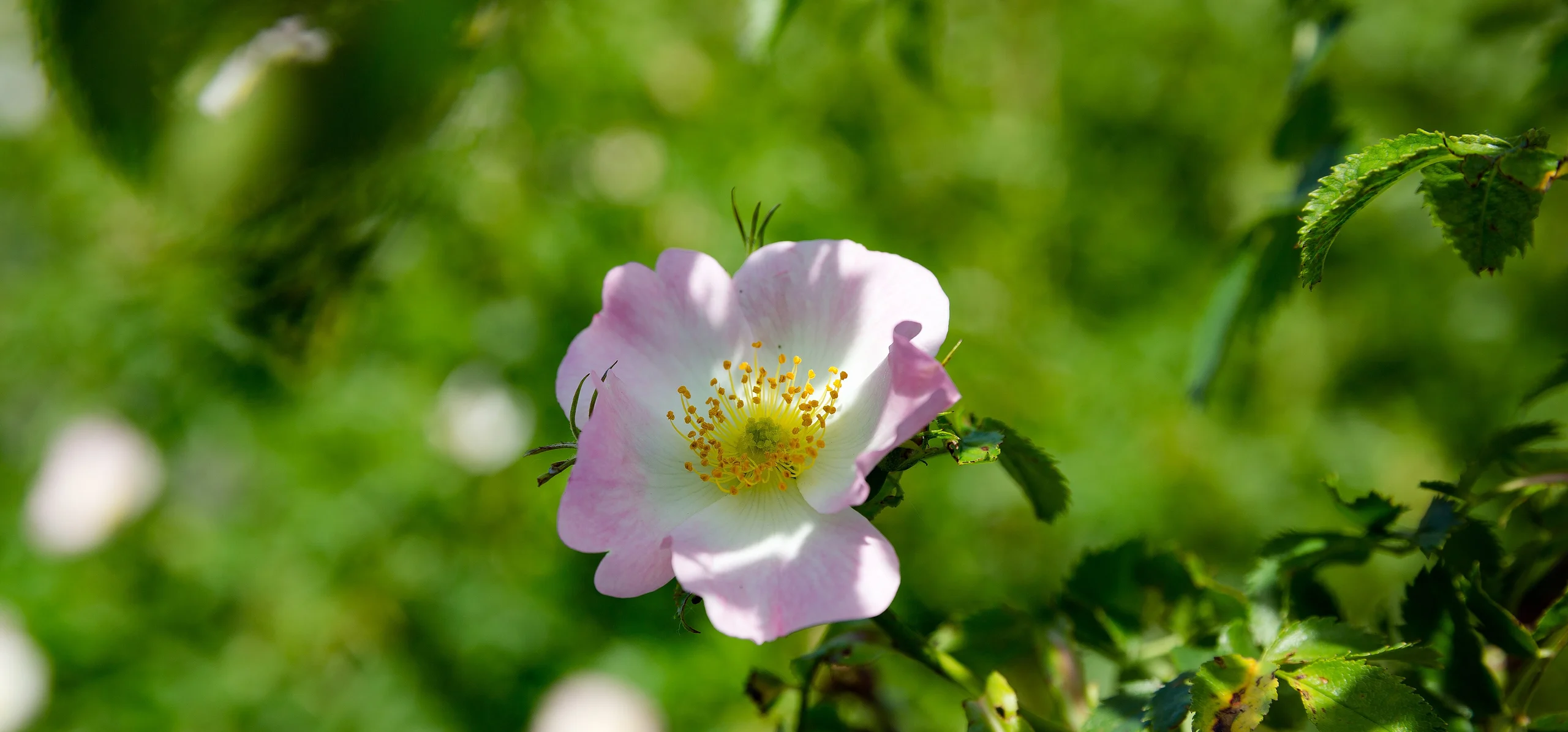
Flowers open singly along the previous year's stems in June, five broad petals in pale pink fading paler toward the centre, sometimes near white, around a prominent boss of yellow stamens; each bloom lasts only a few days, but a mature plant carries a long, sequential flush rather than all its flowers at once. They are unscented or only lightly scented, open and flat rather than double, and left entirely to insects: bees and hoverflies work the exposed stamens hard since there is no nectar reward, only pollen. A dog rose grown for its flowers alone is missing the point of the plant; the display is modest next to a bred garden rose, and the real payoff comes later, in the hips.
Pruning: Light Touch, Old Wood
Dog rose falls into the RHS's pruning group for shrub and species roses that flower once on wood made the previous year rather than on new growth, so the only pruning it needs is to shape it and remove dead, damaged or crossing stems, done in late winter while it is dormant. Cutting it back hard the way a hybrid tea gets pruned removes the wood that would have flowered and fruited that year and produces a flush of vigorous, flowerless growth instead. In a hedge, this usually means an occasional thinning cut low down to renew old stems rather than an annual all-over trim; treat it more like a rambling shrub that gets tidied than a formal hedge plant that gets clipped.
Suckers and Rootstock Use
Rosa canina suckers readily from the base and from roots running just under the surface, sending up new shoots some distance from the original plant, which is exactly the trait that has made it a standard rootstock for grafted garden roses for well over a century: its vigour, hardiness and tolerance of poor soil get grafted underneath less robust modern varieties. This has a practical consequence for anyone who owns a grafted rose rather than a species dog rose: shoots appearing below the graft union, with smaller leaves, different thorns, and often a paler, more open flower than the named variety above, are dog rose rootstock suckers, not the plant that was bought, and should be pulled away where they emerge from the root rather than cut off at soil level, which only encourages more.
Rose Hips: Harvest and Wildlife Value
The hips that follow the flowers are oval, bright orange-red, and ripen from late summer through autumn, staying on the bare stems well into winter as one of the last fruit sources left for blackbirds, thrushes and small mammals once hawthorn haws and blackberries are gone. They are also the traditional source of rosehip syrup, historically prized as a vitamin C supplement and most famously collected across Britain during the Second World War when citrus imports stopped; it is the flesh that gets used, cooked down and strained. That straining step matters: the seeds inside are surrounded by fine, stiff hairs, the same hairs sold commercially as itching powder, and eating a hip whole or unstrained irritates the mouth and gut, so any harvest for syrup needs the pulp passed through a fine cloth or filter before the seeds and hairs are discarded.
Pests, Diseases and Toxicity
Aphids colonise the soft new growth in spring most years, and rose black spot appears on the foliage by mid to late summer in wet seasons, but on an established dog rose growing as it would in the wild, neither usually needs treatment: the plant sheds affected leaves and carries on, and a mixed hedge around it supports enough predatory insects to keep aphid numbers down without spraying. The RHS also lists it as susceptible to rose rust, powdery mildew, dieback and occasionally honey fungus, alongside the deer and rabbit browsing that affects most young hedging whips, but these are background pressures common to roses generally rather than problems this particularly tough species suffers badly. The ASPCA lists rose, genus Rosa, as non-toxic to dogs, cats and horses; the real hazard around dog rose is mechanical, a thorn through a paw or a mouth, not anything in the plant's chemistry. Reserve any intervention for a plant visibly declining year on year rather than treating normal seasonal spotting or a light aphid colony as an emergency.
Test your plant knowledge
Tap a card to flip it and reveal the answer.
Dog rose (Rosa canina) flowers on wood produced the previous year, so hard pruning removes that year's blooms. Tap to reveal ✓ True
Rosa canina is self-supporting and does not need neighbouring shrubs to lean on in a hedge. Tap to reveal ✕ False
The fine, stiff hairs surrounding the seeds inside a dog rose hip are the source of traditional itching powder. Tap to reveal ✓ True
Suckers appearing below the graft union on a garden rose usually come from the Rosa canina rootstock, not the named variety. Tap to reveal ✓ True
The ASPCA lists rose (genus Rosa) as toxic to dogs, cats and horses. Tap to reveal ✕ False
Sources
References consulted for this guide
- GBIF Backbone Taxonomy: Rosa canina L.gbif.org
- Plants of the World Online (Kew): Rosa canina L.powo.science.kew.org
- RHS: Rosa canina (S) (dog rose)rhs.org.uk
- RHS: Plant a bare-root mixed wildlife hedgerhs.org.uk
- ASPCA: Toxic and Non-Toxic Plants, Roseaspca.org
- Reference entity : Wikipédiaen.wikipedia.org