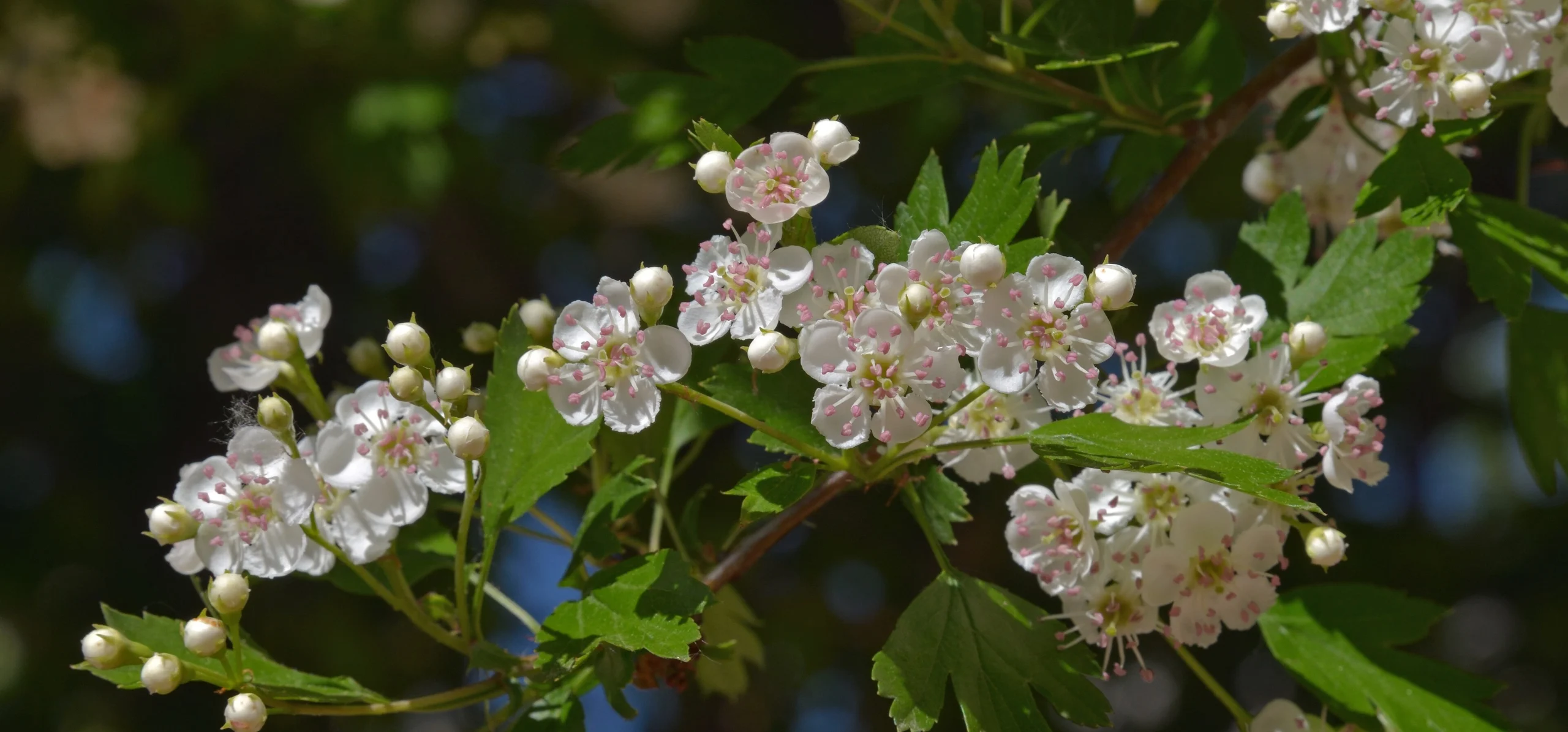
Common Hawthorn
Crataegus monogyna
Family · Rosaceae
Common hawthorn tolerates poor soil and hard pruning, but a thin hedge needs laying, not trimming: siting, fireblight, thorns and where it turns invasive.
Crataegus monogyna
Plant profile
- WateringLittleWater every 10 days
- Light exposurePartial sun
Growth
- Family
- Rosaceae
- Life cycle
- Perennial
- Growth speed
- 5/10
- Mature size
- 400–800 cm
- Spread
- 400–800 cm
- Flowering
- Clusters of white flowers in May, followed by dark red haws through winter
- Propagation
- Seed
- Grafting
Dormancydeciduous, bare in winter
Time to maturityreaches full size in 10-20 years
Soil & climate
- Soil types
- chalk, clay, loam, sand
- Drought tolerance
- Yes
Light & Placement
- Origin
- Europe to the Caucasus, North Africa to Iraq
- Where to place it
- hedgerow
- boundary hedge
- woodland edge
- open field
Safety
- Toxicity
- CatsSafe
- DogsSafe
- HorsesSafe
Invasive speciesnaturalized and locally invasive in the Pacific Northwest of the United States (Oregon, Washington) and in parts of south-eastern Australia, where it forms dense thickets in woodland and along waterways
Data fromGBIF Backbone Taxonomy: Crataegus monogyPlants of the World Online (Kew): CrataeASPCA: Hawthorn toxicity to pets and horRHS: Crataegus monogyna (common hawthornOregon State University Extension: Commo
Where it grows
World distribution
Common Hawthorn is native to 38 countries: Albania, Algeria, Austria, Belarus, Belgium, Bulgaria, Croatia, and Cyprus….GBIF records 1,430,202 documented identifications across 86 countries, with the largest concentrations in United Kingdom, France, and Netherlands.
- Albania
- Algeria
- Austria
- Belarus
- Belgium
- Bulgaria
- Croatia
- Cyprus
- Czechia
- Denmark
- Egypt
- Estonia
Show 26 more countriesShow fewer countries
- Finland
- France
- Georgia
- Germany
- Greece
- Hungary
- Iraq
- Ireland
- Italy
- Lebanon
- Libya
- Morocco
- Netherlands
- Norway
- Palestinian Territories
- Poland
- Portugal
- Romania
- Russia
- Spain
- Sweden
- Switzerland
- Tunisia
- Türkiye
- Ukraine
- United Kingdom
Yellow to orange dots: concentration of documented identifications per country. Green countries: sourced native range. Source: GBIFNative range from POWO (Kew).
A neglected hawthorn hedge with gaps at the base and long unruly growth on top is not dead, it is simply overdue for either a hard prune or a proper laying, and Crataegus monogyna tolerates both better than almost any other hedging species. This is the thorn of the British hedgerow and much of continental Europe's field margins: dense, spiny, covered in white blossom for two or three weeks in May and then in dark red haws from September through winter. It asks for little once rooted, no feeding, no special soil, just an annual decision about how hard to cut it back, and a longer-term one about whether to let it grow into a small tree or keep laying it as a stock-proof barrier.
Origin and Where It Has Spread
Crataegus monogyna is native to a broad band running from Europe east to the Caucasus, and from North Africa to Iraq, according to Plants of the World Online. It has been planted as a hedge and windbreak far outside that range for centuries, and in several places it has stopped behaving. In the Pacific Northwest of the United States, Oregon State University's extension service lists it as naturalized and a potential noxious weed in Oregon: it seeds prolifically, birds carry the haws into oak woodland and open prairie, and it forms dense thickets that shade out the native understory and hybridizes with the local black hawthorn, Crataegus douglasii. It has followed a similar pattern in parts of south-eastern Australia, planted as farm hedging and since spread into remnant woodland and along waterways. None of this makes it a bad hedge on a bounded suburban or rural plot; it just means a hawthorn hedge next to open bushland or prairie needs watching, not planting and forgetting.
Siting, Soil and Planting
Hawthorn is unfussy about soil: the RHS lists it as happy in chalk, clay, loam or sand, in acid, neutral or alkaline conditions, and in anything from moist but well-drained ground to genuinely wet soil, provided it is not waterlogged for long stretches. Full sun gives the densest growth and the best blossom; part shade is tolerated but growth is thinner. Plant bare-root whips between October and February while the ground is workable and not frozen, spacing them 45 to 60 cm apart for a hedge, and consider a staggered double row for a thicker barrier sooner. Container-grown plants can go in at other times of year but need more watering to establish. Left untrimmed, a hawthorn typically reaches 4 to 8 metres over 10 to 20 years; regular hedge-cutting keeps it far lower and denser.
Watering and Establishment
Water a newly planted whip or hedge row well through its first two or three growing seasons, especially during dry spells in the first summer, aiming water at the base rather than the foliage. Established hawthorn is deep-rooted and copes with drought far better than with permanently sodden ground, so overwatering a mature plant does more harm than an occasional dry August.


Pruning a Hawthorn Hedge
For a trimmed hedge, cut once after flowering in early summer and again in early autumn to keep it tidy. The RHS notes that leaving longer gaps between cuts trades a slightly looser shape for noticeably better spring blossom, since flowers form on growth made the previous year. Renovation pruning, cutting hard back into old wood, is done in mid-winter while the plant is dormant. One detail matters more here than for most shrubs: hawthorn hedges are prime nesting habitat, so avoid cutting between March and August, or the equivalent nesting season locally, and check for active nests first if work cannot wait.
Hedge Laying: Fixing a Gappy Base
Where years of trimming have left a hedge thin and gappy at the base, laying rather than replanting is the traditional fix, and the RHS names hawthorn as the best species for it, ahead of blackthorn, hazel, field maple and elm. The hedge needs to have reached roughly 2.5 to 5 metres with main stems 5 to 10 cm thick at the base; oversized or badly placed stems are removed first. Each remaining upright, called a pleacher, is cut almost through near ground level on the side away from the direction of lay and pushed over at around a 35-degree angle. Stakes of hazel or ash go in along the line, and the pleachers are woven between them, then bound at the top with twisted hazel, sweet chestnut or willow whips. The work is done in winter and takes practice; the National Hedgelaying Society runs courses for anyone attempting it for the first time. A laid hedge regrows thick from the base within a couple of seasons, solving the gappiness that trimming alone never fixes.
Flowers, Haws and Wildlife Value
Flowering runs through May in most of the UK and Western Europe: clusters of 10 to 20 white, sometimes pink-tinged flowers open over two or three weeks, with a scent many people find sweet at a distance and less pleasant close up. The haws that follow are dark red, roughly a centimetre across, and hang on well into winter, feeding thrushes, redwings and fieldfares long after most other hedgerow fruit is gone. The RHS rates hawthorn among the best hedging plants for wildlife: the blossom is nectar-rich for pollinating insects, and the dense, thorny growth gives small birds a nesting site safe from most predators.
Fireblight and Other Problems
Fireblight, a bacterial disease that affects hawthorn along with apple, pear and other members of the rose family, causes blackened, scorched-looking shoots. RHS advice is to cut affected branches out well below the visible damage and disinfect tools between cuts to avoid spreading it further. Powdery mildew and fungal leaf spot appear in some years but rarely threaten an established hedge, and congested growth makes both worse. Honey fungus is worth checking for in a mature plant that is declining for no obvious reason, and rabbits or deer will strip bark from young whips, so guard new plantings until the bark toughens.
Thorns, Toxicity and Common Mistakes
The thorns are real: young growth carries sharp spines strong enough to snag a glove, which is exactly why hawthorn has been used for stock-proof hedging for centuries, but it also means keeping it away from paths where people brush past. The ASPCA lists hawthorn as non-toxic to dogs, cats and horses, and the ripe fruit flesh has long been used for jellies, syrups and herbal tea; the small stones inside each haw are usually strained out rather than eaten in quantity, the same caution applied to the pips of many other fruit in the rose family. The most common mistake is trimming a hedge to the same tight shape every year and then wondering why it barely flowers, when leaving a season between formal cuts is what brings the blossom back. The second is planting it as an unmanaged thicket next to open woodland or prairie in a region such as the Pacific Northwest or south-eastern Australia, where it has already shown it can spread well beyond the fence line.
Test your plant knowledge
Tap a card to flip it and reveal the answer.
Hawthorn (Crataegus monogyna) is the species most often recommended for traditional hedge laying. Tap to reveal ✓ True
Hawthorn's haws ripen in spring, before the flowers open. Tap to reveal ✕ False
The ASPCA lists common hawthorn as toxic to dogs, cats and horses. Tap to reveal ✕ False
Fireblight, a bacterial disease of the rose family, can affect hawthorn hedges. Tap to reveal ✓ True
Common hawthorn has only ever grown within its native European and West Asian range. Tap to reveal ✕ False
Sources
References consulted for this guide
- GBIF Backbone Taxonomy: Crataegus monogyna Jacq.gbif.org
- Plants of the World Online (Kew): Crataegus monogyna Jacq.powo.science.kew.org
- ASPCA: Hawthorn toxicity to pets and horsesaspca.org
- RHS: Crataegus monogyna (common hawthorn, hedgerow thorn)rhs.org.uk
- Oregon State University Extension: Common Hawthorn (Crataegus monogyna)solvepestproblems.oregonstate.edu
- Reference entity : Wikipédiaen.wikipedia.org