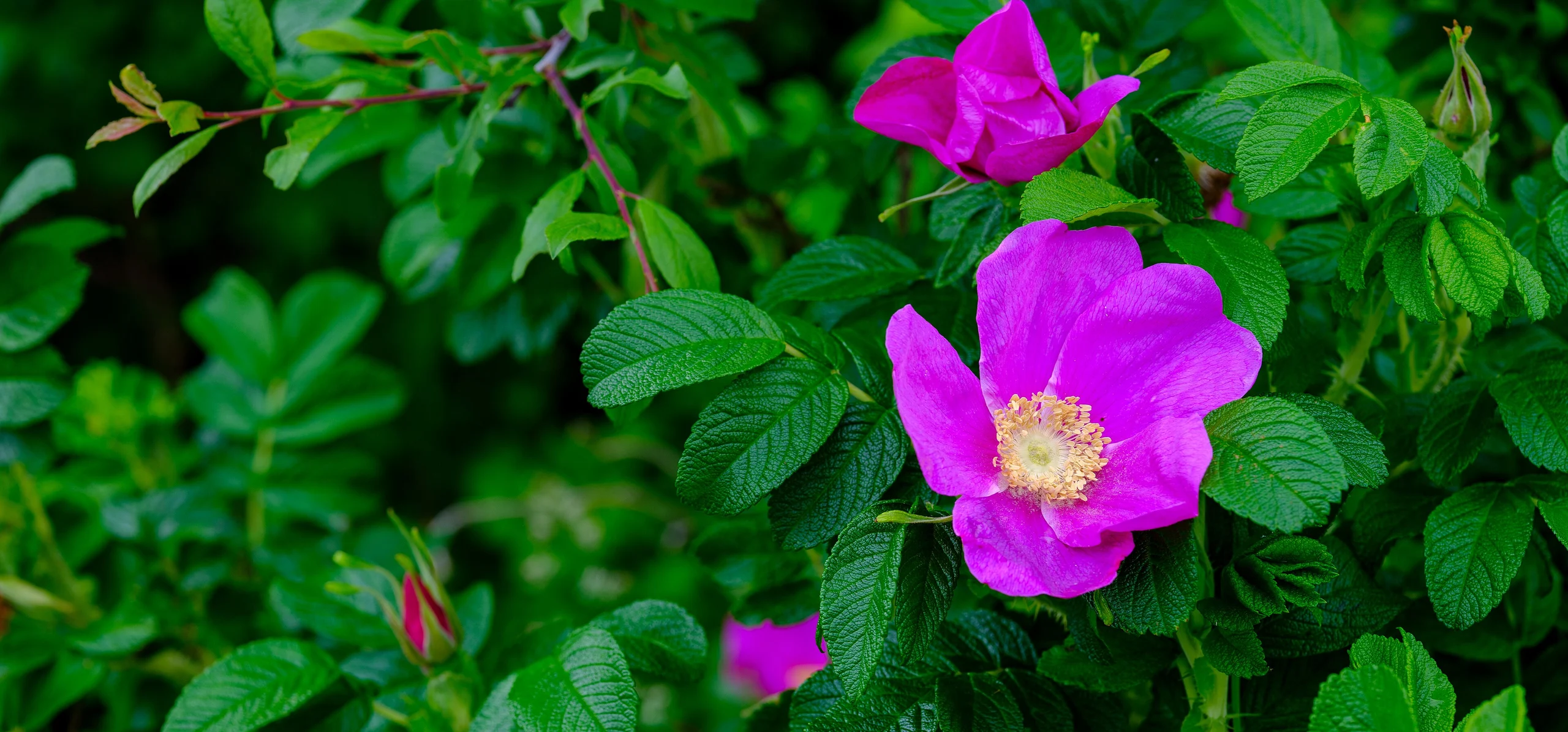
Rugosa Rose
Rosa rugosa
Family · Rosaceae
Rugosa rose flowers in repeated flushes into frost, tolerates salt and sandy soil, but spreads by suckers fast: how to plant, prune and keep it contained.
Rosa rugosa
Plant profile
- WateringLittleWater every 10 days
- Light exposurePartial sun
- Hardiness zoneUSDA 2–7
Growth
- Family
- Rosaceae
- Life cycle
- Perennial
- Growth speed
- 8/10
- Mature size
- 100–180 cm
- Spread
- 100–180 cm
- Flowering
- Repeated flushes from late spring to frost, followed by large orange-red hips
- Propagation
- Seed
- Cutting
- Division
Dormancydeciduous, bare in winter
Time to maturityreaches full size in 2 to 5 years
Soil & climate
- Soil types
- chalk, clay, loam, sand
- Saline soil
- Tolerated
- Drought tolerance
- Yes
Light & Placement
- Origin
- Russian Far East, north China, and northern to central Japan
- Where to place it
- hedge
- coastal or seaside garden
- exposed or windy border
Safety
- Toxicity
- CatsSafe
- DogsSafe
- HorsesSafe
Invasive speciesNaturalized and locally invasive on sandy shorelines in the northeastern US
Data fromGBIF Backbone Taxonomy: Rosa rugosa ThunPlants of the World Online (Kew): Rosa rRHS: Rosa rugosa 'Rubra' (Ru) (red JapanNC State Extension Gardener Plant ToolboASPCA: Toxic and Non-Toxic Plants, Rose
Where it grows
World distribution
Rugosa Rose is native to 4 countries: China, Japan, Russia, and South Korea.GBIF records 274,679 documented identifications across 60 countries, with the largest concentrations in United Kingdom, Denmark, and Belgium.
- China
- Japan
- Russia
- South Korea
Yellow to orange dots: concentration of documented identifications per country. Green countries: sourced native range. Source: GBIFNative range from POWO (Kew).
A rugosa rose (Rosa rugosa) announces itself before the flower even opens: thick, densely bristled canes and glossy, deeply veined leaflets that feel closer to crinkled leather than ordinary rose foliage. Unlike a once-flowering species rose, it keeps producing flushes of bloom from late spring into the first hard frosts, and every flower left on the bush swells into a large, tomato-red hip. It shrugs off salt spray, sandy soil and winters that would kill a hybrid tea outright, but that same vigor means it spreads by suckers and can colonize a bed within a few seasons if left unchecked. Give it full sun, room to run and an annual look at where new shoots are coming up, and it asks for almost nothing else.
Origin and Native Range
Plants of the World Online records the native range of Rosa rugosa as the Russian Far East, north China, and northern to central Japan, where it grows along maritime dunes and beach thickets exposed to salt wind, exactly the environment that shaped its toughness. The species reached Western gardens in the late 19th century and has since naturalized well beyond that range: university extension services in the northeastern United States now describe it as an established, locally invasive shrub on sandy shorelines, where it seeds and suckers freely enough to crowd out native dune plants. In a garden bed it behaves the same way, just at a smaller scale, so its coastal origin is worth remembering when deciding where to plant it and how much room to give it.
Choosing a Rugosa Rose
The wild species carries single, five-petalled flowers in a strong magenta-pink with a heavy, clove-like fragrance, the form closest to what grows on native shorelines. Garden centers more often sell near-species cultivars bred for a particular flower color while keeping the wrinkled foliage and hardiness: 'Rubra' in deep magenta-pink, 'Alba' in white, 'Hansa' in a darker reddish-purple with a semi-double flower, and 'Blanc Double de Coubert' with fully double white blooms. That last distinction matters if hips are part of the plan: heavily double cultivars carry extra petals in place of reproductive parts, so they set fewer hips, sometimes none, while single and semi-double forms such as the straight species and 'Rubra' fruit reliably.
Planting: Site, Soil and Salt Exposure
Rugosa rose wants at least six hours of direct sun a day; it copes with light shade but flowers less freely in it. It tolerates chalk, clay, loam and sand, and handles acidic, neutral or alkaline soil provided drainage is reasonable, moist but free-draining ground suits it best, and it is markedly more tolerant of poor, thin or salty soil than almost any other garden rose. Space plants roughly 1.8 to 3.6 m (6 to 12 ft) apart for a hedge that eventually knits together, or further apart for an isolated specimen. Thanks to its coastal origin, it is one of the few roses that takes a genuinely exposed, windy site in stride, including a seafront bed that would scorch a hybrid tea.
Watering and Feeding
A newly planted rugosa rose needs regular watering through its first year or two while roots establish, then it becomes genuinely drought-tolerant as well as salt-tolerant, two traits that rarely come together in one rose. Once established, a deep soak during extended dry spells is usually enough; overwatering on already-moist ground does more harm than skipping a week. Feeding can stay light: a spring mulch of compost or a balanced fertilizer applied once as growth starts covers most of what the plant needs, since pushing it with extra nitrogen mainly produces soft growth that aphids target first.
How often to water your Rugosa Rose
Flowering Through the Season and the Hips That Follow
Unlike once-flowering species roses such as the dog rose, rugosa rose blooms in repeated flushes from late spring through summer and often into the first frosts, so a single plant carries flowers and ripening hips at the same time for months. The hips that follow are unusually large for a rose, ripening from green to bright orange-red by late summer and staying on the bare stems well into winter as food for birds. They are also the reason rugosa rose is grown for more than looks: the flesh is rich in vitamin C and gets used for jam, syrup and tea, though as with any rose hip, the fine hairs around the seeds need straining out before eating.
Pruning and Controlling the Suckers
Established plants need only a light annual tidy: remove dead, damaged or crossing wood in late winter to early spring, and cut an overgrown or leggy plant back hard to renew it, since rugosa rose regrows vigorously from old wood. The more constant job is managing suckers. Because the species spreads by underground runners as readily as by seed, an unmanaged rugosa rose gradually turns from a single shrub into a thicket, exactly how it becomes a problem on sandy shorelines. In a garden, sever unwanted suckers below ground with a spade where they emerge rather than cutting them off at soil level, and choose the planting site with that spreading habit in mind from the start: a boundary hedge or a bank that needs holding together suits it far better than a tidy mixed border.
Pests, Diseases and Toxicity
Rugosa rose is notably disease-resistant compared with hybrid roses: it rarely develops black spot even in a wet season, though rose rust, powdery mildew and occasional dieback still turn up, especially on stressed plants. Aphids colonize soft new shoots in spring, and rose leafhoppers, spider mites, scale insects and sawflies appear less often but are worth checking for if growth looks mottled or chewed; deer and rabbits will browse young plants where either is common. The ASPCA lists rose, genus Rosa, as non-toxic to dogs, cats and horses, so the real hazard is mechanical: the stems are among the most densely thorned of any garden rose, and a hedge of it makes as effective a barrier against people and animals as it does an ornamental planting.


Test your plant knowledge
Tap a card to flip it and reveal the answer.
Rosa rugosa flowers only once in late spring, like the dog rose. Tap to reveal ✕ False
Rosa rugosa tolerates salt spray and sandy coastal soil better than most garden roses. Tap to reveal ✓ True
Heavily double cultivars like 'Blanc Double de Coubert' set hips just as reliably as single-flowered forms. Tap to reveal ✕ False
Left unmanaged, Rosa rugosa can spread into thickets through underground suckers. Tap to reveal ✓ True
The ASPCA lists rose (genus Rosa) as toxic to dogs, cats and horses. Tap to reveal ✕ False
Sources
References consulted for this guide
- GBIF Backbone Taxonomy: Rosa rugosa Thunb.gbif.org
- Plants of the World Online (Kew): Rosa rugosa Thunb.powo.science.kew.org
- RHS: Rosa rugosa 'Rubra' (Ru) (red Japanese rose)rhs.org.uk
- NC State Extension Gardener Plant Toolbox: Rosa rugosaplants.ces.ncsu.edu
- ASPCA: Toxic and Non-Toxic Plants, Roseaspca.org
- Reference entity : Wikipédiaen.wikipedia.org